
Choosing between Mint Mobile and T-Mobile 5G internet comes down to your willingness to pay upfront versus month-to-month flexibility.
Key Takeaways
- Mint Mobile requires an upfront annual payment to lock in its lowest rate, while T-Mobile offers a simple month-to-month billing structure.
- Both services typically use similar provider-supplied 5G gateway equipment, meaning your connection quality will be highly comparable on either plan.
- T-Mobile provides a slightly higher data prioritization limit at 1.2TB compared to Mint Mobile’s 1TB, making it the better option for heavy streaming households.
Setting up a new home means making dozens of financial decisions, and finding a reliable, affordable connection shouldn’t add to your moving stress. If you are a budget-conscious mover or simply looking to slash your utility costs in 2026, comparing Mint Home Internet vs T-Mobile Home Internet is a great place to start. We understand that parsing through hidden fees and confusing data limits feels overwhelming, so our goal here is straightforward. We want to help you decide which prepaid vs month-to-month 5G home internet service makes the most financial and practical sense for your household, cutting through the sales pitch to reveal what you actually get for your money.

- 415 Mbps
- 5G
- 1.2 TB
- $20.00/mo

- 415 Mbps
- 5G
- 1 TB
- $30.00/mo
*Not all internet providers and speeds available in all areas.
What to Know About MINTernet vs T-Mobile Internet
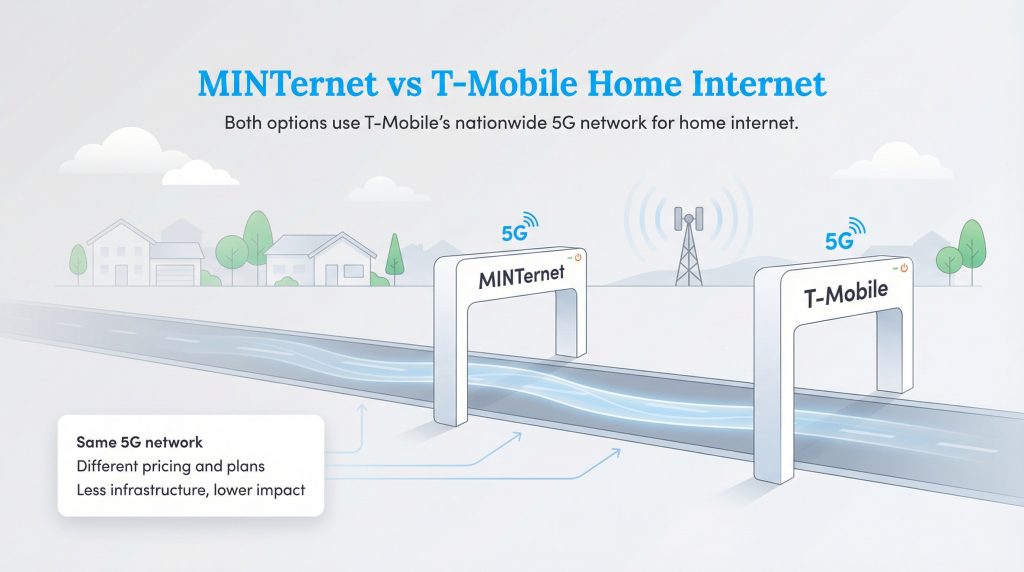
Mint Mobile is part of T-Mobile following its recent acquisition, which means it operates entirely on the same nationwide 5G network. When evaluating MINTernet vs T-Mobile internet, it helps to understand that you are essentially buying access to the same digital highway, just through different toll booths. For anyone searching for a cheap 5G home internet option, both of these providers stand out as strong contenders. Opting for a 5G connection is also an environmentally mindful choice for your new place. Because 5G home internet relies on cellular signals rather than extensive underground wiring, it requires significantly less physical infrastructure in your immediate neighborhood than traditional fiber or broadband installations. Whether you are setting up home internet in an apartment or a single-family house, choosing a wireless gateway helps reduce the need for new in-home cabling and technician visits, cutting down on transportation emissions.
Comparing Mint Mobile Internet Speeds and T-Mobile Performance
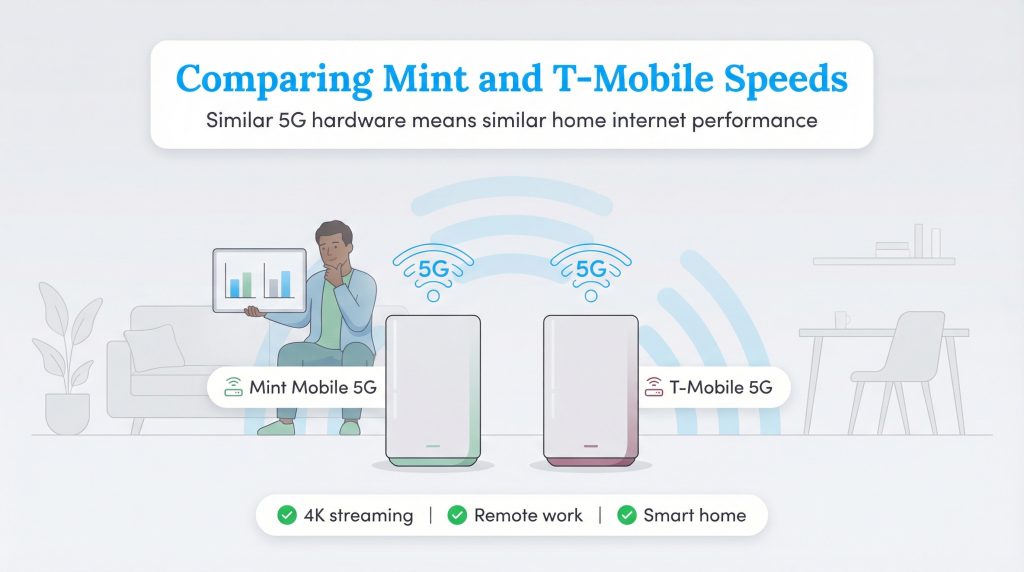
One of the biggest areas of confusion for shoppers is the hardware gap, or rather, the lack of one. If you are comparing the T-Mobile gateway vs Mint Mobile gateway, you might be surprised to learn that both providers typically supply 5G gateways on loan to their customers. While the gateway models can vary based on availability, you won’t have to worry about buying your own router. Going with Mint Mobile does not mean you have to settle for inferior, outdated equipment. Because the equipment standards are similar, your Mint Mobile internet speeds will closely mirror what you would experience as a direct T-Mobile customer. According to Mint Mobile’s broadband label, users can expect download speeds ranging from 133 to 415 Mbps, alongside upload speeds sitting comfortably between 12 and 55 Mbps, depending heavily on local network capacity and tower proximity. If you need a refresher on what these numbers actually mean for your daily routine, exploring resources for understanding recommended internet speeds for households can clarify your exact bandwidth needs.
For most modern homes, these 5G speeds easily handle typical daily demands:
- Streaming 4K video seamlessly on multiple televisions without annoying buffering interruptions.
- Powering remote work applications, including seamless video conferencing and heavy file uploads.
- Managing smart home devices like thermostats, security cameras, and automated lighting simultaneously.
Breaking Down the Costs and Pricing Structures
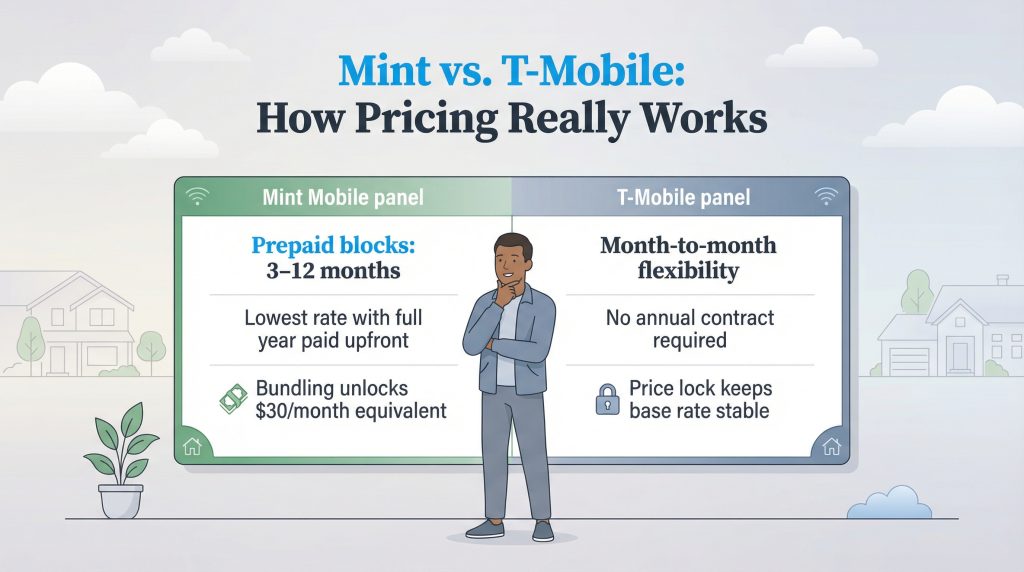
Diving into the financial specifics reveals the biggest difference between these two services. Mint Mobile operates on a prepaid model, requiring you to buy your service in 3-month, 6-month, or 12-month blocks. To snag their lowest advertised monthly rate, you have to hand over a full year’s payment upfront. T-Mobile, conversely, sticks to a predictable month-to-month structure with no annual contracts required. Is Mint Mobile home internet worth it if you already have Mint phone service? Absolutely, because bundling unlocks their lowest $30 monthly equivalent rate without requiring a full 12-month commitment right away. Meanwhile, the T-Mobile home internet price lock guarantees that your base monthly rate won’t unexpectedly jump after your first year, offering long-term peace of mind without a massive initial investment.
| Provider | Monthly Cost Equivalent | Upfront Cost Requirement | Contract Type |
| T-Mobile Home Internet | $50 – $60 (varies by existing voice plan) | First month only ($50 – $60) | Month-to-month |
| Mint Mobile Home Internet | $45 (on 12-month plan) | Full year upfront ($540) | Prepaid (3, 6, or 12 months) |
| Feature | T-Mobile Home Internet | Mint Mobile Home Internet |
| Billing Model | Month-to-month | Prepaid blocks (3, 6, 12 months) |
| Data Deprioritization | After 1.2TB of usage | After 1TB of usage |
| Customer Support | In-store and phone/online | Digital and phone only |
| Equipment | Provided gateway (models vary) | Provided gateway (models vary) |
| Trial Period | 15-day test drive | 14-day money-back guarantee |
The Truth About the T-Mobile Home Internet Data Cap vs. Mint
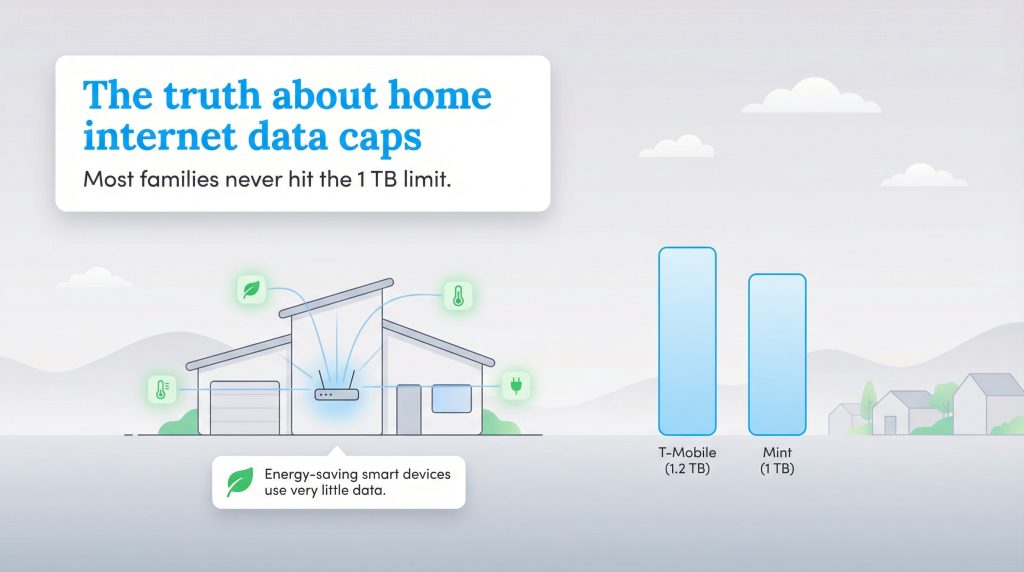
Neither of these providers imposes a hard data cut-off that completely shuts down your connection, but they do utilize network management practices to prioritize data. When your household hits a specific data threshold, your speeds may be deprioritized during times of network congestion. According to official policy pages, the T-Mobile home internet data prioritization limit currently sits at 1.2TB of high-speed data per month, while Mint Mobile enforces a similar 1TB threshold. To put that in perspective, 1TB equates to roughly 300 hours of high-definition video streaming, or hundreds of hours of Zoom calls. For the average family, a 1TB allowance is usually more than enough, but households with avid gamers or constant 4K streaming might find themselves bumping up against that limit near the end of the billing cycle.
While managing heavy downloads requires attention, standard background tasks use very little bandwidth. Operating an ENERGY STAR smart home energy management system barely puts a dent in your monthly allowance, making it simple to keep your house green and efficient without worrying about data throttling.
Customer Support and Network Availability
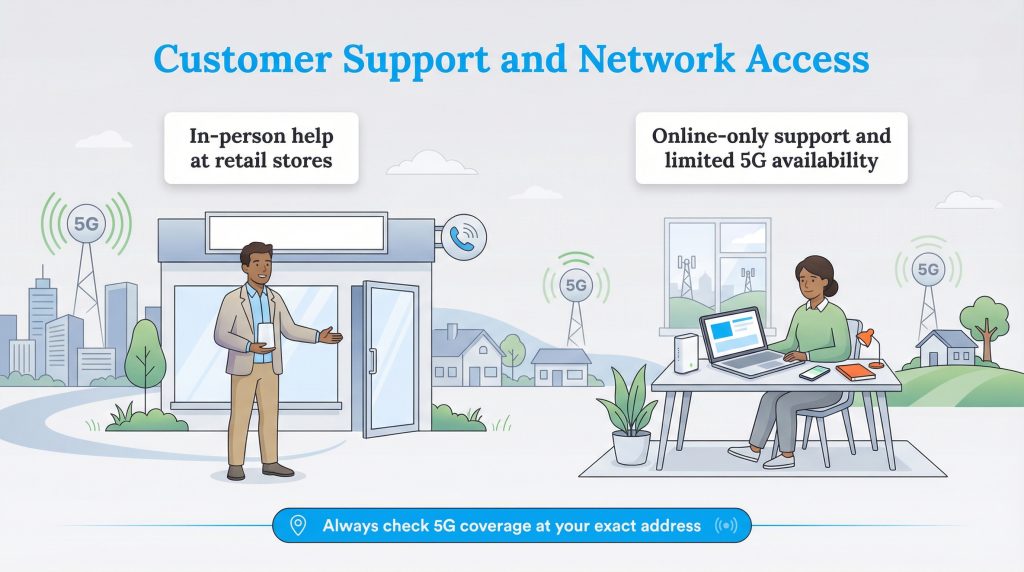
Even though these brands share towers, their customer service structures are worlds apart. T-Mobile maintains thousands of brick-and-mortar retail locations across the country, giving you the ability to walk into a store, speak to a human, and swap out a malfunctioning gateway on your lunch break. Mint Mobile, operating as a smaller digital-first entity, manages all support online and over the phone. When assessing Mint Mobile home internet availability, keep in mind that being the best prepaid home internet option doesn’t guarantee service at every address. Because 5G relies on tower proximity and available bandwidth capacity, you must verify your exact street address on their respective websites. Checking availability for a dense urban center like Houston yields vastly different eligibility results than searching for a suburban or rural address.
Which One Should You Choose?
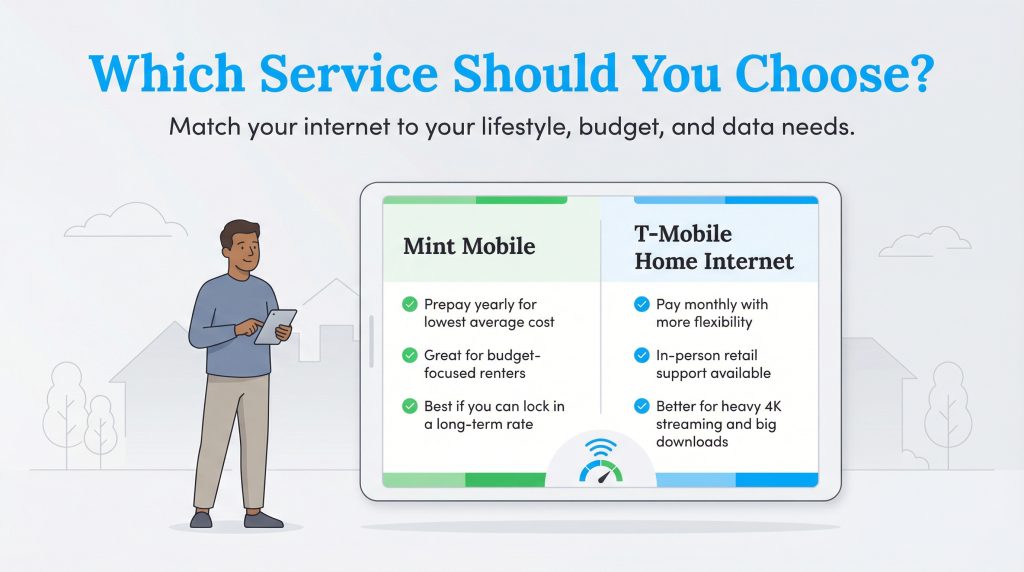
Choosing the right provider often depends on your living situation, budget flexibility, and daily online habits. Both of these services offer a modern upgrade over traditional cable, but recognizing your specific household needs will ensure you make the right choice.
- Choose Mint Mobile if you can comfortably prepay for a full year and want the lowest possible average monthly cost. It is an ideal fit for budget-focused renters who want to lock in a low rate.
- Choose T-Mobile if you value payment flexibility, prefer the option of in-person retail support, or are unsure about the long-term 5G coverage in your new home.
- If you are a heavy data user who streams multiple 4K videos simultaneously or regularly downloads massive game files, prioritize T-Mobile for its slightly more generous 1.2TB network management threshold.
What to Check Before You Commit
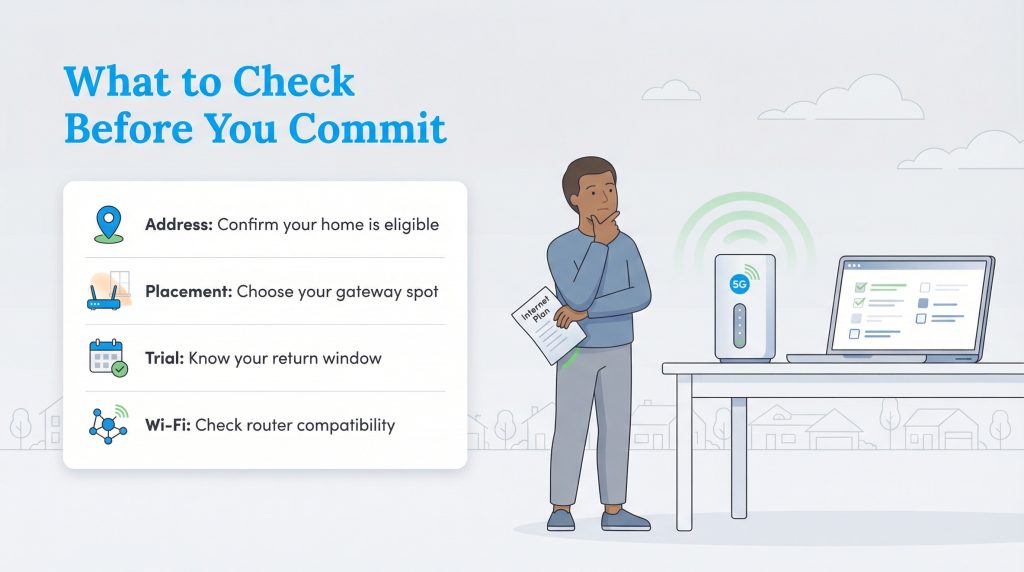
Before you cancel your current provider and make the leap to 5G home internet, there are a few practical steps you should take to ensure a smooth transition. Taking 10 minutes to verify these details can save you from a frustrating setup experience.
- Verify your address eligibility: Always check your specific street address on both providers’ websites, as 5G capacity varies from neighborhood to neighborhood.
- Plan your gateway placement: These routers perform best when placed near a window or on an upper floor, so confirm you have an available power outlet in an optimal spot.
- Understand the return window: Mint offers a 14-day money-back guarantee, while T-Mobile provides a 15-day test drive. Take advantage of these trial periods to test the signal strength in your home.
- Check router compatibility: If you plan to use your own mesh Wi-Fi system, confirm that the provided gateway allows for passthrough or bridge mode to avoid network conflicts.
Making the Smart, Sustainable Switch for Your Home
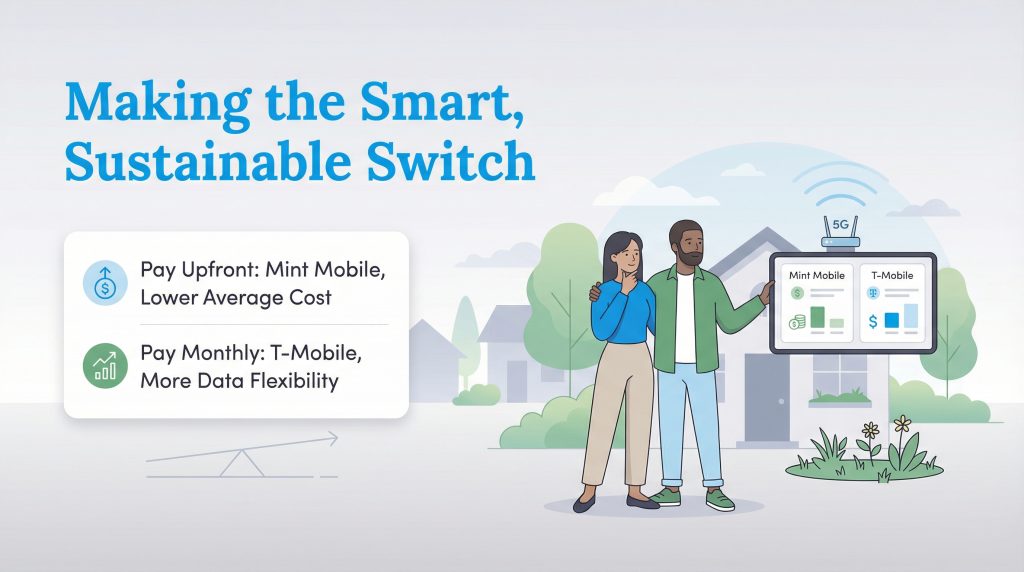
Deciding between T-Mobile and Mint Mobile ultimately boils down to your cash flow and how much data your family realistically consumes. If you have the funds available to cover a full year of service upfront, Mint Mobile offers a fantastic way to lock in a low average monthly rate for top-tier 5G speeds. Alternatively, if you prefer the flexibility of paying as you go, or if your household frequently pushes past 1TB of data usage, T-Mobile remains the superior choice. Just like evaluating your electric and water providers during a move, finding the right internet plan requires balancing your budget with your daily needs. Both options provide an eco-conscious alternative to traditional cable internet, saving you money while keeping you reliably connected to the things that matter most.
Frequently Asked Questions About T-Mobile Home Internet vs. Mint Mobile Home Internet
Is Mint Mobile home internet exactly the same as T-Mobile?
Does Mint Mobile have data caps on its 5G internet?
Can I use my own router with Mint Mobile or T-Mobile 5G internet?
Is it hard to switch my home internet provider?
Does T-Mobile home internet have a price lock guarantee?
Is 5G home internet reliable enough for working from home?
What happens if I need to return my gateway?
About the Author

LaLeesha has a Masters degree in English and enjoys writing whenever she has the chance. She is passionate about gardening, reducing her carbon footprint, and protecting the environment.