
A Shifting Federal Landscape Means Schools, Libraries, and Everyday Households Might Soon Absorb the Cost of Digital Connectivity
Key Takeaways
- The Federal Communications Commission is conducting a comprehensive FCC E-Rate program review 2026, evaluating critical updates to cybersecurity, CIPA compliance, and funding methodologies.
- If school districts lose vital federal subsidies under the new proposals, they will face deep budget deficits, potentially shifting costs to you through increased local property taxes or municipal utility levies.
- You can proactively shield your household budget from these rising costs by using online comparison tools to shop for competitive energy plans and negotiating lower broadband rates before the overhaul takes effect.
Moving into a new home is an exciting milestone, but it also means getting to grips with a fresh set of utility bills, property taxes, and monthly expenses. Just as you are trying to find the most cost-effective and environmentally mindful choices for your new place, a major policy shift in Washington, D.C., is threatening to disrupt your household budget from an unexpected angle. On June 25, 2026, the Federal Communications Commission (FCC) approved a comprehensive Notice of Proposed Rulemaking (NPRM) under WC Docket Nos. 26-133, 13-184, 21-93, and 21-455 to review and modernize the E-Rate program. For 30 years, this federal program has successfully discounted internet connectivity for schools and libraries by 20% to 90%. However, instead of simply sunsetting the program as previously feared, the commission is now proposing a complex regulatory overhaul aimed at reshaping discount methodologies, introducing strict screen time limitations, and enforcing tighter cybersecurity standards. If these subsidies are restricted or reallocated away from your district, local municipalities will have to bridge the funding gap — and that means the extra costs are highly likely to land right on your local property tax bill or cellular surcharge. At Utilities For My Home, we want to help you understand the exact regulatory proposals driving this FCC E-Rate Program Review, which cities are most vulnerable, and how you can proactively protect your wallet from sudden rate hikes.
Why Educational Broadband Subsidies and Household Rates Are Shifting
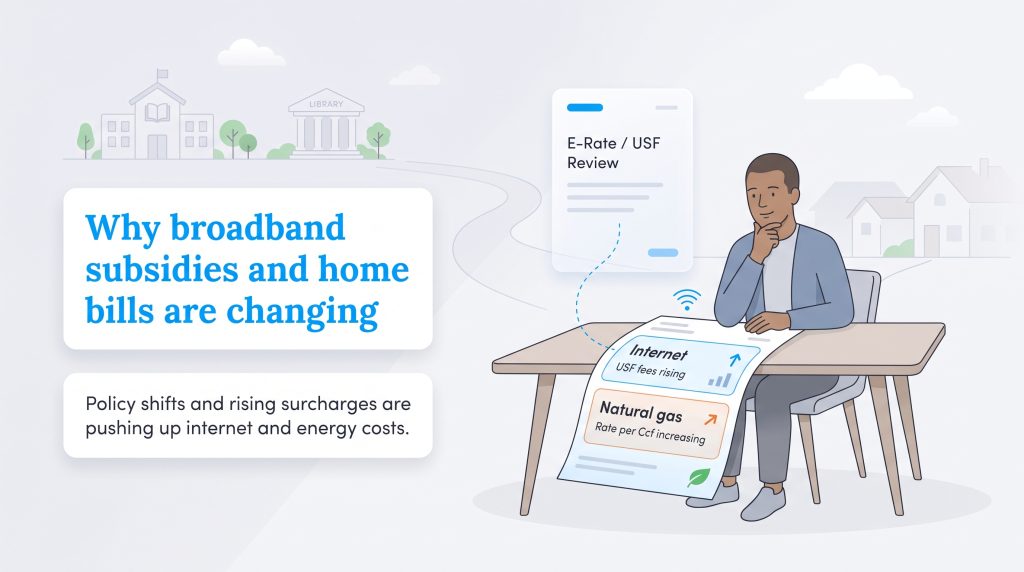
To navigate this changing landscape, we first need to look at why these rates are on the move in the first place. The FCC’s current review of the E-Rate program, spearheaded by Chairman Brendan Carr, is built on the premise that the program has already achieved its original 1996 statutory mandate of establishing universal educational connectivity. Since almost every school and library in the country is now connected to high-speed internet, the commission is shifting its focus toward the quality and impact of that connectivity.
A primary statutory driver for the 2026 review is the FCC’s mounting concern over excessive screen time and declining academic performance. The commission points to a growing body of evidence suggesting that unmonitored, unlimited digital access in the classroom is contributing to severe student distraction. Consequently, the FCC is questioning whether federal funds should continue to subsidize unregulated broadband access, pushing instead to tie future funding to strict educational parameters and verifiable academic outcomes.
The Rising Cost of the Universal Service Fund and Retail Energy
Adding to the pressure, the cost of funding these federal subsidies is passed directly onto consumers. The Universal Service Fund (USF) is supported by fees charged to telecommunications providers, who in turn pass them down as surcharges on your monthly phone and internet bills. By the fourth quarter of 2025, the quarterly USF contribution factor reached a historic high of 38.1%, contributing directly to the steady rise of household broadband costs.
At the same time, traditional utility rates are spiking across the country. For example, on Jan. 30, 2026, Columbia Gas of Ohio implemented a major 35% supply rate increase, raising gas heating rates from $0.7937 to $1.071 per Ccf for the February billing cycle. When you combine rising federal telecommunications surcharges with skyrocketing natural gas rates, your monthly home energy and connectivity bills can quickly spiral out of control without proactive management.
What the FCC’s Notice of Proposed Rulemaking (NPRM) Actually Proposes
The June 2026 E-Rate Notice of Proposed Rulemaking goes far beyond basic budget cuts. The FCC aims to modernize the 30-year-old framework to prevent waste and abuse while aligning the program with modern digital realities. By shifting from an alarmist perspective to a pragmatic one, we can better understand the specific mechanisms the FCC intends to change.
If enacted, the NPRM will introduce several foundational shifts to how schools and libraries apply for and utilize federal funds:
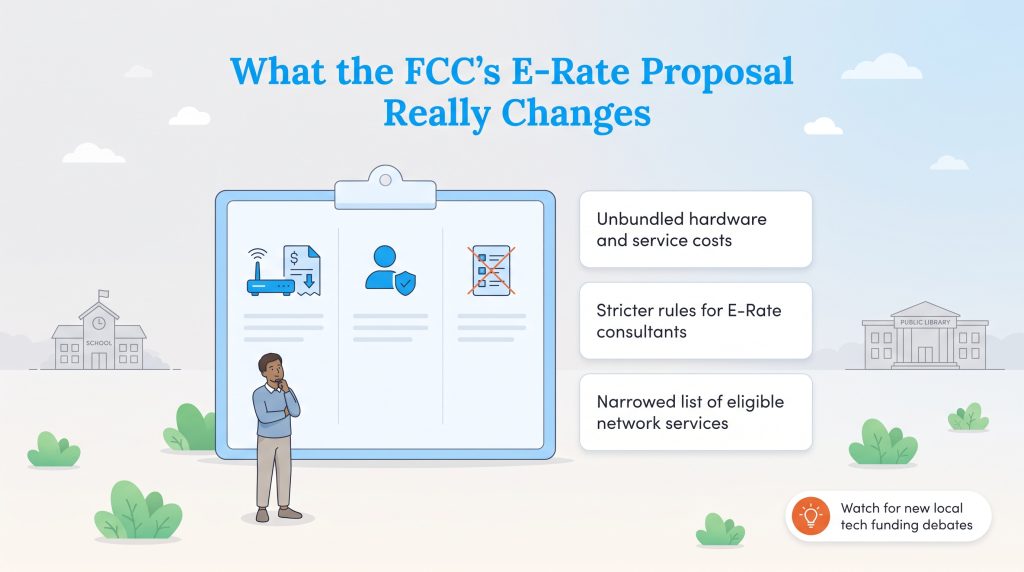
- Unbundling Hardware Versus Service Costs: Historically, schools could bundle expensive networking hardware with their monthly service contracts, burying the true cost of equipment. The FCC proposes strict unbundling requirements, forcing applicants to separate hardware costs from recurring service fees. This move is designed to increase competitive bidding transparency but may leave underfunded districts struggling to afford upfront hardware purchases.
- New Oversight Rules for USAC E-Rate Consultants: Because the E-Rate application process is notoriously complex, many school districts hire third-party USAC E-Rate consultants to manage their filings. The NPRM identifies a risk of predatory pricing and conflict of interest within this ecosystem. The new rules propose mandatory federal registration, strict ethical guidelines, and hard fee caps for consultants to ensure federal dollars remain focused on students rather than administrative overhead.
- Narrowing the E-Rate Eligible Services List: Every year, the FCC publishes an E-Rate eligible services list detailing exactly what technologies qualify for discounts. The 2026 NPRM proposes narrowing this list significantly. Redundant dark fiber internet networks, non-instructional campus Wi-Fi (such as in sports stadiums or administrative buildings), and unmanaged data plans are on the chopping block. The goal is to restrict funds strictly to core, classroom-facing educational connectivity.
How Educational Budget Deficits Shift the Tax Burden to You
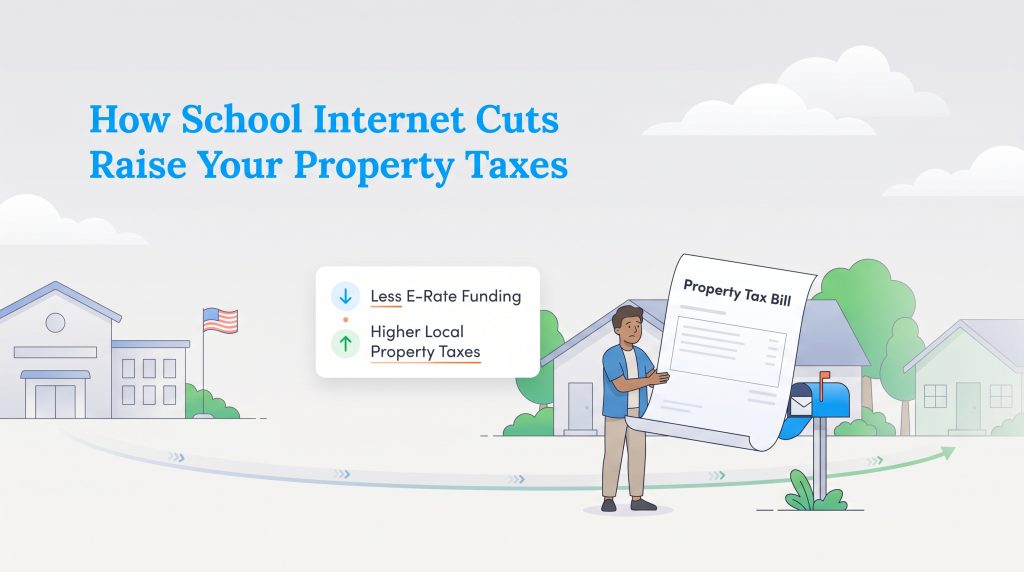
The real danger of a scaled-back E-Rate program is not just a slower classroom internet connection — it is a direct hit to your local property tax bill. Public school districts heavily rely on a combination of state and local revenues to fund their operations. On average, local property taxes make up a staggering 81% of the local funding share. In states like Iowa and Nebraska, school districts are the largest single recipients of property tax revenues, making homeowners highly sensitive to any federal funding shortfalls.
The Formula Behind the School Budget Gap
To understand what schools stand to lose under the new proposals, it helps to look at the math behind federal E-Rate support. The program divides its discounts into Category One (broadband access to the building) and Category Two (internal wiring and Wi-Fi networks within the building). The FCC’s Category Two budget rules establish strict funding limits over five-year cycles, which you can track on the official Universal Service Administrative Company Category Two Budgets documentation.
The transition from the previous cycle to the current one, paired with the new NPRM proposals, illustrates how these formulas impact local funding limits and potential future risks:
| Category Two Budget Metric | FY 2021 – FY 2025 Funding Cycle | FY 2026 – FY 2030 Funding Cycle | Proposed FY 2027 E-Rate Overhaul Impact |
| School Student Multiplier | $167.00 per student | $201.57 per student | Potential reduction for non-instructional device use |
| Library Square-Foot Multiplier | $4.50 per square foot | $5.43 per square foot | Stricter audits on eligible public floor space |
| Standard Municipal Funding Floor | $25,000 per eligible site | $30,175 per eligible site | Increased compliance and reporting burdens |
| Tribal Library Funding Floor | $55,000 per eligible site | $66,385 per eligible site | Sustained or increased priority funding focus |
If the E-Rate program is restricted by these new rules, school districts cannot simply turn off their internet networks. Modern classrooms rely on high-speed broadband for everything from student records and security systems to smart thermostats and day-to-day learning. To keep the lights on and the Wi-Fi running, school boards will have to absorb these massive connectivity costs themselves. Since state funding is often tightly capped, districts will have little choice but to increase local property tax levies, shifting the financial burden directly onto local homeowners and renters.
The Shifting Methodology: Rural Vs. Urban Funding
One of the most consequential proposals in the 2026 NPRM involves a fundamental change to how the FCC calculates an applicant’s discount rate. For decades, the E-Rate program has utilized the National School Lunch Program (NSLP) eligibility metric to determine how much of a discount a school receives. Under this system, districts with a high percentage of students qualifying for free or reduced-price lunches receive the highest internet discounts (up to 90%).
However, the FCC is currently inquiring into completely replacing the National School Lunch Program E-Rate metric. The commission argues that modern community-wide feeding programs have skewed the data, making NSLP an inaccurate measure of a district’s actual technological need. Instead, the NPRM proposes shifting to a geographic and competitive methodology that calculates discounts based on the actual cost to deploy broadband in a specific area. We anticipate this change will explicitly reduce funding for highly populated suburban and urban areas — where market competition naturally lowers broadband prices — and direct significantly more funding to high-cost, remote rural areas.
Major Cities and Areas Bracing for the Impact
The fallout from these proposed changes to the discount methodology will not be felt equally. Densely populated metropolitan areas that currently rely on the NSLP metric are highly vulnerable to steep reductions in federal broadband subsidies. Here is a look at how several major cities are bracing for the impact:
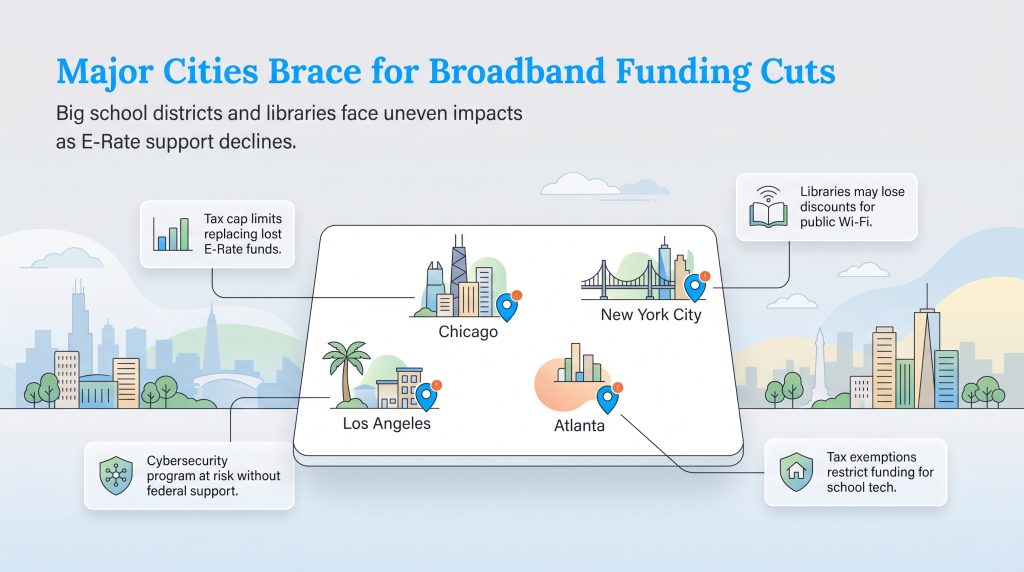
- Chicago, Illinois: Chicago Public Schools (CPS) is highly reliant on property taxes and currently leverages high NSLP participation for maximum E-Rate discounts. The district projects over $4 billion in property tax revenues in Fiscal Year 2025. However, the CPS education levy is strictly capped under the state’s Property Tax Extension Limitation Law (PTELL). If the new methodology slashes their E-Rate discounts, CPS cannot easily raise property taxes, leaving them facing severe budget deficits.
- Atlanta, Georgia: Atlanta Public Schools (APS) faces similar challenges, as its local revenue-raising capacity is heavily restricted by voter-approved homestead tax exemptions. Without the buffer of NSLP-based E-Rate subsidies, the district’s ability to maintain high-quality educational technology will be severely compromised.
- Los Angeles, California: While the Los Angeles Unified School District (LAUSD) recently implemented strict limits on student screen time — including a complete ban on device usage for early education through first grade — it remains deeply dependent on federal subsidies. Any shift away from urban funding models could impact the district’s ability to defend its massive networks against modern cyber threats.
- New York City, New York: Public library systems, including the New York Public Library and Brooklyn Public Library, rely on federal discounts to provide free Wi-Fi for job seekers and students. Removing poverty-based metrics in favor of geographic deployment costs will severely disadvantage these urban libraries, potentially forcing them to reduce public operating hours to balance their budgets.
CIPA Compliance and Cybersecurity Implications
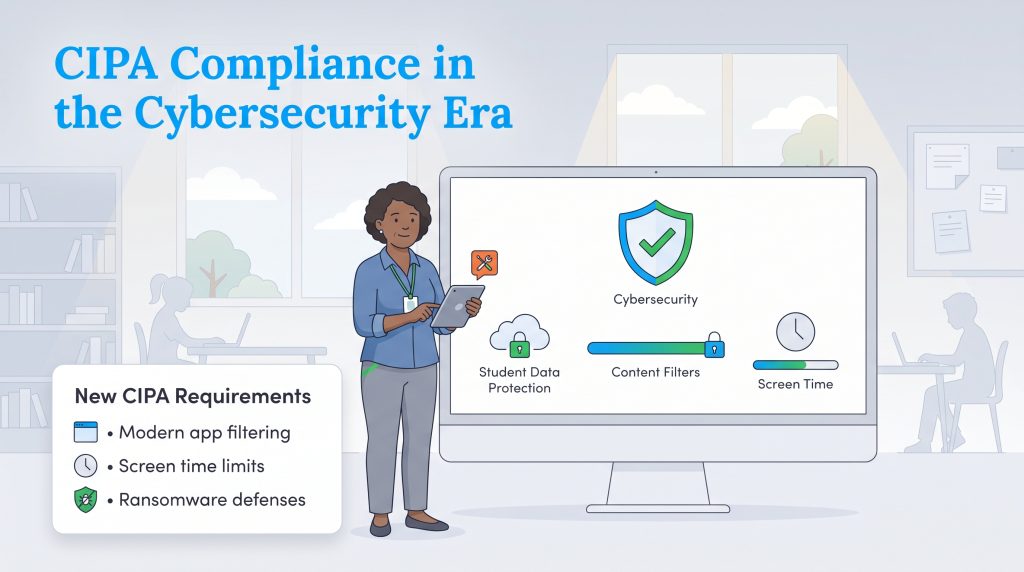
Digital safety and network resilience are at the absolute forefront of the current FCC E-Rate program review. Since 2000, schools and libraries receiving E-Rate discounts have been required to adhere to the Children’s Internet Protection Act (CIPA). Historically, E-Rate CIPA compliance simply meant installing a basic firewall or DNS filter to block obscene or harmful visual content.
The 2026 NPRM proposes a massive expansion of CIPA enforcement. The FCC recognizes that modern online threats to students go far beyond static web pages. The new proposals aim to mandate active application monitoring and incorporate strict E-Rate screen time regulations directly into the compliance framework. Schools that fail to prove they are actively limiting non-instructional device usage and actively filtering modern social media applications may forfeit their federal funding entirely.
Furthermore, the FCC is directly linking this regulatory review to its newly launched $200 million E-Rate cybersecurity pilot program. Over the past five years, K-12 school districts have become prime targets for crippling ransomware attacks, which expose sensitive student data and cost millions of taxpayer dollars to resolve. The pilot program acts as a testing ground for utilizing Universal Service funds to pay for advanced endpoint protection, identity management, and advanced firewalls. By integrating the findings of this pilot program into the broader E-Rate overhaul, the FCC hopes to force schools to adopt rigorous, enterprise-grade cybersecurity postures in exchange for their connectivity subsidies.
Actionable Strategies to Protect Your Household Budget
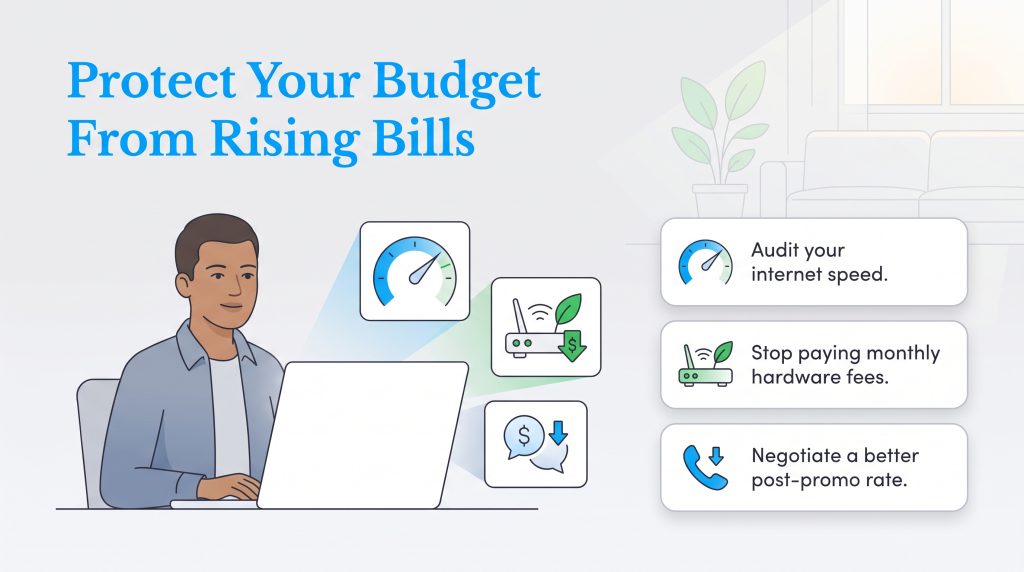
While you cannot control federal regulatory decisions or how school boards balance their budgets, you have plenty of power to protect your household from rising utility and broadband costs. By taking a proactive approach to your home services, you can easily offset potential tax increases and save on internet and utility costs each year. Here are several practical steps you can take today to lock in lower rates and optimize your monthly bills:
- Audit Your Internet Speeds: Many internet service providers (ISPs) use promotional pricing models to attract new customers, offering cheap introductory rates for 12 to 24 months before bumping you up to standard rates that are 20% to 50% higher. Take an internet speed test and review your daily usage. Most households can stream, game, and browse comfortably on 100 to 300 Mbps, which is a good internet speed for average use, meaning you might be overpaying for a premium gigabit plan you do not actually need. Downgrading your speed tier is an easy, energy-saving option that reduces your monthly subscription cost by 20% to 40%.
- Stop Renting Your Hardware: Leasing a modem and router from your internet provider typically costs $10 to $15 per month in hidden, recurring fees. Buying your own compatible, energy-efficient retail router and modem (and learning how to set up a wireless router yourself) is an environmentally mindful choice that typically pays for itself in less than a year, eliminating a persistent drain on your budget.
- Negotiate a Post-Promotional Rate: When your promotional contract expires, do not just accept the higher price. Call your provider’s customer retention department — not the general customer service line — and politely explain that the new standard rate is outside your budget. Highlight your history of on-time payments, quote local competitor pricing, and ask for a loyalty discount or promotional extension.
Preparing for the FY2027 E-Rate Overhaul
If you are worried that these massive regulatory shifts will double your tax bill tomorrow, take a deep breath. The federal rulemaking process is intentionally slow and deliberate. The E-Rate application timeline operates on a strict annual cycle, and any major changes approved from the June 2026 NPRM will require significant administrative lead time before they affect local school districts.
Schools must begin their competitive bidding process (Form 470) and submit their funding requests (Form 471) months in advance of the academic year. Because the FY2026 application window is already closing, the earliest realistic effect for operational changes and new funding methodologies will be FY2027, which officially begins on July 1, 2027. This timeline gives school boards, library directors, and local taxpayers a full year to adjust their budgets and plan for any shortfalls.
In the meantime, the FCC is actively seeking input from the public. You can track these administrative changes, review the proposed E-Rate screen time regulations, and voice your opinions by visiting the Federal Communications Commission Electronic Comment Filing System. Engaging with the ECFS platform ensures that the voices of everyday utility consumers are heard before final rules are codified into law.
Taking Charge of Your Household Connectivity Costs
The ongoing federal review of the E-Rate program serves as a powerful reminder of how remote regulatory decisions in Washington can directly impact your local household expenses. As the FCC pushes to modernize cybersecurity standards, enforce stricter CIPA compliance, and potentially eliminate the National School Lunch Program discount metric, the financial burden of maintaining our digital educational infrastructure is highly likely to shift. School districts and public libraries are preparing for a new reality where federal funds are harder to secure, and local taxpayers may be asked to make up the difference through higher municipal levies.
We cannot stop federal policy shifts, but we can change how we manage our own home expenses. By taking advantage of energy deregulation, auditing your digital usage, negotiating fiercely with broadband providers, and utilizing the robust comparison tools at Utilities For My Home, you can easily shield your family’s budget from rising local taxes and build a more sustainable, cost-effective household.
Frequently Asked Questions About the FCC E-Rate Program Review
What is the FCC E-Rate program?
Why is the FCC reviewing the E-Rate program in 2026?
How could an E-Rate funding cut impact my household property taxes?
What is the timeline for the 2026 E-Rate program changes?
How will the FCC E-Rate review affect the National School Lunch Program (NSLP) discount rate?
Will the E-Rate program review implement new screen time limits?
What can I do to protect my monthly broadband bill from rising?
About the Author

Claudio is a sustainability-focused writer with a background in Anthropology and Psychology from NC State University. He has spent over 15 years working in writing, interpretation, and translation, driven by a deep interest in how human culture shapes the environment. Today, he shares his curiosity with readers by writing about sustainable living solutions and the connection between everyday choices and environmental impact.