
Compare AT&T and Spectrum plans, long-term pricing, and connection reliability to choose the best internet for your household needs
Key Takeaways
- AT&T Fiber offers superior, symmetrical speeds and straightforward pricing, but it has limited availability compared to Spectrum’s widespread cable network.
- Spectrum does not enforce data caps on its standard internet plans, while certain AT&T DSL and fixed-wireless plans may have restrictions.
- Watch out for Year 2 price hikes with both providers, and always factor in hidden costs like Spectrum’s monthly equipment rental fees before switching.
Getting your utilities hooked up in a new place is stressful enough without having to decipher confusing telecom marketing jargon. If you are stuck deciding on AT&T vs. Spectrum, this straightforward guide cuts through the noise to help you find the most reliable and affordable option. We are comparing these two major internet service providers based on real-world speeds, pricing, and overall availability so you can pick the best plan for your household.

- 5 Gbps
- Fiber
- Unlimited
- $34.00/mo

- 2 Gbps
- Cable
- Unlimited
- $30.00/mo
*Not all internet providers and speeds available in all areas.
The Bottom Line Up Front: AT&T vs. Spectrum Quick Comparison
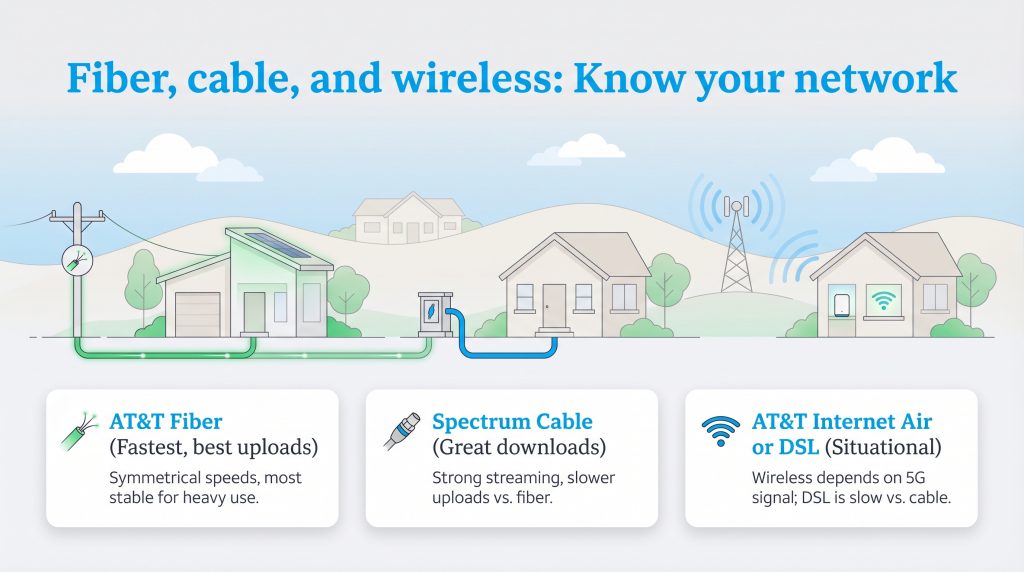
When choosing your next internet plan, the best choice usually comes down to what type of connection is actually wired to your address. The side-by-side cost comparison reveals different strengths, whether you need heavy-duty upload speeds for remote work or a widespread, easily accessible cable network. Review the decision tree and comparison table below to see which provider aligns with your household needs.
- Is AT&T Fiber available at your address? If yes, this is usually the best choice for symmetrical speeds and heavy usage.
- If fiber is unavailable, is Spectrum an option? Spectrum Cable is widely accessible and typically beats AT&T DSL for reliable download speeds.
- Are you deciding between Spectrum and AT&T Internet Air? Choose Spectrum if you need consistent latency for gaming or remote work, but opt for Internet Air if you want a simple, plug-and-play setup without physical wires.
| Provider | Best For | Example Starting Price | Connection Type | Choose If… |
| AT&T Fiber | Heavy users, WFH, multiple streamers | ~$55/mo | Fiber-Optic | You have fiber availability and need fast uploads. |
| Spectrum Internet | General browsing, standard households | ~$49.99/mo | Coaxial Cable | You want widely available, fast download speeds without data caps. |
| AT&T Internet Air | Renters, low-hassle setups | ~$60/mo | Fixed-Wireless 5G | You want a plug-and-play setup without physical wire installation. |
| AT&T DSL | Basic browsing, rural areas | ~$55/mo | Copper DSL | It is the only hardwired option available at your address. |
Network Technology: Fiber, Cable, DSL, and Internet Air
Not all internet is created equal, and the physical infrastructure running to your neighborhood heavily dictates your daily speed and reliability. AT&T relies on a mix of cutting-edge fiber optics, legacy copper lines, and fixed-wireless towers, while Spectrum operates almost entirely on a coaxial cable network. Understanding this difference is vital because comparing AT&T Fiber to Spectrum Cable is a totally different ballgame than comparing AT&T DSL to Spectrum Cable.
AT&T Fiber vs Spectrum Internet
AT&T Fiber represents the gold standard for home connectivity, delivering symmetrical speeds that provide identical download and upload rates. This balanced performance makes AT&T fiber vs Spectrum internet a crucial comparison for households relying heavily on cloud backups, large file transfers, and frequent high-definition video calls. Fiber-optic cables transmit data using pulses of light, which minimizes lag and prevents the dreaded evening slowdowns that often occur when everyone in your neighborhood logs on simultaneously.
On the other side of the ring, Spectrum operates a robust coaxial cable network originally designed for cable television. While Spectrum internet excels at delivering fast download speeds that effortlessly handle 4K streaming and daily browsing, it significantly lags behind fiber when it comes to upload speeds. If your digital life requires pushing large amounts of data out to the web, the coaxial limitations of Spectrum might slow down your workflow compared to a pure fiber connection.
Learn more about Fiber vs. Cable Internet
AT&T Internet Air vs Spectrum
As telecommunications companies race to fill connectivity gaps, fixed-wireless home internet has emerged as a popular alternative to traditional wired setups. AT&T Internet Air vs Spectrum is an increasingly common debate for renters or homeowners who want to skip the hassle of a traditional coaxial installation. Internet Air utilizes AT&T’s 5G cellular network to beam service directly to a wireless receiver inside your home, making setup as simple as plugging the device into a wall outlet and connecting to your new Wi-Fi network.
While the plug-and-play convenience of Internet Air is fantastic, it does come with a few trade-offs when stacked against a hardwired Spectrum connection. Fixed-wireless reliability can fluctuate based on cellular tower congestion, distance from the nearest node, and physical obstructions like heavy foliage or concrete walls. If you live in an area with a pristine 5G signal, Internet Air is a breeze, but high-demand households will generally experience much better stability with Spectrum’s physical cable lines.
AT&T DSL vs Spectrum Cable
If you look up your address and discover you only have access to AT&T’s legacy DSL network, Spectrum’s cable internet is almost always the superior choice. DSL relies on aging copper telephone lines that max out at much slower speeds, struggling to keep up with modern streaming and smart home demands. In this specific AT&T DSL vs Spectrum cable matchup, Spectrum is typically the better pick by offering drastically faster, more reliable performance for a very similar monthly price.
Breaking Down the Costs: Pricing, Hidden Fees, and Data Caps
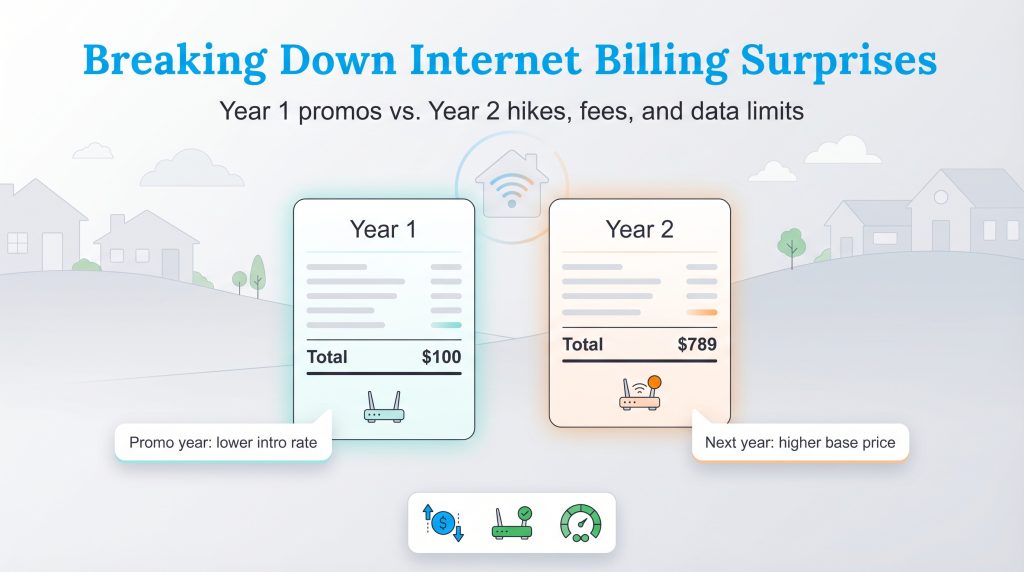
Navigating promotional rates and hidden fees is essential for effectively managing your home internet costs over the long haul. Both of these providers advertise enticing entry-level numbers, but you need to budget for what the bill looks like after the honeymoon phase ends.
AT&T Internet Plans & Pricing
| Plan Name | Price | Download Speeds | Connection Type | |
|---|---|---|---|---|
| Internet 100 | $60 /month | Up to 100 Mbps | DSL | Check Availability |
| Internet 100 | $34 /month | Up to 100 Mbps | Fiber | Check Availability |
| Internet 300 | $45 /month | Up to 300 Mbps | Fiber | Check Availability |
| Internet Air | $65 /month | Up to 300 Mbps | 5G | Check Availability |
| Internet 500 | $55 /month | Up to 500 Mbps | Fiber | Check Availability |
| Internet 1000 | $70 /month | Up to 1000 Mbps | Fiber | Check Availability |
| Internet 2000 | $135 /month | Up to 2 Gbps | Fiber | Check Availability |
| Internet 5000 | $235 /month | Up to 5 Gbps | Fiber | Check Availability |
Spectrum Plans & Pricing
| Plan Name | Price | Download Speeds | Connection Type | |
|---|---|---|---|---|
| Spectrum Internet Advantage | $30 /month | Up to 100 Mbps | Cable | Check Availability |
| Spectrum Internet Advantage + TV Stream | $60 /month | Up to 100 Mbps | Cable | Check Availability |
| Spectrum Internet Premier | $40 /month | Up to 500 Mbps | Cable | Check Availability |
| Spectrum Internet Premier + TV Stream | $70 /month | Up to 500 Mbps | Cable | Check Availability |
| Spectrum Internet Premier + TV Select Signature | $130 /month | Up to 500 Mbps | Cable | Check Availability |
| Spectrum Internet Premier + Home Phone | $65 /month | Up to 500 Mbps | Cable | Check Availability |
| Spectrum Internet Gig | $50 /month | Up to 1000 Mbps | Cable | Check Availability |
| Spectrum Internet Gig + TV Stream | $80 /month | Up to 1000 Mbps | Cable | Check Availability |
| Spectrum Internet Gig + TV Select Signature | $140 /month | Up to 1000 Mbps | Cable | Check Availability |
| Spectrum Internet 2 Gig | $70 /month | Up to 2 Gbps | Cable | Check Availability |
*not all plans available in all areas
Year 1 vs. Year 2 Pricing Shock
The most common complaint we hear from movers is the dreaded post-promotional price shock that hits after 12 to 24 months of service. Internet providers are notorious for dangling cheap introductory rates to win your business, only to quietly hike the monthly rate once that initial agreement expires. It is crucial to read the fine print so you are not caught off guard when your budget takes an unexpected hit during your second year in the home.
Spectrum is particularly reliant on promotional cliffs, often raising base tier prices significantly after the first 12 to 24 months. AT&T has recently moved toward more straightforward pricing for its fiber tiers, though legacy plans, fixed-wireless options, and occasional rate adjustments still mean you need to watch your bill closely. The visual cost calculation table below illustrates an example scenario of how a standard 300 Mbps plan might jump in price once those initial promotional discounts vanish. Keep in mind that actual rates fluctuate based on your location, promotional periods, and the date of service.
| Provider | Plan Tier | Example Year 1 Estimated Price | Example Year 2 Estimated Price |
| Spectrum | Internet 300 Mbps | $49.99/mo | $74.99/mo or higher |
| AT&T Fiber | Internet 300 Mbps | $55.00/mo | $55.00/mo (subject to base rate hikes) |
Equipment Fees and Data Caps
Comparing Spectrum vs AT&T equipment fees uncovers a few critical differences in how these companies bill for the hardware powering your Wi-Fi. AT&T simplifies things by including the necessary gateway, a combination modem and router, directly in their flat monthly fiber pricing without itemizing it as a separate rental charge. Spectrum takes a different approach by including the modem for free but charging a separate monthly fee, often around $5 per month (though it varies by location), if you want them to provide the Wi-Fi router functionality.
Data allowances are another critical factor for cord-cutters who stream everything. Looking at AT&T vs Spectrum data caps, Spectrum generally does not impose data caps on its residential cable internet plans, which is helpful if you stream and download heavily. AT&T Fiber also offers unlimited data, but if you find yourself on certain AT&T DSL or fixed-wireless Internet Air plans, you might be subject to network management policies or fair-use throttling during times of heavy congestion.
Speeds and Performance: Which Provider Fits Your Lifestyle?
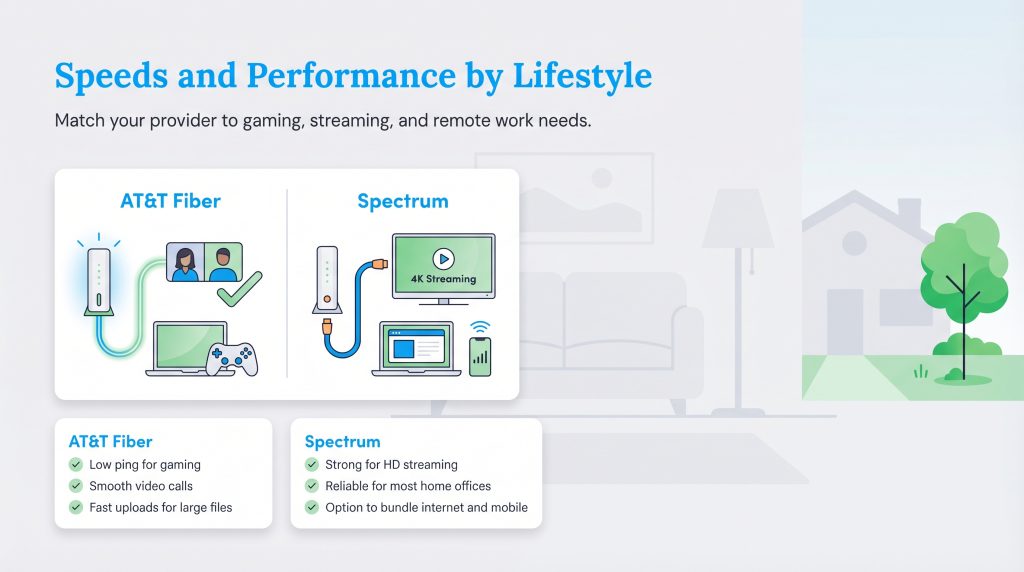
Your household size, the number of connected smart devices, and your daily digital habits directly dictate your speed requirements. A single person casually scrolling social media can easily get by on a basic tier, while a family of four streaming 4K movies and playing competitive multiplayer games requires significantly more bandwidth. If you are unsure where your household falls, checking the recommended broadband speeds from the FCC can help you identify a reliable baseline before you shop.
Is AT&T or Spectrum Better for Gaming and Working From Home?
When trying to determine if AT&T or Spectrum is better for gaming and heavy remote work, the deciding factor is usually ping, which measures latency. AT&T Fiber wins this category decisively, as its light-based infrastructure delivers incredibly low latency, ensuring your video conferences do not freeze and your online gaming inputs register instantly. The symmetrical upload speeds also mean you can present screens on Zoom or upload large graphic files to a company server in a fraction of the time it would take on a coaxial network.
That being said, we know fiber is not available on every block, and Spectrum remains more than capable for the average remote worker or casual gamer. Spectrum’s high download tiers easily manage multiple simultaneous high-definition streams and standard workplace tasks without breaking a sweat. Additionally, remote workers who frequently travel might appreciate bundling their home service with a mobile plan; evaluating the Spectrum vs AT&T mobile bundle options can yield significant overall utility savings if you need strong cell coverage alongside your home internet.
Switching Providers and Checking Availability
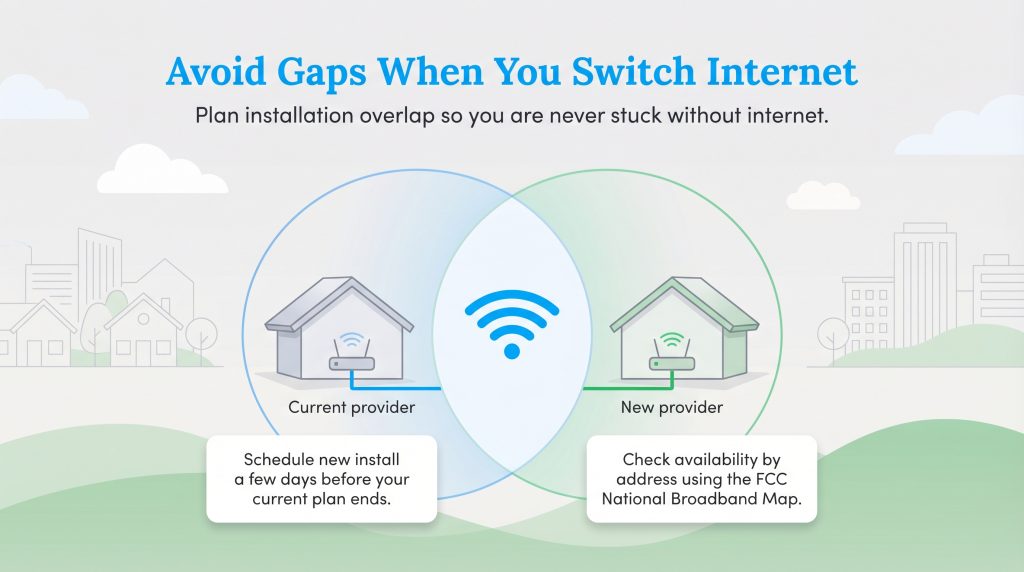
If you are moving or simply tired of your current bill, switching from Spectrum to AT&T, or going the other direction, requires a bit of logistical coordination. The biggest hurdle is avoiding dead zones where you have zero internet access during the transition. Always schedule your new provider’s installation a few days before your current billing cycle ends, allowing overlap to ensure the new network is fully operational before you terminate the old one.
Your final options will ultimately be decided by geographical availability, as AT&T vs Spectrum availability varies wildly depending on your zip code. Spectrum is widely available across a vast footprint thanks to its established cable TV infrastructure, while AT&T Fiber is highly regional and often limited to newer developments or specific urban zones. Before making any concrete decisions, use tools like the FCC National Broadband Map to check official broadband availability for your specific address.
How to Choose a More Sustainable Internet Setup
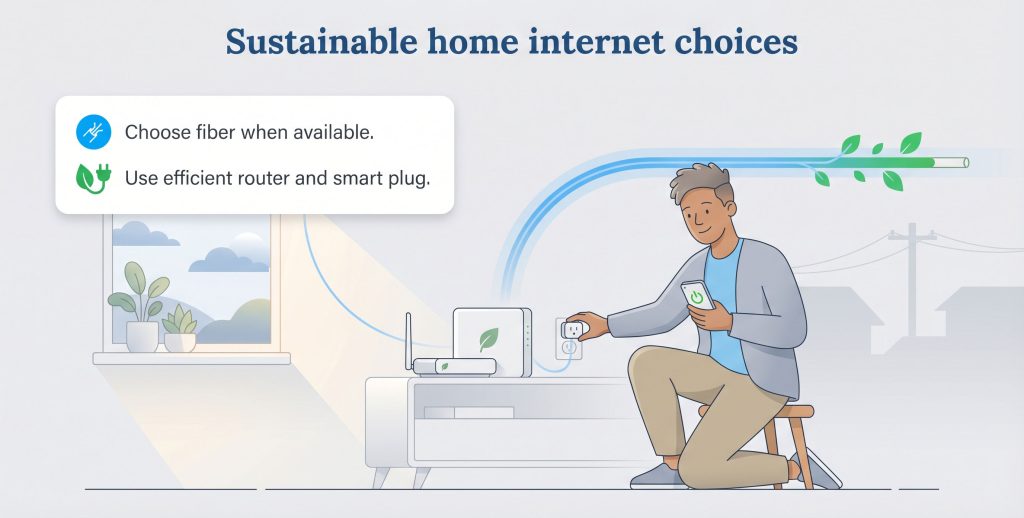
Setting up your home utilities is a great time to implement an environmentally mindful choice, and your broadband network actually plays a role in your overall household energy consumption. Fiber networks are often described as more energy-efficient to operate than older copper-based networks, although real-world impacts depend on local infrastructure. Choosing fiber, if available, inherently supports a more energy-efficient telecommunications grid.
Beyond the network infrastructure, you can reduce your own home’s carbon footprint by managing the phantom power draw from your routers and modems. These devices run all day and night, but upgrading to energy-saving network equipment and utilizing smart plugs can optimize power consumption without interrupting your digital life. Every small reduction in phantom power helps lower your monthly electric bill and supports a greener grid.
Making Your Final Decision on AT&T vs. Spectrum
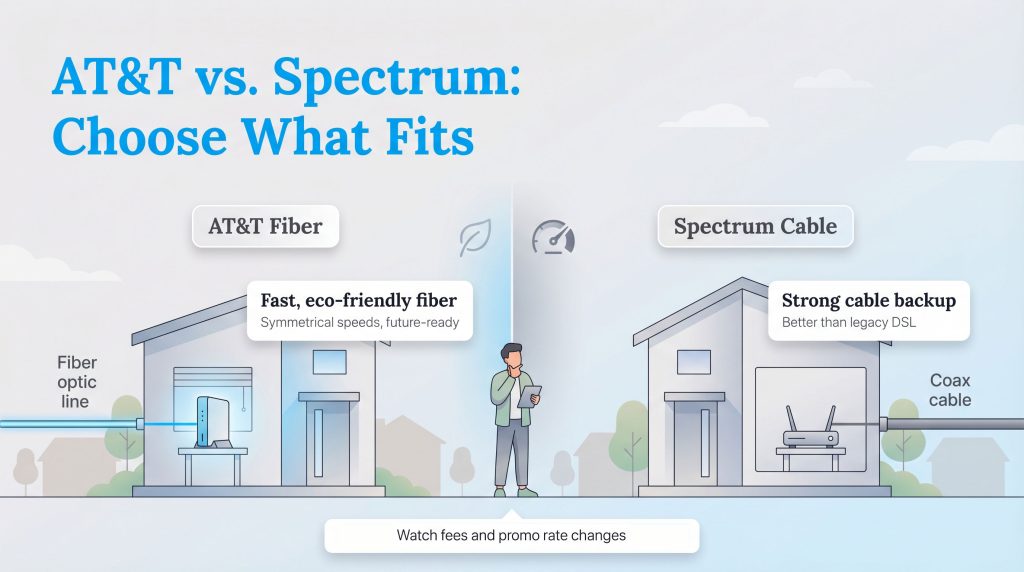
Deciding between these two telecommunications giants requires weighing your budget against your need for speed and reliability. If AT&T Fiber is available at your address, it is the environmentally mindful choice and offers the best overall performance, giving you symmetrical speeds that future-proof your home. However, if your choice is strictly between aging AT&T DSL and a robust Spectrum Cable connection, Spectrum is typically the better pick in most areas where the alternative is AT&T’s slower DSL service.
We know dealing with utility setups can feel like a chore, but optimizing your broadband plan is one of the quickest ways to take control of your monthly expenses. By keeping an eye out for hidden equipment fees and marking your calendar for when those promotional rates expire, you can secure a fast, reliable internet connection that keeps your household running smoothly.
Frequently Asked Questions About AT&T vs. Spectrum
Does Spectrum or AT&T offer a better price for seniors or low-income households?
Can I use my own router with AT&T and Spectrum?
Will AT&T pay off my Spectrum contract if I switch?
Is AT&T Internet Air as fast as Spectrum Cable?
Do I need to hire a professional to install my new internet service?
About the Author

David has been an integral part of some of the biggest utility sites on the internet, including InMyArea.com, HighSpeedInternet.com, BroadbandNow.com, and U.S. News. He brings over 15 years of experience writing about, compiling and analyzing utility data.