
Choosing between Reliant and 4Change Energy comes down to whether you prefer straightforward pricing or strategic bill credits to lower your monthly electricity costs.
Key Takeaways
- 4Change Energy often provides cheaper effective rates through targeted bill credits, making it ideal for homes with predictable, moderate energy usage.
- Reliant Energy offers robust plan variety and established customer service tools, better suiting dynamic households or those wanting free nights and weekends.
- Both providers offer 100% renewable energy options, allowing you to power your home sustainably without sacrificing reliability.
Navigating the deregulated Texas energy market feels like a full-time job, especially when confusing plan terms hide the true cost of your power. We know how frustrating it is to decipher fine print just to keep the lights on. That is why we are putting these two popular providers head-to-head. Our Reliant vs. 4Change Energy comparison uncovers the real costs, hidden fees, and qualitative perks so you can make a confident, energy-saving choice.

- 7.6¢ /kWh
- 9-100%
- 60 days
- 12-24 Months
- Best for High-Usage Homes

- 11.9¢ /kWh
- 24%
- 90 days
- 0-36 Months
- Best for Smart Home Tools & App
*rates may vary by location and household usage
Understanding 4Change Energy vs Reliant Rates at a Glance
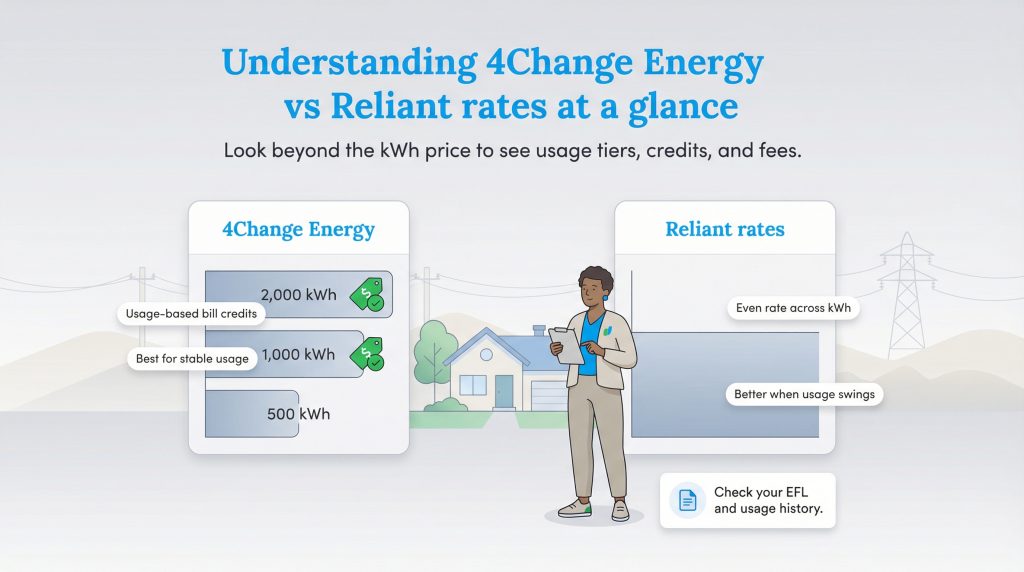
Pinning down the cheapest electricity plan requires looking far beyond the flashy advertised price. To truly understand 4Change Energy vs Reliant rates, you have to peel back the layers and examine base charges, energy delivery fees, and early termination fees (ETFs). 4Change Energy builds its pricing model around specific usage tiers, rewarding you with substantial bill credits if you hit an exact kilowatt-hour (kWh) target. Reliant Energy takes a more traditional approach, generally offering a steadier rate across all usage levels but often starting at a slightly higher baseline price. If your monthly usage fluctuates wildly, those rigid credit tiers can end up costing you more. Conversely, stable households might find substantial savings by carefully managing their usage to hit the credit system tiers. Understanding these fundamental differences helps prevent nasty surprises when your first bill arrives.
How to Compare Energy Plans Correctly
To accurately compare these two providers, you need a reliable method. First, identify your historical monthly usage to see if you naturally hit the 500, 1,000, or 2,000 kWh marks. Next, review the Electricity Facts Label (EFL) for any plan you are considering. You should factor in your local Transmission and Distribution Utility (TDU) delivery charges, any base charges, and the contract term length. Finally, note the early termination fee structure so you understand the financial commitment before signing.
Typical Plan Structures: 4Change Energy vs. Reliant Energy
| Plan Metric | 4Change Energy | Reliant Energy |
|---|---|---|
| Standard Plan Type | Tiered Bill Credit | Fixed-Rate & Time-of-Use |
| Base Charge | Often $0 (verify on EFL) | May include a base charge (verify on EFL) |
| Average ETF | Varies (often calculated per month remaining) | Varies (often a flat fee based on term length) |
Which Provider Should You Pick Based on Usage?
| Household Usage Pattern | Best Fit |
|---|---|
| Predictable (Consistently 1,000 or 2,000 kWh) | 4Change Energy (to maximize bill credits) |
| Fluctuating or Unpredictable | Reliant Energy (for stable fixed rates) |
| Heavy Nighttime Usage | Reliant Energy (Free Nights plans) |
Diving Into Reliant Energy Plans and Pricing
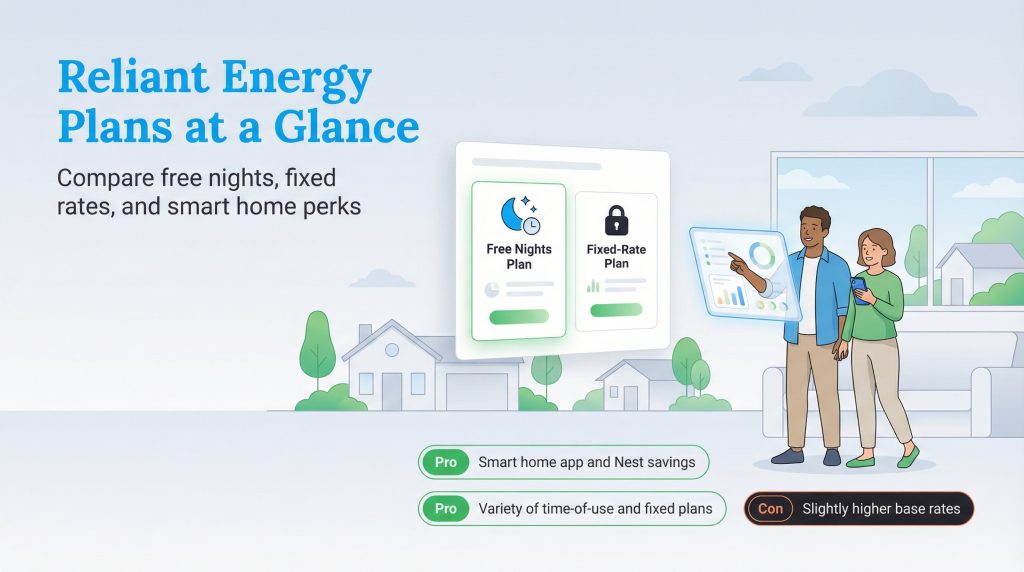
When evaluating Reliant Energy plans and pricing, the sheer variety immediately stands out. As a legacy provider in Texas, Reliant caters to almost every lifestyle by offering robust time-of-use options like their popular Free Nights and Weekends plans. These are ideal if you do most of your heavy power lifting, running the dishwasher, doing laundry, or blasting the AC, after dark. They also feature standard fixed-rate contracts that lock in a steady price for up to 36 months, providing incredible peace of mind during sweltering Texas summers.
Beyond just the electricity itself, Reliant invests heavily in the qualitative side of your experience. Their mobile app includes helpful features like daily usage tracking and bill projections, allowing you to monitor your consumption closely. They also partner directly with Google Nest, sometimes offering promotions that include smart thermostats with their plans to help you seamlessly optimize your home climate control. If you want to explore other residential electric options, it is hard to find a competitor matching this level of tech integration.
- Pro: Excellent smart home integrations and intuitive digital dashboard tools.
- Pro: Massive variety of plan structures, including free nights and reliable fixed rates.
- Con: Base rates and monthly charges tend to be slightly higher than discount competitors.
Reliant Plans and Pricing
| Plan Name | Rate | Plan Type | Cancellation Fee | |
|---|---|---|---|---|
| Reliant Power Savings 12 plan | $0.119 /kWh | 12 Months Rate | $150 | Check Availability |
| Reliant Power Savings 24 plan | $0.125 /kWh | 24 Months Rate | $295 | Check Availability |
| Reliant Power On 15 | $0.139 /kWh | 15 Months Fixed Rate | $150.00 | Check Availability |
| Reliant Power On 24 Plan | $0.148 /kWh | 24 Months Fixed Rate | $295.00 | Check Availability |
| Reliant Power on 36 Plan | $0.149 /kWh | 36 Months Fixed Rate | $395.00 | Check Availability |
| Reliant Power On 12 Plan | $0.150 /kWh | 12 Months Fixed Rate | $150.00 | Check Availability |
| Reliant Conservation 12 plan | $0.159 /kWh | 12 Months Rate | $150 | Check Availability |
| Reliant Basic Power 12 plan | $0.162 /kWh | 12 Months Rate | $150 | Check Availability |
| Reliant Conservation 24 plan | $0.169 /kWh | 24 Months Rate | $295 | Check Availability |
| Reliant Power On Flex plan | $0.179 /kWh | Variable Rate | $0.00 | Check Availability |
| Reliant Basic Power 24 plan | $0.183 /kWh | 24 Months Rate | $295 | Check Availability |
| Reliant Power Savings 2,000 kWh 24 plan | $0.203 /kWh | 24 Months Rate | $295 | Check Availability |
| Reliant Power Savings 2,000 kWh 12 plan | $0.213 /kWh | 12 Months Rate | $150 | Check Availability |
How 4Change Energy Bill Credits Work
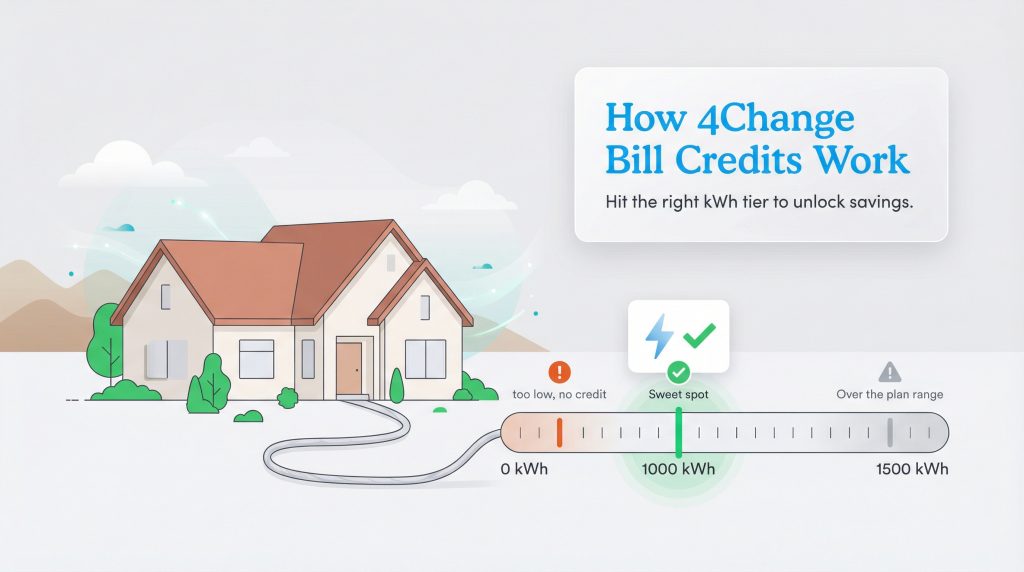
Getting 4Change Energy bill credits explained properly is the absolute key to unlocking their low advertised rates. This provider leans heavily on a tiered pricing model that rewards customers for hitting precise usage milestones. For instance, a plan might offer a generous bill credit, but only if you use exactly 1,000 kWh in a single billing cycle. If you use 999 kWh, you miss the credit entirely. Failing to hit that tier results in a much higher effective rate, which catches many new Texas residents off guard.
This setup can feel a bit like a frustrating hurdle if you aren’t prepared. It demands that you actively monitor your thermostat and household habits to ensure you land squarely in that sweet spot. However, if your home consistently consumes between 1,000 and 1,500 kWh every month, these strategic credits easily make 4Change one of the most affordable options on the market. Always review the Power to Choose shopping guide and FAQ before signing a contract so you understand exactly where those credit thresholds sit.
4Change Energy Plans and Pricing
| Plan Name | Rate | Plan Type | Cancellation Fee | |
|---|---|---|---|---|
| Maxx Saver Value 6 | $0.076 /kWh | 6 Months Fixed Rate | $20.00 | Check Availability |
| Maxx Saver Value 24 | $0.077 /kWh | 24 Months Rate | $20 | Check Availability |
| Maxx Saver Value 12 | $0.084 /kWh | 12 Months Rate | $20 | Check Availability |
| Maxx Saver Select 12 | $0.127 /kWh | 12 Months Fixed Rate | $20.00 | Check Availability |
| Maxx Saver Select 24 | $0.130 /kWh | 24 Months Rate | $20 | Check Availability |
| Maxx Select Green 12 - Exclusive Offer! | $0.132 /kWh | 12 Months Fixed Rate | $20.00 | Check Availability |
| Maxx Saver Select 18 - Exclusive Offer! | $0.143 /kWh | 18 Months Fixed Rate | $20.00 | Check Availability |
| Charitable Saver 12 | $0.144 /kWh | 12 Months Fixed Rate | $20.00 | Check Availability |
| Power Saver 12 | $0.167 /kWh | 12 Months Rate | $20 | Check Availability |
| Savvy Saver 24 | $0.169 /kWh | 24 Months Fixed Rate | $20.00 | Check Availability |
| Power Saver 24 | $0.170 /kWh | 24 Months Rate | $20 | Check Availability |
| One Rate 24 | $0.172 /kWh | 24 Months Fixed Rate | $20.00 | Check Availability |
| Power Maxx Saver 24 | $0.174 /kWh | 24 Months Rate | $20 | Check Availability |
| One Rate 12 | $0.176 /kWh | 12 Months Rate | $20 | Check Availability |
| Cash Money 12 | $0.179 /kWh | 12 Months Rate | $20 | Check Availability |
| Power Maxx Saver 12 | $0.181 /kWh | 12 Months Rate | $20 | Check Availability |
| Power Saver Monthly | $0.198 /kWh | 1 Month Months Rate | $ | Check Availability |
Is 4Change Energy Good for Eco-Conscious Homes?
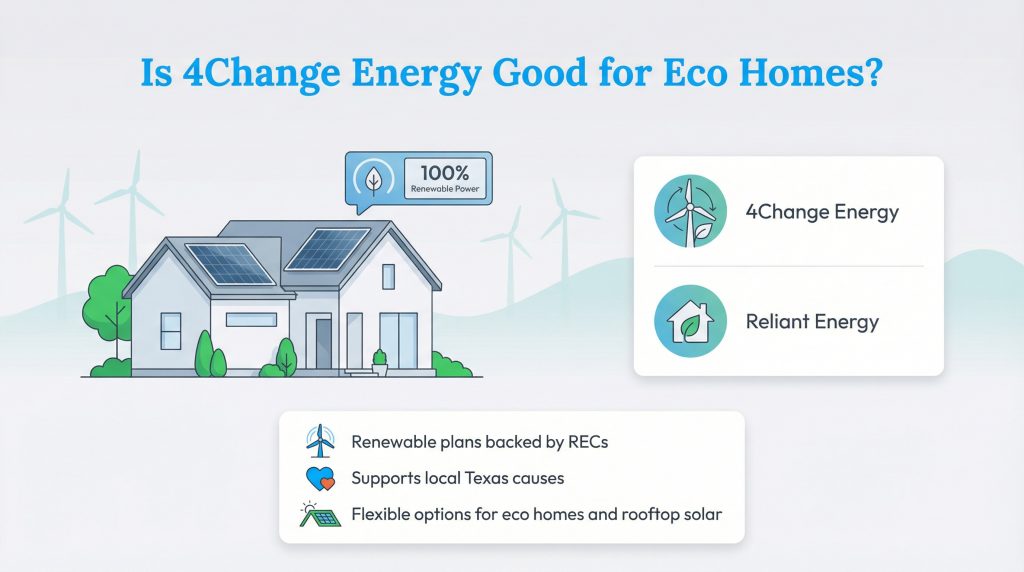
You might be wondering, is 4Change Energy good for an environmentally mindful choice? Absolutely. They provide excellent 100% renewable plan options typically backed by Renewable Energy Certificates (RECs). Beyond just supplying green energy, 4Change has promoted charitable giving initiatives, historically allocating a portion of their profits to local Texas causes like feeding programs and cancer research. Always check their current program details to see which charities they are actively supporting.
Reliant Energy also holds its own in the sustainability arena. They offer eco-conscious alternatives, including carbon offset programs and specific plans tailored for homeowners generating their own rooftop power. Reviewing Texas renewable energy generation data shows just how accessible wind power has become, making it incredibly simple for providers to offer these green plans without sacrificing grid reliability.
What to Know About Switching from Reliant to 4Change Energy
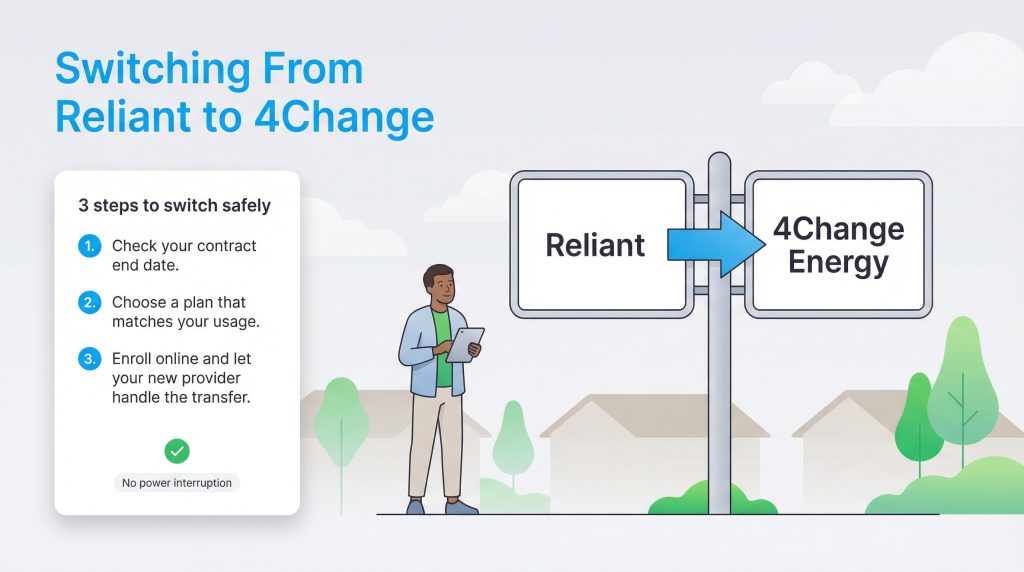
If you are ready to trim your monthly expenses, switching from Reliant to 4Change Energy is a surprisingly seamless process. The primary hurdle most homeowners face is navigating the transition without triggering an early termination penalty. Always check your current contract details first to identify any looming Reliant Energy cancellation fee. According to the Public Utility Commission of Texas (PUCT), if you are within 14 days of your contract expiring, you can generally switch penalty-free.
Whether you are moving into a new build or managing your utilities in Houston, the transition happens entirely on the backend. You will not lose power, and nobody needs to visit your property to flip a switch. Just be mindful that breaking a 4Change contract later down the road also incurs a 4Change Energy cancellation fee, which is usually calculated based on the months remaining on your term.
Follow these three simple steps to switch providers safely:
- Review your current Electricity Facts Label to confirm your contract end date and avoid surprise fees.
- Select a new plan that aligns with your exact historical energy usage to maximize potential bill credits.
- Sign up with your new provider online, and they will handle the transition communication with your local utility company.
Making Your Final Decision on Texas Electricity Providers
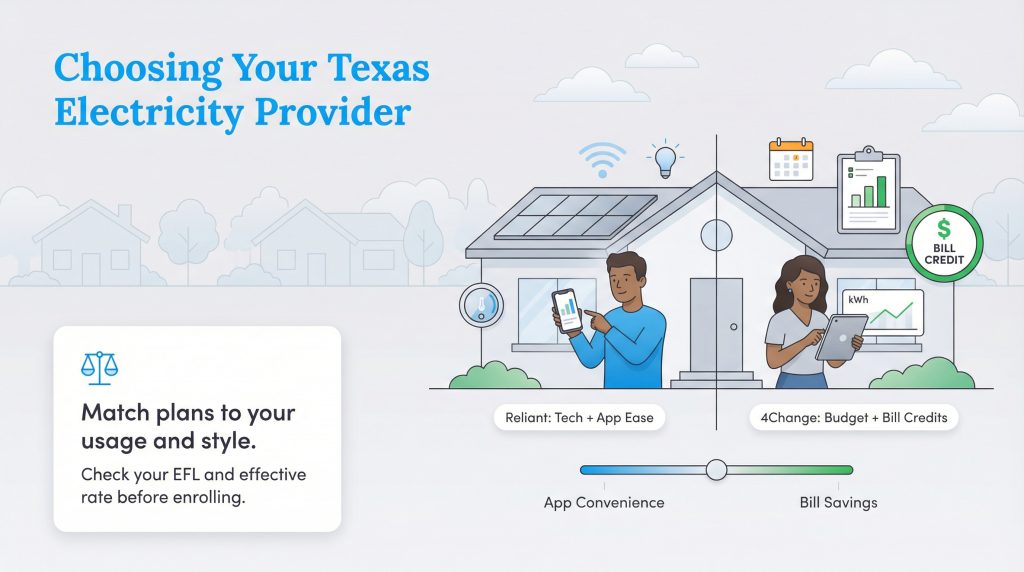
Choosing the right power company ultimately boils down to your personal management style and household energy usage. Reliant Energy is undeniably better for tech-forward users who crave robust plan variety, established customer service, and smart home perks. If you value a polished mobile app and standard fixed rates, they are worth the slightly higher baseline cost.
Conversely, 4Change Energy is the standout choice for budget-focused homeowners willing to meticulously track their daily consumption. If you can reliably hit those strict usage tiers, capturing their lucrative bill credits is one of the smartest strategies to save on your electric bill. Before you enroll, always pull up the EFL to verify the base charges, check the early termination fees, and calculate the effective rate based on your exact past usage. Weigh your past usage history, pick the provider that matches your household rhythm, and enjoy the savings that come from making an informed, confident choice.
Frequently Asked Questions About Reliant and 4Change Energy
Which company has the cheapest electricity rates?
How do I avoid the Reliant Energy cancellation fee?
Does 4Change Energy require a deposit?
How does Reliant Energy’s customer service compare to 4Change Energy’s?
Can I get 100% green energy with either provider?
Do TDU delivery charges affect Reliant and 4Change Energy differently?
What happens if I miss my 4Change Energy bill credit threshold by a single kilowatt-hour?
About the Author

David has been an integral part of some of the biggest utility sites on the internet, including InMyArea.com, HighSpeedInternet.com, BroadbandNow.com, and U.S. News. He brings over 15 years of experience writing about, compiling and analyzing utility data.