
Quarterly Delivery Surcharge Jumps to 1.05% for 1.6 Million Southeastern Pennsylvania Homes Starting October 2026
Key Takeaways
- PECO filed Tariff Supplement No. 36 with state regulators, raising its quarterly Distribution System Improvement Charge from 0.42% to 1.05% effective Oct. 1, 2026.
- The adjustment is a non-bypassable delivery fee that impacts roughly 1.6 million residential and commercial accounts across southeastern Pennsylvania.
- While typical households will see an increase of under a dollar per month, optimizing your generation supply and usage can offset rising grid costs.
If you live in southeastern Pennsylvania, your autumn electric bill will come with a modest adjustment from your utility company. On Sept. 18, 2026, PECO Energy Company submitted Electric Tariff Supplement No. 36 to the Pennsylvania Public Utility Commission (PA PUC), adjusting its quarterly Distribution System Improvement Charge (DSIC) upward. Beginning Oct. 1, 2026, the surcharge percentage will rise from 0.42% to 1.05% of billed distribution charges. We have broken down the regulatory mechanics behind this filing, calculated what it will cost the typical household, and pulled together practical strategies you can use to protect your monthly energy budget.
Why PECO Is Raising the Distribution System Improvement Charge
The Distribution System Improvement Charge is not an arbitrary fee — it is a regulatory cost-recovery tool established under Pennsylvania Act 11 of 2012. This mechanism allows electric distribution companies to recover the reasonable, prudent capital expenses required to modernize, repair, and replace aging distribution equipment between formal base rate cases.
Rather than making customers wait years for massive, sudden rate shocks through formal base rate litigation, the quarterly DSIC mechanism provides continuous funding to maintain local grid reliability. Under regulatory guidelines, eligible investments include:
- Replacement of aging utility poles, towers, and crossarms
- Overhead distribution wires and underground conduits
- Neighborhood line transformers and substation circuit breakers
- Smart grid infrastructure, automatic reclosers, and system relays
- Mandatory, unreimbursed utility pole relocations triggered by state and municipal roadwork
The quarterly adjustment is governed by a strict earnings cap. Utilities cannot collect the surcharge if their earnings exceed the benchmark set by regulators. In this filing, PECO demonstrated a return on equity of 5.510% — well below the PA PUC’s authorized equity return ceiling of 10.05% for DSIC calculations. Because the utility met all statutory conditions, the surcharge adjustment took effect for the final quarter of the year.
Impacted Counties, Cities, and Service Territories
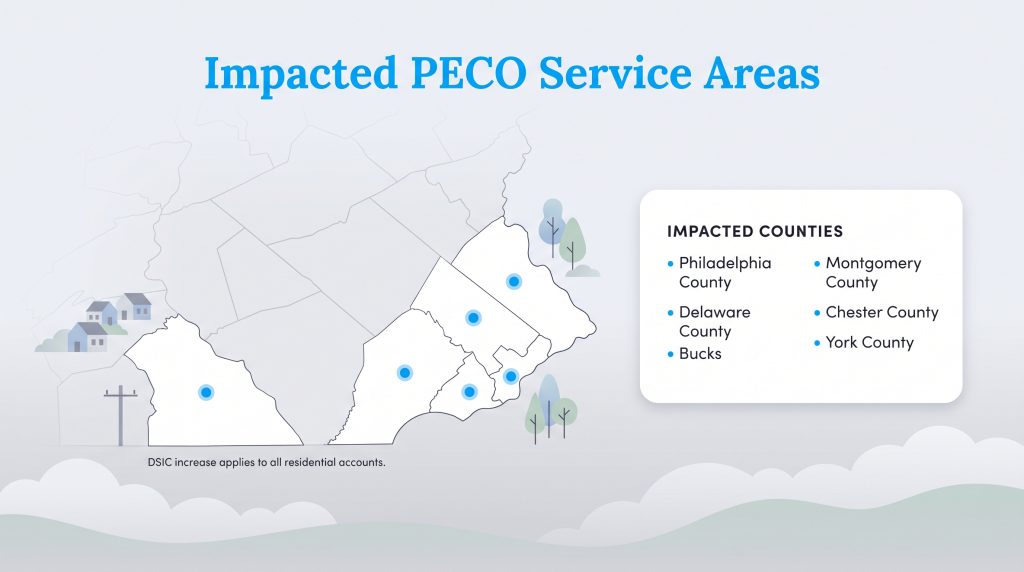
PECO serves approximately 1.6 million electric customers across an extensive 2,100-square-mile territory in southeastern Pennsylvania. Because the DSIC applies across all standard retail distribution schedules, the increase touches every residential account within the company’s regional footprint.
The communities affected by Tariff Supplement No. 36 include:
- Philadelphia County: The entire City of Philadelphia, spanning all center city neighborhoods, South Philadelphia, West Philadelphia, and Northeast Philadelphia.
- Delaware County: Dense suburban and riverfront communities, including Upper Darby and Chester.
- Montgomery County: Fast-growing residential corridors and commercial hubs such as Norristown and King of Prussia.
- Bucks County: Lower and central Bucks municipalities, including Bensalem and Bristol.
- Chester County: Western suburban communities and historic boroughs, including West Chester and Coatesville.
- York County: Small rural distribution pockets in the southeastern corner of the county near the Peach Bottom facility.
How Tariff Supplement No. 36 Affects Your Monthly Electric Bill
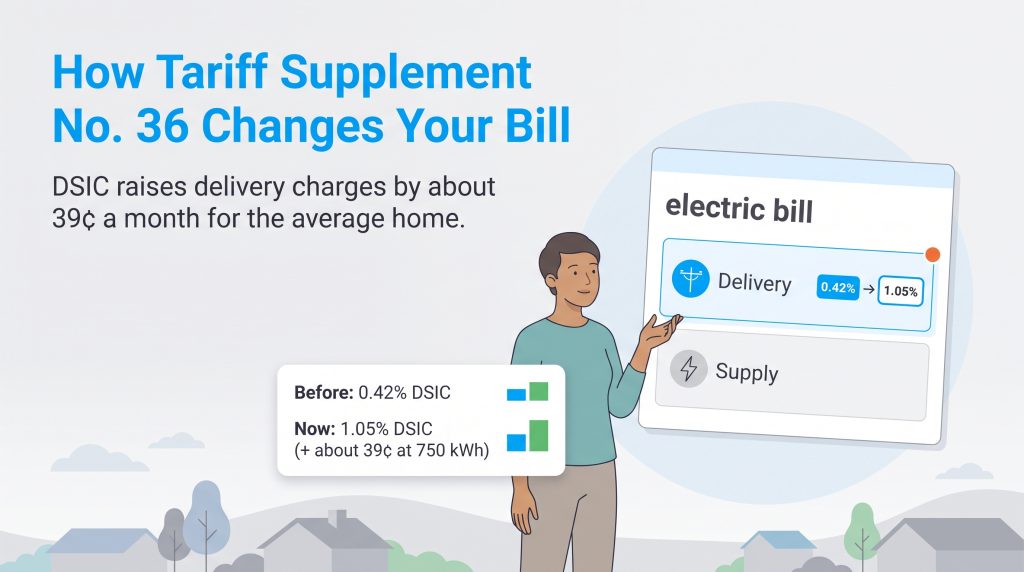
To understand this increase, it helps to look at how your electric bill is structured. Your total monthly bill consists of two primary categories: delivery charges (the physical wires and customer service provided by PECO) and supply charges (the actual kilowatt-hours of electricity generated).
The DSIC applies strictly to the delivery portion of your bill as a percentage surcharge. It is non-bypassable, which means every customer connected to the grid pays it, regardless of which company provides the electricity supply.
The table below illustrates how the shift from 0.42% to 1.05% alters your monthly delivery charges across typical consumption tiers:
| Household Electricity Usage (Monthly kWh) | Estimated Base Distribution Charge | Prior Monthly DSIC (0.42%) | New Monthly DSIC (1.05%) | Net Monthly Difference |
| 500 kWh (Apartment / Small Home) | $42.00 | $0.18 | $0.44 | +$0.26 |
| 750 kWh (Average Single-Family Home) | $62.00 | $0.26 | $0.65 | +$0.39 |
| 1,000 kWh (Larger Home / Moderate AC) | $82.00 | $0.34 | $0.86 | +$0.52 |
| 1,500 kWh (High Usage / Electric Heating) | $120.00 | $0.50 | $1.26 | +$0.76 |
For an average home using roughly 750 kWh, the adjustment amounts to approximately 39 cents per month, or about $1.17 across the entire fourth quarter. While this charge alone will not disrupt your budget, small regulatory riders add up over time across 1.6 million ratepayers.
Actionable Steps to Keep Your Energy Costs Down
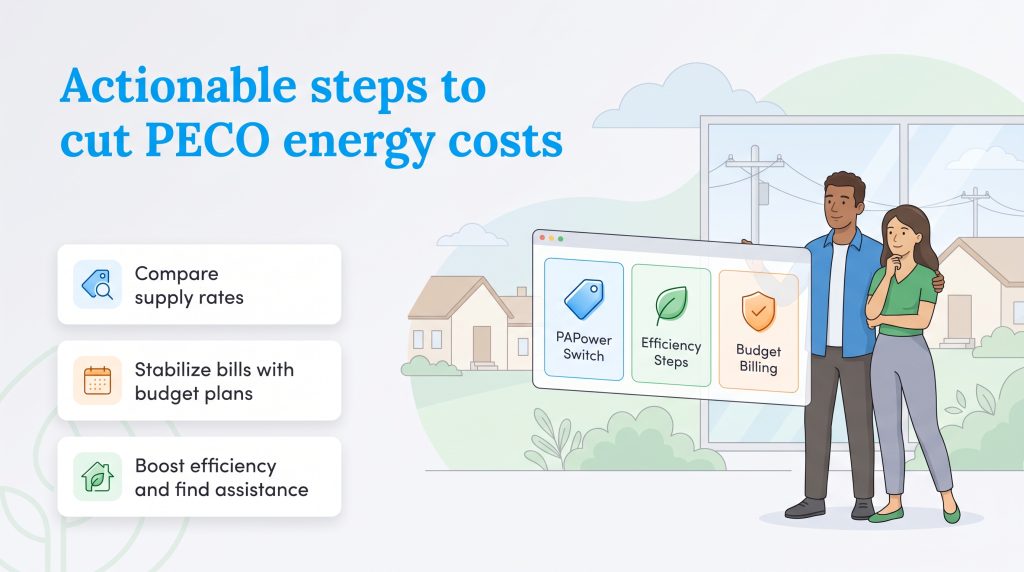
Even though you cannot opt out of non-bypassable distribution surcharges, delivery only accounts for a portion of what you spend. Electric generation and transmission often represent more than half of your total statement. Taking control of your supply contract and household efficiency can yield immediate monthly savings that far outweigh incremental delivery rate adjustments.
Compare Generation Rates on PAPowerSwitch
Pennsylvania operates a deregulated energy market, giving you the legal right to shop for third-party electricity suppliers. PECO continues to deliver the electricity and maintain the wires, but you can choose who generates the power.
- Visit the official state-managed shopping marketplace, PA PUC PAPowerSwitch, to check PECO’s current Price to Compare against competing offers.
- Search for fixed-rate contracts that lock in predictable pricing without unexpected monthly spikes.
- Look for an environmentally mindful choice, such as certified green energy suppliers backed by wind or solar renewable energy certificates.
- Always check the fine print for early termination penalties, monthly administrative fees, or clauses that roll fixed rates into volatile variable pricing after an introductory window.
Smooth Out Seasonal Bills With Budget Billing
If summer cooling and winter heating cause your utility bills to swing unpredictably, PECO’s Budget Billing program offers welcome stability. The utility averages your historical 12-month usage to calculate an equalized monthly payment amount. Your monthly statement stays consistent, helping you avoid seasonal sticker shock while your account reconciles quarterly.
Adopt Low-Cost Energy Efficiency Habits
Reducing waste is the most direct way to insulate your household from rate increases. Start by inspecting weatherstripping around windows and exterior doors to seal drafts ahead of cooler weather. Swapping out remaining incandescent bulbs for ENERGY STAR certified LEDs and lowering your water heater thermostat to 120°F delivers passive month-over-month reductions. If your home has a heat pump or central air system, scheduling regular seasonal tune-ups preserves operating efficiency and reduces baseline kilowatt-hour draw.
Explore Financial and Weatherization Assistance
If you or someone in your community is facing financial hardship, several state and utility-sponsored assistance programs can help:
- Low-Income Home Energy Assistance Program (LIHEAP): Federally funded grants administered by Pennsylvania to assist qualifying households with seasonal energy costs.
- Customer Assistance Program (CAP): PECO’s program offering discounted monthly delivery rates and debt forgiveness for income-eligible families.
- Low-Income Usage Reduction Program (LIURP): Free home weatherization improvements, insulation upgrades, and appliance inspections for qualifying high-usage homes.
What to Watch in the Months Ahead
Quarterly surcharge filings like Tariff Supplement No. 36 reflect an ongoing push across the Mid-Atlantic to upgrade aging distribution infrastructure against extreme weather and growing grid load. Because the DSIC rate is recalculated every three months based on capital project completions, PECO customers will see this surcharge update again in early 2027. We will keep monitoring state regulatory dockets and rate changes so you can stay informed, make smart shopping choices, and manage your utility budget with confidence.
Frequently Asked Questions About PECO Rate Changes
What is the PECO DSIC charge on my electric bill?
Can I avoid paying the DSIC by switching electric suppliers?
When does PECO Tariff Supplement No. 36 take effect?
How much will the new PECO tariff increase my bill?
About the Author

Claudio is a sustainability-focused writer with a background in Anthropology and Psychology from NC State University. He has spent over 15 years working in writing, interpretation, and translation, driven by a deep interest in how human culture shapes the environment. Today, he shares his curiosity with readers by writing about sustainable living solutions and the connection between everyday choices and environmental impact.