
Choosing the right electricity plan for your apartment requires understanding your usage and matching your contract to your lease.
Key Takeaways
- Most “bill credit” plans are designed for houses, so renters should look for plans with low rates at the 500 kWh usage level to avoid unexpected fees.
- Always match your electricity contract length to your lease term or choose a plan with a portable transfer option to avoid early termination penalties.
- If you have a limited credit history, consider prepaid or no-deposit electricity plans to get connected without paying a large upfront cost.
Moving into a new apartment is stressful enough without having to worry about navigating a confusing energy market. Between packing boxes and signing your lease, choosing an electricity provider can feel like just another chore. However, picking the wrong plan can cost you hundreds of dollars in hidden fees over the course of a year. The good news is that finding the best energy plans for renters is actually quite simple once you know which numbers to look for and how to avoid the “low usage” traps.
Why Energy Plans for Apartments Are Different
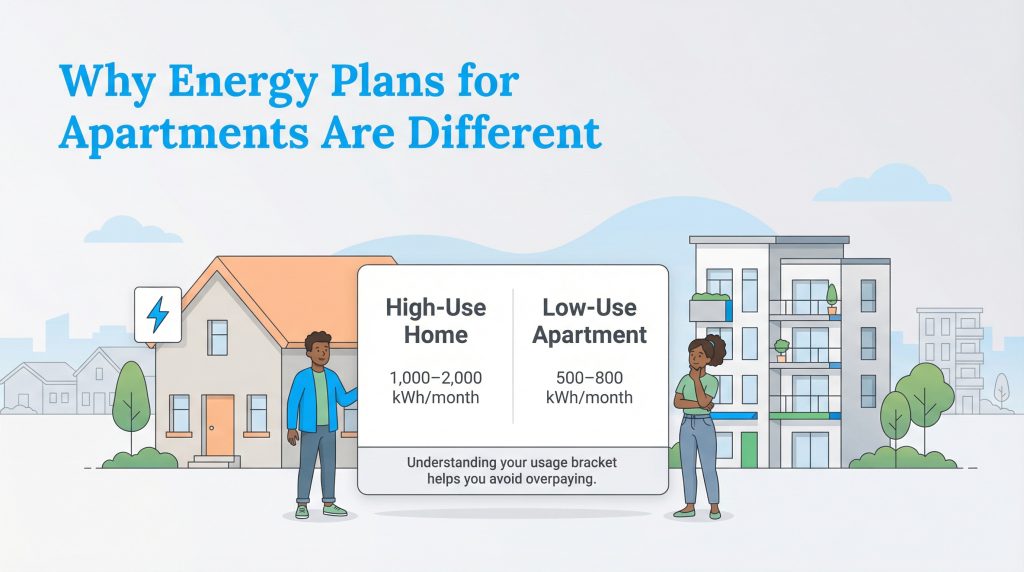
You might think electricity is the same for everyone, but the plan that works for a large four-bedroom house will often be a terrible deal for a one-bedroom apartment. The main difference comes down to usage. Electricity providers structure their rates based on how much power you consume. A typical single-family home might use between 1,000 and 2,000 kilowatt-hours (kWh) per month, allowing them to access bulk discounts or special credits. In contrast, in many parts of the United States, the average electric bill for 1 bedroom apartment is based on much lower consumption, usually between 500 and 800 kWh per month, though this can vary based on your local climate. You can always compare electricity plans in your area to see what is available for your specific usage needs.
Because electricity plans for apartments involve lower usage, you cannot simply look at the advertised “teaser rate” that shows up in bold print on a sales page. Those lowest advertised rates often require you to use at least 1,000 kWh to qualify. If you sign up for one of these homeowner-focused plans but only use 600 kWh in your apartment, your rate per kilowatt-hour could skyrocket. Understanding your usage bracket is the first step to ensuring you don’t overpay for power in a smaller space.
The “Low Usage” Trap: 500 kWh vs. 1000 kWh
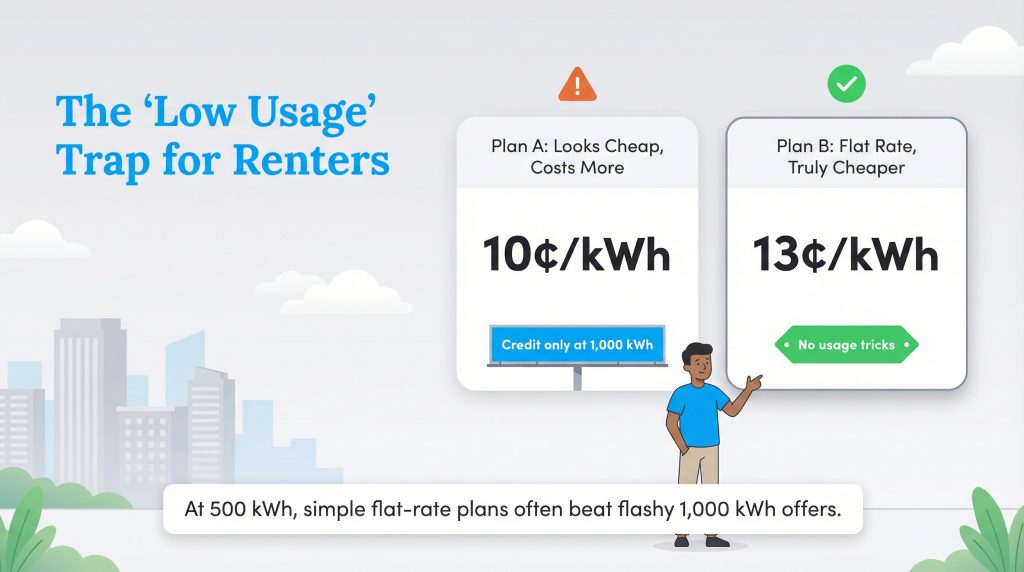
This is the most critical concept for renters to grasp. Many energy providers in deregulated markets advertise extremely low rates, like 10 cents per kWh, to grab your attention. However, if you read the fine print — specifically the Electricity Facts Label (EFL) — you will often see that this rate includes a “bill credit” that only kicks in after you use 1,000 kWh. Since most apartments are energy-efficient and smaller, you might never reach that threshold, meaning you miss out on the credit entirely.
When you miss that usage target, your effective rate can nearly double. To find cheap electricity for 1 bedroom apartment, you must ignore the 1,000 kWh rate and look strictly at the price for 500 kWh. Often, a plan with a slightly higher advertised rate is actually cheaper for you because it doesn’t rely on usage gimmicks or minimum thresholds.
Here is a simplified, illustrative example of how two different plans might compare if you use 500 kWh in a month:
| Plan Type | Advertised Rate (at 1000 kWh) | Real Cost at 500 kWh |
| Plan A (Bill Credit Plan) | 10¢ / kWh | 18¢ / kWh (Credit missed) |
| Plan B (Flat Rate Plan) | 13¢ / kWh | 13¢ / kWh (Stable rate) |
As you can see, even though Plan A looks cheaper in the advertisement, Plan B is the better financial choice for a renter. The best electricity plans for apartments are usually simple, flat-rate plans that don’t penalize you for conserving energy.
Matching Your Energy Contract to Your Lease
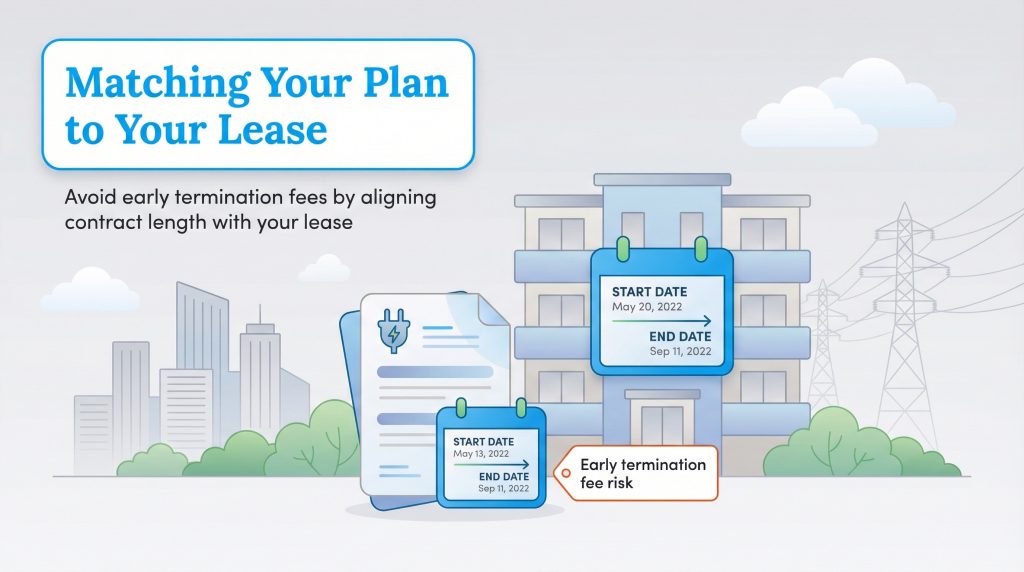
Another common mistake renters make is signing an electricity contract that is longer than their apartment lease. Energy providers love to lock customers into long-term commitments, such as 24 or 36 months, by offering slightly lower rates. However, if you only have a 12-month lease on your apartment, signing a three-year energy contract is risky. If you move out before your electricity contract ends, you could be hit with an Early Termination Fee (ETF). These fees can range from $150 to over $300, instantly wiping out any savings you gained from a lower rate.
While some providers allow you to transfer your service to a new address without penalty, you might move to an area where that provider doesn’t operate or where the rates are much higher. It is safer to align your electricity plan dates with your lease dates. If you are unsure how long you will stay, look for short term energy plans that offer more flexibility. Avoiding exit fees is just as important as securing a low rate when calculating your total annual costs.
Types of Plans: Fixed, Variable, and Month-to-Month
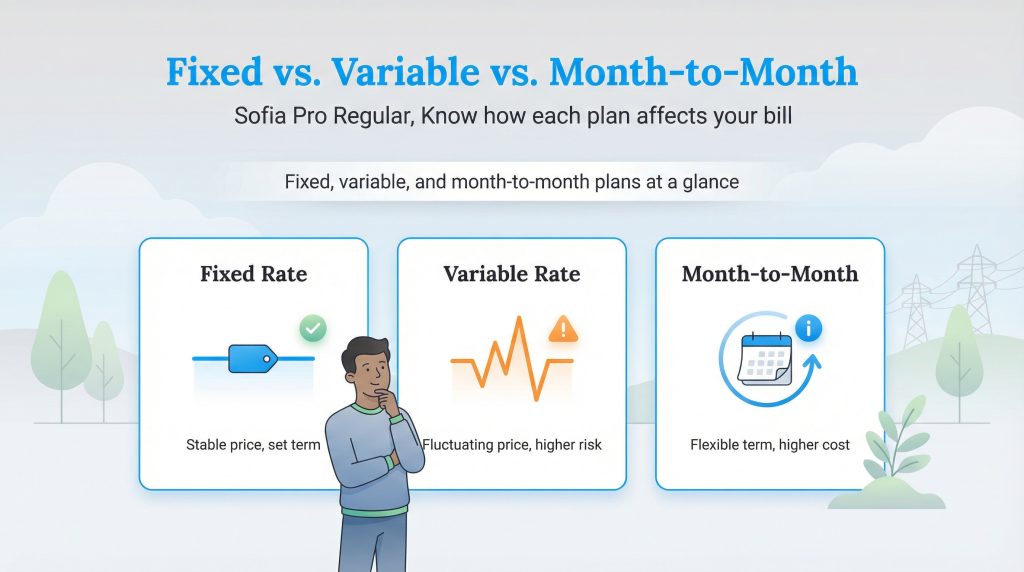
When shopping for electricity, you will generally encounter three main types of plans. Understanding the difference is key to avoiding bill shock.
- Fixed-Rate Plans: These are the most stable option and usually the best choice for renters with a standard 12-month lease. You lock in a specific rate for the duration of your contract. Even if market prices spike during a heatwave or winter storm, your rate per kWh stays the same.
- Variable-Rate Plans: These plans are risky. The rate can change every single month based on the wholesale market price of electricity. While they might start low, they can double or triple without warning during peak seasons. We generally do not recommend these unless you are waiting for a specific commitment.
- Month-to-Month Plans: These offer the ultimate flexibility because they have no long-term contract and usually no cancellation fee. However, month to month electricity plans often come with higher rates in exchange for that freedom. They are ideal for short-term sublets or if you are between housing situations.
Dealing with Deposits and Credit Checks
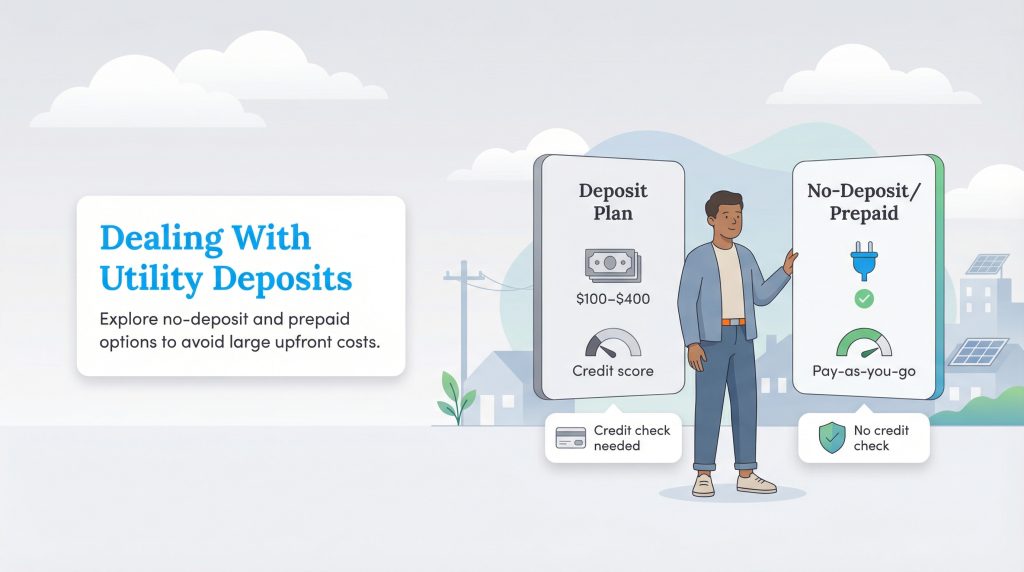
Setting up utilities can sometimes be a hurdle if you do not have an established credit history or if your credit score is lower than what providers prefer. Many standard electricity companies run a credit check before turning on service. If you don’t meet their criteria, they may ask for a security deposit that can range from $100 to $400. This large upfront cost can be difficult to manage right when you are paying for a security deposit on the apartment itself.
Fortunately, there are alternatives. No deposit electricity for renters is available through specific providers or prepaid plans. Prepaid electricity plans for renters allow you to pay as you go, similar to a prepaid phone plan. You load money into your account, and electricity is deducted daily. This avoids the credit check entirely. Additionally, in many states, some standard providers waive deposits for certain groups, such as seniors (typically 65+), victims of family violence, or those who can provide a “letter of credit” from a previous utility company proving good payment history. Check your state’s rules and your provider’s terms to confirm what is available where you live. For more information on assistance programs, you can visit USA.gov.
Eco-Friendly Options for Apartment Dwellers
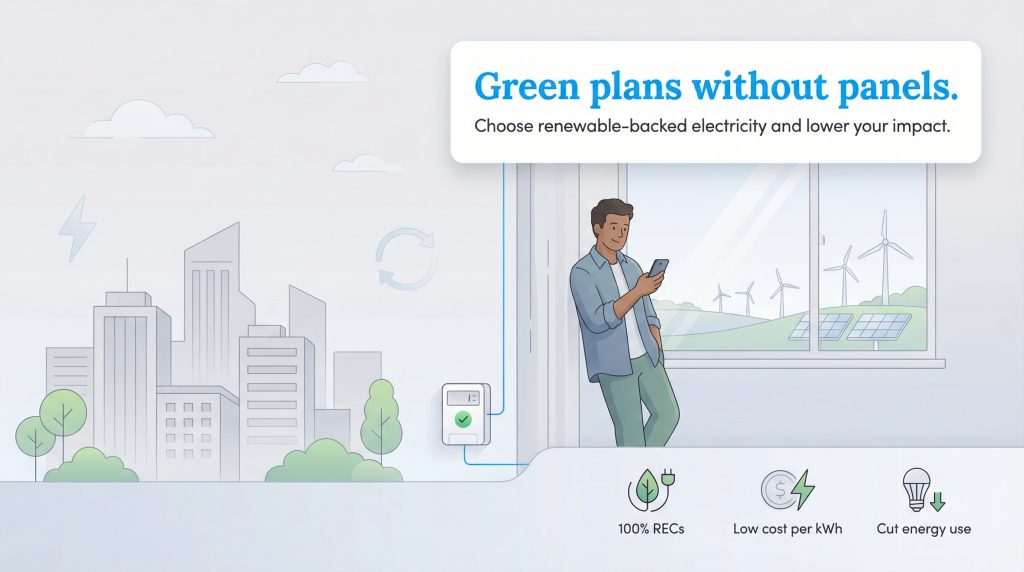
Just because you rent an apartment doesn’t mean you can’t support green energy. You might not be able to install solar panels on the roof, but you can still choose an electricity plan that sources power from renewable generation and learn more about sustainable energy options. Many providers offer plans backed by 100% Renewable Energy Credits (RECs). This means that for every unit of electricity you use, the company purchases an equivalent amount of renewable energy to put onto the grid.
In many competitive markets, choosing these eco-conscious alternatives often costs only a fraction of a cent more per kWh — and sometimes they are even priced competitively with fossil-fuel plans. It is a simple, effective way to reduce your personal carbon footprint without making any physical changes to your rental unit. You can pair these green plans with simple ways to save on your electric bill, like using LED bulbs, to further reduce your impact.
Wrapping Up Your Rental Energy Strategy
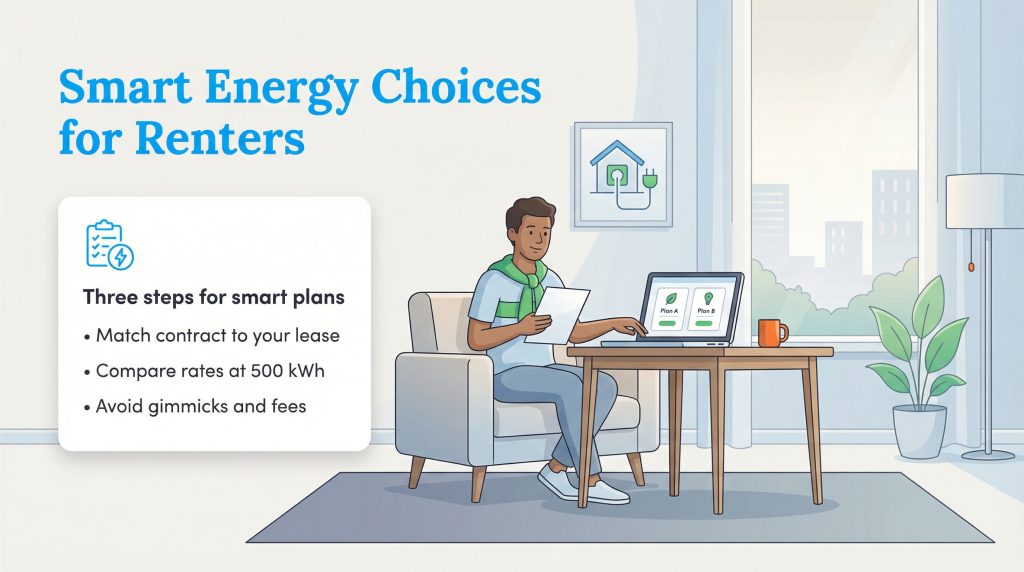
Finding the right energy plan for your apartment comes down to three simple rules: check your lease length, focus on the rate at 500 kWh, and don’t be afraid to shop around. Taking ten minutes to compare the details of the Electricity Facts Label can save you money every single month that you live in your new home. By avoiding gimmicky plans designed for large houses and steering clear of early termination fees, you keep more cash in your pocket for the things that make your apartment feel like yours. We hope this guide empowers you to make a confident decision and enjoy your new space.
Frequently Asked Questions About Energy Plans for Renters
What is the average electric bill for a 1-bedroom apartment?
Can I get electricity if I have bad credit?
Do I have to pay a cancellation fee if I move out of my apartment?
Is a fixed or variable rate better for renters?
How do I find the best electricity plans for apartments near me?
About the Author

Claudio is a sustainability-focused writer with a background in Anthropology and Psychology from NC State University. He has spent over 15 years working in writing, interpretation, and translation, driven by a deep interest in how human culture shapes the environment. Today, he shares his curiosity with readers by writing about sustainable living solutions and the connection between everyday choices and environmental impact.