

Choosing Between 4Change Energy and Just Energy Comes Down to Whether You Prioritize Charitable Giving, Green Energy Plans, or Bottom-Line Rate Pricing

- 7.2¢ /kWh
- 9-100%
- 60 days
- 8-24 Months
- Best for High-Usage Homes

- 8.8¢ /kWh
- 31%
- 60 days
- 12-36 Months
- Popular Bill Credit Plans
*rates may vary by location and household usage
Key Takeaways
- 4Change Energy is generally better for budget-conscious shoppers who value charitable donations built into their utility bills.
- Just Energy is ideal for eco-conscious households seeking plans that may offer 100% renewable energy and transparent usage tracking.
- Always calculate your current early termination fee against potential savings before making a switch to either provider.
Whether you are moving into a cozy apartment or powering a sprawling family home, choosing the right electricity provider depends entirely on your monthly energy consumption. Comparing 4Change Energy vs. Just Energy gives you a clear path forward through the process of choosing a residential electric plan. You want a provider that offers reliable service, fair pricing, and peace of mind when you flip the switch. We know how frustrating it gets when you are buried in confusing terms and hidden fees, so we evaluate these companies using current state listings, provider terms, and Electricity Facts Labels (EFLs) to ensure absolute accuracy. This guide serves as your practical roadmap for a detailed Texas electricity provider comparison, helping you find a plan that actually fits your lifestyle and budget.
At a Glance: 4Change Energy vs. Just Energy Comparison
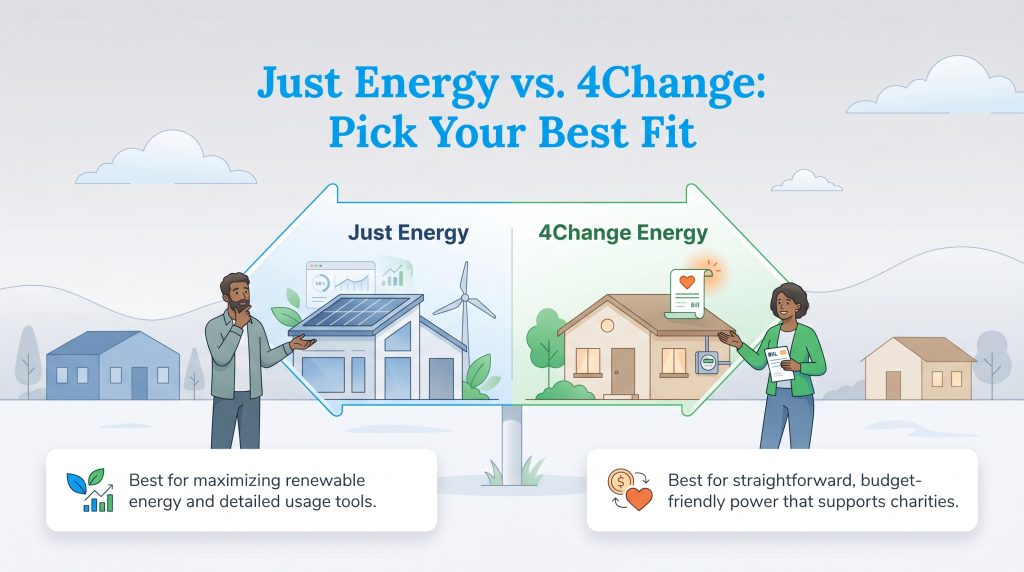
When you sit down to compare these top-tier providers, the choice boils down to your core household values and what you need from your monthly bill. 4Change Energy keeps overhead extremely low and passes those savings directly to budget-conscious shoppers, proudly dedicating 4% of their annual profits to local Texas charities. On the other hand, Just Energy shines for households that want a global brand equipped with robust digital portal tools and comprehensive green options. Just Energy often carries a slightly higher premium, but their transparent flat-rate plans and established customer service infrastructure make them a highly reliable choice.
| Comparison Feature | 4Change Energy | Just Energy |
|---|---|---|
| Lowest Rate Sweet Spot | Best around exactly 1,000 kWh | Consistent across most usage tiers |
| Early Termination Fee (ETF) | Typically $20 per remaining month | Flat-rate fee (e.g., $135 to $200) |
| PUCT Rating/Score | Competitive historical scores | Competitive historical scores |
| 100% Green Options | Available but heavily limited | Extensive 100% renewable plans |
| Free Nights/Weekends | Available on select plans | Available on select plans |
Plan Pricing and Usage Tiers Explained
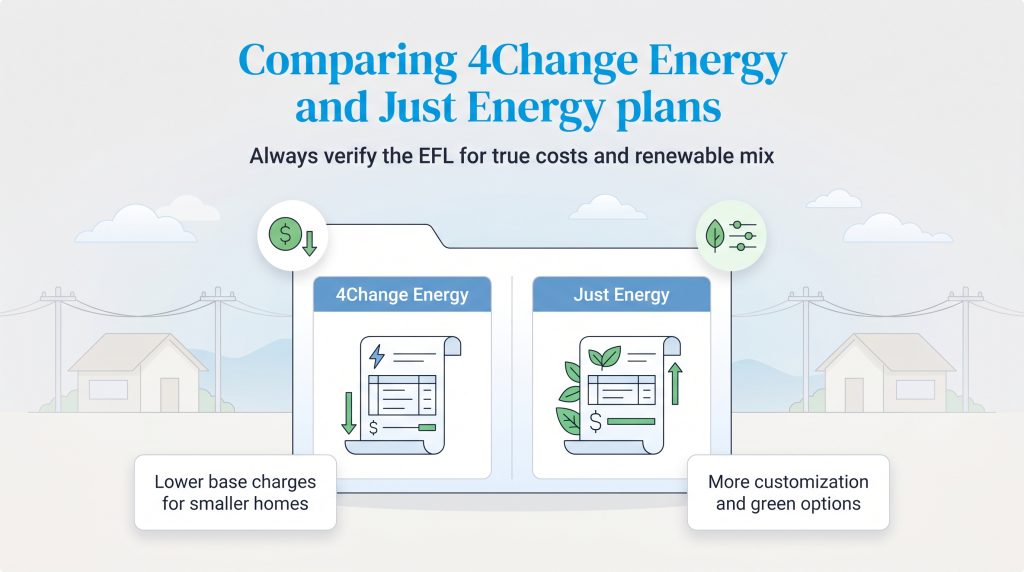
Understanding exactly what you are paying for is the hardest part of choosing a residential electric plan. Both providers structure their billing slightly differently. Every Texas electricity bill includes two main components: a Base Charge (a flat monthly fee to service your account) and TDU charges (Transmission and Distribution Utility fees that cover the local poles and wires). Because Power to Choose Texas listings often show drastically different prices based on your home size, you must evaluate how these companies price their electricity at the three standard consumption benchmarks:
- 500 kWh (Small Apartment): Often features higher average cents-per-kWh rates because flat base fees take up a larger percentage of your overall bill.
- 1,000 kWh (Average Home): The standard benchmark where many providers apply significant discounts to drastically lower your effective rate.
- 2,000 kWh (Large Home): Requires stable, flat-rate pricing to remain affordable, as bill credits typically expire once your usage exceeds a certain limit.
Top 4Change Energy Plans and Bill Credits
4Change Energy is famous for utilizing bill credits to keep advertised rates low. For example, their popular Maxx Saver Value plans often apply a sizable credit (sometimes up to $100) if you use exactly 1,000 kWh or more during a billing cycle. This strategy heavily rewards average-sized homes that consistently hit this target usage tier. However, if you fall short at 950 kWh, you miss the credit completely and pay a much higher premium for that month’s power. If you check 4Change Energy bill credits closely on the EFL, you will quickly see why understanding your personal usage history is critical before signing up.
| Plan Name | Rate /kWH | Plan Term | Cancellation Fee | |
|---|---|---|---|---|
| Maxx Saver Value 8 | 7.2¢ | 6 Months | $20.00 | Check Availability |
| Maxx Saver Value 12 | 7.3¢ | Month to Month | N/A | Check Availability |
| Maxx Saver Value 24 | 8.9¢ | Month to Month | N/A | Check Availability |
| Maxx Saver Value 36 | 10.4¢ | Month to Month | N/A | Check Availability |
| Maxx Saver Select 12 | 12.7¢ | Month to Month | N/A | Check Availability |
| Maxx Saver Select 24 | 13¢ | Month to Month | N/A | Check Availability |
| Maxx Select Green 12 - Exclusive Offer! | 13.2¢ | 12 Months | $20.00 | Check Availability |
| Charitable Saver 24 | 13.5¢ | Month to Month | N/A | Check Availability |
| Maxx Saver Select 18 - Exclusive Offer! | 14.3¢ | 18 Months | $20.00 | Check Availability |
| Charitable Saver 12 | 14.4¢ | 12 Months | $20.00 | Check Availability |
| Power Saver 12 | 16.7¢ | Month to Month | N/A | Check Availability |
| Savvy Saver 24 | 16.9¢ | 24 Months | $20.00 | Check Availability |
| One Rate 12 | 17¢ | Month to Month | N/A | Check Availability |
| Power Saver 24 | 17¢ | Month to Month | N/A | Check Availability |
| Power Maxx Saver 12 | 17.1¢ | Month to Month | N/A | Check Availability |
| One Rate 24 | 17.2¢ | 24 Months | $20.00 | Check Availability |
| Perfect Fit 12 | 17.3¢ | Month to Month | N/A | Check Availability |
| Cash Money 12 | 17.4¢ | Month to Month | N/A | Check Availability |
| Power Maxx Saver 24 | 18.2¢ | Month to Month | N/A | Check Availability |
| Power Maxx Advantage 24 | 18.5¢ | Month to Month | N/A | Check Availability |
| Power Maxx Advantage 12 | 19.1¢ | Month to Month | N/A | Check Availability |
| Power Saver Monthly | 19.8¢ | Month to Month | N/A | Check Availability |
Top Just Energy Plans and Time-of-Use Offers
Just Energy plans generally take a more straightforward, flat-rate approach. While their base rates might sit slightly higher than 4Change Energy’s heavily credited plans, they offer predictable pricing that does not unexpectedly spike if you use too little power during a mild spring month. When reviewing your options, you will need to weigh fixed rate vs variable rate energy plans carefully. Fixed-rate plans lock in your price to protect you from summer price spikes, while variable rates fluctuate based on volatile market conditions. Just Energy also offers extensive free nights and weekends electricity plans, which can yield massive savings if you shift heavy appliance usage to designated off-peak hours.
| Plan Name | Rate /kWH | Plan Term | Cancellation Fee | |
|---|---|---|---|---|
| Power Plus - 24 | 8.8¢ | 24 Months | $0.00 | Check Availability |
| Smart Choice - 24 | 8.9¢ | 24 Months | $0.00 | Check Availability |
| Smart Choice - 6 | 10.3¢ | 6 Months | $0.00 | Check Availability |
| Power Plus - 12 | 10.9¢ | 12 Months | $0.00 | Check Availability |
| Sustainable Living Bundle - 3 | 11.5¢ | 3 Months | $175.00 | Check Availability |
| Sustainable Days Bundle - 3 | 11.5¢ | 3 Months | $175.00 | Check Availability |
| Smart Choice - 12 | 12.1¢ | 12 Months | $175.00 | Check Availability |
| Simple Choice- 12 | 15.4¢ | 12 Months | $0.00 | Check Availability |
| Basics - 12 | 16.3¢ | 12 Months | $0.00 | Check Availability |
| Simple Choice- 24 | 16.5¢ | 24 Months | $0.00 | Check Availability |
| Basics - 24 | 16.7¢ | 24 Months | $0.00 | Check Availability |
| Basics PTC - 60 | 16.9¢ | 60 Months | $175.00 | Check Availability |
| Basics PTC - 24 | 16.9¢ | 24 Months | $175.00 | Check Availability |
| Mega Saver - 24 | 20.2¢ | 24 Months | $0.00 | Check Availability |
Pro Tip: Watch out for bill credit plans that advertise exceptionally low rates but only trigger the discount if your monthly usage falls within a very narrow, specific window. Always read the Electricity Facts Label to ensure you consistently hit the required threshold.
| Bill Credit Plan Reality Check | ||
| Scenario | Monthly Usage | Result |
| Hitting the Sweet Spot | 1,000 kWh to 1,500 kWh | You receive the statement credit, resulting in a low effective rate. |
| Missing the Target (Under) | 950 kWh | No credit is applied, and you pay a significantly higher base rate per kWh. |
| Missing the Target (Over) | 1,550 kWh | No credit is applied, leading to an unexpected spike in your total bill. |
Early Termination Fees (ETF) and Hidden Charges
We know that feeling trapped in a bad electricity contract is incredibly frustrating. Many homeowners avoid switching providers because they are terrified of the upfront penalty. Understanding exactly how early termination fees (ETF) work is crucial for building a transparent budget. 4Change Energy typically charges a $20 per-month-remaining fee, meaning if you cancel with five months left on your contract, your penalty is $100. Conversely, Just Energy generally uses flat-rate cancellation fees depending on the contract length, which often range from $135 to over $200. Breaking your contract can actually be a brilliant financial move if the math works out in your favor.
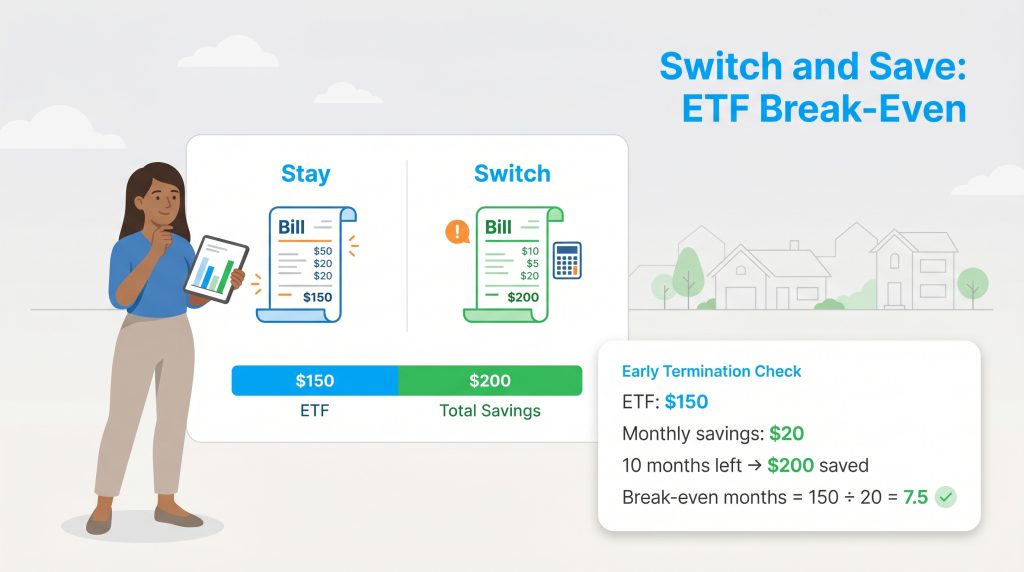
To really reduce your monthly electric bill, you have to look past the upfront penalty and focus on the long-term savings. Let’s imagine you currently pay 15 cents per kWh, but you find a new plan offering 13 cents per kWh. If your household uses 1,000 kWh a month, that 2-cent difference saves you $20 every single billing cycle. If you have 10 months left on your contract and face an ETF of $150, here is how you figure out if jumping ship is worth it:
- Identify your early termination fee: Check your current plan’s EFL to find your exact penalty amount (e.g., $150).
- Calculate your monthly savings: Subtract the new rate from your old rate, then multiply by your average monthly usage (e.g., $20 per month).
- Multiply by remaining months: Multiply your monthly savings by the time left on your contract (e.g., $20 x 10 months = $200 in savings).
- Compare the numbers: If your total projected savings ($200) are greater than your ETF ($150), making the switch is absolutely the right call.
Money-Saver: If you prefer a quick calculation, use this simple formula to find out how many months it will take to recoup your penalty: Break-even months = ETF ÷ monthly savings. If the result is fewer than the months remaining on your current contract, the switch is financially sound.
Green Energy and Renewable Options
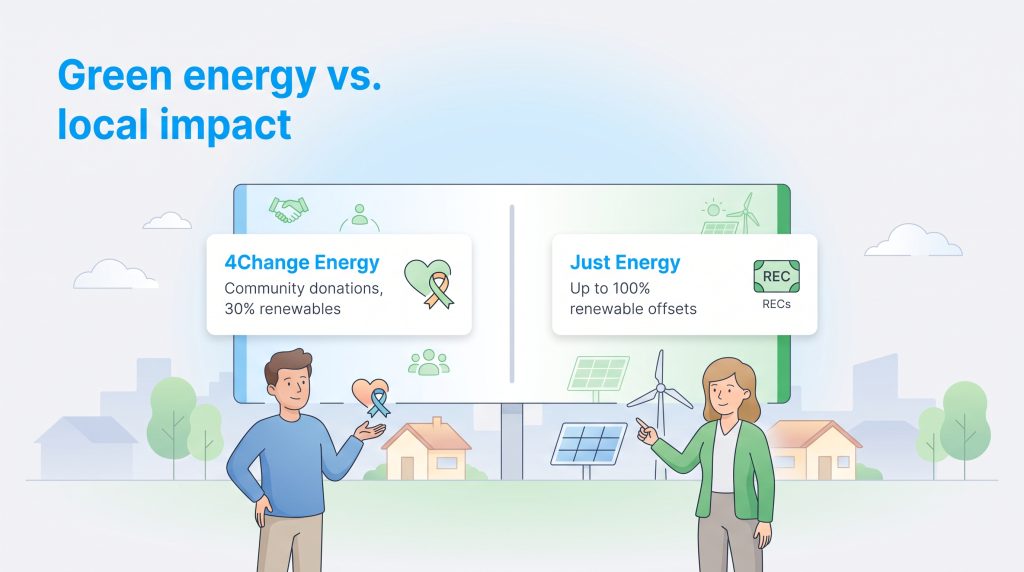
Your utility bill represents more than just the power flowing through your outlets — it’s also a reflection of the companies you choose to support. If community impact matters to you, 4Change Energy stands out by donating an impressive 4% of their annual profits to local Texas charities such as feeding programs and the American Cancer Society. While their standard plans feature the state average of around 30% renewable content, they occasionally offer upgraded eco-conscious alternatives.
If you prefer an environmentally mindful choice, Just Energy takes the lead. They frequently offer comprehensive renewable energy plans Texas residents can use to offset 100% of their usage, making them an excellent energy-saving option for those looking to upgrade their home alongside new ENERGY STAR appliances. Embracing wind and solar power directly supports the growing Texas renewable energy generation profile, helping transition the grid away from fossil fuels.
Eco Edge: Residential green energy plans typically utilize Renewable Energy Certificates (RECs), which guarantee that clean energy is generated and added to the power grid on your behalf to offset your actual fossil fuel consumption.
Customer Reviews, Service, and PUCT Ratings
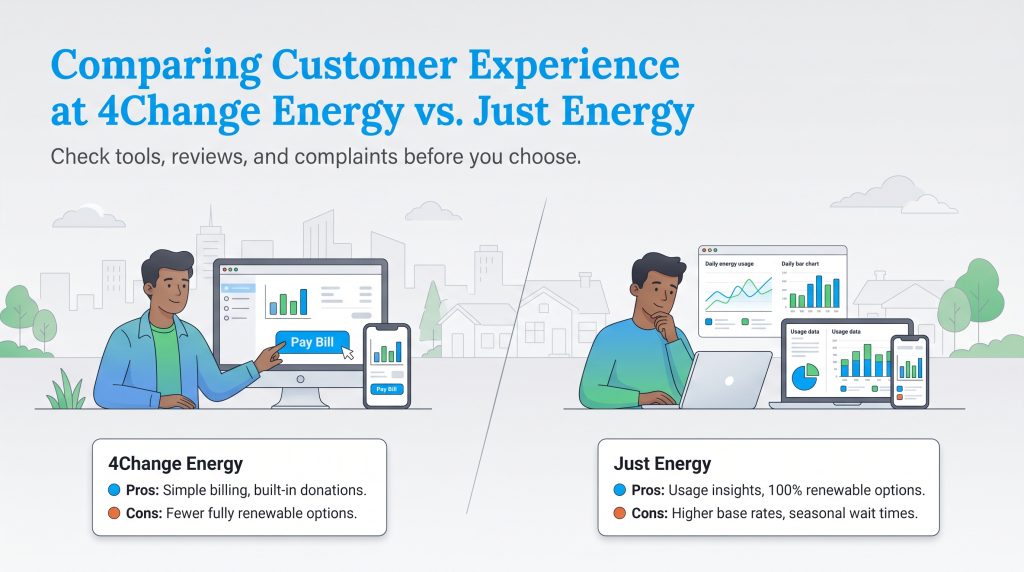
A great rate means very little if you cannot reach customer support during a billing dispute. When evaluating whether these providers offer a smooth day-to-day experience, we look past aggregate star ratings to examine objective third-party trust signals. Recent Public Utility Commission of Texas (PUCT) complaint statistics indicate that both providers generally maintain competitive records, though exact complaint metrics fluctuate during peak summer heat waves when billing inquiries surge across the state.
When diving into verified 4Change energy reviews, customers frequently praise their functional online billing portal and straightforward auto-pay setup, but some note frustration over strict usage tier penalties if they miss their bill credit window. Conversely, Just Energy customer service reviews often highlight their robust digital portal tools that offer daily usage tracking to help you adjust your habits. However, some Just Energy users cite occasional billing clarity issues regarding flat-rate charges. If you are also comparing other providers like Gexa Energy, you will find that both 4Change Energy and Just Energy hold their own, but they excel in distinctly different areas.
- 4Change Energy Pros: Low-cost tiered pricing and robust charitable donations built into their business model.
- 4Change Energy Cons: Strict usage tier penalties can cause sudden rate spikes if you use too much or too little power.
- Just Energy Pros: Readily available 100% renewable energy options and comprehensive digital tools for usage insights.
- Just Energy Cons: Base rates sit slightly higher, and cancellation fees use a more expensive flat-rate structure.
Making the Right Electric Provider Choice for Your Home
Picking the perfect electricity provider does not have to be a major headache. You now have the insights needed to match your household priorities with the right company. If you are strictly hunting for competitive pricing around the 1,000 kWh mark and want your dollars to fuel local charities, 4Change Energy is a fantastic fit. Conversely, if you want powerful digital tools and the ability to offset your life with 100% sustainable energy, Just Energy is well worth the investment. Take a few minutes to check your current contract, crunch the numbers on any termination fees, and lock in a rate that makes sense for you. Before long, you will have a reliable electricity plan firmly in place — leaving you free to kick back, relax, and enjoy the comfort of your home.
Frequently Asked Questions About 4Change Energy vs. Just Energy
Does 4Change Energy or Just Energy have cheaper rates?
How do 4Change Energy’s bill credits work at 1000 kWh?
Which provider has better green energy and solar buyback plans?
Can I avoid the early termination fee with Just Energy or 4Change Energy if I move?
Does 4Change Energy or Just Energy require a deposit?
What happens when my fixed-rate contract expires?
Do these providers offer free nights and weekends?
About the Author

David has been an integral part of some of the biggest utility sites on the internet, including InMyArea.com, HighSpeedInternet.com, BroadbandNow.com, and U.S. News. He brings over 15 years of experience writing about, compiling and analyzing utility data.

LaLeesha has a Masters degree in English and enjoys writing whenever she has the chance. She is passionate about gardening, reducing her carbon footprint, and protecting the environment. She also recently served as President of the Board for City Sprouts (a community garden).