
City Council Approves Rate Adjustments to Fund Critical Infrastructure and the Multi-Billion-Dollar Pure Water Project
Key Takeaways
- San Diego approved a 14.7% volumetric water rate increase and a 6% wastewater adjustment to fund regional infrastructure upgrades and capital debt service.
- The average single-family household using 12 HCF per billing cycle will see monthly bills rise by roughly $22, adding $264 annually to utility expenses.
- Ratepayers can lower bills through turf replacement rebates, EPA WaterSense fixture upgrades, and the city’s H2O San Diego assistance program.
San Diego residents are navigating higher municipal utility bills following the San Diego City Council’s approval of a 14.7% volumetric water rate hike and restructured wastewater fees. Impacting approximately 1.4 million customers across the city, the rate adjustments are part of a multi-year effort to modernize decades-old pipe networks, satisfy federal clean-water mandates, and fund the city’s signature Pure Water recycling initiative. Because municipal water systems operate as regional public monopolies, you cannot shop around for another tap water supplier — making water conservation, leak detection, and local rebate programs your best line of defense. Below, we break down why rates are climbing, how your monthly statements will look, and the concrete steps you can take to keep your household budget balanced.
Understanding the Primary Drivers Behind the Rate Escalation
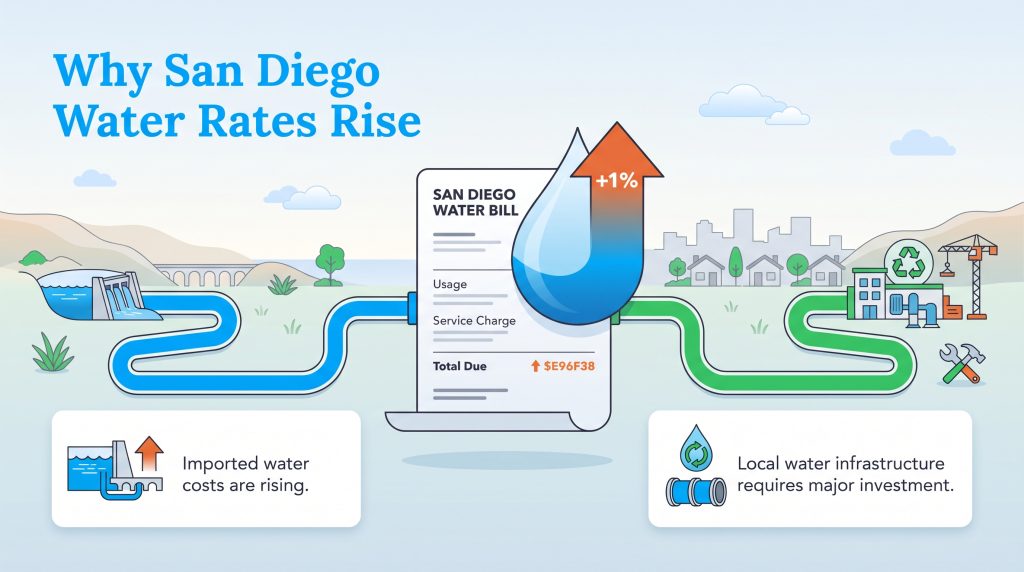
Municipal water rates do not rise in a vacuum; they reflect the steep cost of securing raw water in a semi-arid coastal region. The City of San Diego Public Utilities Department relies heavily on regional water imports and large-scale capital financing to maintain safe drinking water standards across hundreds of miles of terrain.
Surging Wholesale Water Costs
San Diego imports up to 90% of its drinking water from the San Diego County Water Authority (SDCWA), making local retail bills sensitive to wholesale price increases. Approximately 40% of the city’s water operating budget goes directly toward buying treated and untreated supplies from the SDCWA. When the regional water authority passed through wholesale rate increases — driven by rising treatment expenses and regional pipeline maintenance — the city passed those charges directly along to local households.
The Pure Water Recycling Project and Capital Debt
The single largest local infrastructure project in San Diego history is the Pure Water program. This multi-billion-dollar initiative purifies recycled wastewater into high-quality drinking water, with the goal of supplying nearly half of the city’s total water demand locally by 2035. While the project secures a drought-resilient local water supply, servicing the revenue bonds and paying for heavy construction across central San Diego has added significant capital repayment obligations to customer bills.
Aging Infrastructure and Deferred Maintenance
Beneath city streets, miles of cast-iron distribution mains and concrete sewer pipes have reached the end of their operational lifespans. Revenue from the approved rate adjustments directly funds the $40.1 million Montezuma/Mid-City Pipeline project, extensive dam safety overhauls at Lake Hodges, and scheduled trunk sewer rehabilitation through ecological corridors like Tecolote Canyon.
How the 14.7% Rate Increase Affects Your Monthly Bill
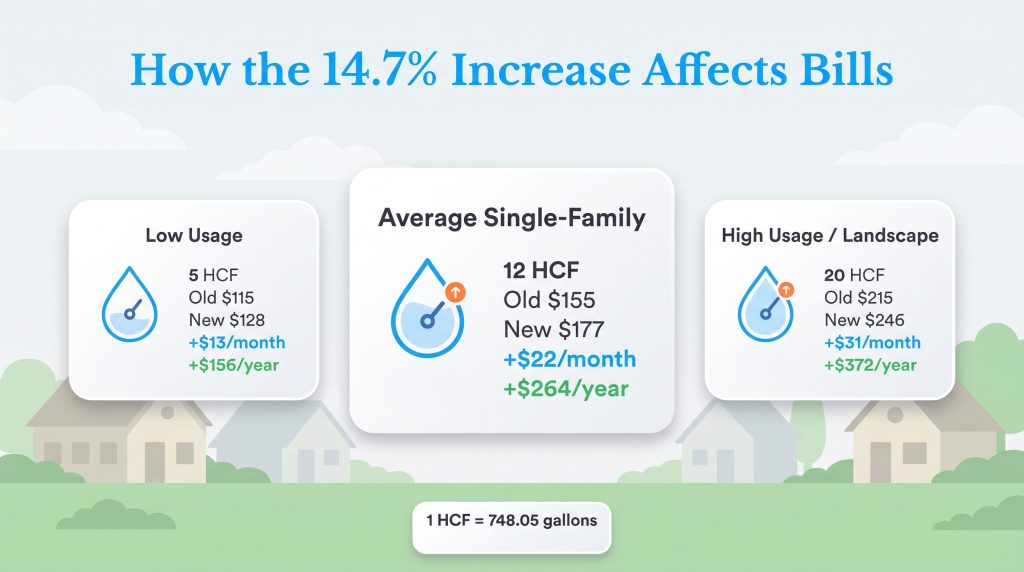
Because the 14.7% rate adjustment applies to volumetric water consumption, the financial hit lands unevenly across households. Single-family homes with large lawns or high headcounts will see the steepest dollar adjustments, whereas compact households that conserve water will notice smaller increases.
The city bills water consumption in hundred cubic feet (HCF), where one HCF equals 748.05 gallons. Fixed monthly meter charges have also been adjusted upward to guarantee baseline revenue for system maintenance.
| Consumption Tier | Estimated Usage Level | Old Combined Monthly Bill | New Combined Monthly Bill | Monthly Increase | Annual Budget Impact |
| Low Usage | 5 HCF (~3,740 gallons) | $115 | $128 | $13 | $156 |
| Average Single-Family | 12 HCF (~8,976 gallons) | $155 | $177 | $22 | $264 |
| High Usage / Landscape | 20 HCF (~14,960 gallons) | $215 | $246 | $31 | $372 |
For an average family using 12 HCF per billing cycle, the combined monthly bill rises from approximately $155 to $177 — creating an added annual expense of $264. When factoring in future phased adjustments scheduled through the decade, staying proactive with home water conservation is essential.
Public Pushback and Billing Scrutiny at City Hall
The City Council’s public hearings featured testimony from concerned residents, neighborhood groups, and consumer advocates. Much of the community frustration centered on long-standing operational issues within the Public Utilities Department rather than the concept of clean water itself.
Ratepayer advocates pointed out that the city has faced persistent challenges with its automated meter reading systems, resulting in estimated bills, delayed statements, and unexpected catch-up charges. Many residents questioned the fairness of raising rates while customer support queues remain backlogged and contested billing disputes remain open. While municipal officials emphasized that rate hikes are legally required under bond covenants to prevent utility insolvency, public demand for accountability and accurate metering remains high.
Service Territory and Affected San Diego Communities
The approved rate structure directly governs all residential, commercial, and industrial customers served by the City of San Diego Public Utilities Department. The service footprint covers more than 1.4 million residents spread across nine City Council districts.
The rate adjustments apply across all municipal neighborhoods:
- Central & Urban Core: Downtown San Diego, North Park, South Park, Hillcrest, Normal Heights, and Barrio Logan.
- Coastal Communities: Ocean Beach, Pacific Beach, Point Loma, Mission Beach, and La Jolla.
- Northern Neighborhoods: Clairemont, Linda Vista, Kearny Mesa, Mira Mesa, Rancho Peñasquitos, and Rancho Bernardo.
- Eastern & Southern Districts: Tierrasanta, San Carlos, College Area, Encanto, Paradise Hills, and San Ysidro.
If you live in adjacent municipalities such as Chula Vista, La Mesa, or El Cajon, your water service is managed by separate regional providers — such as Sweetwater Authority or Helix Water District. However, because those utilities also purchase wholesale supplies from the SDCWA, similar cost pressures are emerging across the county.
Practical Steps to Lower Your Water Bill and Access Relief
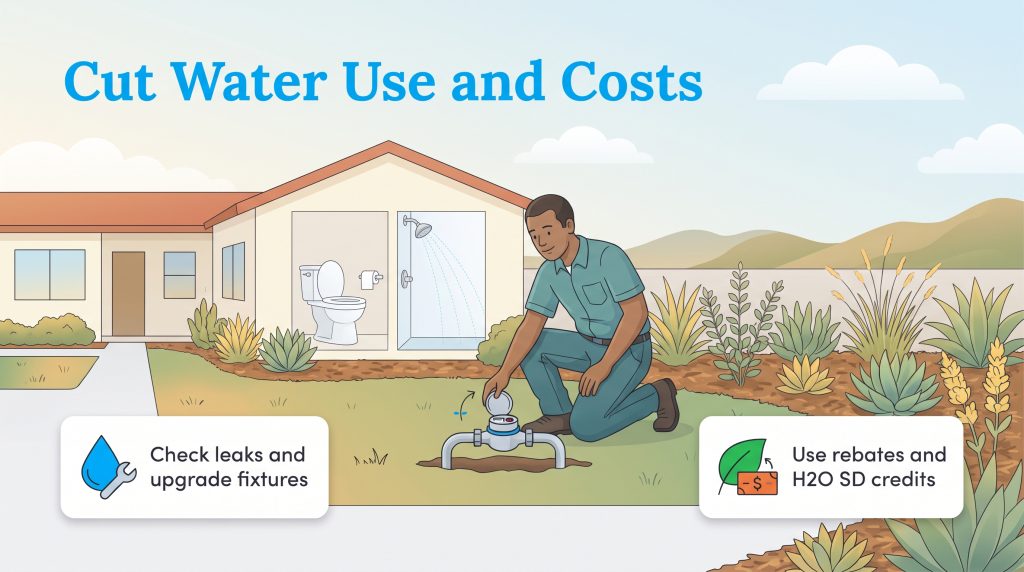
You cannot choose another municipal tap water provider, but you can control how many units of water flow through your meter. Applying targeted efficiency upgrades and tapping into municipal assistance can substantially offset rate increases.
- Check for Hidden Plumbing Leaks: Running toilets and underground irrigation leaks are the primary culprits behind sudden bill spikes. You can request a free residential water-use survey through the Public Utilities Department to pinpoint hidden waste.
- Upgrade to WaterSense Fixtures: Replacing older plumbing fixtures with high-efficiency toilets and low-flow showerheads can trim indoor water use by 20% or more. Look for regional rebates through the City of San Diego Water Conservation Office.
- Replace Thirsty Grass with Native Landscaping: Outdoor watering accounts for over 50% of typical single-family water consumption. The San Diego County Turf Replacement Program provides rebates of $2 to $4 per square foot when you replace turf with drought-tolerant California native plants.
- Collect Free Organic Mulch: San Diego residents can pick up up to two cubic yards of mulch for free at the Miramar Greenery. Spreading a three-inch layer over garden beds retains soil moisture and cuts your weekly irrigation schedule.
- Apply for H2O San Diego Assistance: If your household income qualifies you for SDG&E’s CARE program, you may be eligible for the city’s Help to Others (H2O SD) program, which provides bill credits of up to $100 annually to help low-income families maintain essential service.
Taking Charge of Your Household Water Budget
While rising utility costs present real challenges for San Diego households, understanding your billing tiers and monitoring your meter gives you the upper hand. Simple shifts — like updating faulty flappers, adjusting sprinkler timers to avoid midday sun, and applying for municipal landscape rebates — can wipe out the impact of the latest volumetric rate hike. We will continue tracking City Council utility reviews, wholesale water decisions, and customer relief programs so you have the verified facts you need to protect your home budget.
Frequently Asked Questions About San Diego Water Rates
Why did San Diego water and wastewater rates go up?
How much more will the average San Diego household pay each month?
Can I switch to a different water provider to avoid the rate increase?
What financial help is available if I cannot afford my water bill?
About the Author

Claudio is a sustainability-focused writer with a background in Anthropology and Psychology from NC State University. He has spent over 15 years working in writing, interpretation, and translation, driven by a deep interest in how human culture shapes the environment. Today, he shares his curiosity with readers by writing about sustainable living solutions and the connection between everyday choices and environmental impact.