
Understanding the differences in efficiency, cost, and appearance to make the right choice for your energy needs.
Key Takeaways
- Monocrystalline panels are the most efficient and space-saving option for residential roofs, though they typically come with a higher price tag.
- Polycrystalline panels offer a budget-friendly alternative, recognizable by their speckled blue hue, but they require more roof space to generate the same amount of power.
- Thin-film and solar shingles serve specific niches, offering flexibility for DIY projects or high-end aesthetic integration rather than standard rooftop installations.
Making the switch to renewable energy is an exciting milestone for any homeowner, but the highly technical jargon found on installation quotes can feel a bit overwhelming at first glance. While modern manufacturers offer hundreds of different specific models, there are really only three main categories of technology you need to grasp when exploring the types of solar panels available today. Because the average solar panel lifespan typically ranges from 25 to 30 years, knowing your foundational options is the key to ensuring your long-term financial investment truly pays off. The right choice for your specific property ultimately dictates your upfront installation costs, the long-term aesthetic appeal of your roof, and exactly how much money you will save on your monthly utility bills over the next few decades.
The 3 Main Types of Solar Panels
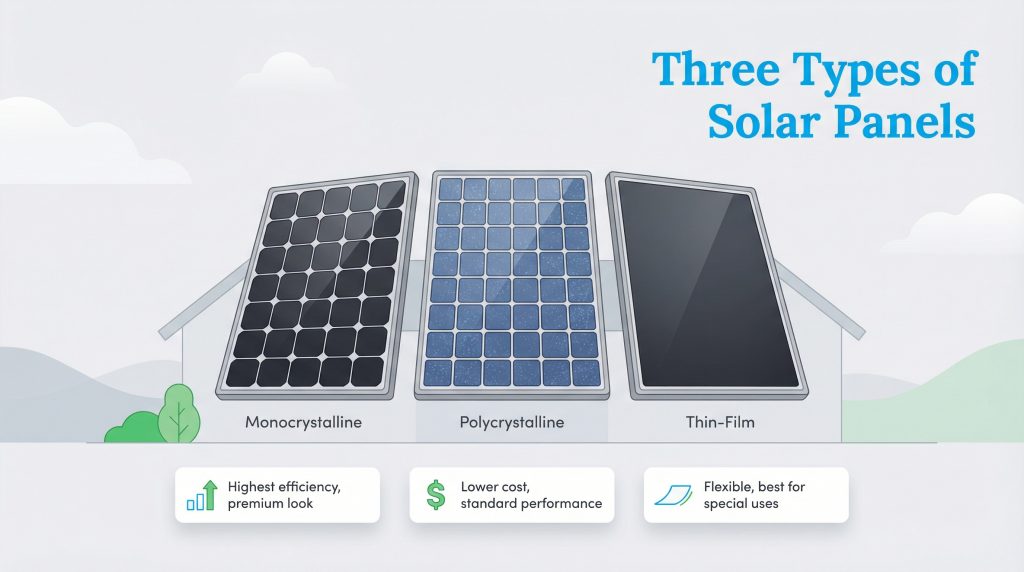
When you sit down to compare the main types of solar panels for homes, you are usually choosing between monocrystalline, polycrystalline, and thin-film modules. Most conventional solar panels on the market today rely heavily on silicon, a highly conductive natural element that converts incoming sunlight into usable electricity through the photovoltaic effect. Having these basic solar panel materials explained is essential because the primary performance difference between your options lies directly in the purity of that silicon and the specific way manufacturers process it in the factory. We will break down the solar technology you are most likely to encounter when shopping for a robust residential system.
Monocrystalline Solar Panels (Mono)
Monocrystalline panels are widely considered the premium gold standard for modern residential installations. Manufacturers construct these highly sought-after panels from a single, continuous crystal structure of pure silicon. The production method, known as the Czochralski process, involves pulling a solid cylindrical ingot from melted silicon. Because they use such high-purity material, the electrons have more room to move, making these modules incredibly efficient at generating raw power.
Today, high-efficiency monocrystalline panels frequently exceed 400 watts in power output per panel, making them incredibly potent. You can easily identify them by their distinct visual appearance. They feature a uniform, sleek black color that looks modern and discrete. If you look closely at the individual internal cells, you might notice distinctly cut corners, creating small white diamond shapes between the squares. This specific manufacturing process helps maximize the overall energy output.
When weighing the daily realities of monocrystalline panels, consider these specific trade-offs for your household:
- + Highest efficiency: They offer the absolute highest efficiency ratings on the market (typically 17% to 22% or higher) and boast the longest expected lifespan, easily exceeding 25 years with minimal degradation. Their dark, uniform aesthetic also blends exceptionally well with most modern roofing materials.
- – Higher upfront cost: The single-crystal manufacturing process is highly complex and time-consuming, resulting in a significantly higher initial purchase price. The precise cutting process also creates more wasted silicon offcuts than alternative manufacturing methods.
Polycrystalline Solar Panels (Poly)
Polycrystalline panels serve as the tried-and-true, budget-friendly older alternative. Instead of carefully cultivating a single crystal, manufacturers melt together many smaller fragments of raw silicon and pour them into square molds to form the necessary wafers. This specific production process is much faster and cheaper, making these panels a historically popular choice for ground mounts or installations where available physical space is not a limiting factor.
When comparing monocrystalline vs polycrystalline solar panels, the financial numbers are often the biggest deciding factor. Monocrystalline panels typically range from $1.00 to $1.50 per watt for the panels themselves, whereas polycrystalline modules offer an estimated cost of $0.70 to $1.00 per watt. Visually, these budget-friendly panels stand out immediately. They possess a speckled, fragmented blue color that closely resembles crushed granite or shattered glass. Unlike their monocrystalline counterparts, the individual cells are perfectly square with no empty gaps in the corners.
If you are carefully evaluating solar panel types based on their immediate value, here is how poly panels stack up:
- + Budget-friendly: They are noticeably cheaper to manufacture and purchase, making them a very solid entry point for budget-conscious projects. The melting process also utilizes almost all of the raw silicon, resulting in far less manufacturing waste.
- – Lower efficiency: They have lower baseline efficiency ratings, usually resting between 15% and 17%. You will absolutely need a larger dedicated roof area to generate the exact same power as a premium mono system. Additionally, the fragmented “bluish” tint can clash with certain modern roof colors.
Thin-Film Solar Panels
Thin-film panels represent the highly flexible, specialty sector of the modern solar market. Unlike the heavy, rigid silicon wafers utilized in mono and poly panels, thin-film technology involves actively depositing extremely thin layers of specialized photovoltaic substances onto adaptable backings like glass, durable plastic, or lightweight metal.
To fully understand this category, it helps to look at the three primary materials utilized in thin-film production: Cadmium Telluride (CdTe), Amorphous Silicon (a-Si), and Copper Indium Gallium Selenide (CIGS). CdTe is the most widely produced thin-film material and is heavily favored for massive utility-scale solar farms. Amorphous silicon uses non-crystalline silicon and is mostly found in small electronics like calculators. CIGS is the premium option in this tier, sandwiching copper, indium, gallium, and selenide between conductive layers to create a highly flexible, durable module.
You generally will not see thin-film solar panels on standard residential rooftops because they require a massive amount of surface area to be truly effective. However, they are excellent for unconventional applications like curved camper roofs, marine decks, or sprawling commercial warehouses where the existing roof structure simply cannot support the immense weight of standard silicon panels.
- + Highly adaptable: They are incredibly lightweight, highly flexible, and often perform marginally better in low-light or extreme-heat conditions than traditional panels. They are also generally cheaper to mass-produce in large rolling sheets.
- – Significant space requirements: They suffer from the lowest baseline efficiency of the three main types, typically hovering between 10% and 13%. They also tend to degrade much faster than standard silicon panels, meaning a significantly shorter functional lifespan, often lasting around 10 to 20 years depending on the exact material composite used.
Advanced Solar Cell Types and Technologies
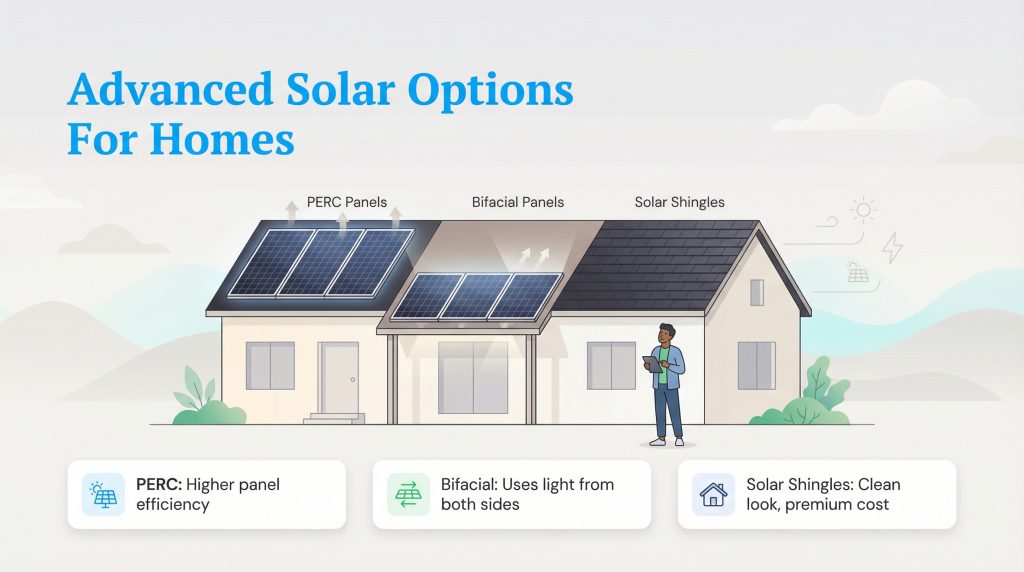
Renewable energy technology moves incredibly fast. Beyond the traditional “Big Three” categories, you might spot unfamiliar terminology on a solar quote that sounds highly technical or even a bit like science fiction. Understanding these varying solar cell types is critical because they dictate the ultimate efficiency and financial return of your setup. Here is exactly what those modern advancements actually mean for your home.
PERC Solar Panels
PERC officially stands for Passivated Emitter and Rear Cell. While it sounds overly complicated, it is quite simply a brilliant upgrade to standard monocrystalline cells. Manufacturers add a specialized reflective passivation layer to the immediate back of the silicon cell. This unique layer actively bounces any sunlight that initially passed all the way through the cell back up toward the surface, giving the panel a crucial “second chance” to absorb that light and convert it into usable electricity.
Furthermore, this rear layer helps prevent unwanted electron recombination, a natural process that otherwise limits power generation. If you see the acronym PERC proudly listed on an installer’s quote, it is an exceptionally good sign. It usually indicates you are receiving much higher efficiency ratings without suffering a massive, prohibitive jump in price.
Bifacial Solar Panels
Bifacial panels are intelligently designed to capture incoming sunlight on both the front and back sides of the module. The rear side catches ambient light actively reflecting off the ground, surrounding walls, or snowy surfaces — an effect known as the albedo effect. You will rarely see bifacial panels listed on standard quotes for traditional rooftop solar simply because the back of the panel is entirely covered and shadowed by your roof shingles in a flush-mounted array.
However, if you possess the acreage to build a dedicated ground-mounted system, a functional solar pergola, or a heavy-duty awning, bifacial panels can significantly boost your overall energy generation by capturing light that would otherwise be entirely wasted.
Solar Shingles and Building-Integrated PV
The ongoing debate involving standard panels versus solar shingles almost always comes down to residential curb appeal. Innovative products like the Tesla Solar Roof or GAF Timberline Solar integrate active photovoltaic cells directly into the durable roofing materials themselves. This category of technology is known as Building-Integrated Photovoltaics (BIPV). The end result is a virtually seamless, invisible solar array that doubles as your home’s primary weather barrier.
While they look absolutely fantastic from the street, be prepared for a steep premium price tag. Solar shingles are generally much less efficient per square foot than traditional raised panels, and they are notoriously more expensive and complex to install. They are heavily suited for design-conscious homeowners who desperately need a full roof replacement anyway and are prioritizing luxury aesthetics over a fast, pure return on investment.
Comparing Solar Panels: Efficiency, Cost, and Aesthetics
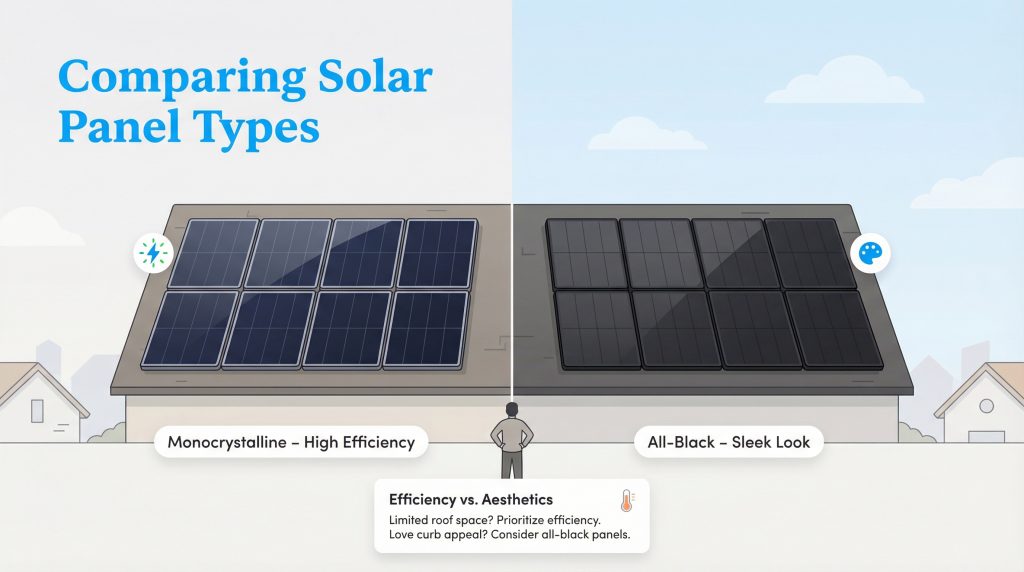
When investigating the cost of different solar panel types, having a clear point of reference makes decision-making significantly easier. Evaluating efficiency alongside average output provides a much clearer picture of what you will actually get for your hard-earned money. To help you quickly visualize the core differences, here is a comprehensive side-by-side look at the main residential options so you can effortlessly compare what matters most to your household budget:
| Panel Type | Efficiency Range | Average Wattage Output | Estimated Cost Per Watt | Appearance | Lifespan |
|---|---|---|---|---|---|
| Monocrystalline | 17% – 22%+ | 350W – 450W+ | $1.00 – $1.50 | Black, Uniform | 25+ Years |
| Polycrystalline | 15% – 17% | 250W – 350W | $0.70 – $1.00 | Blue, Speckled | 25 Years |
| Thin-Film | 10% – 13% | 100W – 250W | $0.50 – $1.00 | Flat, Black/Blue | 10 – 20 Years |
Note: The estimated cost per watt reflects the general hardware price of the panels themselves; your actual final installed quote will fluctuate significantly depending on the panel brand, your chosen installation company, local labor rates, and available state incentives in your immediate area.
Which Panels Are the Most Efficient?
Efficiency simply measures exactly how much incoming sunlight a distinct panel can successfully convert into usable electricity for your home. If you have heavily limited roof space or complex architectural shading, efficiency is without question the most critical metric you must review. The best solar panels for home use almost always fall into the high-efficiency monocrystalline category because they aggressively maximize the power potential of a relatively small area.
For more deep technical details on exactly how complex photovoltaic technology works on a microscopic level, resources like the Department of Energy provide absolutely excellent, highly authoritative overviews of the fascinating science operating behind the cells.
The Rise of All-Black Solar Panels
As you shop around, you may see installation quotes specifically highlighting “all-black” or “triple black” panels. This is largely a conscious aesthetic choice driven by homeowner demand. Manufacturers intentionally use a dark black backsheet and an anodized black aluminum frame instead of the traditional bright white backsheet and glaring silver frame. This thoughtful design choice makes the entire panel blend much more seamlessly into darker asphalt shingles.
Be closely aware that all-black solar panels can run slightly hotter than those equipped with standard white backsheets. Because black backsheets naturally absorb more ambient heat from the sun, these panels can elevate in temperature, which may reduce power output marginally in extremely hot conditions. However, for most everyday homeowners, this minor drop in performance is incredibly small compared to the immense visual benefit of a sleek, uniform roofline.
Understanding Performance Metrics (Wattage & Temperature Coefficient)
To truly determine the most efficient type of solar panel for your unique property, you need to look far beyond the basic marketing terminology and dive directly into the manufacturer’s specification sheet. Two of the absolute most important numbers on any professional solar quote are the raw wattage rating and the specific temperature coefficient. Understanding these critical metrics will empower you to compare competing quotes with total confidence.
Wattage output tells you precisely how much electricity a single panel can generate under Standard Test Conditions (STC) — an industry-wide benchmark simulating ideal laboratory lighting and temperature. Most modern residential panels easily generate between 300 and 400 watts, but premium, high-tier models easily push past the impressive 400-watt mark. When you carefully read a manufacturer’s quote, the total system size — usually measured in kilowatts (kW) — is quite simply the wattage of one panel multiplied by the total number of panels resting on your roof.
However, lab conditions are not the real world. You also need to heavily understand how extreme summer heat negatively affects solar efficiency. This unavoidable reality brings us to temperature coefficient solar panels. The temperature coefficient mathematically measures exactly how much a panel’s total power output drops for every single degree Celsius the temperature rises above a baseline of 25 degrees Celsius (77 degrees Fahrenheit). Ironically, solar panels actually prefer bright, fiercely cold days to operate at peak capacity. When your roof heavily bakes in the aggressive summer sun, internal electron flow becomes increasingly sluggish, and your overall energy production visibly dips.
Here is exactly how the two main residential silicon options typically compare when subjected to high heat:
- Monocrystalline panels generally handle extreme heat better. Their average temperature coefficient typically hovers securely around -0.3% to -0.4% per degree Celsius, meaning they lose significantly less power on scorching, humid summer afternoons.
- Polycrystalline panels feature a slightly lower heat tolerance. Their expected coefficient is often rated between -0.4% and -0.5% per degree Celsius, which can noticeably impact your reliable energy generation during peak summer months, especially if you reside in a notoriously hot southern climate.
How to Choose the Right Solar Panel for Your Home
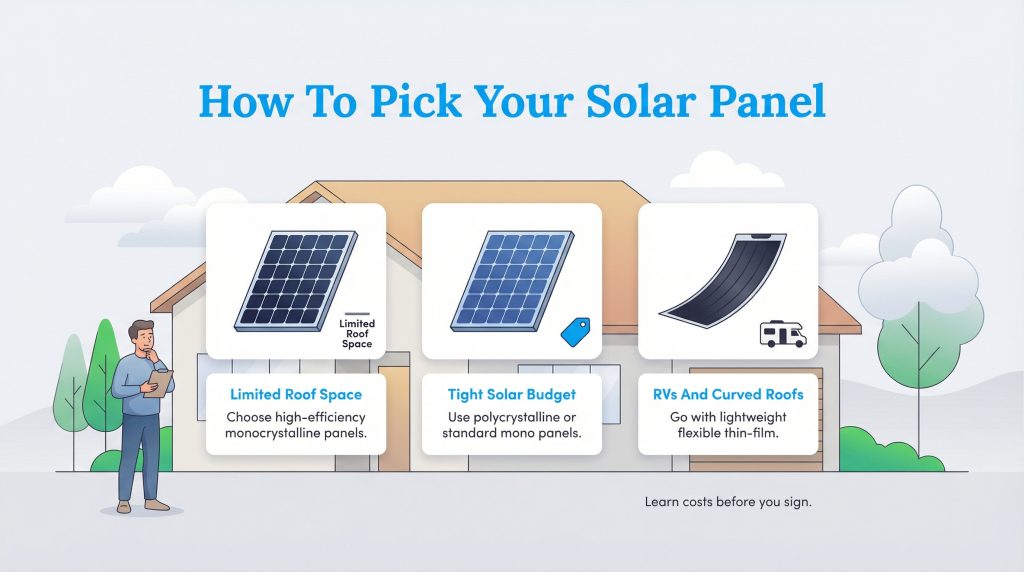
Choosing the absolute right hardware for your property is entirely about strategically matching the available technology to your household’s specific constraints. Every single home is structurally different, and what works perfectly for your neighbor might not be the smartest financial play for your roof. Here are a few common scenarios to properly help you decide the best path forward.
Best Solar Panels for Home Use
If you have a moderately small roof or must contend with lots of permanent architectural obstructions like brick chimneys, skylights, and exhaust vents, you desperately need to generate as much raw power as physically possible per square foot. High-efficiency monocrystalline panels are universally your best bet here. Their incredibly high efficiency ensures you can successfully offset a massive portion of your monthly utility bill, even when working within a highly compact array layout.
Best for Tight Budgets
If you have an abundance of wide-open roof space and want to aggressively keep your upfront installation costs down, definitely ask your chosen installer about quoting polycrystalline panels. While they are slowly becoming somewhat less common in modern high-end residential markets, they can still reliably provide a very solid, steady return on investment over their lifespan. Alternatively, standard (non-premium) monocrystalline panels are now becoming very competitively priced due to streamlined manufacturing and often compete directly against these lower-cost solar panels.
Best for DIY and RVs
If you are actively outfitting a mobile camper van, a marine boat, or a detached shed featuring an uncooperative curved roof, thin-film panels are undoubtedly the clear winner. Their profound flexibility and extremely lightweight nature make them exceptionally easy to install on non-standard surfaces where securing heavy glass and metal panels would be downright dangerous or structurally impossible to safely mount.
However, while they are incredibly versatile, you must account for thin film solar panel efficiency tradeoffs when used in mobile, low-light environments. Because they generally hover securely around 10% to 13% efficiency, you will undeniably need a massive amount of unshaded surface area to reliably run power-hungry appliances inside an RV. Furthermore, while they perform relatively decently in heavily overcast campsites, their overall low wattage output means they are almost never a viable primary power source for conventional homes.
It is profoundly helpful to deeply understand the financial side of renewable energy before ever signing a binding contract. You can effortlessly learn more about current pricing trends in our dedicated guide on how much solar panels cost.
Sizing Your Roof for Renewable Energy
Before you enthusiastically start requesting extensive quotes from eager local installers, take immediate action to assess your available roof space. Walk outside and carefully look for large, unshaded rectangular areas that face directly south, southwest, or west, as these specific orientations easily capture the most direct, intense sunlight throughout the day. Mentally subtract any cluttered space taken up by thick tree shade, chimneys, and plumbing vents, as these will severely dictate your usable square footage.
Understand the direct, mathematical relationship between panel efficiency and physical footprint. If you have a severely compact roof, you absolutely must invest in high-efficiency panels to aggressively maximize that limited space. Conversely, if you have a sprawling, unobstructed roof design, you can easily achieve the exact same total system size using physically larger, slightly less efficient panels, completely saving money on your initial investment.
Finally, sit down and evaluate your past 12 months of utility bills to accurately determine your required system size. Look specifically at your total annual kilowatt-hour (kWh) consumption rather than just staring at your fluctuating monthly dollar cost. By knowing exactly how much raw electricity your household actively consumes over a full year, you can easily command your solar project discussions and ensure you purchase a system perfectly sized for your actual needs, without paying for excess capacity you will never use.
Finding the Perfect Solar Match for Your Home
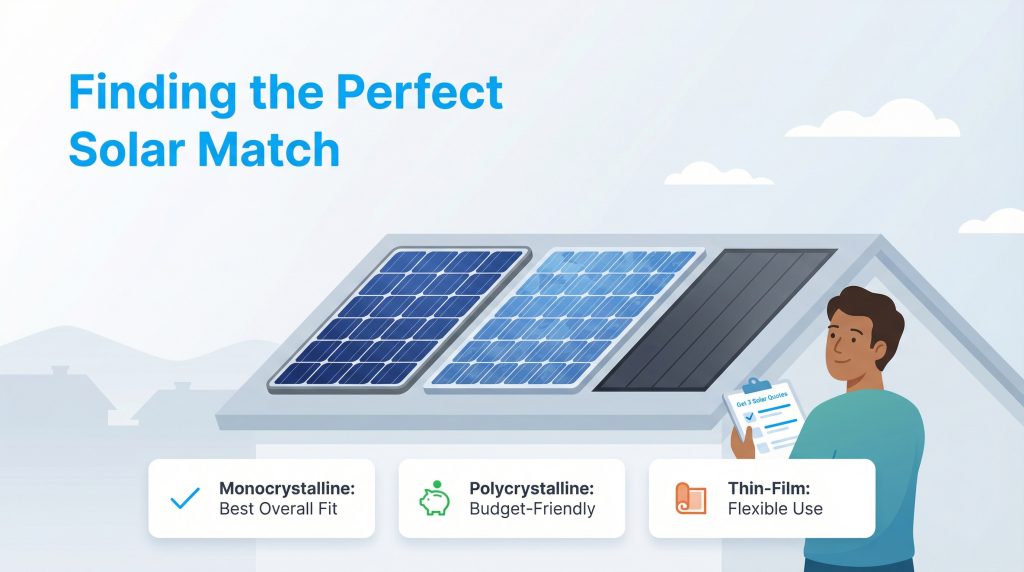
For most modern residential homeowners, high-efficiency monocrystalline panels represent the absolute “sweet spot” in the market due to rapidly falling manufacturing prices and vastly superior performance metrics. They effortlessly offer the best possible balance of sleek aesthetics, immense power output, and structural longevity. However, if you are strictly working with a very tight budget and possess ample roof space, or if you desperately need a highly flexible solution for a mobile recreational project, polycrystalline and thin-film technologies remain incredibly valid and effective choices. The smartest approach is to actively request at least three different estimates and ask your representatives specifically which panel type is actively included in each proposal. This high level of transparency ensures you know exactly what hardware is going onto your roof. No matter which panel type you ultimately select, you are successfully shifting more of your home’s energy use toward a cleaner, much more environmentally mindful choice.
FAQs About Types of Solar Panels
What is the most efficient type of solar panel?
Can I mix different types of solar panels on my roof?
Do solar panels work on cloudy days?
Are solar shingles better than regular panels?
How do I know which type of panel I am buying?
What are solar panels made out of?
What type of solar panel is best for a DIY project?
How long is the average solar panel lifespan?
About the Author

David has been an integral part of some of the biggest utility sites on the internet, including InMyArea.com, HighSpeedInternet.com, BroadbandNow.com, and U.S. News. He brings over 15 years of experience writing about, compiling and analyzing utility data.