
Understanding how your utility company credits you for excess solar energy, and why that might be changing.
Key Takeaways
- Net metering allows homeowners to send excess solar energy back to the grid in exchange for bill credits they can use later.
- Many states are switching to “net billing” or NEM 3.0, which often reduces the monetary value of exported electricity compared to retail rates.
- Virtual net metering offers a way for renters or those with shaded roofs to benefit from solar credits without installing panels on their own property.
Opening your first utility bill after installing solar panels can feel a bit like reading a foreign language, but understanding net metering is the single most important key to unlocking your long-term savings. Simply put, net metering is the billing mechanism that credits solar energy system owners for the excess electricity they add to the municipal grid. While your shiny new panels generate the power on your roof, the actual financial magic happens at your utility meter. The grid acts as a massive battery for your home, storing monetary value when the sun is shining brightly and releasing it when you turn the lights on at night. We are here to demystify exactly how this accounting system works, break down the recent changes in billing policies, and help you determine if installing a residential solar system is still a smart financial move for your household.
What Is Net Metering?
Most residential solar systems generate significantly more electricity than a home consumes during peak daylight hours. Without a battery to store it, that energy has to go somewhere. Instead of letting that valuable power go to waste, it flows automatically into the electric grid for your neighbors to use. Net energy metering (NEM) ensures you receive fair financial compensation for this clean energy contribution.
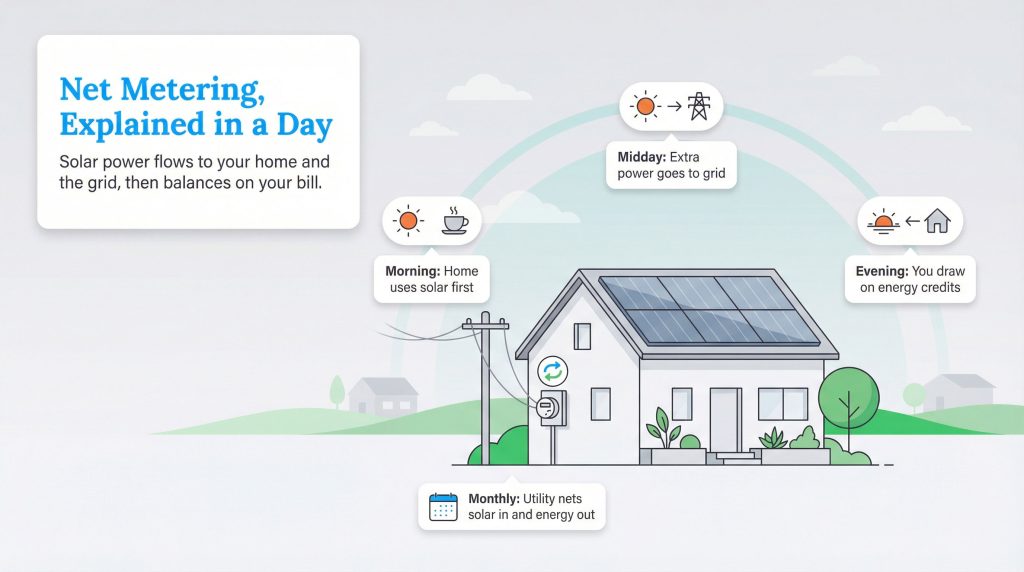
Think of this system like the rollover minutes on an early 2000s cell phone plan. If you produce a surplus of solar energy today, the utility company logs a solar credit rollover on your personal account. You can then spend those accrued credits later in the day when the sun goes down, or even bank them for several months to use during the winter when your solar production naturally drops. It ensures you capture the maximum financial value for every kilowatt-hour (kWh) your solar panels generate.
How Does Net Metering Work?
To fully understand how does net metering work in practice, you must look at the continuous daily flow of energy in a solar-powered home. The entire process relies on a bidirectional meter — a special utility device that can spin forward when you buy power and backward when you supply power.
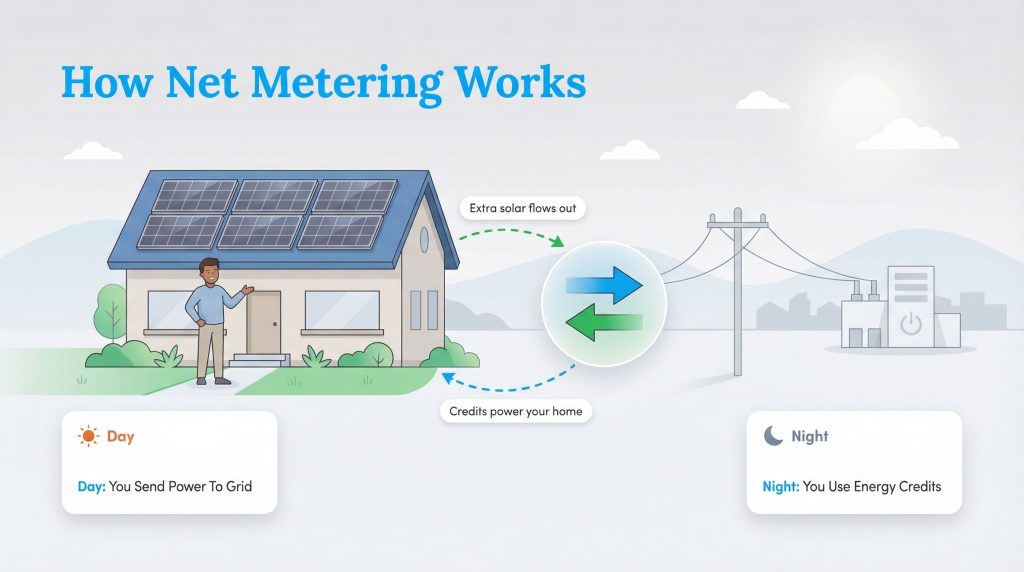
Here is the standard daily cycle for a home connected to the electrical grid:
- Solar Generation: As the sun rises, your rooftop panels start capturing sunlight and converting it into usable electricity. If your home currently needs power to run your morning coffee maker or air conditioning unit, your house automatically consumes this free solar energy first.
- Grid Export: Around midday, your solar system likely produces far more energy than your home can realistically use. This excess electricity flows backward through your bidirectional meter and directly onto the municipal grid. Your utility meter records this outflow, banking proportional credits onto your energy account.
- Utility Crediting: When the sun sets and your solar panels power down for the evening, your home seamlessly switches back to pulling electricity from the local grid. Instead of paying out of pocket for this nighttime usage, you pay using the exact credits you banked earlier in the day. At the end of your billing cycle, the utility calculates the net difference between the energy you produced and the energy you consumed.
Retail Rate vs. Wholesale Rate: Understanding Solar Buyback Rates
The financial return of your solar system depends heavily on exactly how your utility company values the electricity you send them. This specific valuation is known as your solar buyback rates, and they typically fall into one of two major categories: retail or wholesale.
The core difference between the retail rate vs wholesale rate is straightforward but deeply impactful on your wallet. The retail rate is the full, comprehensive price you pay the utility for the electricity you consume from the grid. This premium price includes the baseline cost of generating the power, the cost of maintaining vast transmission lines, and the fees for delivering it directly to your door. Conversely, the wholesale rate — frequently called the avoided cost rate — is the significantly lower price the utility pays to buy bulk power from massive power plants. It reflects only the raw, baseline cost of energy, completely stripping out delivery and grid maintenance fees.
To see how these rates change your monthly bill, imagine your solar panels produce 10 kWh of excess energy on a sunny Tuesday afternoon:
- Under Retail Rate Crediting: If your local utility charges you 15 cents per kWh, they credit you the full 15 cents for every kWh you export. Sending 10 kWh to the grid earns you a $1.50 credit. You can then use this to offset exactly $1.50 worth of energy you buy back from the grid later that night. It is a perfect, even trade.
- Under Wholesale Rate Crediting: If the utility’s wholesale rate is only 5 cents per kWh, your 10 kWh of excess energy earns you a meager 50-cent credit. When you inevitably buy 10 kWh back from the grid that evening at the standard 15-cent retail price, it costs you $1.50. You end up owing the utility $1.00 out of pocket for the exact same amount of energy you produced earlier in the day.
Net Metering vs. Net Billing: The Policy Shift
For more than a decade, the gold standard for renewable incentives was traditional 1-to-1 net metering. However, as residential solar becomes exponentially more popular, utility companies argue that paying the full retail rate forces non-solar customers to subsidize the cost of grid maintenance. As a result, states and utility commissions across the country are rapidly shifting toward a new framework known as net billing.
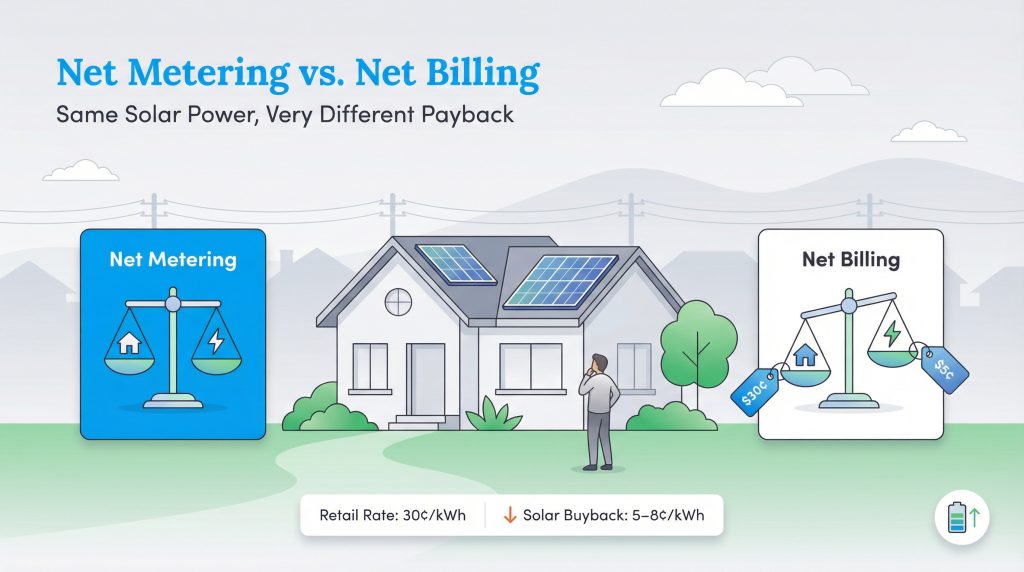
Understanding net billing vs net metering is essential because it fundamentally restructures your system’s financial return. Under a net billing paradigm, you continue to buy electricity at the high retail rate, but you are forced to sell your excess solar back to the grid at the much lower wholesale rate. This lower compensation model drastically reduces your potential savings if you export large amounts of power during the middle of the day.
Here is a detailed breakdown of how these two dominant structures compare:
| Feature | Traditional Net Metering | Modern Net Billing |
|---|---|---|
| Payout Rates | 1-to-1 Retail Rate (High value) | Wholesale / Avoided Cost Rate (Low value) |
| Credit Rollover | Rolls over indefinitely or settles annually | Credits may expire monthly or settle at fractions of a cent |
| Overall ROI | Shorter payback period (5 — 7 years) | Longer payback period (8 — 12 years without a battery) |
| System Strategy | Oversize solar panels to bank maximum credits | Right-size panels and strongly prioritize battery storage |
If you are actively researching specific solar policies for your state, the NC Clean Energy Technology Center (DSIRE) maintains an excellent, free database of state incentives that is updated regularly. Confirming which exact structure your utility provider uses is the vital first step in designing an economically efficient solar array.
The Impact of NEM 3.0 and Time-of-Use (TOU) Rates
When discussing the aggressive transition to net billing, the most dramatic and widely discussed example is NEM 3.0 California. Implemented by the state’s Public Utilities Commission, this controversial policy drastically reduced the financial value of exported solar energy by roughly 75% compared to the state’s previous iteration. While this was technically a California-specific ruling, industry experts view it as a massive bellwether for the rest of the United States. Utility providers in other states are closely monitoring this exact shift and actively proposing similar rate restructurings to their own local governments.

A central component of NEM 3.0 and similar modern net billing policies is the mandatory integration of time-of-use (TOU) rates. Under a TOU pricing plan, the cost of electricity is not fixed; instead, it fluctuates based on the specific time of day and the overall stress on the regional grid. Power is incredibly cheap during the middle of the day when massive solar farms are churning out abundant energy. However, prices skyrocket during peak evening hours — usually between 4:00 p.m. and 9:00 p.m. — when people return home from work, crank up their air conditioners, and the sun inevitably sets.
This dynamic creates a massive financial challenge for solar owners without batteries. Your rooftop panels naturally export the most power at noon when electricity is at its cheapest, meaning you earn very few credits for it. Then, you are forced to buy power back from the grid at night when rates are at their absolute highest peak. To maximize your savings under these new rules, you must actively shift your home’s energy consumption. You should aim to run your dishwasher, pool pump, and electric dryer during the peak daylight hours to consume your own solar power directly, entirely preventing it from leaving your home for a low-value export credit.
Do You Need Solar Battery Storage for Net Metering?
With utility companies continually tightening their buyback rules and shifting peak hours, adding solar battery storage to your home has transitioned from a high-tech luxury upgrade to a near necessity in many competitive energy markets. A home battery allows you to capture your excess midday solar energy and store it physically inside your garage or utility room.
When the sun goes down and evening TOU rates suddenly spike, your house automatically pulls electricity from your battery instead of buying outrageously expensive grid power. By keeping your energy on-site, you completely insulate yourself from the utility company’s low wholesale export rates.
If you are deciding whether the upfront cost of physical storage is worth the investment, consider this straightforward pros-and-cons evaluation:
- The Pros: Protects you from low wholesale export rates, provides reliable and seamless backup power during neighborhood grid outages, and allows you to avoid peak evening TOU pricing entirely. It maximizes your independence from the utility provider.
- The Cons: Adds a significant upfront cost to your total solar installation (often increasing the price by $10,000 or more) and lithium-ion batteries eventually degrade, typically requiring a replacement after 10 to 15 years of heavy cycling.
If you currently live in a state that still generously offers traditional 1-to-1 net metering, the municipal electric grid acts as a perfectly efficient, free battery. In those specific areas, purchasing physical storage might not make immediate financial sense. However, if your utility has shifted to net billing or wholesale crediting, investing in solar battery storage is highly recommended. Properly sizing a battery system alongside your panels is one of the absolute best ways to save on your electric bill over the long term.
Important Terms on Your Solar Bill
As you actively track your return on investment, your solar bills will look quite different from standard electric statements. Understanding these specific industry terms will help you guarantee you are receiving the accurate financial credits you deserve each month:
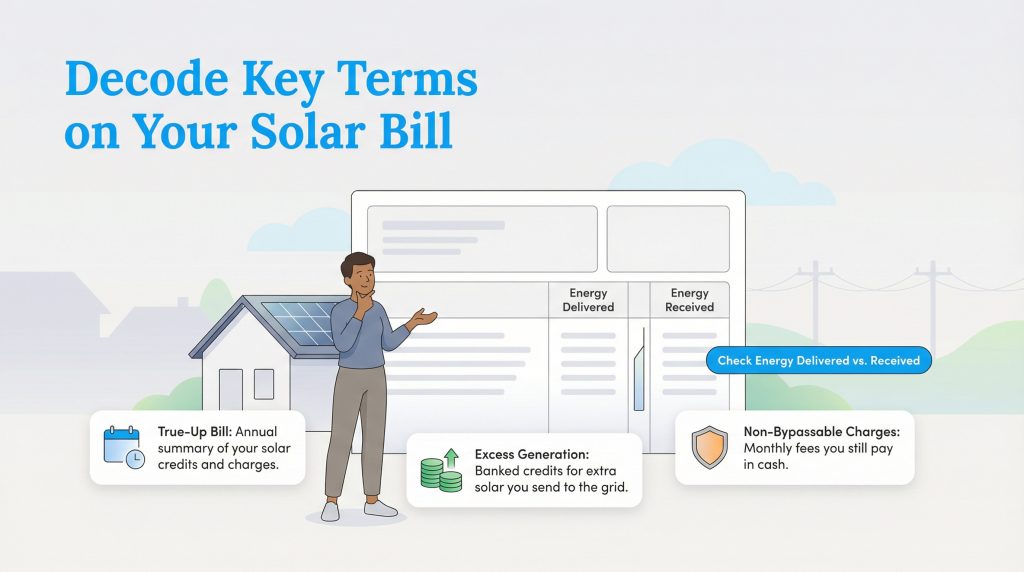
- True-Up Bill: This is a massive annual statement that cleanly reconciles your accrued credits and daily charges over a rolling 12-month period. If you carry a negative balance, some utilities will “cash you out” at a lower wholesale rate and reset your account to zero for the next year.
- Excess Generation Credit: This is the cumulative, ongoing bank of energy you have safely sent to the grid that has not been used yet. Depending on your provider’s specific bill layout, this frequently appears as a negative number or a separate “banked” line item.
- Non-Bypassable Charges (NBCs): Extremely common in states with progressive solar policies, these are mandatory cash fees for vital grid maintenance, public purpose programs, and emergency wildfire funds. You generally cannot pay these NBCs using your banked solar credits; they must be paid in cash monthly.
Virtual Net Metering for Renters and HOAs
If you rent an apartment, live in a strict homeowners association (HOA), or happen to have a roof completely shaded by historic oak trees, you might assume you cannot participate in the clean energy economy. Fortunately, you can still reap the financial benefits of solar through an innovative policy called virtual net metering.
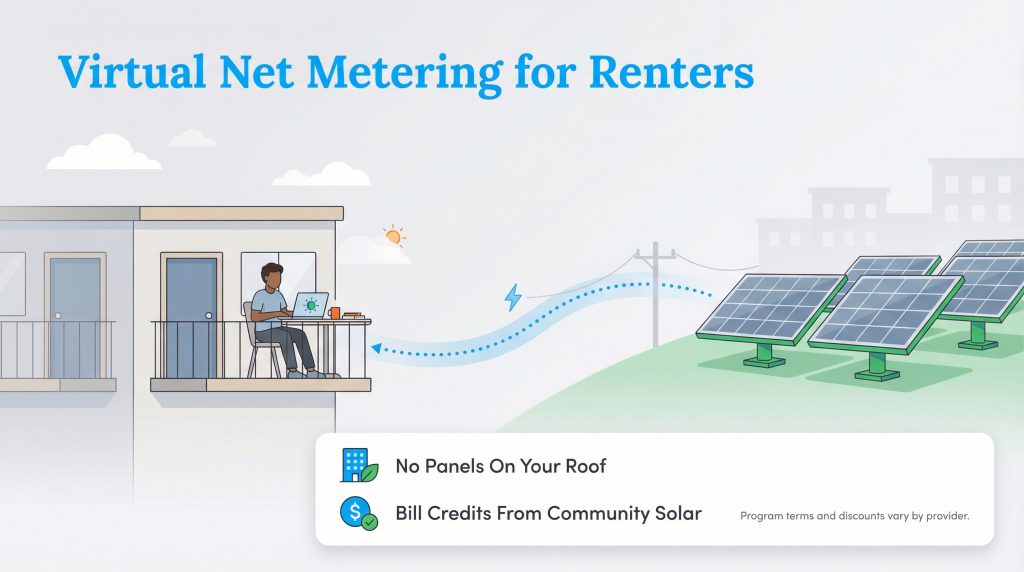
Virtual net metering allows you to subscribe to a large “Community Solar” farm located off-site. The electricity produced by your designated share of the solar farm is fed directly into the broader grid. The utility company then tracks this generation and applies the corresponding financial credits directly to your personal residential electric bill — exactly as if the panels were spinning the meter on your own property. It is a fantastic, environmentally mindful choice that expands renewable access to millions of families who were previously locked out of the traditional rooftop market.
This approach requires absolutely no physical installation on your residence and zero upfront equipment costs. It also offers incredible flexibility, usually allowing you to seamlessly transfer or cancel your subscription if you move to a different apartment within the same utility territory. Keep in mind that some community solar programs offer a guaranteed percentage discount on your supply charges rather than a strict 1-to-1 retail credit, so it is crucial to read the specific contract terms carefully before signing up.
Maximizing Your Solar ROI in 2026
While the highly lucrative era of widespread 1-to-1 net metering is gradually fading in some regions, generating your own localized power remains one of the most effective ways to achieve true energy independence. The economics of solar ownership have simply shifted from simple export schemes to intelligent self-consumption strategies. By prioritizing smart energy management and exploring solar energy solutions tailored to your lifestyle, you can continue to see strong financial returns regardless of changing utility policies.
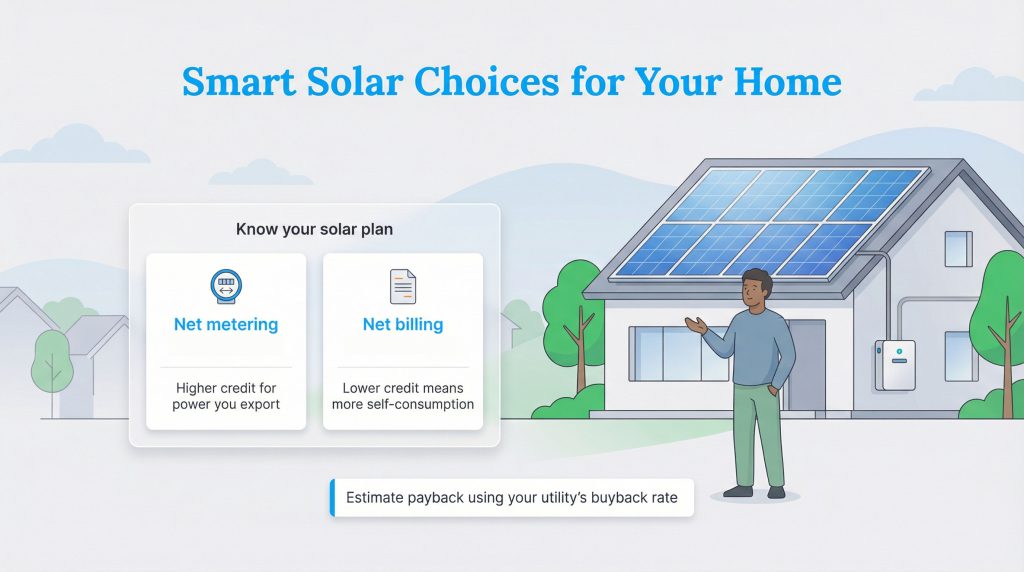
To make the smartest choice for your home, always start by checking your local utility provider’s policy to verify if you are on a traditional net metering or a modern net billing plan. Once you understand exactly how your utility company values your excess solar power, you can confidently right-size your panel system, add battery storage if necessary, and ensure you are making an eco-conscious alternative that perfectly fits your long-term household budget.
Frequently Asked Questions About Net Metering
Is net metering going away?
Do solar credits rollover from month to month?
Can I get a cash refund for my excess solar energy?
What happens to my solar credits if I move?
Can I go off-grid with net metering?
How does a solar battery change net metering?
About the Author

LaLeesha has a Masters degree in English and enjoys writing whenever she has the chance. She is passionate about gardening, reducing her carbon footprint, and protecting the environment.