
How solar panels turn sunlight into reliable power and long-term savings for your home.
Key Takeaways
- Solar cells capture sunlight and turn it into direct current (DC) electricity inside your panels.
- An inverter converts DC to AC so your home can safely use that solar power for everyday appliances.
- Net metering lets you trade excess power with the grid, earning credits when you overproduce and drawing power when the sun isn’t shining.
Solar panels can feel a bit like modern magic — the sun hits your roof, and suddenly the lights in your kitchen turn on. While the result feels instantaneous, the science behind it is actually a straightforward series of chemical and electrical steps. You don’t need an advanced physics degree to understand how do solar panels work, but knowing the underlying basics helps you make much smarter decisions when investing in renewable energy. Our goal here is to demystify the incredible journey of a photon from the sun all the way to your wall socket, empowering you to confidently explore the best solar options for your household.
The Short Answer: How Solar Energy Works
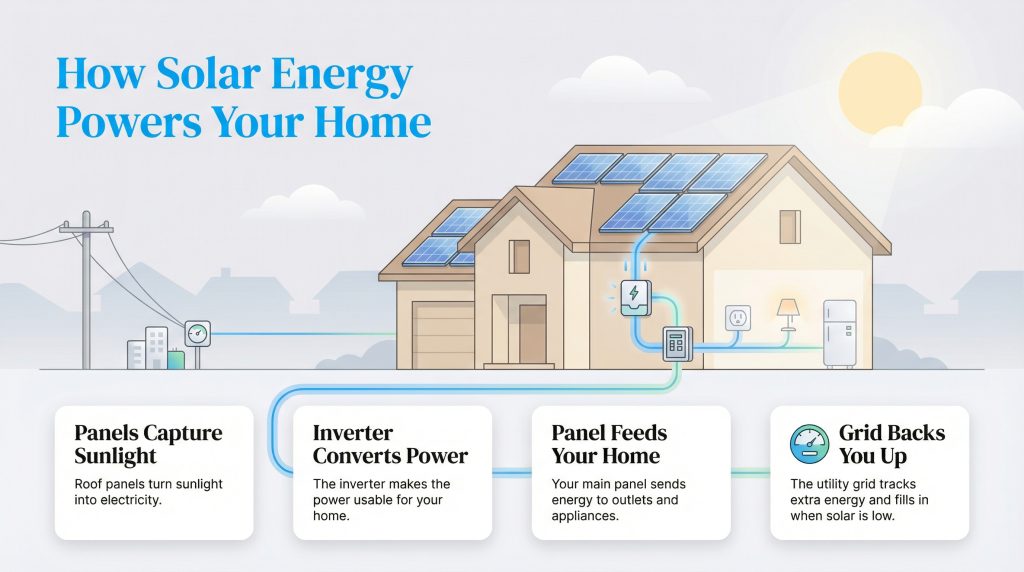
If you are looking for the quick version, the entire residential solar process boils down to a reliable, four-step chain reaction. First, the modules mounted on your roof absorb natural sunlight and turn it into raw electricity in the form of Direct Current (DC). Next, a critical piece of hardware called an inverter translates that raw energy into Alternating Current (AC), which is the standard form of power your home uses. From there, your main electrical breaker panel distributes the AC power to your individual outlets and appliances. Finally, the local utility grid acts as a financial backup system, tracking the extra energy you send out so you can receive bill credits to use when your system isn’t actively producing power.
| Component | What It Does | What You Notice | Average Lifespan |
|---|---|---|---|
| Solar Panels (PV Modules) | Capture sunlight and create DC electricity. | Panels on your roof facing the sun. | 25 to 30 years |
| Inverter | Converts DC power to AC power for your home. | Usually a box on the side of your house or microinverters under panels. | 10 to 15 years |
| Electrical Panel | Distributes solar power through your home circuits. | Your lights and appliances run like normal. | 20 to 30 years |
| Utility Meter & Grid | Tracks how much power you send to and take from the grid. | Lower electric bills and possible credits when you export power. | 15 to 20 years |
The Anatomy of a Solar Panel: What Are They Made Of?
Before diving into the actual electricity generation process, it helps to understand the physical hardware sitting on your roof. When homeowners ask, “What are solar panels made of?” they are usually surprised to learn about the highly durable, multilayered construction required to protect the sensitive internal technology. A standard solar module is essentially a technological sandwich designed to withstand decades of harsh weather while capturing maximum light.
- Silicon solar cells: The beating heart of the panel. These specially treated semiconductor wafers are the active components responsible for capturing sunlight and converting it into raw power.
- Protective encapsulants: Surrounding the delicate silicon cells is a tough layer of polymer resin, typically made of ethylene-vinyl acetate (EVA). This encapsulant seals out moisture, prevents internal corrosion, and holds the fragile cells firmly in place.
- Anti-reflective glass casing: The front face of the module is covered by heavy-duty tempered glass. It protects against hail and falling debris while featuring an anti-reflective coating to ensure maximum sunlight penetrates straight through to the cells.
- Metal frames: Binding the entire assembly together is an anodized aluminum frame. This lightweight but rigid structure prevents the panel from bending in high winds and allows it to be securely mounted to your roof’s racking system.
This robust construction guarantees long-term physical reliability while maintaining optimal energy production over the entire 25-plus year lifespan of your system.
The Photovoltaic Effect Explained
To truly grasp the science of renewable energy, you need a basic understanding of the physics at play. Having the Photovoltaic effect explained essentially comes down to the subatomic interaction between raw sunlight and manufactured semiconductor materials. When sunlight travels millions of miles through space and finally strikes the silicon wafers inside a panel, it delivers tiny packets of pure energy known as photons. These photons crash directly into the silicon atoms, transferring their energy and physically knocking electrons loose from their standard atomic orbits.
Because the silicon cells are manufactured with an intentional electrical imbalance — featuring a positively charged layer and a negatively charged layer — these newly freed electrons are forced to travel in a singular direction toward conductive metal plates. If you want a helpful way to visualize this electrical current, imagine the flow of electrons like water flowing through a household pipe. The sunlight acts as the water pump, applying the pressure (voltage) needed to push the water (electrons) through the plumbing (wires) of your home. The stronger the sunlight, the more water is pumped through the system, creating a steady stream of usable power without utilizing any moving parts or generating any emissions.
Step 1: Solar Panels Capture Sunlight
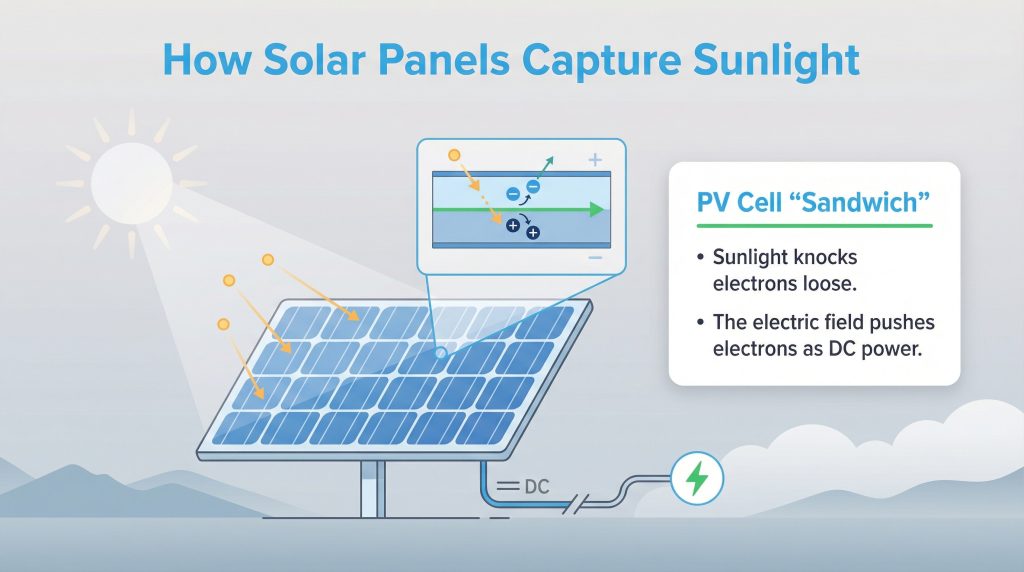
If you have ever wondered exactly how do solar panels generate electricity, the functional journey begins the moment morning light hits your roof. As the photovoltaic (PV) cells absorb the sun’s rays and knock those electrons loose, they are instantly collected by thin metal wiring embedded within the panel. This active generation is the cornerstone of your entire system.
The electricity created during this first stage flows as Direct Current (DC). While DC power is incredibly efficient and commonly used for small, battery-operated electronics like flashlights or mobile phones, it isn’t quite ready to power your home’s heavy-duty refrigerator or central air conditioning unit just yet. It requires an essential intermediary step to become functional for daily residential use.
Step 2: The Solar Inverter Converts DC to AC
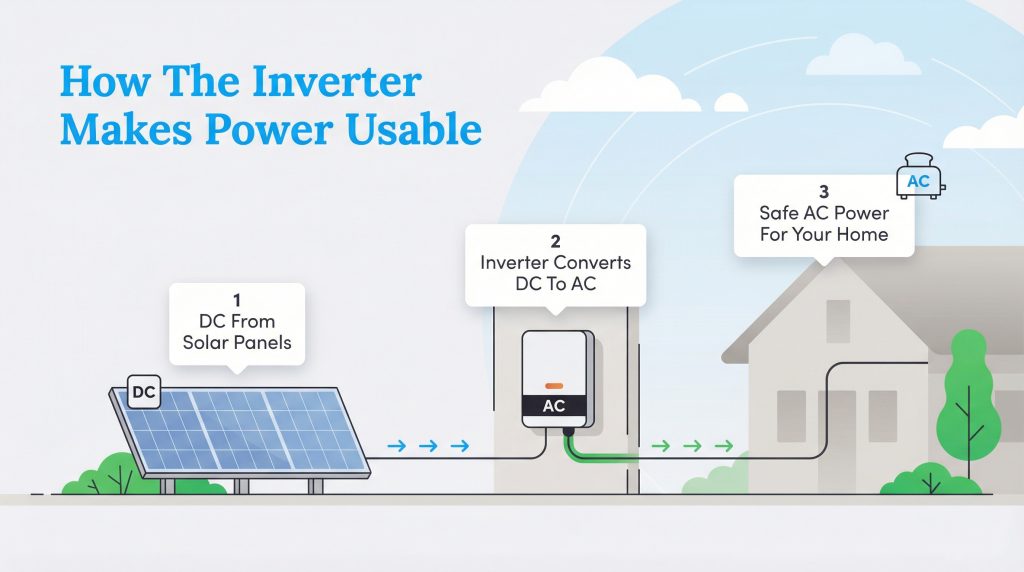
This is arguably the most critical technical stage that many consumers overlook. While your panels are busy creating DC electricity, nearly all modern American homes and household appliances run on Alternating Current (AC) electricity. If you tried to plug your television directly into a solar panel, it simply wouldn’t turn on. You need a technological translator to bridge that gap, which leads us to understanding how do solar inverters work.
The solar inverter takes the incoming DC electricity and rapidly oscillates it to create safe, usable AC electricity. Depending on your installer’s recommendation, this crucial conversion will happen through one of two primary mechanical setups:
- String Inverters: This system uses a single, centralized box often installed on the side of your house or in your garage. All the panels are connected to it in a “string.” It is highly cost-effective and works exceptionally well for roofs that receive uninterrupted sunlight with zero shading issues.
- Microinverters: In this setup, miniature inverters are attached to the back of each individual solar panel. They allow every panel to convert DC to AC independently. If one panel happens to be shaded by a passing cloud or a nearby tree branch, the rest of your array continues producing at maximum capacity.
Step 3: Your Electrical Panel Distributes the Power
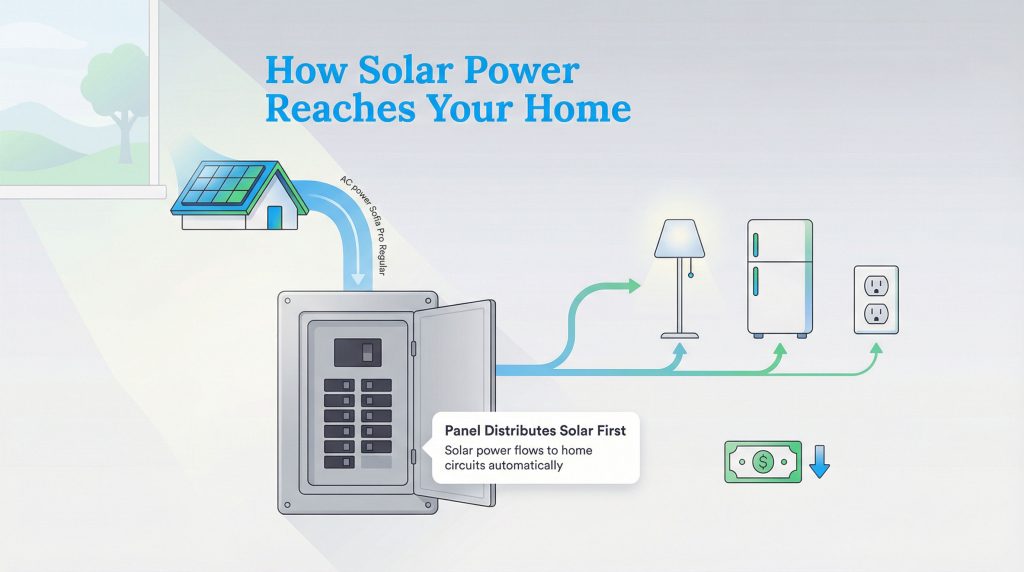
Once the electricity has been safely converted to AC, it moves straight from the inverter into your home’s main electrical panel, commonly known as the breaker box. This is the exact same hub that regulates the electricity coming from your utility company. From this central distribution point, the newly generated solar power is routed through the walls to the various active circuits in your house.
When your solar system is actively producing energy during the day, your home will intelligently and automatically prioritize using that free solar power first. It flows directly to your lights, appliances, and smart devices just like standard utility power. The transition between grid power and solar power is entirely seamless — you won’t ever notice a flicker of the lights or a dip in performance.
Step 4: The Grid, Net Metering, and Battery Storage
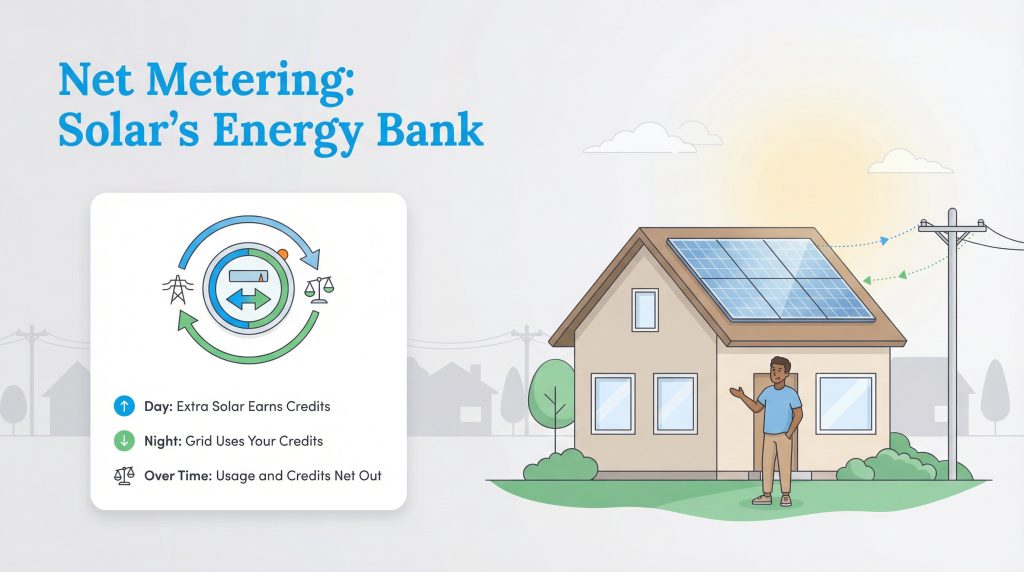
Most residential solar setups are designed to remain “grid-tied,” meaning your home stays connected to your local utility company. This physical connection is vital because your personal energy production naturally varies depending on the time of day. This brings us to an incredibly beneficial billing mechanism called net metering, which essentially turns the municipal electric grid into a high-capacity storage system for your wallet.
Think of the local grid like an energy bank account. On bright, sunny afternoons, your panels will frequently produce far more energy than your home is currently consuming. Instead of letting that valuable power go to waste, it automatically flows backward through your meter and onto the grid to help power your neighbors’ homes. In return, the utility company credits your account. While exact net metering rules vary by state, the overarching concept allows your daytime overproduction to completely offset the power you inevitably pull from the grid at night. For a deeper dive into how municipal utilities manage this flow, you can explore our comprehensive guide on electric utilities.
Adding Solar Battery Storage
While the utility grid serves as an excellent virtual backup, adding a dedicated physical storage solution significantly alters your relationship with your power company. When evaluating grid-tied vs off-grid solar systems, a heavy-duty battery is the defining component. A home battery captures the excess power your panels generate during the afternoon and stores it securely on-site instead of sending it away. This allows you to power your home with your own clean energy late into the evening or during unexpected neighborhood blackouts, offering a profound level of energy independence and peace of mind.
Types of Solar Panels: Which Is Best?
When you start gathering installation quotes, one of the first decisions you will face involves choosing the specific Types of solar panels for your roof. The industry primarily categorizes residential panels into three distinct varieties, each featuring a different manufacturing process, visual aesthetic, and performance capability. Understanding the crucial differences between Monocrystalline vs polycrystalline solar panels — as well as newer thin-film technologies — ensures you select hardware that perfectly balances your budget with your energy production needs.
| Panel Type | Average Efficiency | Relative Cost | Best Use Case |
|---|---|---|---|
| Monocrystalline | 19% to 22% | Highest | Homes with limited roof space that require maximum power output. |
| Polycrystalline | 15% to 17% | Moderate | Budget-conscious homeowners with large, unobstructed roofs. |
| Thin-Film | 10% to 13% | Lowest | Unconventional structures, metal roofs, or mobile applications like RVs. |
Monocrystalline panels are cut from a single, pure silicon crystal, giving them their sleek black appearance and the highest solar panel conversion efficiency on the market. Polycrystalline panels, recognizable by their slightly speckled blue hue, are made by melting silicon fragments together. While they are slightly less efficient, they are notably cheaper to produce, making them an excellent choice if you have plenty of spare roof space to install a larger array.
Do Solar Panels Work at Night or During Bad Weather?
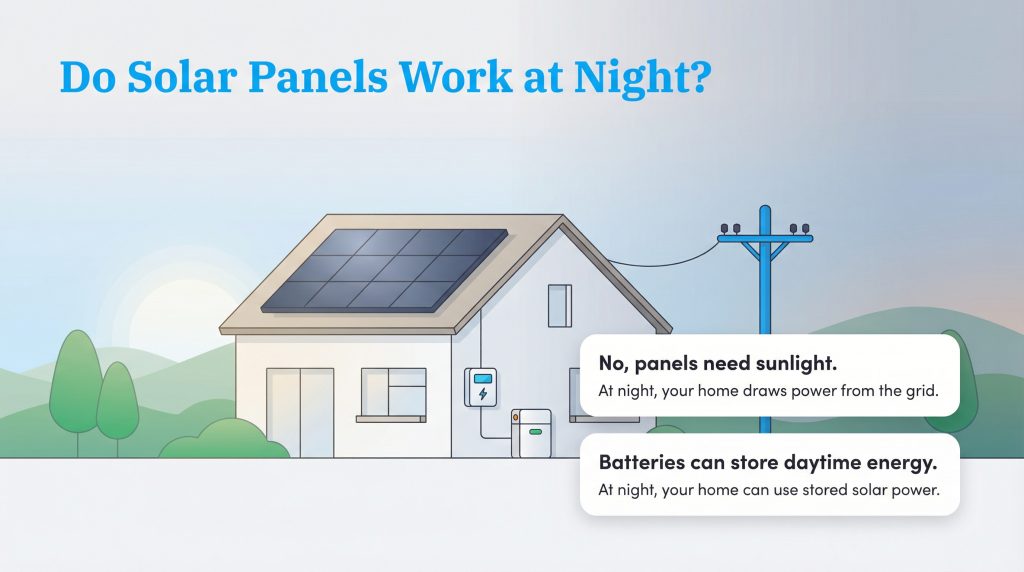
A common question anxious homeowners ask is, Do solar panels work on cloudy days? The answer is a resounding yes. Solar cells respond directly to visible light, not ambient environmental heat. While their overall output is naturally reduced on overcast or rainy days because less direct sunlight is penetrating the cloud cover, they are absolutely still generating a steady stream of power. Interestingly, photovoltaic cells can actually operate more efficiently in cooler winter temperatures than they do in extreme, blistering summer heat.

At night, however, the panels lack the incoming photons required to function and will not produce power in the dark. Because your system remains seamlessly connected to the utility network, your home automatically switches to drawing power from the grid as soon as evening solar production drops off. If you opted for a battery system, your home will tap into that stored energy instead. This smooth integration ensures you never experience a disruption in your lifestyle. You can explore further technical details regarding this grid relationship on the Department of Energy’s website.
Evaluating Your Home for Solar Readiness
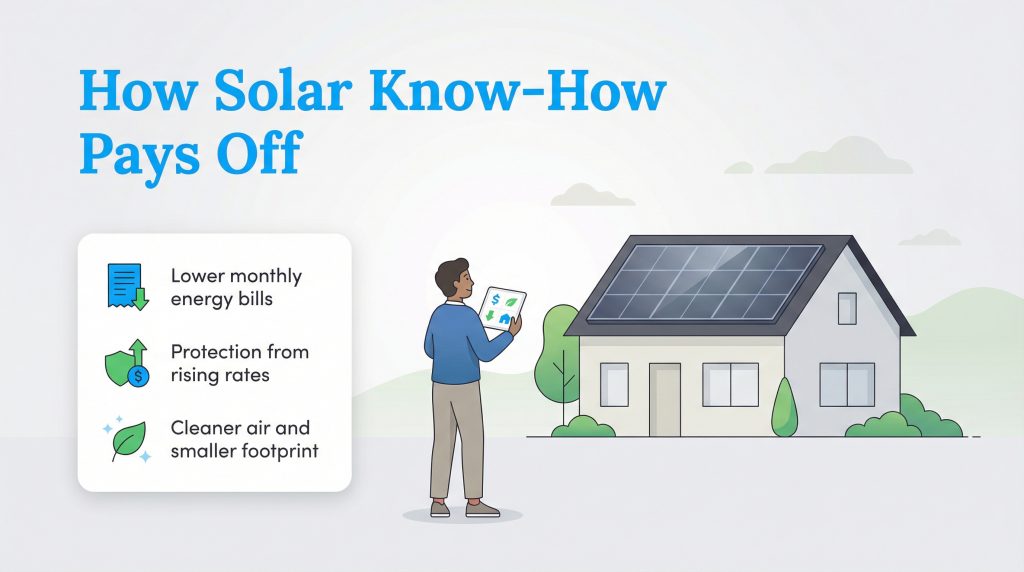
Once you understand the impressive inner workings of this technology, the next logical step is evaluating your own property’s viability. Start by physically assessing your roof’s orientation and current condition. In the United States, south-facing roofs generally capture the most direct sunlight throughout the day, completely maximizing your system’s output. However, east and west-facing roofs are also highly effective candidates, especially if you possess a wide, unobstructed surface area free from heavy tree shading. Evaluating this early is key to ensuring you achieve the Lower monthly bills you are aiming for.
Next, take a close look at your past energy bills to determine your average monthly kilowatt-hour (kWh) usage. A properly sized residential solar energy system setup relies entirely on this historical data to guarantee efficiency. By understanding precisely how much power your family consumes during peak summer air conditioning months versus cooler winter periods, a professional installer can help you review various system options and design an array that perfectly matches your unique demands without overpaying for unnecessary capacity.
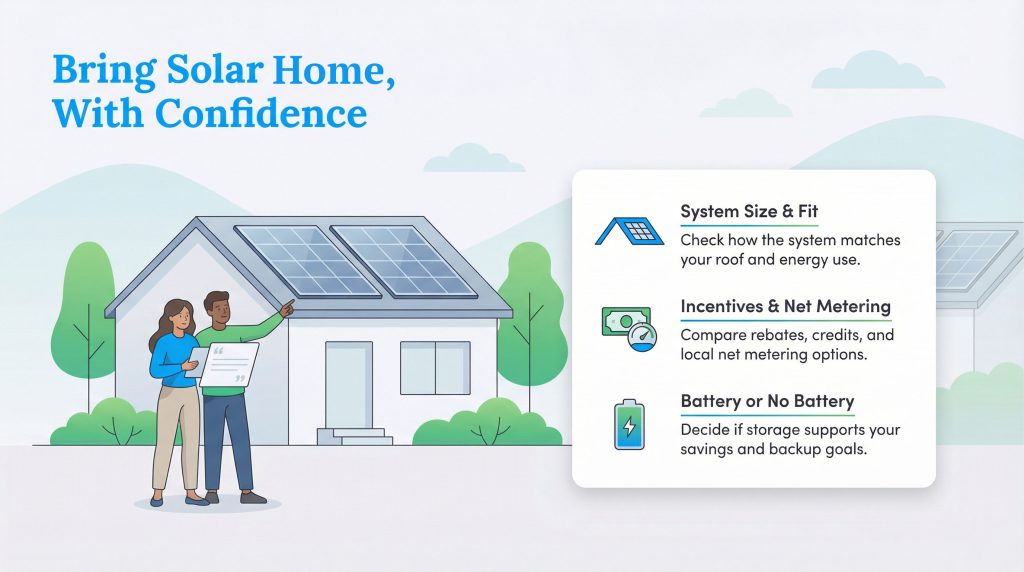
Finally, you must consult your local municipal guidelines and utility laws. Net metering policies dictate exactly how you will be compensated for the excess clean energy you export back to the grid. In some progressive regions, you receive a full one-to-one retail credit, while other areas may utilize a wholesale compensation structure. Knowing these specific local regulations ensures you can accurately project your total return on investment. If you are ready to take actionable steps toward total energy independence, visit our extensive solar energy hub for more detailed guides and expert advice.
FAQs About Solar Panels
Do solar panels work when the power goes out?
How long do solar panels last?
Do I need a battery for my solar panels to work?
Can solar panels heat my water?
Do solar panels require a lot of maintenance?
How much energy does one solar panel produce?
Can solar panels run a whole house?
Do I need to clean my solar panels?
About the Author

David has been an integral part of some of the biggest utility sites on the internet, including InMyArea.com, HighSpeedInternet.com, BroadbandNow.com, and U.S. News. He brings over 15 years of experience writing about, compiling and analyzing utility data.