
Discover If Momentum Solar’s Concierge Service and 25-Year Warranties Are the Right Fit for Your Renewable Energy Goals
Key Takeaways
- Momentum Solar handles everything in-house, from local permitting to rooftop panel installation, providing a single point of contact without third-party subcontractors.
- They offer a comprehensive 25-year warranty on both equipment and general workmanship, though their roof leak and penetration protection is strictly limited to five years.
- Be cautious of aggressive sales tactics during the consultation process, and carefully review your contract regarding cancellation fees before signing on the dotted line.
If you are exploring solar energy options for your new home, Momentum Solar frequently emerges as a top contender, heavily marketing its signature in-house “concierge” service and long-term equipment guarantees. However, deciding on the right renewable energy provider is a major financial investment, and filtering through the polished sales pitches to find objective facts can be exhausting. While their equipment and general workmanship carry a 25-year warranty, finer details like a strict five-year limit on roof leak protection and third-party financing partnerships deserve a closer look. To help you determine if Momentum Solar is legit and worth your hard-earned money, we have thoroughly analyzed their pricing structures, regional coverage areas, mobile app features, and real customer complaints to build a comprehensive Momentum Solar review for 2026.
What Is Momentum Solar?
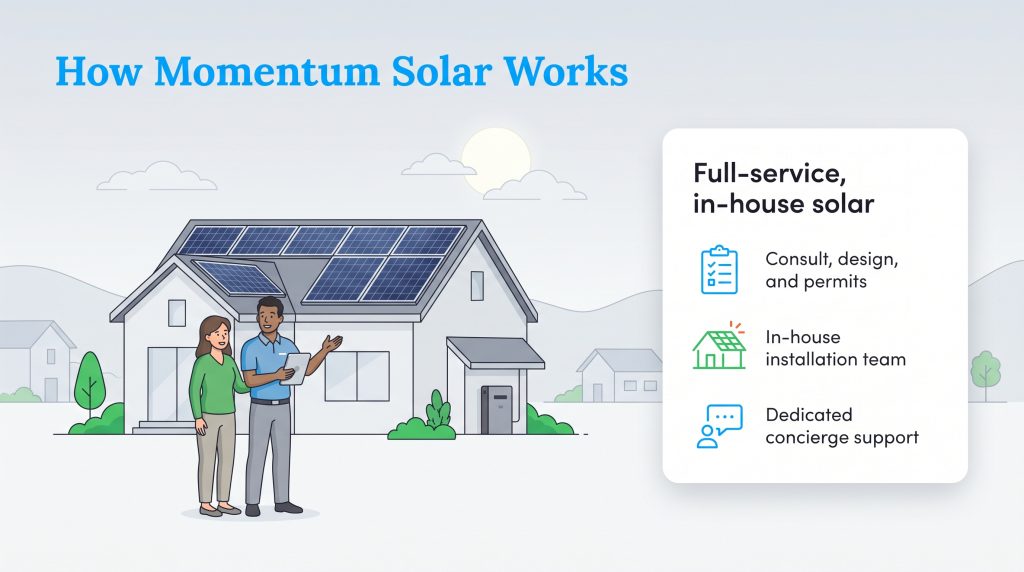
Momentum Solar is a privately-owned, full-service residential solar provider founded in 2009. Headquartered in South Plainfield, New Jersey, the company operates as a major regional installer across 12 U.S. states. Unlike many national competitors that act primarily as marketing brokers and outsource their labor to local third parties, Momentum Solar is known for utilizing entirely in-house installation teams. This direct oversight ensures stronger accountability and tighter quality control throughout the entire lifecycle of your system.
To back up their technical credibility, Momentum employs staff certified by the North American Board of Certified Energy Practitioners (NABCEP), which is widely considered the gold standard for renewable energy training and safety in the United States. They also hold the prestigious designation of Enphase Platinum Installer, meaning their technicians have completed rigorous training and maintain an exceptional track record installing and configuring Enphase microinverters and battery storage units.
The Momentum Solar Concierge & In-House EPC Model
In the solar industry, Momentum operates under a vertically integrated Engineering, Procurement, and Construction (EPC) model. That means the company manages everything under one roof: initial enrollment, custom engineering blueprints, equipment sourcing, municipal permitting, physical installation, and final utility grid activation. You never have to wonder which local electrical contractor is showing up at your driveway because every technician is a W-2 employee of Momentum Solar.
Their standout feature is their “concierge service,” which assigns you a dedicated representative to walk you through the project from the initial quote to post-installation support. This direct line of communication is a rarity in the solar industry and helps smooth out the inevitable municipal delays that occur during complex home improvement projects. Their core residential offerings include:
- Solar Panel Installation: They provide custom-designed, high-efficiency monocrystalline panels sourced exclusively from active Tier-1 manufacturers like Qcells, REC, Trina Solar, Jinko Solar, and Canadian Solar.
- Solar Battery Backups: In select markets, they offer seamless integration with premium storage solutions, including the Momentum Solar Enphase battery (IQ and Encharge series) and the Tesla Powerwall, providing reliable backup power during unexpected grid outages.
- Customized System Design: Their engineers evaluate your specific roof dimensions, pitch, shading factors, and historical energy consumption to build a system that maximizes your solar offset.
The Momentum Solar Quote and Installation Process
Getting started with Momentum Solar begins with a comprehensive energy audit. After requesting a quote, you will schedule an in-home or virtual consultation where a representative assesses your past 12 months of utility bills, evaluates your roof’s structural condition, and discusses your financial goals. Their engineering team then customizes a proposal that outlines optimal panel placement, overall system size in kilowatts (kW), and projected monthly utility savings.
Once you sign the contract, Momentum handles all the administrative heavy lifting. They file the necessary municipal building permits, coordinate directly with your local utility provider for grid interconnection, and even assist with Homeowners Association (HOA) architectural approvals if required. While the physical rooftop installation typically takes just one day — with customers frequently noting that the crews are respectful and “quiet on the rooftop” — the full timeline from signing the contract to passing local inspections and achieving Permission to Operate (PTO) averages two to three months.
Momentum Solar Plans, Pricing, and Financing Options
Your total Momentum Solar cost will vary based on your geographic location, roof complexity, and household energy consumption. While actual quotes are customized to your property, a standard 6 kW to 10 kW system costs between $18,000 and $29,970 before tax incentives. This averages out to roughly $3.00 to $3.50 per watt, positioning Momentum right in line with national industry averages for full-service installers.
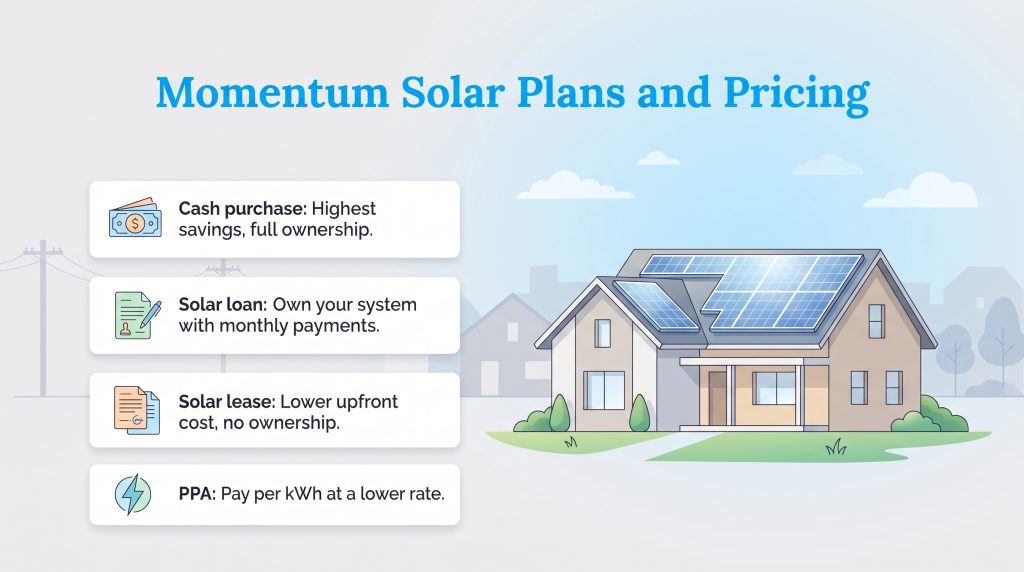
To make this environmentally mindful choice accessible and help lower your monthly electric bill, Momentum Solar financing is broken down into four distinct paths:
- Cash Purchase: Buying your solar system outright requires the highest upfront capital, but it yields the greatest long-term savings. By avoiding interest rates and loan origination fees, a cash purchase maximizes your return on investment (ROI) and immediately increases your home’s overall resale value. You also retain full eligibility for the 30% federal tax credit and local rebates.
- Solar Loans: If you want to own your system but prefer to pay over time, Momentum partners with specialized solar lenders like GoodLeap to offer flexible financing. Many of these are $0-down options with fixed monthly payments. This allows you to build home equity and claim the federal tax credit while spreading out the financial impact over 10 to 25 years.
- Solar Leases: With a lease, a third-party financing partner owns and maintains the equipment on your roof while you pay a fixed monthly “rent” to use the panels and keep the electricity they generate. While this provides immediate utility bill savings with little to no upfront cost, you do not own the system and cannot claim federal tax credits or local rebates.
- Power Purchase Agreements (PPAs): Similar to a lease, a third party owns the equipment under a Momentum Solar PPA. However, instead of paying a fixed monthly rental fee, you agree to purchase the actual power the panels produce at a set per-kilowatt-hour (kWh) rate. This rate is locked in lower than your local utility company’s retail rate, shielding you from volatile energy market hikes.
Comparing Cash, Loans, Leases, and PPAs
Choosing how to pay for your solar panels is just as important as choosing the hardware itself. Your financing structure dictates who owns the equipment on your roof, who gets to pocket the lucrative government tax breaks, and how complicated it might be if you decide to sell your house in a few years. Here is a side-by-side breakdown of how Momentum’s four payment options stack up:
| Feature | Cash Purchase | Solar Loan | Solar Lease | PPA |
|---|---|---|---|---|
| Upfront Cost | $18,000–$29,970 | Typically $0 Down | $0 Down | $0 Down |
| System Ownership | Homeowner | Homeowner | Third-Party Financier (e.g., IGS Solar) | Third-Party Financier (e.g., IGS Solar) |
| Tax Credit (ITC) Eligibility | Yes (You claim 30%) | Yes (You claim 30%) | No (Financier claims 30%) | No (Financier claims 30%) |
| Long-Term ROI | Highest (Payback in 6–9 years) | High (Offset by loan interest) | Moderate (Immediate bill savings only) | Moderate (Predictable kWh rate savings) |
One critical detail many homeowners overlook during the sales pitch is how leases and PPAs are serviced after installation. While Momentum Solar handles the physical installation, third-party lease and PPA contracts are frequently underwritten and managed by external financing entities such as IGS Solar. That means your monthly payments go to the financing company rather than Momentum directly, and you will need to coordinate with that third-party owner if you ever need to transfer the lease to a homebuyer.
💡 Pro Tip: If you opt for a solar lease or PPA, ask your representative to highlight the “annual escalator” clause in the contract. Many third-party agreements include a built-in rate hike of 1% to 2.9% per year, which can slowly eat into your monthly savings if local utility rates remain flat.
Deals, Incentives, and Ways to Save

Transitioning to solar power comes with significant financial perks if you know where to look. To maximize your return on investment, Momentum Solar’s concierge service acts as an administrative guide, helping you navigate the complex web of available government programs and local utility discounts to significantly reduce your net costs.
Federal Tax Credits, Net Metering, and SRECs
The most substantial financial benefit for homeowners who choose to own their system via cash or a solar loan is the Federal Residential Clean Energy Credit, commonly known as the Investment Tax Credit (ITC). This federal incentive allows you to deduct 30% of your total solar installation and battery storage costs directly from your federal income tax liability. For a standard $20,000 installation, this credit reduces your net cost by $6,000, bringing your effective price down to $14,000. Momentum’s team provides the necessary documentation to make filing IRS Form 5695 straightforward. For full eligibility details, you can review the Department of Energy’s guide to the ITC.
Beyond federal incentives, your dedicated representative will help you leverage essential state and utility-specific programs:
- Net Metering: In states that mandate net metering, the utility grid acts like a free virtual battery. When your panels produce more electricity than your home consumes on a sunny afternoon, the excess power flows back to the grid in exchange for utility bill credits. You then draw against those banked credits at night. Momentum handles all the interconnection paperwork so you can start banking credits on day one.
- Solar Renewable Energy Certificates (SRECs): In states with aggressive renewable energy portfolio standards — most notably New Jersey, Massachusetts, and Pennsylvania — you can earn passive income simply by generating solar power. For every 1,000 kWh (1 megawatt-hour) of electricity your rooftop panels produce, you earn one SREC. Utilities are legally required to buy these certificates to meet clean energy quotas, allowing you to sell your SRECs on state markets for hundreds of dollars in extra cash each year.
- State and Local Rebates: Many states, municipalities, and specific utility companies offer property tax exemptions for solar equipment, sales tax waivers, or upfront cash rebates for installing battery storage. Momentum factors these local opportunities into your custom proposal so no money is left on the table.
Coverage Area: Where Is Momentum Solar Available?
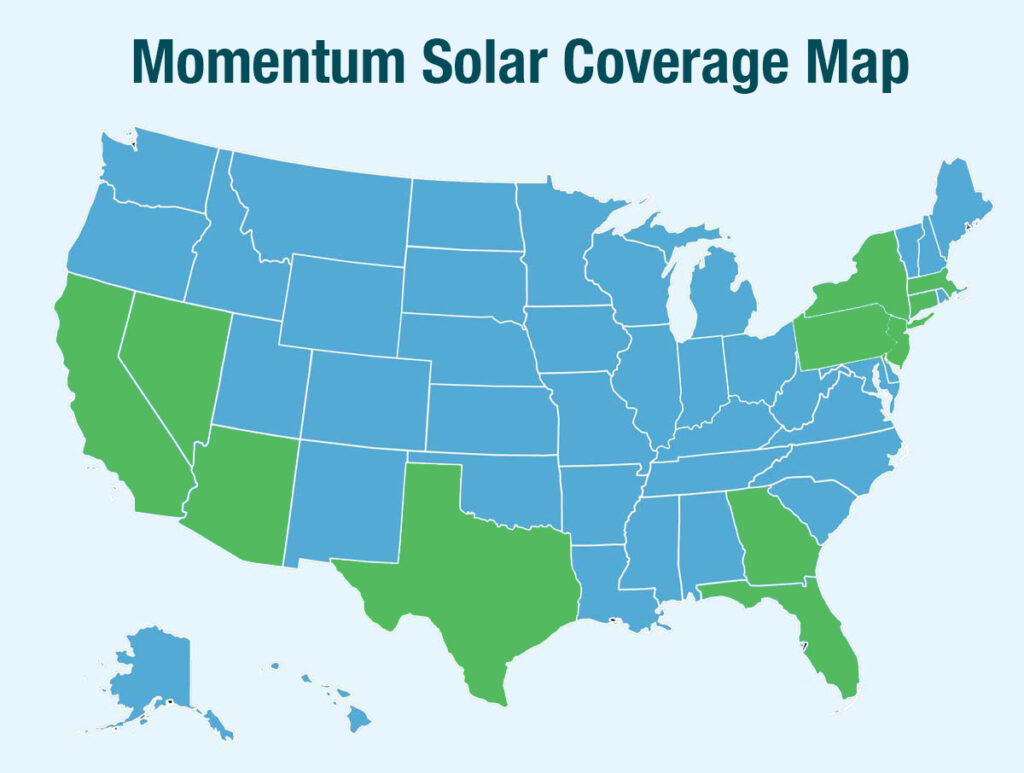
Because they rely entirely on their own W-2 workforce rather than a sprawling network of third-party contractors, Momentum Solar operates within a targeted regional footprint. They specifically focus on sun-rich states or regions with high retail electricity rates that boast consumer-friendly renewable energy incentives.
State-by-State Availability and Major Service Hubs
As of 2026, the Momentum Solar coverage area spans 12 licensed operational territories. They provide full-service solar panel installations and customer support in Arizona, California, Connecticut, Florida, Georgia, Massachusetts, Nevada, New Jersey, New York, Pennsylvania, Rhode Island, and Texas. They intentionally establish robust local warehousing and dispatch hubs within major metropolitan areas so their in-house crews can respond quickly to installation and service calls.
You will find active Momentum Solar branch offices supporting residents in heavily populated energy markets, including Houston, Dallas, Austin, and San Antonio. In the Southeast, their teams frequently cover Orlando and Tampa, while out West they have established strong footholds in Las Vegas and Orange County.
However, equipment availability is not identical across every territory. While rooftop solar panels are installed across all 12 states, Momentum’s solar battery installations are currently restricted to select markets — specifically five core states, including New York, New Jersey, Texas, Florida, and Connecticut. If you live in one of their newer expansion territories like Georgia or Arizona and require whole-home battery backup, confirm local storage availability during your initial consultation.
Solar Equipment: Panels, Inverters, and Battery Storage
When you invest in a residential solar system, you are bolting power-generating hardware to your roof for the next 25 to 30 years. Momentum Solar does not manufacture its own equipment; instead, it sources hardware from established, bankable manufacturers. By sticking to Tier-1 monocrystalline solar panels, Enphase microinverters, and high-capacity lithium-iron-phosphate (LFP) batteries, Momentum ensures your array can withstand harsh weather while maintaining high conversion efficiency.
| Component | Brands Installed | Key Technical Specs |
|---|---|---|
| Solar Panels | Qcells, REC, Trina Solar, Jinko Solar, Canadian Solar | Tier-1 Monocrystalline; 20%–21.5% efficiency ratings; -0.34%/°C temperature coefficient |
| Microinverters | Enphase Energy (IQ7 and IQ8 Series) | Panel-level DC-to-AC conversion; 97% CEC efficiency; rapid shutdown compliance |
| Battery Storage | Enphase IQ / Encharge 10, Tesla Powerwall | 10.1 kWh (Enphase) to 13.5 kWh (Tesla) usable capacity; solar islanding capability |
The solar panels Momentum installs — predominantly from Qcells, REC, and Trina Solar — feature sleek, all-black monocrystalline silicon cells. These panels boast efficiency ratings between 20% and 21.5%, meaning they convert over a fifth of the sunlight hitting your roof directly into usable electricity. They also feature a low temperature coefficient of around -0.34% per degree Celsius. Just like smartphones, solar panels lose a tiny bit of efficiency on scorching summer days; a low temperature coefficient ensures your panels keep cranking out peak power even during blistering July heatwaves in Texas or Florida.
Beneath the panels, Momentum relies heavily on Enphase microinverters rather than traditional string inverters. In an older string inverter setup, all your panels are wired together in a series — much like vintage Christmas lights. If a tree branch casts shade on a single panel, the output of the entire string drops dramatically. Enphase microinverters tuck neatly under each individual solar panel, converting direct current (DC) to alternating current (AC) right at the source. If leaves or chimney shadows cover one panel, the rest of your rooftop array continues operating at 100% capacity.
For homeowners seeking energy independence during blackouts, Momentum installs the Enphase IQ Battery (including the Encharge 10 with 10.1 kWh of usable capacity) and the Tesla Powerwall (13.5 kWh usable capacity). Standard grid-tied solar panels automatically shut down during a power outage to prevent back-feeding live electricity onto downed utility lines. Adding an Enphase or Tesla battery enables “solar islanding,” which safely disconnects your home from the dead utility grid and creates a self-sustaining microgrid so your panels can keep charging your battery and running your refrigerator, Wi-Fi, and lights for days.
Fees, Roof Guarantees, and the 25-Year Warranty
Solar warranties are notoriously full of fine print, and knowing the difference between equipment coverage, labor coverage, and roof penetration guarantees can save you thousands of dollars down the road. Momentum Solar backs its systems with a comprehensive 25-year equipment warranty and a 25-year general workmanship warranty across its installations, but they enforce a strict five-year limit on roof penetration and leak guarantees.
Here is how the three layers of your Momentum Solar warranty actually work in practice:
- 25-Year Equipment & Output Warranty: Backed by the hardware manufacturers, this guarantees your solar panels and Enphase microinverters against physical manufacturing defects for a quarter-century. It also includes a linear performance guarantee ensuring your panels will still produce at least 85% to 86% of their original rated power output at year 25 (accounting for normal annual degradation of roughly 0.5% per year). Battery storage units typically carry a separate 10- to 15-year manufacturer warranty.
- 25-Year Workmanship Warranty: This covers Momentum’s physical labor, electrical wiring, racking attachments, and conduit runs for 25 years. If an inverter fails or a mounting bracket loosens due to improper installation, Momentum covers the diagnostic visit and replacement labor.
- 5-Year Roof Penetration & Leak Guarantee: While general labor is covered for 25 years, Momentum only guarantees the actual holes drilled into your roof decking against water intrusion for five years post-installation. Most roof leaks caused by faulty flashing show up within the first few heavy rainstorms, so five years is generally sufficient to catch installer errors, though some competitors extend leak protection to 10 years.
Beyond warranty limits, you need to budget for potential post-contract fees — specifically contract cancellation penalties and panel removal costs. Under state consumer protection laws, you are granted a legal “cooling-off” cancellation window (typically three to 10 business days after signing your contract, depending on your state) during which you can walk away penalty-free. However, if you attempt to cancel your project after that window expires and Momentum has already drafted engineering blueprints, conducted site surveys, or submitted municipal permits, they can charge hefty administrative and permitting recovery fees ranging from several hundred to several thousand dollars.
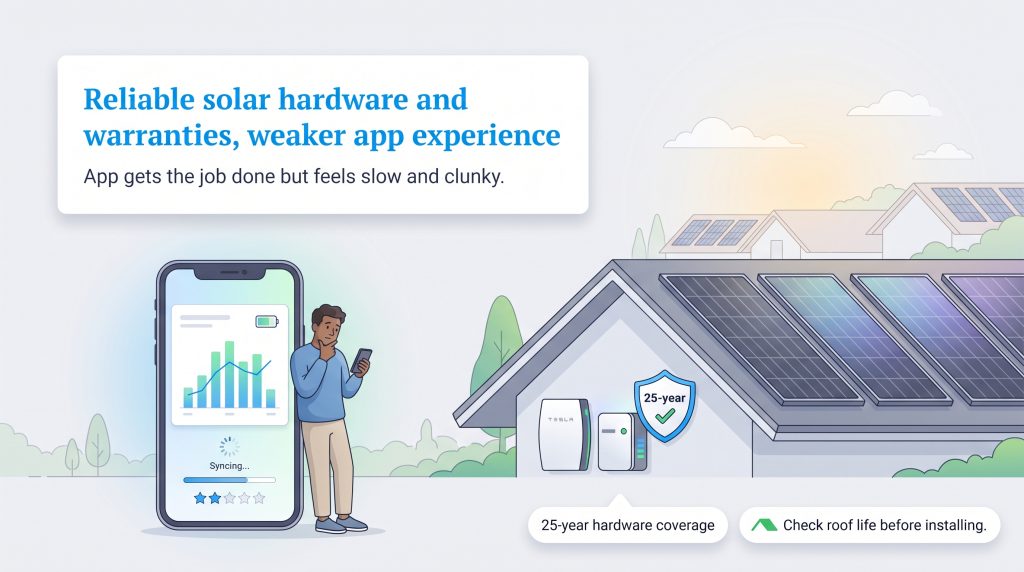
🚩 Heads Up: If your roof requires shingle maintenance or a full replacement 10 years down the line, your workmanship warranty will not cover the cost of taking the panels down. Momentum charges a detachment and reset fee (often several thousand dollars) to safely remove and reinstall the solar array. Make sure your roof has at least 15 years of healthy life left before installing solar to avoid these mid-lifecycle fees.
The Momentum Solar App & System Monitoring
While their hardware and warranty protections are reliable, Momentum’s proprietary digital tools leave plenty of room for improvement. To understand how you will interact with their software, it helps to separate their mobile ecosystem into two distinct phases: pre-installation project tracking and post-installation energy monitoring.
During the two to three months between signing your contract and getting your system turned on, you will use the Momentum Solar App (and its companion referral platform, Solar Connect). During this pre-installation phase, the app actually serves a pretty useful purpose. It acts as a centralized project tracker where you can upload utility bills, message your concierge representative, and watch your project move through permitting, engineering, installation, and final utility inspection milestones.
Once your panels are activated and generating electricity, however, the proprietary Momentum Solar app becomes frustratingly clunky. Currently, the app holds lackluster ratings, averaging around 2.5 to 2.7 stars on both the Apple App Store and Google Play Store. Homeowners frequently complain about frozen screens, login loops, slow load times, and syncing delays when trying to view real-time solar production or battery storage levels during peak evening hours.
💡 Pro Tip: Once your solar array is active, bypass the glitchy Momentum app entirely and download the Enphase Enlighten (MyEnlighten) app instead. Because Momentum installs Enphase microinverters on your roof, your system connects directly to Enphase’s native software, giving you superior, real-time kWh production data, panel-by-panel health diagnostics, and local weather-comparison metrics with zero lag.
Sustainability and Green Energy Initiatives
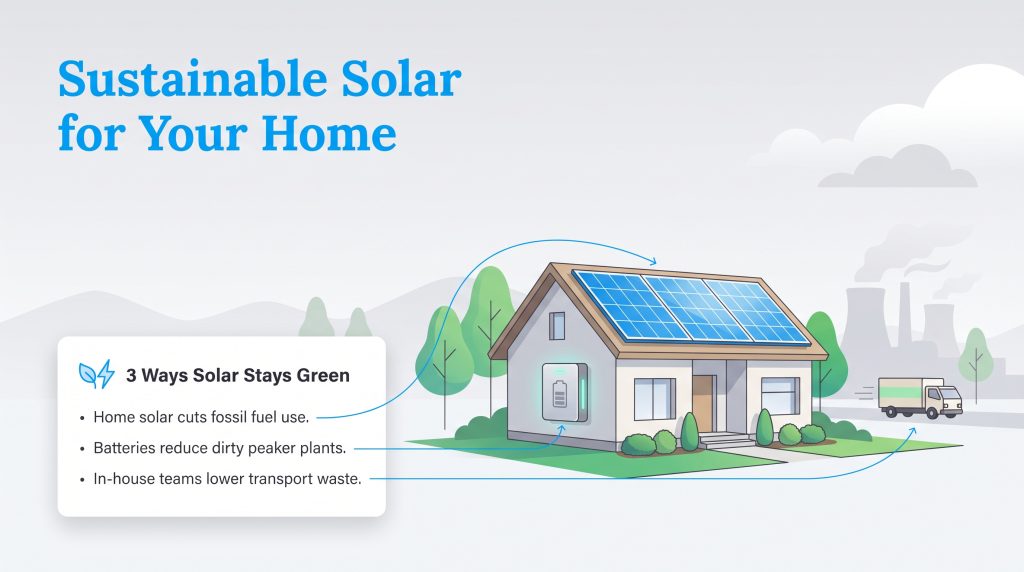
Switching to solar power is not just a financially savvy move; it is a practical commitment to environmental sustainability. Momentum Solar leans heavily into eco-conscious operations, stating a mission to help residential customers achieve up to a 100% solar energy offset where roof space allows. By generating your own clean electricity at home, you drastically lower your household’s reliance on aging, fossil fuel-dependent grid infrastructure.
Their integration of advanced battery storage solutions plays a major role in this green initiative. By storing excess daytime solar energy in an Enphase or Tesla battery, you become an energy-saving option for your entire neighborhood during evening peak demand hours. Discharging your own clean battery power between 5 p.m. and 9 p.m. reduces the need for your local utility company to fire up highly polluting natural gas “peaker plants” to meet evening grid stress, cutting down on community-wide greenhouse gas emissions.
Momentum’s in-house EPC model is also a more eco-conscious alternative compared to decentralized solar brokers. By cutting out third-party subcontractors and managing regional warehouses near major service hubs, they minimize unnecessary fleet transportation emissions, streamline bulk material deliveries to reduce packaging waste, and maintain strict equipment recycling standards from the warehouse to your rooftop.
Why Choose or Avoid Momentum Solar
Every home and homeowner is different. To help you decide if this provider aligns with your energy goals and personal tolerance for sales pitches, here is an objective look at their biggest operational strengths and most notable drawbacks.
- Pros of Momentum Solar:
- Turnkey, full-service concierge experience that simplifies permitting, HOA approvals, and utility interconnection.
- All physical labor is performed by in-house W-2 installation crews rather than outsourced subcontractors.
- Strong 25-year warranty coverage on both Tier-1 solar equipment and general workmanship.
- Certified NABCEP professionals and Enphase Platinum Installer status ensure top-notch electrical work.
- Cons of Momentum Solar:
- Highly aggressive door-to-door sales tactics, persistent cold calls, and lengthy in-home consultations.
- Roof penetration and leak protection is limited to just five years.
- Availability is restricted to a regional footprint of 12 states (with battery installations limited to five states).
- Their proprietary mobile app is poorly rated for post-installation energy monitoring.
- Lack of transparent online pricing requires you to sit through a full sales consultation to get a quote.
Who Is Momentum Solar Best For?
Momentum Solar is an excellent fit for busy homeowners who want a completely hands-off, white-glove installation experience. If you do not have the time or patience to juggle multiple electrical contractors, argue with your HOA board, or decode municipal building permits, their in-house concierge service handles every scrap of paperwork for you. They are also ideal for buyers who plan to purchase their system via cash or loan and want the peace of mind that comes with NABCEP-certified technicians installing Tier-1 panels and Enphase microinverters.
Conversely, if you prefer to shop for home improvements entirely online with transparent, upfront calculator pricing — or if you have zero patience for old-school, high-pressure in-home sales pitches — you will likely find Momentum’s consultation process frustrating.
Momentum Solar Reviews: What Are Customers Really Saying?
Evaluating third-party customer feedback is an essential step when comparing solar providers. When synthesizing Momentum Solar reviews across platforms like EnergySage, the Better Business Bureau (BBB), Trustpilot, ConsumerAffairs, and Reddit, the sentiment reveals a stark divide between their aggressive marketing department and their skilled installation crews.
BBB Ratings, Reddit Feedback, and State Complaints
Across major consumer review aggregators, Momentum Solar earns respectable — though mixed — ratings. They maintain an A+ rating with the BBB, demonstrating an active corporate willingness to respond to formal disputes and resolve customer billing or service issues. On EnergySage, Momentum holds a solid 3.7 out of 5 stars, while scoring roughly 4.0+ stars on Trustpilot and 3.8 out of 5 stars on ConsumerAffairs. In positive reviews, homeowners consistently praise the actual installation day, noting that the in-house crews arrive on time, finish the roof work in a few hours, and leave the property spotless.
However, a deep dive into Momentum Solar complaints on Reddit and BBB consumer logs reveals three recurring pain points you should watch out for:
- “Wolf of Wall Street” Sales Pressure: On Reddit’s r/solar community and state complaint boards, homeowners frequently criticize Momentum’s door-to-door canvas teams and call center reps. Customers describe a high-octane sales culture where representatives refuse to take “no” for an answer, call repeatedly from different local numbers, and conduct two- to three-hour in-home pitches using artificial “sign today only” discounts to force an immediate signature.
- Delays in Permission to Operate (PTO): Several customers report that once the panels are bolted to the roof, momentum slows down. Homeowners have expressed frustration over waiting two to four months for Momentum and the local utility company to finalize paperwork and pass final electrical inspections — leaving buyers staring at inactive panels on their roof while paying their regular electric bill.
- Post-Installation Communication Bottlenecks: While the concierge rep is highly responsive before installation, some customers report hitting a wall when trying to claim warranty repairs months later. Homeowners dealing with faulty microinverters or roof leak inspections note that getting a service tech dispatched can take weeks of persistent follow-up phone calls.
Momentum Solar vs. Top Competitors
To make sure you are getting a fair deal on your renewable energy system, you should always compare quotes from at least three installers. Here is how Momentum Solar stacks up against top regional and national competitors — including Sunrun, Tesla Solar, Trinity Solar, and Palmetto Solar — across pricing, labor models, and warranty terms.
| Provider | Average Price Range (6–10 kW) | Financing Options | Coverage Area | Subcontractors Used? | Workmanship & Equipment Warranty | Roof Leak Warranty |
|---|---|---|---|---|---|---|
| Momentum Solar | $18,000–$29,970 | Cash, Loan, Lease, PPA | Regional (12 States) | No (100% In-House) | 25 Years | 5 Years |
| Sunrun | $19,000–$32,000 | Cash, Loan, Lease, PPA | National (20+ States, DC & PR) | Yes (Varies by market) | 10–25 Years (Plan dependent) | 10 Years |
| Tesla Solar | $15,000–$24,000 | Cash, Loan | National (All 50 States) | Yes (Certified Partners) | 10 Years Workmanship / 25 Years Panels | 10 Years |
| Trinity Solar | $18,500–$30,000 | Cash, Loan, Lease, PPA | Regional (10 States) | No (In-House Crews) | 5 Years Workmanship / 25 Years Panels | 5 Years |
| Palmetto Solar | $17,500–$28,500 | Cash, Loan, Lease, PPA | National (25+ States) | Yes (Vetted Local Pros) | 25 Years (With Protection Plan) | 10–25 Years (Plan dependent) |
While Tesla Solar frequently beats the competition on upfront cash pricing thanks to its automated online ordering model, it relies on third-party certified installers in many regions and is notorious for hard-to-reach customer support. Sunrun and Palmetto Solar offer wider national footprints and longer 10-year roof leak protection, but both lean on subcontractor networks depending on your zip code. Momentum Solar and East Coast rival Trinity Solar share a similar DNA — utilizing in-house installation crews and door-to-door marketing — though Momentum edges out Trinity with a much stronger 25-year general workmanship warranty compared to Trinity’s five-year standard labor coverage.
Determining If Momentum Solar Is Right for Your Home
Momentum Solar delivers a dependable, turnkey solar installation backed by Tier-1 monocrystalline panels, Enphase microinverters, and a 100% in-house workforce. If you live within their 12-state footprint and want a single company to handle every permit, inspection, and rooftop bolt without outsourcing to random subcontractors, their concierge model and 25-year equipment and workmanship warranties offer genuine long-term value.
The biggest hurdle is simply surviving their high-pressure sales pitch. If you invite Momentum Solar into your home for a consultation, take control of the appointment from the start: set a strict 60-minute time limit, refuse to sign a same-day contract on a salesperson’s tablet, and demand a written breakdown of cash versus loan pricing before considering a third-party lease. Take their final proposal, compare the per-watt cost against at least two local NABCEP-certified installers, and verify that your roof is young enough to outlast their five-year leak guarantee before signing on the dotted line.
Frequently Asked Questions About Momentum Solar
Is Momentum Solar a legitimate company?
How much does a Momentum Solar system cost?
What warranties does Momentum offer?
What happens to my Momentum Solar panels during a power outage?
Who underwrites Momentum Solar leases and loans?
Can I monitor my Momentum Solar panels without using their mobile app?
How do I cancel a Momentum Solar contract?
About the Author

David has been an integral part of some of the biggest utility sites on the internet, including InMyArea.com, HighSpeedInternet.com, BroadbandNow.com, and U.S. News. He brings over 15 years of experience writing about, compiling and analyzing utility data.