

Decoding the recurring charges on your home utility invoices helps you uncover hidden fees and accurately compare long-term service rates
Key Takeaways
- A Monthly Recurring Charge (MRC) is a recurring fixed fee you pay every billing cycle for utility access, administrative costs, or equipment rentals, regardless of your actual usage.
- Comparing MRC vs NRC billing is crucial, as non-recurring charges (NRC) are only paid once during initial service setup or activation.
- High monthly recurring charges can be easy to overlook underneath low advertised energy rates, making it vital to calculate your total estimated bill before signing a new contract.
If you’re looking at your first internet, gas, or electricity statement and wondering, “What is an MRC?” you aren’t alone. Utility bills often stack fixed fees, usage charges, taxes, and one-time setup costs into one confusing total. An MRC, or Monthly Recurring Charge, is a fee that appears every billing cycle, whether your usage goes up or down. Once you know where to spot it, you can compare plans more accurately and avoid surprises after move-in.
The Monthly Recurring Charge Meaning Clarified
While you might search for “what is a MRC,” grammatically we are talking about an MRC. Acknowledging that minor grammar nuance aside, understanding the true monthly recurring charge meaning boils down to separating fixed costs from variable costs. Variable charges constantly fluctuate based on how much electricity you consume, water you use, or data you download. In contrast, an MRC remains static. You pay this baseline fee to cover account access, delivery infrastructure, billing, metering, or equipment rentals. Some of these fixed charges are regulated by your local government, while others are optional fees created by individual providers. Even if you shut off your main breaker, lock the doors, and leave for a month-long vacation, your utility provider will still expect payment for this structural baseline cost.
Quick Fact
Utility companies often label MRCs using different terminology on your invoice, so keep an eye out for terms like “Base Charge,” “Customer Charge,” or “Administrative Fee.”
MRC vs NRC Billing: What to Know
When evaluating service contracts, distinguishing between MRC vs NRC billing keeps you from panicking over an unusually high first invoice. NRC stands for Non-Recurring Charge. These are the one-off fees associated with setting up a new home service. Common examples include installation labor, account activation fees, technician visits, security deposits, or one-time equipment purchases. Seeing a higher total on your initial statement is completely normal because those one-time NRCs are bundled with your standard MRCs. You can breathe a sigh of relief knowing an installation or activation NRC will not unexpectedly show up again next month.
Where to Spot an MRC on Your Utility and Internet Bills
Tracking down fixed fees requires a bit of detective work since providers scatter them across different sections of your invoice. The exact label depends on the provider, so don’t worry if you don’t see “MRC” printed word for word. Look for recurring line items that stay the same each month. Breaking down common household utilities reveals exactly where these charges typically hide:
- Electricity and Natural Gas: Check the delivery section of your statement. In Texas, local delivery utilities are often called Transmission and Distribution Service Providers, or TDSPs. In other states, you may see similar charges from your electric distribution company, gas utility, or local delivery provider to cover meter maintenance and grid infrastructure.
- Internet and Telecom: If you’re trying to understand an MRC on an internet bill, start with modem and router rental fees. If you bundle your connection with cable, telecom providers also frequently apply monthly broadcast TV fees or regional sports network surcharges. The FCC offers a fantastic guide for understanding common telephone bill charges if you need to dispute an unusual network fee.
- Water and Sewer: Municipal water departments typically enforce a base meter fee, which varies by location. This guarantees consistent revenue to maintain underground pipes and public treatment facilities regardless of regional droughts or lower consumption.
How to Calculate the Real Cost of an MRC
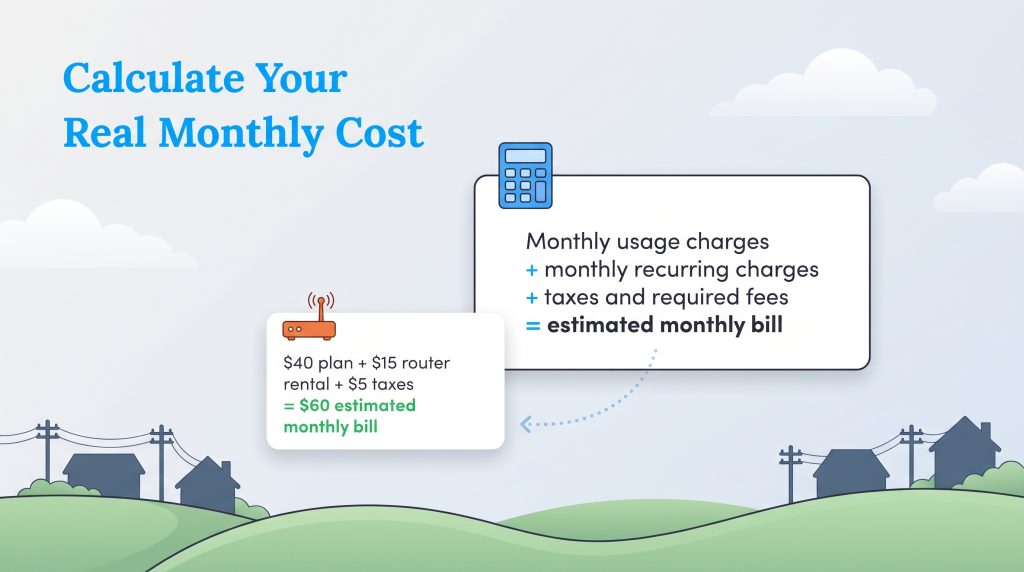
To accurately compare different service plans, you need to calculate how an MRC affects your total monthly expenses. Instead of just looking at the advertised rate, use this simple formula to determine your true cost:
Monthly usage charges + monthly recurring charges + taxes and required fees = estimated monthly bill
For example, if an internet provider advertises a $40 monthly plan but charges a $15 MRC for a router rental and $5 in local taxes, your real monthly cost is $60. Running this quick calculation ensures you compare apples to apples when shopping for home services.
What to Check Before You Sign Up for a Plan
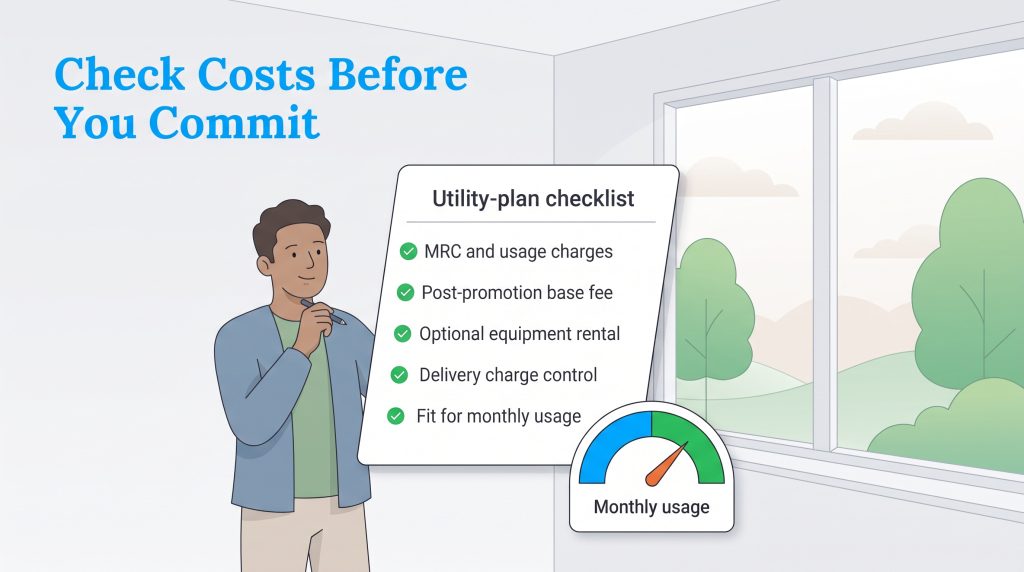
Moving into a new residence provides the perfect opportunity to audit your potential utility costs. Before signing a long-term agreement, ask your prospective providers a few clarifying questions about their billing structure:
- Is the MRC listed separately from usage charges? Confirming this helps you understand your baseline costs.
- Does the base fee change after a promotional period? Many providers increase the MRC once your initial 12-month contract expires.
- Is rented equipment optional? You can often decline leased hardware to save money.
- Are delivery charges regulated or supplier-controlled? Regulated utility charges usually cannot be negotiated, but retail supplier fees often can.
- Does the plan make sense for your typical monthly usage? A high base fee might ruin a good energy rate if you live in a small apartment.
How High MRCs Can Mask Cheap Energy Rates
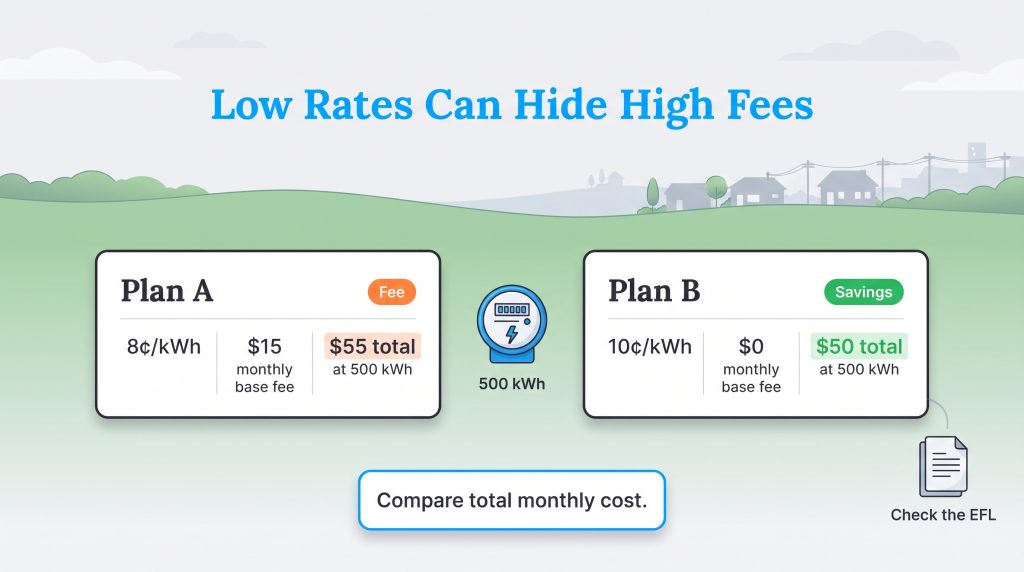
Living in a deregulated energy state empowers you to shop around for retail electricity providers, but it also opens the door to tricky marketing tactics. You might stumble across a spectacularly low per-kWh energy rate, only to realize the contract includes a steep monthly base fee. These hidden fixed costs can completely upend your budget if you live in a smaller apartment or consume very little energy. A low-usage household usually benefits from a no-base-fee plan, even if the per-unit rate is slightly higher. Conversely, a high-usage household may benefit from a lower usage rate, even with a recurring base fee. The right choice depends on your total monthly cost, not just the advertised rate.
Consider how a high base fee impacts two identical households using 500 kWh of electricity in a single month, before taxes and other required fees:
| Electricity Plan | Energy Rate | Base MRC | Total Estimated Bill (500 kWh) |
|---|---|---|---|
| Plan A | 8 cents / kWh | $15.00 | $55.00 |
| Plan B | 10 cents / kWh | $0.00 | $50.00 |
Even though Plan A advertises a cheaper energy rate, the heavy base charge makes it more expensive for lower-usage customers. However, Plan A might still be the better option for a high-usage household that consumes 2,000 kWh a month, as the lower energy rate offsets the fixed fee. Always review the pricing breakdown before signing a contract by utilizing official state platforms. For example, Pennsylvania residents can easily verify accurate numbers by https://www.papowerswitch.com/shop-for-home/”>comparing official state energy rates online.
Money Saver
Always check the Electricity Facts Label (EFL) or “Price to Compare” document before enrolling in a new energy plan to confirm the exact monthly base charge and avoid a plan that costs more than the advertised rate suggests.
Strategies to Lower Monthly Recurring Charges
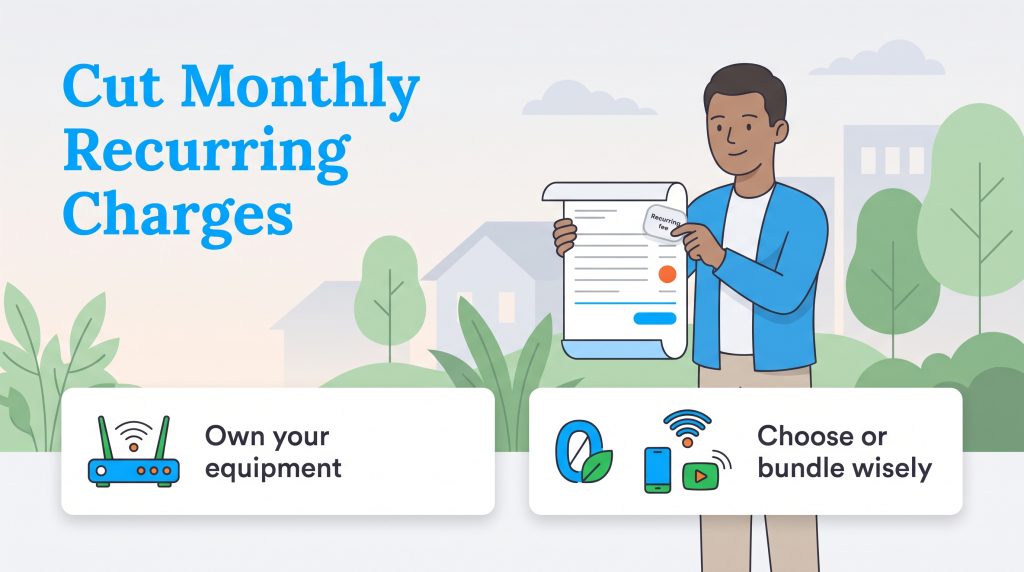
You might assume base charges are entirely non-negotiable, but savvy consumers have several avenues to minimize or eliminate these recurring fixed costs. Learning how to lower monthly recurring charges requires proactive shopping and a willingness to challenge the status quo on your invoices.
- Buy Your Own Equipment: Leasing a Wi-Fi router from your Internet Service Provider easily adds $10 to $15 to your bill every single month. Purchasing your own compatible modem and router eliminates that monthly rental MRC entirely, usually paying for itself in one to two years. Before buying, always check your provider’s equipment compatibility list.
- Shop for Zero-Fee Energy Plans: If you reside in a deregulated electricity or natural gas market, actively filter your search results for plans boasting no monthly base fees. While the per-kWh rate might be slightly higher, skipping the MRC often saves money for smaller, energy-efficient households. Keep in mind that regulated utility base delivery charges usually cannot be removed.
- Consolidate Services: Bundling your home internet, mobile phone, and streaming services under one provider frequently reduces duplicated administrative MRCs while unlocking exclusive multi-line discounts. Just remember to review promotional expiration dates and set a calendar reminder before your contract renews.
If you are moving soon, check our comprehensive guide on setting up internet in a new home to learn which hardware you should purchase beforehand.
Eco Edge
Choosing an energy-efficient home setup can lower your variable usage charges, even when fixed monthly charges stay the same. Look for ENERGY STAR-certified appliances, smart thermostats, and utility efficiency rebates before your next billing cycle.
Taking Control of Your Monthly Utility Costs
Grasping the core difference between variable usage expenses and fixed monthly recurring charges acts as the critical first step to mastering your entire home budget. Once you know exactly what baseline fees to anticipate, you can accurately evaluate long-term contracts, trim unnecessary equipment rentals, and prevent billing surprises. A quick bill audit can reveal which charges are unavoidable, which ones are negotiable, and which services may be worth switching. Once you understand your MRCs, you’ll have a clearer picture of what each provider actually costs month after month.
Frequently Asked Questions About Monthly Recurring Charges
These quick answers cover common questions about spotting, comparing, and reducing MRCs on household service bills. Use them as a fast reference when reviewing a new bill or shopping for service.
Is an MRC a fixed cost?
What does MRC stand for in telecom?
Can I negotiate a monthly recurring charge on my bill?
Does a high MRC mean I am being overcharged?
Are Delivery Fees Considered Monthly Recurring Charges?
About the Author

David has been an integral part of some of the biggest utility sites on the internet, including InMyArea.com, HighSpeedInternet.com, BroadbandNow.com, and U.S. News. He brings over 15 years of experience writing about, compiling and analyzing utility data.

LaLeesha has a Masters degree in English and enjoys writing whenever she has the chance. She is passionate about gardening, reducing her carbon footprint, and protecting the environment. She also recently served as President of the Board for City Sprouts (a community garden).