
Key Takeaways
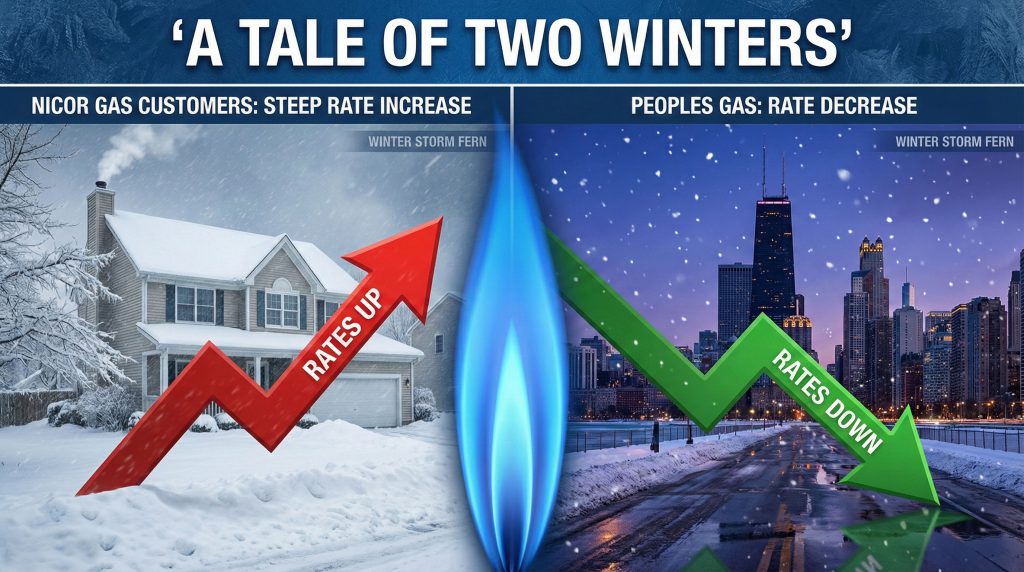
- A Divided Market: Suburban Nicor Gas customers face a roughly 27% rate hike for February, reaching 53.23 cents per therm, while Chicago (Peoples Gas) and North Shore residents see rates decrease.
- The Storm Factor: The recent “Winter Storm Fern” spiked demand and froze wellheads, forcing utilities to rely on expensive stored gas reserves to keep homes warm.
- Bill Shock: A typical suburban family could see their gas bill jump by nearly $20 compared to last month, and nearly $40 compared to last year, due to the rate change alone.
- Help is Available: Residents struggling with the spike can apply for grants up to $400 via utility-specific “Sharing Programs” or federal LIHEAP funds through August.
For millions of Illinois residents, the arrival of February bills will bring a starkly different financial reality depending on which side of the city limit they live.
In a significant market divergence, Nicor Gas, which serves 2.2 million customers across the suburbs and downstate, has raised its supply rate to 53.23 cents per therm for February 2026. This represents a roughly 27% increase over January’s rate and a staggering 66% jump compared to February 2025.
Conversely, Chicago residents served by Peoples Gas will see their supply rate drop to 38.81 cents per therm, while North Shore Gas customers along the lakefront will see a decrease to 46.76 cents per therm.
Why the Price Hike?
The primary culprit for the volatility is the recent Winter Storm Fern, which hammered the Midwest with Arctic temperatures in late January.
Extreme cold creates a “double whammy” for energy markets: it spikes demand as furnaces work overtime, and it freezes natural gas wellheads (a phenomenon known as “freeze-offs”), restricting supply. While Peoples Gas and North Shore Gas appear to have hedged their portfolios effectively against this spike, Nicor Gas relied heavily on withdrawing gas from storage to meet the record demand.
Because utilities pass the cost of gas directly to consumers with no markup, the higher value of that stored gas, combined with expensive spot-market purchases during the storm, is now flowing through to suburban bills.
Is Your City Impacted?
If you aren’t sure which utility serves your home, check your bill or see if your city is on the list below.
- Nicor Gas (Rate Increase): Includes most suburbs such as Naperville, Aurora, Joliet, Rockford, Elgin, Schaumburg, Evanston, Des Plaines, and Bloomington-Normal.
- Peoples Gas (Rate Decrease): Exclusively serves the City of Chicago.
- North Shore Gas (Rate Decrease): Serves the northern corridor including Waukegan, Highland Park, Lake Forest, Winnetka, Gurnee, and Zion.
The Real-World Impact on Your Bill
What does this look like in dollars and cents? Assuming a typical single-family home uses about 175 therms during a freezing February, here is how the supply portion of the bill breaks down:
- Nicor Gas Customer: You will pay approximately $93.15 for gas supply this month. That is about $20 more than last month and $37 more than last February for the same amount of heat.
- Peoples Gas Customer: You will pay approximately $67.92 for gas supply. This is a savings of about $5.00 compared to January.
- North Shore Gas Customer: You will pay approximately $81.83, a savings of over $11.00 compared to January.
Note: These figures cover only the cost of the fuel. Delivery fees and taxes are additional.
Find Natural Gas Providers in Illinois
3 Ways to Offset the Increase
If you are in the Nicor territory and worried about the spike, here are three immediate steps you can take:
1. Claim Your Rebates You can’t control the rate, but you can control your usage. Utility programs offer significant cash back for efficiency upgrades.
- Nicor Gas offers rebates up to $225 for installing high-efficiency furnaces and additional incentives for air sealing and insulation.
- Peoples Gas and North Shore Gas offer rebates up to $500 for boiler systems and $400-$500 for weatherization projects like attic insulation.
2. Apply for “Sharing” Grants If you are falling behind, utility-funded assistance programs are available.
- Nicor Gas: The Sharing Program, administered by the Salvation Army, provides grants of up to $400 for eligible households.
- Peoples Gas: The Share the Warmth program offers matching grants up to $200.
- North Shore Gas: Also offers a Share the Warmth program administered by the Community Action Partnership of Lake County.
3. Check LIHEAP Eligibility The Low Income Home Energy Assistance Program (LIHEAP) is currently accepting applications through August 15, 2026. If your household income is at or below 200% of the federal poverty level (approx. $4,357/month for a two-person household), you likely qualify for direct bill payment assistance.
The Bottom Line
While spring is around the corner, February is often the most expensive month for heating. For suburban residents, this month’s rate hike serves as a reminder to check thermostat settings and seal up drafty windows. For Chicagoans, the rate dip is a welcome reprieve, but keeping an eye on usage remains the best way to keep bills manageable.
For more information on rates and consumer rights, visit the Citizens Utility Board.
About the Author

David has been an integral part of some of the biggest utility sites on the internet, including InMyArea.com, HighSpeedInternet.com, BroadbandNow.com, and U.S. News. He brings over 15 years of experience writing about, compiling and analyzing utility data.