
State Regulators Approve $275.2 Million in Statewide Assistance Charges While Freezing Baseline Winter Gas Rates for Nearly Two Million PSE&G Households
Key Takeaways
- Delivery bills will see a $275.2 million statewide surcharge rebalancing across all electric and natural gas accounts starting Oct. 1, 2026, funding essential assistance programs.
- Public Service Electric and Gas Company (PSE&G) will hold residential supply rates flat at $0.363424 per therm through September 2027 while cutting balancing fees.
- Ratepayers can compare third-party supplier offers against utility benchmarks to protect their household energy budgets against unnecessary markups.
As autumn chills arrive in the Garden State, state energy regulators have rolled out two key regulatory decisions that directly touch your household energy bills. On Sept. 24, 2026, the New Jersey Board of Public Utilities (BPU) approved updated compliance filings restructuring statewide assistance surcharges inside your monthly delivery charges, alongside a separate settlement locking in baseline natural gas supply pricing for PSE&G customers. Whether you heat your home with natural gas or run electric baseboards, knowing how these delivery and commodity charges break down on your statement helps you spot hidden savings, dodge predatory marketing pitches, and prepare your winter budget.
Understanding the Statewide Societal Benefits Charge Rebalancing
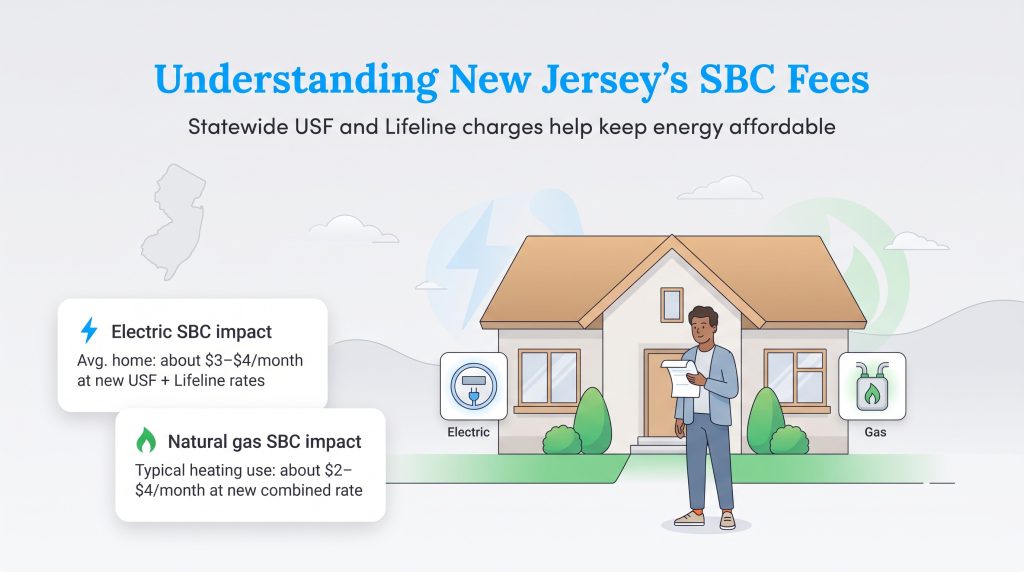
Every regulated electric and gas utility in New Jersey must collect dedicated funds to finance statewide social, economic, and environmental programs. These riders sit inside the Societal Benefits Charge (SBC) section of your monthly statement, representing a statutory mechanism designed to keep utility access affordable for vulnerable households.
Under the NJ BPU 2026/2027 USF and Lifeline order, regulators authorized the collection of $275.2 million across the state beginning Oct. 1, 2026. The revenue splits between two primary energy sectors:
- Retail Electric Distribution: Approximately $199.8 million collected across electric customers.
- Retail Natural Gas Delivery: Approximately $75.4 million collected across natural gas customers.
How the New Electric and Gas Unit Rates Break Down
The adjusted figures fund two programs: the Universal Service Fund (USF), which subsidizes utility bills for low-income residents, and the Lifeline program, which provides utility bill credits for eligible senior citizens and disabled residents.
For electric consumers, the BPU set an interim statewide USF factor of $0.003728 per kilowatt-hour (kWh) and a Lifeline rate of $0.000780 per kWh, producing a combined charge of $0.004508 per kWh. Natural gas customers will pay an approved combined baseline charge of $0.0262 per therm, consisting of a $0.0205 per therm USF component and a $0.0057 per therm Lifeline component.
Why You Pay These Delivery Fees Regardless of Your Energy Supplier
Because the SBC is an authorized distribution delivery rider, these fees are non-bypassable. Even if you choose an independent third-party retail supplier for your electric generation or natural gas supply, your local electric and gas distribution utility still delivers the physical energy through wires and mains. Consequently, all retail customers absorb these updated unit rates regardless of supplier choice.
Monthly Dollar Impact on Typical Households
To see how these non-bypassable charges alter your monthly statement, here is what the updated combined USF and Lifeline fee adds to typical monthly consumption tiers:
| Monthly Electric Usage | Monthly Electric Fee ($0.004508/kWh) | Monthly Gas Usage | Monthly Gas Fee ($0.0262/therm) |
| 500 kWh (Small apartment) | $2.25 | 25 therms (Warm months / cooking) | $0.66 |
| 650 kWh (Statewide baseline) | $2.93 | 75 therms (Moderate fall heating) | $1.97 |
| 750 kWh (Average home) | $3.38 | 100 therms (Average winter heating) | $2.62 |
| 1,000 kWh (Large home / heating) | $4.51 | 160 therms (Peak freezing month) | $4.19 |
PSE&G Secures Rate Certainty for 1.9 Million Gas Customers
While statewide delivery fees are seeing an annual recalculation, natural gas customers in northern and central New Jersey received welcome news on the commodity supply side. The BPU officially accepted a negotiated settlement resolving PSE&G’s 2026/2027 annual Basic Gas Supply Service (BGSS) compliance review.
Documented in the NJ BPU PSE&G BGSS provisional rate settlement, the agreement between the utility, board regulatory staff, and the New Jersey Division of Rate Counsel establishes stable default rates as households head into peak furnace season.
The $0.363 Commodity Price Benchmark
Under the settlement terms, the residential BGSS commodity rate provisionally remains flat at $0.363424 per therm — inclusive of pipeline losses and the New Jersey Sales and Use Tax — through Sept. 30, 2027. Because wholesale natural gas costs fluctuate throughout the year, this provisional rate ensures retail accounts do not face sudden commodity spikes, with any utility over-recoveries refunded back to customers with interest.
At the same time, regulators cut the residential balancing charge to $0.095430 per balancing therm. This administrative charge covers the daily operational costs of balancing gas line pressure across transmission pipelines, lowering overall overhead for 1.9 million residential accounts. You can monitor periodic tariff updates directly on PSE&G monthly commodity gas tariff schedules.
Estimated Winter Supply Costs for PSE&G Ratepayers
When you isolate the variable supply costs and balancing fees on your PSE&G winter gas invoice, here is what you can anticipate paying before general base delivery charges:
| Monthly Winter Consumption | BGSS Commodity Charge ($0.363424/therm) | Balancing Charge ($0.095430/therm) | Non-Bypassable USF/Lifeline Charge ($0.0262/therm) | Subtotal: Key Variable Charges |
| 50 therms (Small unit / mild month) | $18.17 | $4.77 | $1.31 | $24.25 |
| 100 therms (Typical single-family home) | $36.34 | $9.54 | $2.62 | $48.50 |
| 160 therms (Harsh deep freeze) | $58.15 | $15.27 | $4.19 | $77.61 |
Service Territories and Municipalities Impacted by the Rulings
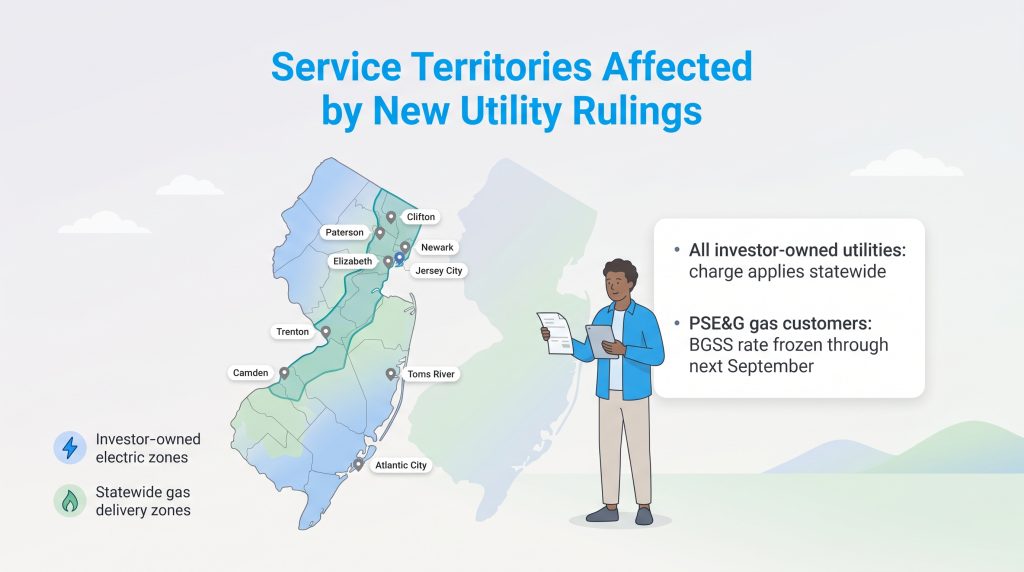
Because these two regulatory orders involve both statewide mandates and company-specific territory rules, the geographic reach spans every corner of the state. Knowing your specific utility provider ensures you understand exactly which changes apply to your address.
Statewide Electric and Natural Gas Delivery Zones
The $275.2 million Societal Benefits Charge rebalancing applies uniformly across all investor-owned utility territories throughout New Jersey’s 21 counties and 564 municipalities.
- Electric Utilities: Customers served by Public Service Electric and Gas Company, Jersey Central Power & Light (JCP&L), Atlantic City Electric, and Rockland Electric Company will all see the $0.004508 per kWh combined factor on their invoices.
- Gas Utilities: In addition to PSE&G, customers receiving gas distribution through New Jersey Natural Gas (NJNG), South Jersey Gas, and Elizabethtown Gas will see the $0.0262 per therm charge applied to their delivered fuel.
- Key Urban Centers: Major cities subject to these delivery riders include Newark, Jersey City, Paterson, Elizabeth, Trenton, Camden, Atlantic City, Toms River, and Clifton.
The PSE&G Gas Distribution Footprint
The BGSS provisional rate freeze specifically protects PSE&G’s natural gas customer base, which stretches across an extensive north-south corridor. The service territory spans large segments of Bergen, Essex, Hudson, Mercer, Middlesex, Passaic, Union, Burlington, Camden, Gloucester, and Somerset counties.
Residents living in urban centers like Newark, Hoboken, Jersey City, New Brunswick, Bayonne, and Trenton who purchase default utility gas supply will enjoy this steady $0.363424 per therm commodity pricing through next September.
Smart Ratepayer Strategies to Protect Your Monthly Budget
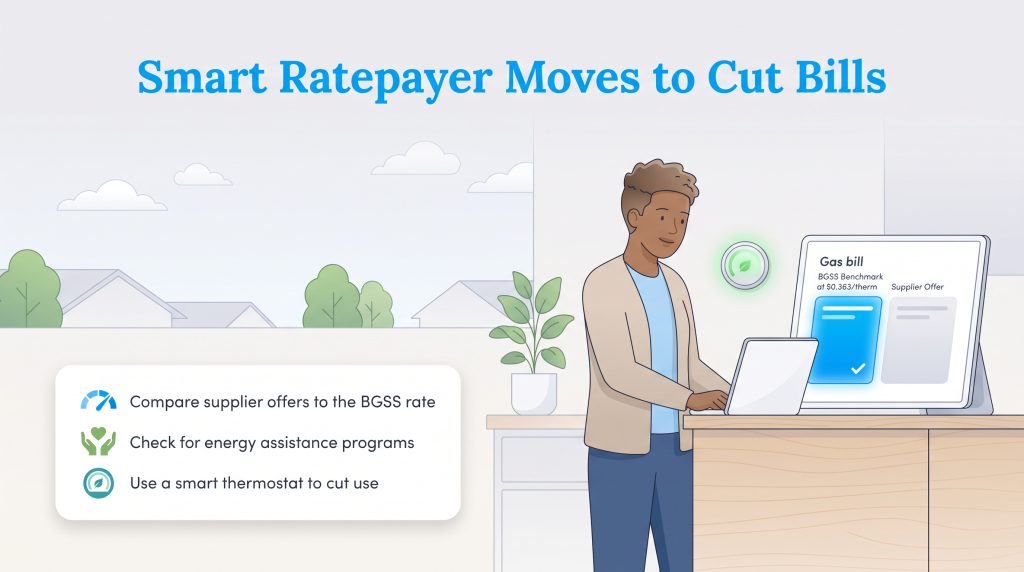
Navigating utility deregulation can feel confusing, but state regulatory baseline filings actually give you substantial leverage. With delivery fees fixed by law, controlling your monthly total requires smart energy habits and disciplined shopping.
Use the BGSS Rate as Your Shopping Benchmark
If an independent energy supplier contacts you via mail, phone, or door-to-door sales offering to manage your natural gas, check their offer against the BPU benchmark. PSE&G’s default rate of roughly $0.363 per therm represents your “Price to Compare.” Any third-party retail gas contract priced above $0.363 per therm will instantly increase your monthly winter bills. Watch out for variable plans that lure you in with low teaser rates for three months before jumping significantly higher.
Check Your Eligibility for Funded Assistance
If you or someone in your community struggles with energy expenses, remember that your delivery dollars directly finance support programs. New Jersey households spending over 2% of their annual income on electric or 2% on natural gas bills may qualify for the Universal Service Fund, which provides ongoing monthly bill credits up to $180 per month. You can also explore emergency assistance through the Low-Income Home Energy Assistance Program (LIHEAP) and the state Lifeline program.
Adopt Low-Cost Energy Efficiency Habits
Reducing consumption is the only guaranteed way to trim both delivery and supply fees simultaneously. Making an environmentally mindful choice like installing an ENERGY STAR certified smart thermostat can trim heating bills by up to 10% each winter. Setting your thermostat 7° to 10°F lower while you are sleeping or out of the house keeps your home comfortable while preventing fuel waste.
How to Keep Your New Jersey Energy Bills Manageable This Winter
State utility rate changes can feel out of your control, but understanding how delivery riders and supply charges operate gives you a distinct advantage. While non-bypassable Societal Benefits Charges ensure vital lifeline support for our most vulnerable neighbors, PSE&G’s stable commodity supply ceiling provides dependable price predictability throughout the colder months. By using the BPU’s approved rates as your baseline shopping guide, staying alert to third-party contract terms, and utilizing seasonal energy efficiency improvements, you can maintain a warm home without taking a heavy hit to your household finances.
Frequently Asked Questions About New Jersey Utility Rates
What is the Societal Benefits Charge on my New Jersey utility bill?
Can I avoid paying the Universal Service Fund fee by switching to an independent energy supplier?
What is PSE&G’s Basic Gas Supply Service rate for winter 2026/2027?
How can I tell if a third-party natural gas supplier is offering a good deal?
About the Author

Claudio is a sustainability-focused writer with a background in Anthropology and Psychology from NC State University. He has spent over 15 years working in writing, interpretation, and translation, driven by a deep interest in how human culture shapes the environment. Today, he shares his curiosity with readers by writing about sustainable living solutions and the connection between everyday choices and environmental impact.