
A wave of sweeping legislation and immediate summer relief is hitting Garden State utility bills next month.
Key Takeaways
- Standard residential customers will receive a $25 bill credit in August 2026, while low-income households will get a $150 additional boost.
- New state laws mandate regional grid membership, which will wipe out $60 million in annual transmission charges previously passed to consumers.
- State regulators are creating a separate rate class for large data centers to shield standard homes from paying for corporate infrastructure upgrades.
Setting up utilities in New Jersey can feel like riding a financial rollercoaster, especially after the average 20% rate spike that hit households last summer. We know how stressful it is to open a monthly bill and see costs climbing, which is why we are here to break down a massive new package of energy laws signed by Governor Mikie Sherrill on July 7, 2026. From direct summer bill credits to long-term grid reforms that stop utility companies from passing wasteful spending down to you, these changes are designed to bring some much-needed relief to your wallet. Let’s look at exactly why your electricity rates are changing, which major cities are affected, and the easy steps you can take today to lock in lower costs and make your home more energy-efficient.
The Summer Relief Blueprint: Your August 2026 Bill Credits
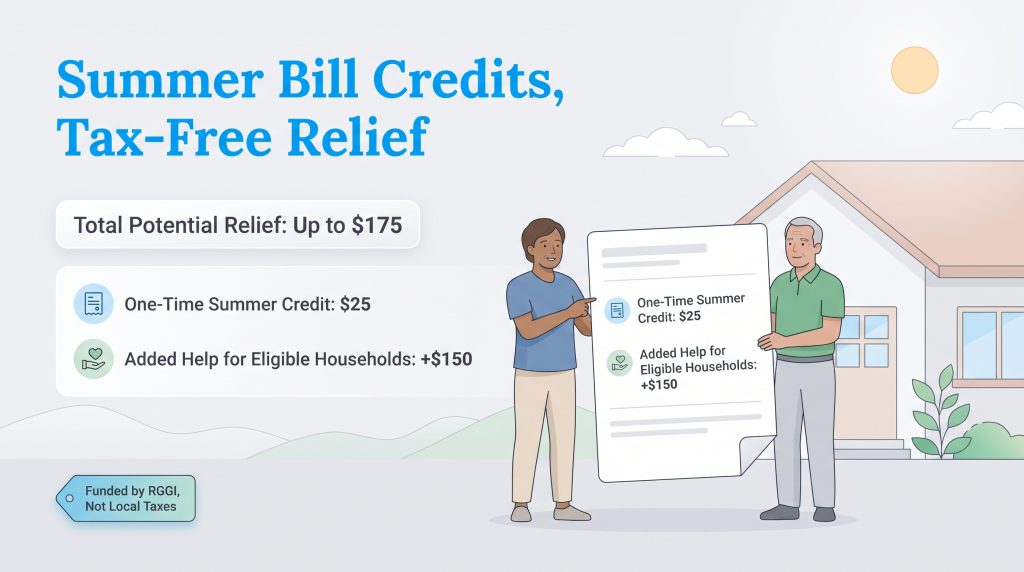
As sweltering summer temperatures drive up air conditioning usage, the state administration is rolling out $90 million in immediate utility relief. If you have an active residential electric account, you will automatically receive a one-time $25 credit on your bill in August 2026 through the Residential Universal Bill Credit program. Even better, this money is pulled from the state’s Regional Greenhouse Gas Initiative proceeds, meaning it doesn’t come out of your local tax dollars.
Targeted Relief for Low-Income Households
If your household qualifies for the state’s Residential Energy Assistance Payment program, you are eligible for an additional $150 credit, bringing your total direct summer relief to $175 next month. This targeted boost is designed to ease the burden on fixed-income families and seniors who are hit hardest by rising energy costs. To see if you qualify for these income-based credits, we encourage you to use the state’s online screening resources.
Why Are New Jersey Utility Rates Changing?
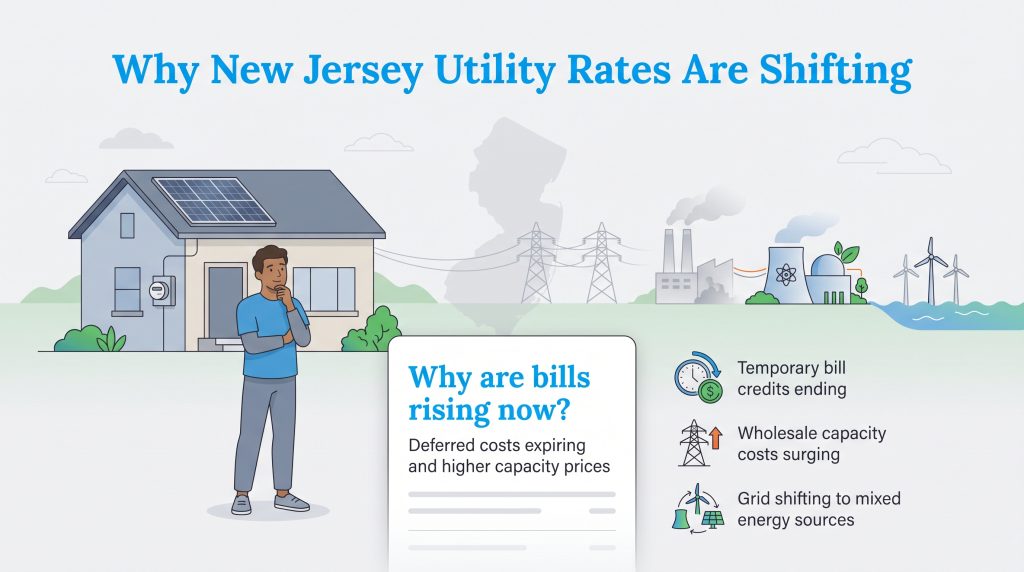
While the upcoming bill credits are incredibly helpful, you might be wondering why New Jersey utility prices have felt so volatile lately. The immediate rate pressure stems from the expiration of the Temporary Supply Offset Clause on May 31, 2026. Last summer, default electric supply rates spiked by 17.24%, and while the state temporarily deferred a portion of those costs to smooth out the impact, customers are now seeing baseline rates return to their full uncredited levels.
Grid-Level Bottlenecks and Capacity Price Surges
Behind the scenes, the regional grid operator — PJM Interconnection — has been struggling with resource adequacy across its 13-state network. As older, inefficient coal plants are retired, the grid is facing delays in connecting replacement generation systems to the high-voltage transmission lines. This supply squeeze has triggered unprecedented inflation in wholesale capacity market prices, which utility companies recover directly from your bill.
Clean Energy Setbacks and Pivots
New Jersey’s ambitious coastal clean-energy transition also hit a few roadblocks recently. High-profile offshore wind projects stalled after Shell exited the Atlantic Shores project, and state regulators canceled a major transmission agreement with PJM. In response, the state is shifting to an “all-of-the-above” generation strategy. This includes lifting a 50-year de facto moratorium on new nuclear power development and passing the Garden State Balcony Solar Act, which lets renters plug small-scale panels directly into standard outlets.
Dismantling Corporate Loopholes: What the New Laws Do
To protect you from these rising wholesale costs, the state legislature passed three landmark energy affordability laws on July 7, 2026. These laws are designed to shift infrastructure costs away from standard homes and force utility companies and large corporations to pay their fair share. Combined with other state policies, these reforms are projected to save New Jersey ratepayers more than $1 billion annually.
Mandating Grid Membership to Cut Transmission Fees
The first new law, S1673/A2757, mandates that all New Jersey utilities maintain membership in the regional grid operator, PJM. Previously, utilities voluntarily joined PJM and were rewarded with an extra 0.5% return on equity, which was passed directly to you through higher transmission rates. By making membership a legal mandate, utilities are stripped of this voluntary incentive, wiping out approximately $60 million in annual transmission charges.
Capping Wasteful Utility Spending
The second law, S4411/A5188, targets the lack of oversight on “supplemental transmission projects” like localized wires, poles, and substations. Between 2008 and 2025, utility companies spent $14.7 billion on these projects with zero state oversight, passing the entire bill to consumers. Now, utilities must get a Certificate of Public Convenience and Necessity from the Board of Public Utilities before building. If they choose an energy-saving option — such as advanced battery storage or smart grid technology — the state will fast-track their project review.
Holding Massive Data Centers Accountable
The third law, S731/A796, creates a separate ratepayer class for massive data centers that draw 50 megawatts or more of power. A single 50-megawatt facility uses enough electricity to power up to 25,000 standard homes, placing an immense strain on the local grid. To shield you from paying for corporate grid expansions, data center developers must now provide a 10-year financial guarantee to pay for at least 85% of their requested power. Additionally, if the grid gets strained during extreme summer heat waves, utilities must cut power to these commercial giants before initiating residential rolling blackouts.
Geographic Impact: Major Cities and Utilities Affected
These changes will directly impact standard ratepayers across the state, but the effects will be most visible in high-density metropolitan zones. Major cities like Newark, Jersey City, Camden, Elizabeth, and Trenton fall squarely under these new regulatory frameworks. In urban environments, where a higher percentage of families rent and live on fixed incomes, energy assistance programs are crucial safety nets.
The state is targeting these major urban areas with specialized relief. For example, the state’s budget includes a $100 million loan to Jersey City to help ease municipal budget pressures. The specific utility providers implementing these new ratepayer protections and summer bill credits include:
- Public Service Electric and Gas (PSE&G)
- Jersey Central Power & Light (JCP&L)
- Atlantic City Electric
- Rockland Electric
Take Control: Smart Ways to Manage Your Monthly Bill
You do not have to sit back and watch your energy costs climb. In New Jersey’s deregulated energy market, you have several tools at your disposal to lower your utility bills and make your home more environmentally friendly.
Harnessing New Jersey Energy Choice
Under the state’s Energy Choice guidelines, you have the legal right to switch your electricity or natural gas supply provider to an independent third-party company. Your default utility company will still physically deliver the energy, manage the grid, and respond to emergencies, but you can shop around for a cheaper supply rate. To protect yourself from variable-rate spikes, we recommend looking for a licensed third-party supplier offering a fixed-rate contract below your utility’s default rate. You can safely browse licensed suppliers on the state-certified shopping portal, NJ Power Switch. Always verify the contract terms to avoid unexpected fees, and keep an eye out for “slamming” — the illegal practice of switching your energy provider without your explicit consent.
Joining a Government Energy Aggregation Program
Many New Jersey municipalities are banding together to buy electricity in bulk, helping residents secure lower supply rates. These Government Energy Aggregation programs are currently active in 30 communities across the state, including cities like Hoboken. These programs are designed with consumer choice in mind: you are automatically enrolled at a competitive bulk rate, but you can opt out at any time without a penalty. Many aggregation programs offer an environmentally mindful choice, such as a 100% green renewable option, allowing you to easily support clean energy while saving money.
Accessing State-Sponsored Assistance and Efficiency Programs
If you are struggling to keep up with your bills, New Jersey offers a comprehensive portfolio of assistance initiatives. The state’s Summer Termination Program protects qualifying households from shutoffs during sweltering heat waves from June 15 through Aug. 31. To make it easy, you can check your eligibility and apply for multiple programs through the DCAid Portal.
| Utility Program | Best For | Typical Benefit | Eligibility Threshold |
| LIHEAP | Heating and cooling bill assistance | Average of $300 to $360 toward seasonal bills | Gross income $\le$ 60% of State Median Income |
| Universal Service Fund (USF) | Ongoing monthly bill reduction | Monthly credit ranging from $20 to $200 | Gross income $\le$ 60% of State Median Income |
| PAGE | Moderate-income emergency assistance | Up to $700 in emergency crisis grants | Moderate income above USF limits |
| Comfort Partners | Making homes energy-efficient at no cost | Free energy audits, smart thermostats, and upgrades | Gross income $\le$ 250% of Federal Poverty Line |
For more general information on consumer rights and utility protections, you can browse the resources provided directly by the New Jersey Board of Public Utilities.
Stepping Together Into a Fairer Energy Future
New Jersey’s regulatory overhaul represents a bold step toward creating a balanced, reliable, and affordable energy system. While macroeconomic pressures and delayed clean energy developments will continue to shape our wholesale markets, these new state-level guardrails ensure that standard households are no longer left carrying the financial burden for major corporate expansions. By pairing these structural reforms with your own proactive energy decisions — whether that means exploring green third-party suppliers, participating in a municipal bulk-buying program, or taking advantage of state assistance — you can protect your household budget and build a sustainable home.
About the Author

Claudio is a sustainability-focused writer with a background in Anthropology and Psychology from NC State University. He has spent over 15 years working in writing, interpretation, and translation, driven by a deep interest in how human culture shapes the environment. Today, he shares his curiosity with readers by writing about sustainable living solutions and the connection between everyday choices and environmental impact.