
CenterPoint, Columbia Gas, and Duke Energy announce steep rate cuts for March. Here is why the market flipped and how you can use Energy Choice Ohio to your advantage.
Key Takeaways
- Massive Rate Relief for March: Following severe winter price spikes, Ohio’s major natural gas utilities, including Columbia Gas, CenterPoint, Duke Energy, and Enbridge Gas, have announced steep default supply rate reductions for March 2026. Customers could see pure commodity supply costs plummet by over 40% to 56% in some territories.
- Weather and Record Production Driving the Drop: The sudden wholesale price collapse is fueled by a shift toward milder weather forecasts and record-breaking U.S. natural gas production exceeding 110 billion cubic feet per day. This massive influx of domestic supply easily overwhelmed waning late-winter heating demand.
- Total Bills Remain Historically High: Despite the recent drop in wholesale commodity costs, the average Ohio utility bill is substantially higher today than in previous years. Rising base distribution rates and pipeline infrastructure replacement riders approved by state regulators continue to elevate the floor of consumer energy expenses.
- The Perfect Time to Lock in Rates: With the market entering the transitional “shoulder months,” consumers have a highly lucrative opportunity to utilize Ohio’s Energy Choice program. Securing a fixed-rate competitive contract now can shield households from future winter volatility and guarantee long-term budget predictability.
The Ohio natural gas market is currently undergoing a period of intense price recalibration. Following a highly volatile winter season characterized by extreme weather events, acute demand spikes, and substantial commodity price inflation, residential utility customers across the state are finally poised to experience significant financial relief.
As you review your March 2026 billing cycles, you will likely notice that the standard default supply rates for the state’s major regulated utilities, most notably Columbia Gas of Ohio, CenterPoint Energy Ohio, Duke Energy Ohio, and Enbridge Gas Ohio, have registered steep, unprecedented month-over-month declines.
Understanding Your Ohio Natural Gas Bill
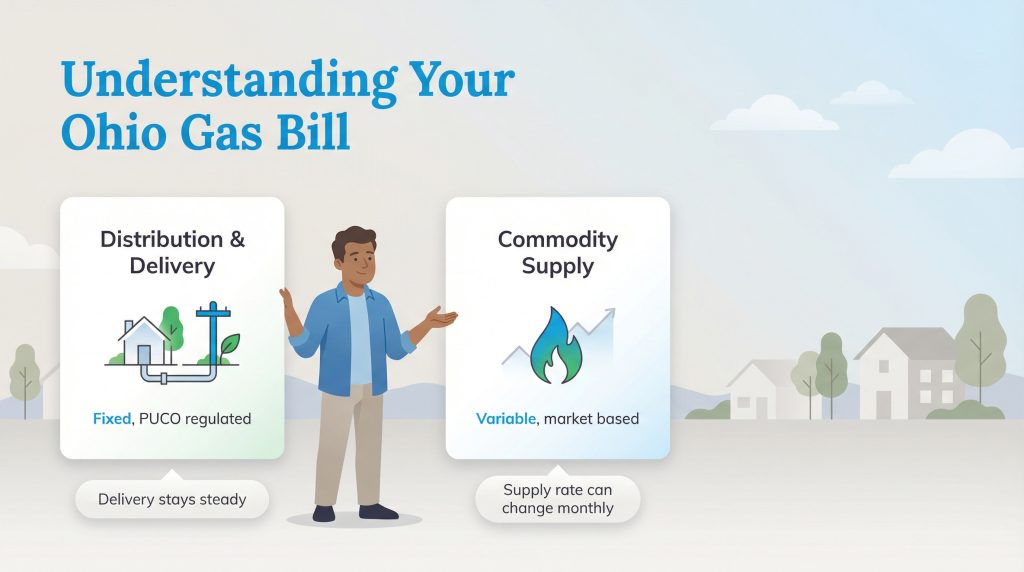
To fully contextualize the magnitude of the March 2026 rate reductions, it helps to understand the bifurcated nature of natural gas billing in Ohio. The Public Utilities Commission of Ohio (PUCO) oversees a deregulated energy market where the physical delivery of natural gas is strictly separated from the supply of the commodity itself.
Your residential natural gas bill comprises two primary components:
- Distribution and Delivery Charges: These are regulated fees collected by local distribution companies (LDCs) to maintain pipeline infrastructure, ensure operational safety, and physically transport the natural gas to your home. These base rates are fixed by PUCO and are immune to the daily fluctuations of the commodities market.
- Commodity Supply Charges: This represents the actual market cost of the natural gas you consumed. Under the Energy Choice Ohio program, you have the legal right to choose an independent competitive supplier. If you do not choose one, your local utility is mandated to provide gas at a default, regulated rate, most commonly known as the Standard Choice Offer (SCO) or the Gas Cost Recovery (GCR) rate.
The SCO is a dynamically adjusting, monthly variable rate tied directly to the New York Mercantile Exchange (NYMEX) month-end settlement price. The GCR, utilized historically by utilities like Duke Energy, operates slightly differently, providing a dollar-for-dollar recovery of the exact costs incurred by the utility to purchase gas, often averaging out historical costs to minimize extreme month-to-month shock.
March 2026 Utility Rate Trajectories: By the Numbers
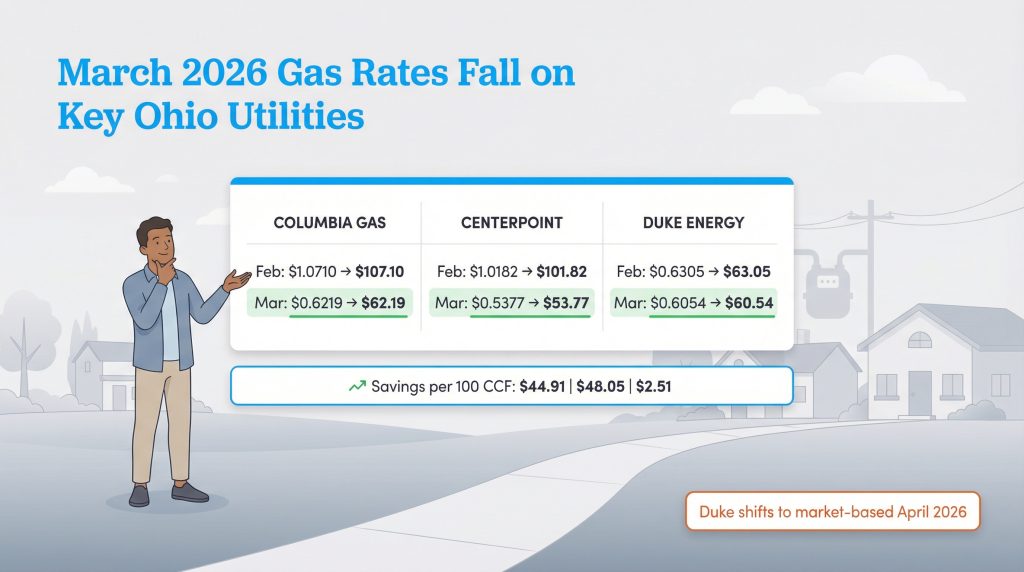
The transition from the February 2026 billing cycle to March 2026 illustrates a dramatic cooling of wholesale commodity prices. Here is how it impacts the major providers:
Columbia Gas of Ohio
Columbia Gas of Ohio is the state’s largest natural gas provider, serving the greater Columbus metropolitan area, Toledo, Springfield, and numerous mid-sized municipalities extending into the eastern Appalachian corridor.
During the peak of the winter heating season in February 2026, the utility’s SCO rate surged to an unprecedented $1.0710 per CCF (Hundred Cubic Feet). However, effective for the billing period extending through March 31, 2026, the SCO rate has plummeted to $0.6219 per CCF.
This represents a precipitous month-over-month decrease of 41.9%. For a household consuming a standard benchmark of 100 CCF during this period, the supply portion of the bill will drop from $107.10 in February to $62.19 in March, yielding direct supply savings of approximately $44.91.
| Columbia Gas of Ohio Historical SCO Rates | Rate per CCF |
| December 2024 | $0.5091 |
| March 2025 | $0.5566 |
| December 2025 | $0.7674 |
| January 2026 | $0.7937 |
| February 2026 | $1.0710 |
| March 2026 | $0.6219 |
CenterPoint Energy Ohio
CenterPoint Energy Ohio serves the western and southwestern corridors of the state, acting as the primary energy lifeline for the city of Dayton and surrounding highly populated suburbs like Centerville, Kettering, and Miamisburg.
The pricing trajectory for CenterPoint Energy has mirrored the extreme volatility of the broader market. In February 2026, the SCO rate exploded to $1.0182 per CCF. Effective March 1, 2026, CenterPoint’s SCO rate has been sharply adjusted downward to $0.5377 per CCF.
This massive 47.1% reduction from the February peak means that, based on an average consumption of 100 CCF, residential customers will see their pure commodity supply costs decrease from $101.82 to $53.77, generating roughly $48.05 in monthly savings.
| CenterPoint Energy Ohio Historical SCO Rates | Rate per CCF |
| January 2024 | $0.3800 |
| March 2025 | $0.5500 |
| December 2025 | $0.6900 |
| January 2026 | $0.7215 |
| February 2026 | $1.0182 |
| March 2026 | $0.5377 |
Duke Energy Ohio
Duke Energy Ohio operates across 3,000 square miles in the southwestern tip of the state, heavily concentrated in the greater Cincinnati area and surrounding municipalities like Hamilton and Middletown. Currently, Duke utilizes the GCR rate structure for its default customers.
In February 2026, the GCR rate spiked to $0.6305 per CCF. For the current March 2026 billing cycle, the GCR rate has experienced a modest reduction, dropping to $0.6054 per CCF. The impact for Duke Energy customers is noticeably less pronounced than for those on the SCO framework (yielding savings of roughly $2.51 per 100 CCF). This is directly attributable to the GCR mechanism, which prevents the extreme peaks seen in SCO rates but also delays the realization of extreme market troughs.
Important Note: Effective April 1, 2026, Duke will abandon the historical GCR method and transition to a fully market-based Standard Service Offer (SSO), which will mirror the SCO mechanisms of CenterPoint and Columbia Gas, exposing customers to higher degrees of month-to-month volatility.
Enbridge Gas Ohio (Formerly Dominion Energy)
Enbridge Gas Ohio operates a slightly different pricing structure compared to its southern Ohio counterparts, pricing its natural gas predominantly in Thousand Cubic Feet (MCF).
For the billing period extending from February 10 through March 10, 2026, Enbridge’s SCO rate had spiked to $7.960 per MCF (which equates to roughly $0.796 per CCF). However, effective today, March 11, 2026, Enbridge has implemented a massive rate reduction, dropping their SCO rate to $3.469 per MCF.
This downward adjustment represents a stunning 56.4% decrease in commodity supply costs. For an average home consuming 10 MCFs a month, this effectively drops the pure supply portion of the bill from nearly $80 down to approximately $34.69.
| Enbridge Gas Ohio Historical SCO Rates | Rate per MCF |
| January 2026 | $5.187 |
| February 2026 | $7.960 |
| March 11, 2026 | $3.469 |
Behind the Scenes: Why Are Rates Plummeting?
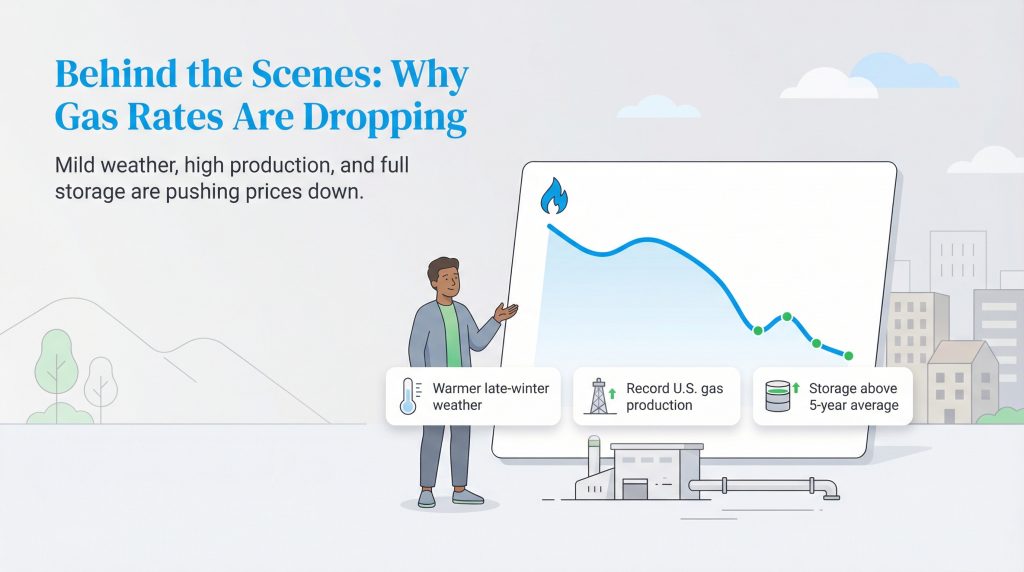
The precipitous drop in consumer natural gas rates for March 2026 is the downstream manifestation of a globally interconnected commodities market. Several interlocking, systemic factors have precipitated this price collapse:
- Weather Normalization: In January and early February, Winter Storm Fern unleashed subzero temperatures, triggering an aggressive spike in heating demand. By late February, updated meteorological forecasts predicted above-average temperatures across the lower 48 states, effectively destroying near-term heating demand projections and prompting commodity traders to aggressively sell off front-month contracts.
- Record Domestic Production: The United States is currently operating in an era of historical energy dominance. Domestic natural gas output recently surged to an astonishing 110 billion cubic feet per day. This massive, relentless influx of supply easily overwhelmed the waning late-winter demand.
- Storage Surpluses: Despite massive drawdowns caused by Winter Storm Fern, the sheer volume of baseline production meant that subterranean storage deficits were quickly mitigated. With U.S. storage levels running above the five-year average, the market faced intense downward price pressure.
| NYMEX Henry Hub Historical Settlement Prices (March Contracts) | Price per MMBtu |
| March 2017 | $2.627 |
| March 2018 | $2.639 |
| March 2019 | $2.855 |
| March 2020 | $1.821 |
| March 2021 | $2.854 |
| March 2022 | $4.568 |
| March 2023 | $2.451 |
| March 2024 | $1.615 |
| March 2025 | $3.906 |
| March 2026 | $2.969 |
While domestic fundamentals are bearish, international events, such as the recent drone strike on Qatar’s Ras Laffan plant (which accounts for 20% of global LNG supply), continue to inject structural volatility, keeping the market unpredictable.
The Catch: Why Total Bills Are Still Up
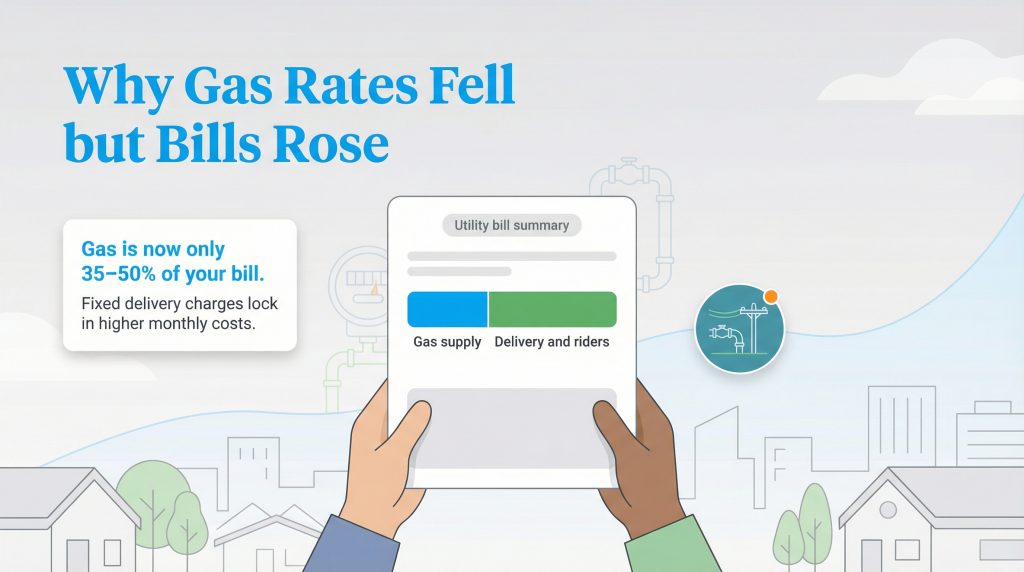
While the drop in the March 2026 SCO and GCR rates is cause for immediate optimism, a multi-year analysis reveals a troubling paradox: total utility bills in Ohio are significantly higher today than they were half a decade ago, regardless of wholesale commodity price drops.
This paradox is explained by the escalating cost of utility distribution riders and base rate increases. The physical gas itself now only accounts for 35% to 50% of the total cost of a residential utility bill. PUCO has routinely authorized utilities to implement fixed infrastructure riders to fund necessary grid modernization and pipeline replacement. These charges have collectively added $15 to $20 to the average monthly bill over the last several years alone. While these investments are critical for public safety, the capital expenditure is passed directly onto the ratepayer, permanently elevating the structural floor of your total utility bill.
Action Plan: How to Take Advantage and Lock In
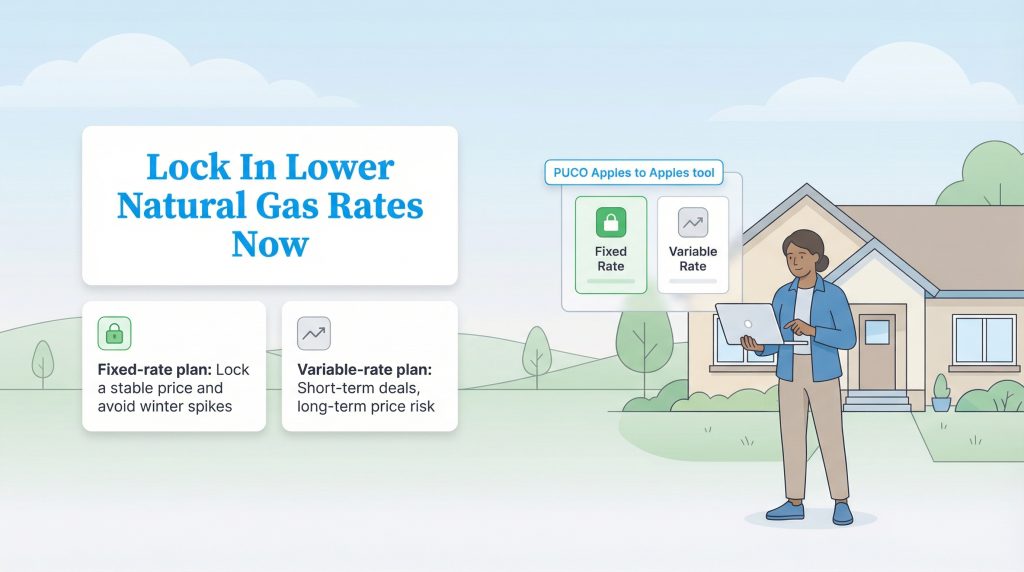
With SCO and GCR rates falling rapidly in March, residential consumers are presented with a highly lucrative, yet fleeting, opportunity to proactively manage future utility expenses.
In the energy sector, March through April are known as “shoulder months.” Moderate weather significantly reduces the demand for natural gas heating, suppressing market prices. Consequently, competitive energy suppliers are able to procure natural gas futures at lower wholesale costs, allowing them to offer retail customers highly attractive fixed-rate contracts.
By utilizing the PUCO Apples to Apples Comparison tool, consumers can secure market hedges. Here is a look at the landscape:
- Fixed-Rate Plans: These contracts lock in a specified price per CCF for a predetermined term (e.g., 6 to 36 months). A fixed rate shields you from future winter price spikes and offers vital budget predictability.
- Variable-Rate Plans: These fluctuate monthly. While they may offer aggressive promotional rates right now, they expose you to the exact market volatility that caused February bills to double.
Current Competitive Offers (CenterPoint Territory Example)
Several highly competitive fixed-rate plans currently actively undercut the March 2026 default SCO rates.
| Supplier (CenterPoint Territory) | Rate per CCF | Term Length | Early Termination Fee (ETF) | Monthly Fee |
| Utility Gas and Power | $0.4990 | 12 months (Fixed) | $150.00 | $0.00 |
| Ohio Natural Gas | $0.5590 | 12 months (Fixed) | $12.50 | $0.00 |
| CleanSky Energy | $0.6490 | 6 months (Fixed) | $50.00 | $0.00 |
| AEP Energy Inc. | $0.6990 | 24/36 months (Fixed) | $0.00 | $0.00 |
| IGS Energy | $0.8490 | 12 months (Fixed) | $99.00 | $0.00 |
Note: Before entering the private market to secure an individual fixed-rate contract, verify if you reside in a municipality that participates in a governmental aggregation program (like NOPEC), as these programs often negotiate bulk, fixed-rate contracts on behalf of their citizens that bypass default utility volatility altogether.
The Bottom Line
The March 2026 natural gas rate reductions represent a vital reprieve for Ohio consumers battered by winter utility bills. However, relying passively on utility default rates exposes you to systemic, compounding financial risk.
The structural realities of the deregulated market demand active consumer engagement. The current transition into the spring shoulder months provides an optimal window to leverage the PUCO Apples to Apples comparison tool, lock in fixed-rate supply contracts at deeply depressed valuations, and secure long-term budget predictability in an inherently unpredictable energy landscape.
About the Author

David has been an integral part of some of the biggest utility sites on the internet, including InMyArea.com, HighSpeedInternet.com, BroadbandNow.com, and U.S. News. He brings over 15 years of experience writing about, compiling and analyzing utility data.