
November Rate Hikes Signal Higher Heating Costs Across the Bay State
Key Takeaways
- Massachusetts utility providers implemented mandatory winter rate increases effective Nov. 1, 2026, with gas supply charges jumping substantially compared to off-peak October levels.
- Berkshire Gas, Eversource, National Grid, Unitil, and Liberty Utilities each filed higher Gas Adjustment Factors (GAF) that more than double per-therm supply charges for many households.
- Ratepayers can mitigate rising bills through Mass Save energy assessments, heating assistance programs, and competitive supplier rate evaluations.
Heating your home in Massachusetts is set to cost considerably more as winter sets in, following state-approved natural gas rate increases that took effect on Nov. 1, 2026. Every regulated gas distribution company in the Commonwealth — including National Grid, Eversource, Berkshire Gas, Unitil, and Liberty Utilities — adjusted its seasonal Gas Adjustment Factor (GAF) and Local Distribution Adjustment Factor (LDAF) upward. Driven by regional pipeline constraints, higher winter wholesale procurement costs, and lingering reconciliation adjustments from previous cold snaps, the rate adjustments push per-therm supply costs well above summer and early-autumn levels. For millions of residents already navigating high New England living costs, understanding where these hikes landed and how to manage winter usage will be crucial over the coming months.
Why Natural Gas Rates Increased on November 1
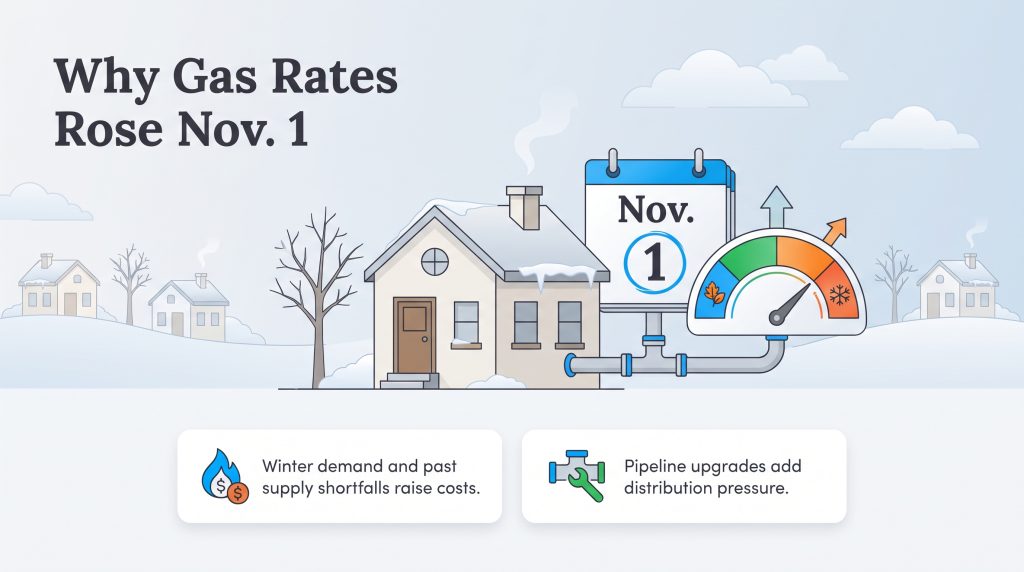
Natural gas rates in Massachusetts follow a distinct semi-annual schedule governed by the Massachusetts Department of Public Utilities (DPU). Each year, the state’s peak winter pricing period begins Nov. 1 and runs through April 30, replacing the off-peak summer period that ends Oct. 31. Because wholesale market demand for natural gas spikes during cold weather — when homes require fuel for heating and regional power plants burn gas to generate electricity — utilities must pay a premium to secure fuel supplies.
The November 2026 rate jump is also heavily influenced by regulatory reconciliation balances. Under Massachusetts law, utilities supply gas to default customers at cost, without marking up the price for corporate profit. When wholesale commodity markets surge above forecast mid-winter, local utilities often under-collect default supply costs. Those unrecovered expenses roll over into subsequent winter rate calculations, elevating the baseline per-therm cost for residential customers. Combined with ongoing capital spending to modernize aging distribution mains and pipeline systems under the state’s infrastructure safety programs, both supply and distribution components saw upward pressure this season.
Because Massachusetts operates a restructured natural gas market, residential customers have the option to choose competitive third-party retail gas suppliers for their supply service rather than staying on the default utility rate. While distribution lines remain managed by the regulated utility, choosing a competitive supplier allows homeowners to compare fixed and variable supply rates to protect against winter volatility.
Provider-by-Provider Rate Breakdown for Winter 2026–2027
To see the exact change on your monthly statement, look at the supply portion of your bill, listed as the Gas Adjustment Factor (GAF) per therm. Below is an overview of standard residential heating default supply rates (R-3) and delivery charges (LDAF) approved for Massachusetts utilities, effective Nov. 1, 2026, through April 30, 2027.
| Gas Utility Provider | Summer Supply Rate (GAF) | Winter Supply Rate (GAF) | % Change (Supply) | Winter LDAF Delivery Charge |
|---|---|---|---|---|
| Berkshire Gas Company | $0.3194 / therm | $1.0048 / therm | +214.6% | $0.5305 / therm |
| Eversource Gas of MA (Columbia Gas) | $0.3145 / therm | $0.9447 / therm | +200.4% | $0.6299 / therm |
| Eversource (NSTAR Gas) | ~$0.30–$0.33 / therm | $0.8644 / therm | ~+162% to +188% | $0.7434 / therm |
| National Grid (Boston Gas) | ~$0.32–$0.35 / therm | $0.9809 / therm | ~+180% to +206% | $0.6809 / therm |
| National Grid (Colonial Gas) | ~$0.32–$0.35 / therm | $0.9809 / therm | ~+180% to +206% | $0.5039 / therm |
| Fitchburg Gas & Electric (Unitil) | $0.3468 / therm | $0.7868 / therm | +126.9% | $1.1637 / therm |
| Liberty Utilities (Fall River/Attleboro) | ~$0.33–$0.36 / therm | $0.9120 / therm | ~+153% to +176% | $0.5417 / therm |
| Liberty Utilities (Blackstone) | ~$0.38–$0.42 / therm | $1.3570 / therm | ~+223% to +257% | $0.3920 / therm |
Note: Total billed amounts also include monthly customer charges, base distribution volumetric fees, and energy efficiency line items approved by the DPU.
Berkshire Gas Company
Berkshire Gas customers in Western Massachusetts experienced one of the sharpest month-over-month supply adjustments. The default supply charge jumped from $0.3194 per therm in October to $1.0048 per therm on Nov. 1. A typical residential customer consuming 120 therms during a brisk December or January billing period will see their supply cost alone climb from around $38 to over $120.
Eversource Energy (NSTAR and EGMA)
Eversource serves residential customers across greater Boston and the Pioneer Valley under separate legacy operating territories. Customers in the Eversource Gas Company of Massachusetts (formerly Columbia Gas) division saw their heating supply rate jump from $0.3145 per therm to $0.9447 per therm. In the NSTAR Gas territory, the supply rate rose to $0.8644 per therm, paired with an LDAF charge of $0.7434 per therm.
National Grid (Boston Gas and Colonial Gas)
Representing the largest customer base in Massachusetts, National Grid’s Boston Gas and Colonial Gas divisions saw their default residential heating supply rate reset to $0.9809 per therm on Nov. 1. This represents a jump of nearly three times the off-peak summer rate. With base delivery rates and energy efficiency surcharges added, residential customers heating free-standing homes can anticipate seasonal monthly bills regularly exceeding $250 during the coldest stretches.
Unitil and Liberty Utilities
Unitil customers in North Central Massachusetts face a default supply charge of $0.7868 per therm coupled with an elevated LDAF delivery component of $1.1637 per therm, making total per-therm volumetric costs among the highest in the state. Liberty Utilities customers in Fall River and North Attleboro will pay a supply rate of $0.9120 per therm, while its smaller Blackstone service territory reflects a peak supply rate of $1.3570 per therm.
Impacted Massachusetts Communities and Service Territories
The November rate adjustments affect nearly all natural gas heating customers across the Commonwealth, spanning urban, suburban, and rural regions. Because utilities operate under strict geographic franchises, your physical location dictates your gas distributor.
Greater Boston and Eastern Massachusetts
National Grid’s Boston Gas footprint covers much of Suffolk, Middlesex, and Norfolk counties, including Boston, Cambridge, Somerville, Quincy, Newton, and Waltham. Eversource’s NSTAR division serves neighboring communities such as Framingham, Natick, Somerville, and Cambridge, as well as portions of the South Shore.
North Shore, Merrimack Valley, and Central Massachusetts
National Grid’s Colonial Gas division delivers gas across Lowell, Andover, Haverhill, and sections of Cape Ann. Unitil manages natural gas infrastructure primarily in northern Worcester County, encompassing Fitchburg, Lunenburg, Ashby, and Townsend.
Western Massachusetts and the Pioneer Valley
The Berkshire Gas service territory covers 20 western communities in Berkshire and Franklin counties, including Pittsfield, North Adams, Greenfield, and Amherst. Eversource Gas Company of Massachusetts provides delivery services to major Pioneer Valley population centers, including Springfield, Chicopee, Holyoke, and Westfield.
South Shore, Bristol County, and the Blackstone Valley
Liberty Utilities serves southern Massachusetts communities centered in Bristol County, such as Fall River, Somerset, Swansea, North Attleboro, and Plainville, alongside the Blackstone Valley municipality of Blackstone.
Actionable Steps to Protect Your Household Budget
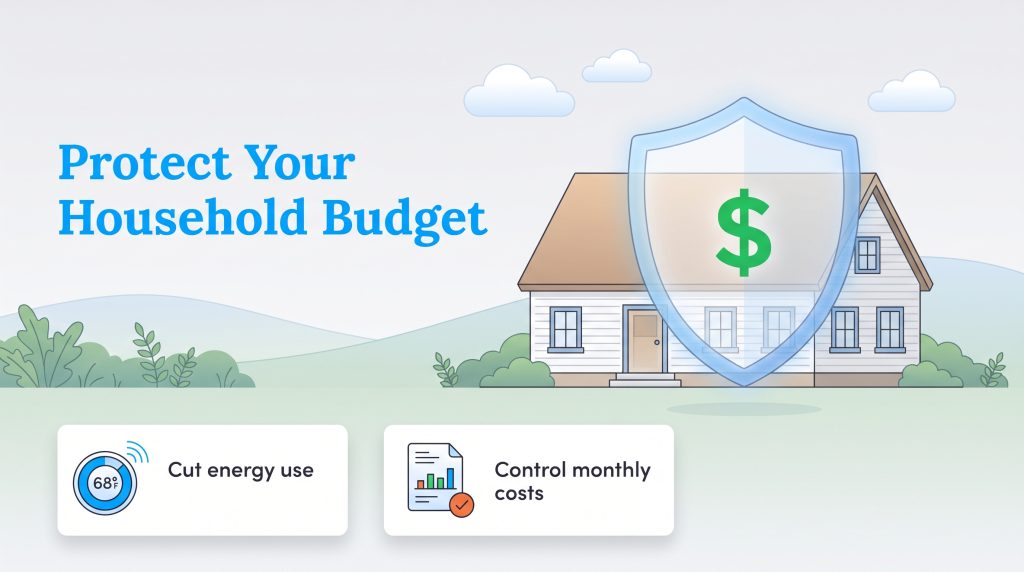
While wholesale utility rate increases are unavoidable if you stay on standard default service, you can take practical steps to reduce your overall monthly expenses.
- Schedule a No-Cost Home Energy Assessment: Connect with Mass Save to schedule an energy assessment. Technicians provide 75% to 100% off approved insulation upgrades, air sealing at no charge, and rebates of up to $10,000 for energy-efficient heat pump conversions.
- Install a Smart Thermostat: Lowering your home temperature by 7° to 10° for eight hours a day can save up to 10% annually on heating costs, according to the U.S. Department of Energy. Smart thermostats automate these adjustments while you sleep or work.
- Enroll in Budget Billing: Massachusetts utilities offer levelized budget billing programs that spread your annual utility costs into equal monthly installments, preventing sudden financial shocks during December, January, and February.
- Compare Competitive Gas Suppliers: Review alternative retail gas suppliers to see if locking in a fixed per-therm contract offers lower prices than default service. Check contract lengths, ensure there are no early cancellation penalties, and verify terms carefully before signing.
- Apply for Fuel Assistance and Utility Discounts: If your income falls below 60% of the state median, you may qualify for the Low-Income Home Energy Assistance Program (LIHEAP) and the Massachusetts tiered utility discount rates, which provide up to 60% off monthly electric and gas distribution charges.
Navigating High Winter Utility Costs
As winter temperatures settle across Massachusetts, understanding how and why your utility bills fluctuate gives you the control needed to protect your monthly household finances. The seasonal rate increases that took effect on Nov. 1, 2026, underline the value of weatherization, attentive thermostat habits, and proactive bill planning. By taking advantage of state-sponsored energy efficiency programs, reviewing alternative retail supplier rates, and smoothing out payment schedules with budget billing, Bay State residents can stay warm comfortably while keeping winter heating expenses in check.
Frequently Asked Questions About Massachusetts Gas Rates
Why do gas prices increase every November in Massachusetts?
Can I switch to a third-party gas supplier to save money?
What is the difference between the GAF and LDAF charges on my bill?
What financial help is available if I cannot afford my winter gas bill?
About the Author

Claudio is a sustainability-focused writer with a background in Anthropology and Psychology from NC State University. He has spent over 15 years working in writing, interpretation, and translation, driven by a deep interest in how human culture shapes the environment. Today, he shares his curiosity with readers by writing about sustainable living solutions and the connection between everyday choices and environmental impact.