
Switching your natural gas supplier can lower your monthly utility bills and give you access to eco-conscious energy options without interrupting your service.
Key Takeaways
- Deregulation allows you to shop for competitive rates on the supply portion of your gas bill while keeping the same utility company for delivery.
- The best times to switch are during “shoulder months,” such as spring and fall, when demand is low and prices often drop.
- Always check your current contract for early termination fees before making a switch to ensure penalties don’t wipe out your savings.
Opening your natural gas bill during the peak of winter can be a shock to the system. If that total due is higher than you expected, you aren’t helpless. In deregulated energy markets, you have the power to fire your current natural gas supplier and hire a more affordable one. It is a straightforward administrative change that can help you keep more money in your pocket every month, and we’re here to guide you through the process without any service interruptions.
Why You Should Consider Switching Natural Gas Suppliers
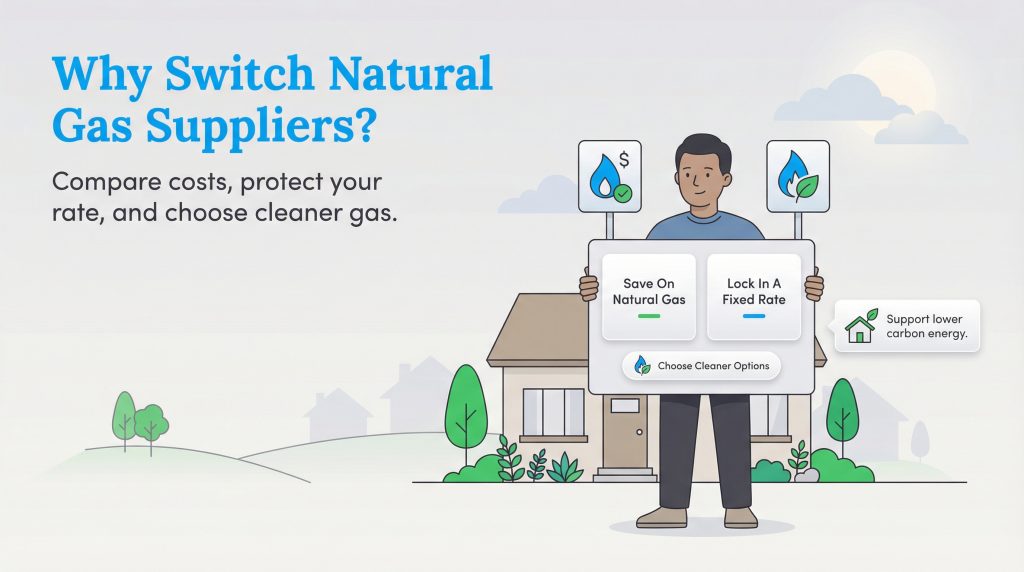
Energy deregulation might sound complicated, but it is actually quite simple. Think of it like shopping for a mortgage or a cell phone plan. The infrastructure, the house, or the cell towers, remains the same, but you get to choose the company that provides the service and sets your rate. In the energy world, this means your local utility company still owns the pipes and maintains the gas lines, but you can choose a different company to actually supply the natural gas flowing through them. However, note that not all states have deregulated energy markets. You should verify with your local utility or state public utility commission that you are eligible to choose a supplier in your area.
The primary benefit of exercising this choice is saving money. Competitive suppliers often offer rates lower than the default utility price to win your business. Beyond immediate savings, switching allows for price protection. You can lock in a fixed rate for a set period, shielding your budget from the volatile price spikes that often happen during freezing winters or turbulent economic times.
Switching is also one of the most effective ways to lower your household’s carbon footprint. Many providers now offer renewable natural gas (RNG) sourced from organic materials like landfills or agricultural waste, or plans that include carbon offsets. By choosing an eco-conscious supplier, you support sustainable living initiatives without needing to install new equipment or change your home heating methods.
When Is the Best Time to Switch Providers?
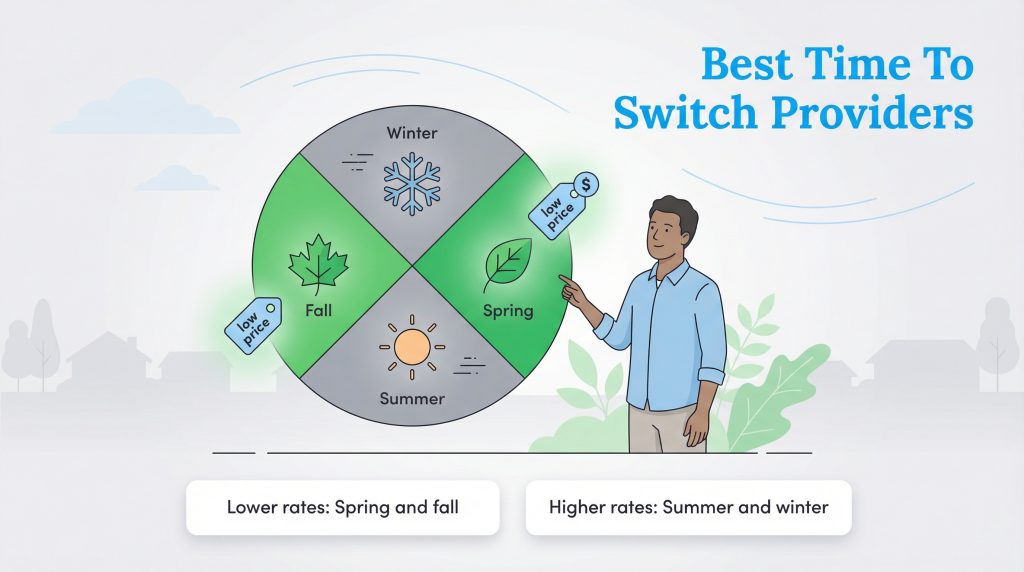
Timing is everything when it comes to securing the lowest natural gas rates. Prices are driven by supply and demand, which fluctuate predictably with the seasons. Historic data often shows that the best time to shop for a new plan is during the “shoulder months,” typically spring and fall. During these periods, the weather is mild, so people aren’t cranking up their heaters or air conditioners, causing overall demand to plummet.
Conversely, gas prices often spike in the winter due to high heating demand and in the summer when power plants use more natural gas to generate electricity for air conditioning. By shopping when the market is quiet, you are more likely to find a bargain. If your contract is expiring in the middle of a peak season, you might want to switch to a short-term plan until you reach a shoulder month to lock in a long-term rate.
Understanding Your Bill: Supply vs. Delivery Charges
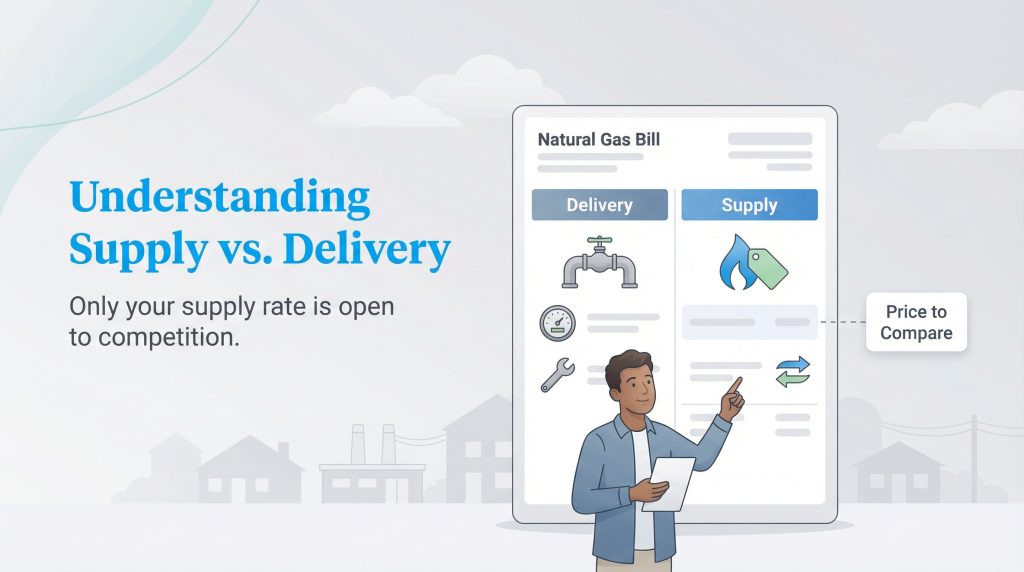
To effectively lower your bill, you need to understand how it is structured. Your natural gas bill is essentially split into two distinct parts: Delivery Charges and Supply Charges. This distinction is crucial because you can only change one of them.
The Delivery Charge (sometimes called distribution) goes to your local utility company, the entity that owns the pipes, reads your meter, and fixes leaks. You cannot change this provider, and your state’s public utility commission regulates these rates. The Supply Charge (or Generation) covers the actual cost of the natural gas you burn. This is the portion open to competition.
| Charge Type | Who Sets It | Can You Change It? |
| Delivery (Distribution) | Local Utility & State PUC | No |
| Supply (Generation) | Competitive Supplier | Yes |
Grab your current bill and look for a line item labeled “Price to Compare,” “Supply Rate,” or “Generation Charge.” This number is usually expressed in cents per therm or Ccf. This is the benchmark you need to beat. If you can find a supplier offering a lower rate than what is printed on your bill, you are on your way to savings.
How to Switch Natural Gas Providers in 5 Steps
Switching providers is a low-effort task that yields high rewards. It typically takes less time than ordering dinner online. Follow these five steps to ensure a smooth transition to a better rate.
Step 1: Check Your Current Contract
Before you look at new rates, you must review your current situation. If you are already with a third-party supplier, check your contract for an early termination fee (ETF). These penalties can cost anywhere from tens to hundreds of dollars, which would likely negate any savings you’d gain by switching early. If your contract is close to expiring or you are on a month-to-month variable plan, you are free to switch without penalty.
Step 2: Compare Natural Gas Rates
Once you are clear to move, visit your state’s official energy choice website or a trusted comparison tool to see what is available. You will see two main types of plans: fixed and variable.
Fixed vs. Variable Gas Rates: Which Is Better?
A Fixed Rate locks in your price per therm for the duration of the contract, usually 6, 12, or 24 months. This is generally the safest bet for budgeting, as your rate won’t change even if market prices skyrocket during a blizzard. A Variable Rate fluctuates with the market. While it may be cheaper in the short term, it can unexpectedly spike, leading to painful bill shock. For peace of mind and stability, we strongly recommend choosing a fixed-rate plan.
When you compare natural gas rates, look closely at the price per therm. For example, if you use 800 therms a year and you switch from $0.70 per therm to $0.60 per therm, you’d save about $80 a year before fees.
Step 3: Vet the Supplier
Don’t just click on the absolute lowest number you see. Take a moment to research the supplier. Some of the “cheapest natural gas providers” may cut costs by skimping on customer service. Look for reviews regarding their billing transparency and customer support quality. A slightly higher rate from a reputable company is often worth avoiding the headache of poor service later. You can also check your state’s public utility commission site for any past complaints to ensure the provider is reputable.
Step 4: Confirm the Switch
Once you have selected a plan, the signup process is simple. You will usually do this directly through the new supplier’s website. You will need your current utility account number, which is found on your recent bill, to authorize the change. The process typically takes less than 10 minutes to complete.
Step 5: Verify the Change
After you sign up, you don’t need to do anything else. However, you should keep an eye on your mail or email. Your new provider will notify your local utility of the switch. When your next bill arrives—usually in one to two billing cycles—check the “Supply” section to ensure the new provider’s name and the new rate are listed correctly.
Common Myths About Switching Gas Companies
Despite the benefits, many people hesitate to switch because of misconceptions about reliability and safety. Let’s clear those up. A common fear is that your service will be shut off during the switch. This is false. The gas flowing into your home never stops, and the physical pipes do not change. The only thing that changes is the financial transaction on the back end.
Another myth is the fear of double-billing. In deregulated markets, your utility typically consolidates the charges on a single bill, so you are not double-billed for the same usage. Your local utility will continue to send you one single bill that includes your new supplier’s charges. They collect the money and pass the supply portion on to the provider you chose. You won’t have to manage multiple invoices.
Finally, some worry about who to call in an emergency. If your power goes out or you smell a gas leak, you still call your local utility company. They are responsible for safety and infrastructure maintenance, regardless of who you buy your gas supply from. For more information on how utilities work in your specific area, you can visit our natural gas guide.
Take Control of Your Heating Costs Today
Switching natural gas providers is one of the quickest and most effective ways to lower your household expenses without sacrificing comfort. It is a low-risk administrative task that can save you hundreds of dollars over the course of a year. You don’t need a technician to visit your house, and you won’t experience any downtime. If you pair a lower rate with energy-efficient upgrades (look for ENERGY STAR certified appliances), you can maximize your savings and reduce your environmental impact even further.
Grab your bill right now and check your current supply rate. If it looks high, take a few minutes to see what else is out there. For verified information on your rights and safe switching practices, you can always check with resources like Energy.gov or your state’s Public Utility Commission.
Frequently Asked Questions About Switching Natural Gas Providers
Does it cost money to switch natural gas providers?
Will my natural gas service be interrupted if I switch?
What is the difference between a fixed and variable gas rate?
How do I know if I can switch natural gas providers?
Can I switch gas providers if I am a renter?
How long does it take for the switch to take effect?
What happens if I move after signing a contract?
About the Author

Claudio is a sustainability-focused writer with a background in Anthropology and Psychology from NC State University. He has spent over 15 years working in writing, interpretation, and translation, driven by a deep interest in how human culture shapes the environment. Today, he shares his curiosity with readers by writing about sustainable living solutions and the connection between everyday choices and environmental impact.