
Master the art of reading your natural gas meter to track usage, spot billing errors, and take control of your energy costs.
Key Takeaways
- Read dial meters from left to right, remembering that the pointers alternate between moving clockwise and counter-clockwise.
- Always record the lower number if a pointer is situated between two digits, unless the pointer is between 9 and 0, in which case it counts as 9.
- Calculate your approximate bill by converting your meter’s measurement (usually CCF) into Therms and multiplying by your provider’s rate.
Most of us only glance at our gas meters when we’re clearing away cobwebs or checking for storm damage, and the row of clock-like faces can look intimidatingly complex at first sight. However, learning to decipher these dials is a homeowner superpower that transforms a mysterious metal box into a precise financial tool. In this guide, we will help you understand exactly how to read your gas meter so you can verify that your utility provider is billing you for actual usage rather than estimates. Whether you are setting up utilities in a new home or just looking to lower your monthly expenses, we are here to show you how to catch potential leaks early and track the real-world impact of your eco-friendly habits.
Quick Cheat Sheet for Reading Gas Meters
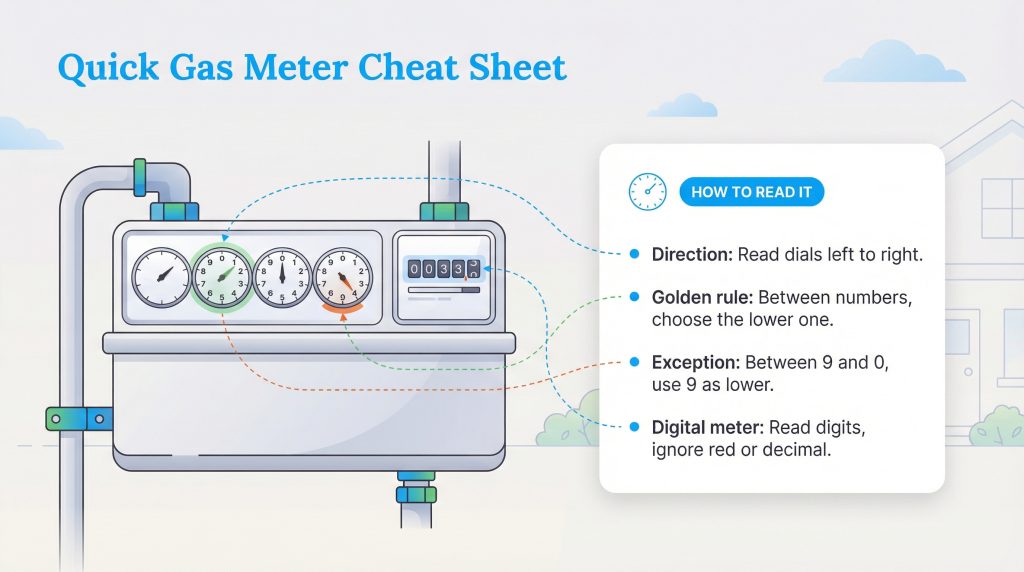
If you are standing outside right now with your smartphone in hand, we have put together a quick guide to getting the numbers you need without the fluff.
- Direction: Always read the dials in a row from left to right.
- The Golden Rule: When a hand is pointing between two numbers, always choose the lower number.
- The Exception: If the hand is between 9 and 0, 9 is the lower number (think of 0 as 10 in this context).
- Digital Meters: Read the numbers exactly as displayed, ignoring any red numbers or decimals at the end of the row.
How to Read an Analog Gas Meter (The Dials)
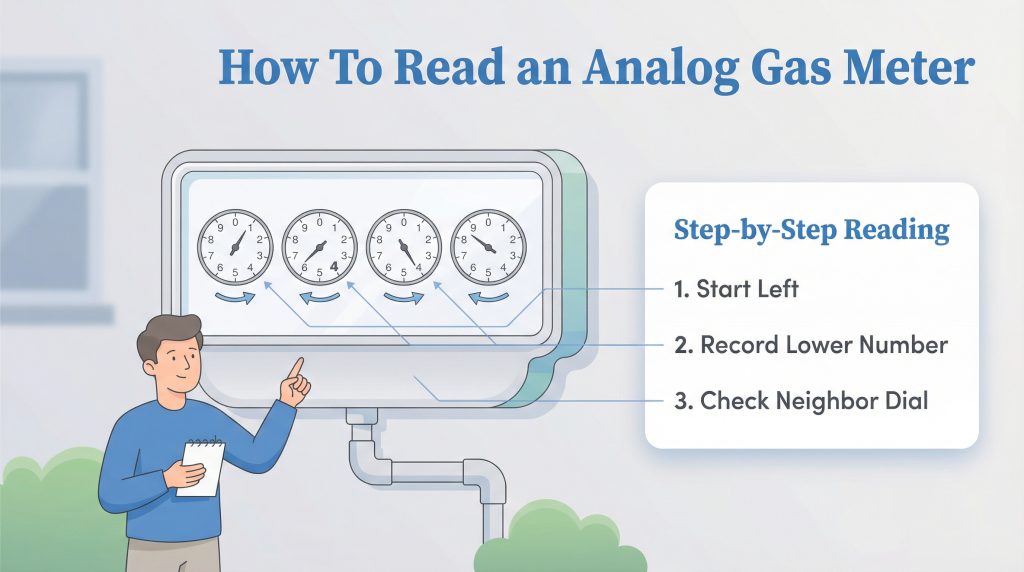
Analog meters are the most common style found in older homes, and they are also the source of most reading errors. The confusion usually stems from the fact that the dials do not all spin in the same direction.
Understanding Directionality
To keep the mechanism accurate, the gears inside the meter cause the pointers to rotate in alternating directions. On a standard 4-dial or 5-dial meter, the pattern often looks like this:
- First dial (far left): Moves clockwise
- Second dial: Moves counter-clockwise
- Third dial: Moves clockwise
- Fourth dial: Moves counter-clockwise
You don’t need to memorize the rotation to read the number, but noticing the direction helps you understand which way the numbers are ascending. Always check the directional arrows on your specific meter face to be sure.
Step-by-Step Reading Guide
Follow these steps to translate the positions of the pointers into a usable usage figure.
- Start Left: Locate the first dial on the far left side of the row. This represents the largest unit of measurement.
- Determine the Number: Look at where the hand is pointing. If the hand is resting in the space between two numbers, record the lower of the two numbers. For example, if the hand is between 3 and 4, write down 3.
- Handle the “On the Line” Scenarios: If a pointer appears to be resting exactly on a number, don’t assume it’s that number just yet. Look at the dial to the immediate right. If the hand on that neighbor dial has passed 0, then the pointer on the left is indeed on the number. If the neighbor dial has not passed 0, the pointer on the left hasn’t quite reached the number yet, so you should record the lower number.
- Write it Down: Continue across the row, writing down the numbers from left to right to get your full reading.
How to Read a Digital Gas Meter
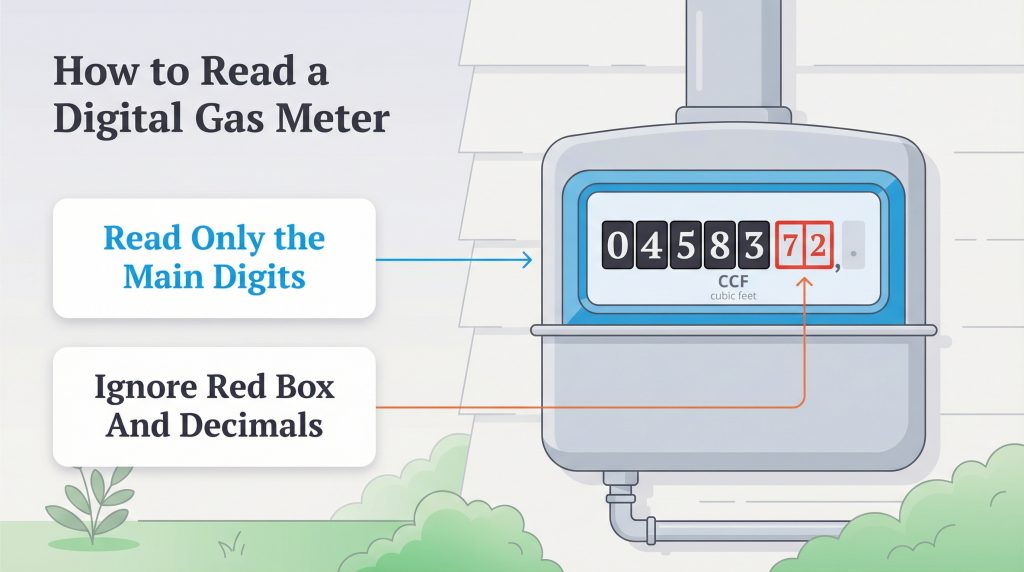
If you have a newer natural gas meter, you might be lucky enough to have a digital display. Reading these is much like reading the odometer in your car.
- Metric vs. Imperial: Most residential gas meters in the United States measure gas volume in cubic feet, which utilities often bill as CCF (hundreds of cubic feet). Occasionally, you may see cubic meters (m³), but the reading process remains the same.
- What to Ignore: You simply read the digits from left to right. However, if you see numbers inside a red box or numbers following a decimal point, ignore them. These represent fractions of a unit and are generally not included in your billing calculation.
Converting Your Reading to Dollars

Taking the reading is only the first step. To understand how that number affects your wallet, you need to do a little math. This process helps you audit your bill and see exactly what you are paying for.
Step 1: Determine Usage
Your meter never resets to zero; it keeps a running total of all the gas that has ever flowed through it. To find out how much you used this month, take your current reading and subtract the reading from the previous month. The result is your total usage for the billing period.
Step 2: Understand the Units (CCF vs. Therms)
Most gas meters measure volume in hundreds of cubic feet, known as CCF. However, your utility company bills you for the heat energy provided, measured in Therms. Because the energy density of natural gas can fluctuate slightly, the volume needs to be converted.
Step 3: Estimate the Cost
To verify your bill, check your latest statement for the current “Therm Factor” and the price per Therm. You can then use this simple formula:
Usage (CCF) x Therm Factor x Rate per Therm = Estimated Supply Cost
For example, if you used 30 CCF this month, your Therm Factor is 1.03, and your rate is $1.20 per Therm:
30 x 1.03 x $1.20 ≈ $37.08 in gas supply charges
Keep in mind this figure covers the cost of the gas itself but excludes fixed service charges, taxes, and delivery fees. For a deeper dive into the line items on your statement, check out our guide on understanding your gas bill. If the final number is higher than you expected, you may want to explore how to save on your gas bill.
Safety and Maintenance Tips
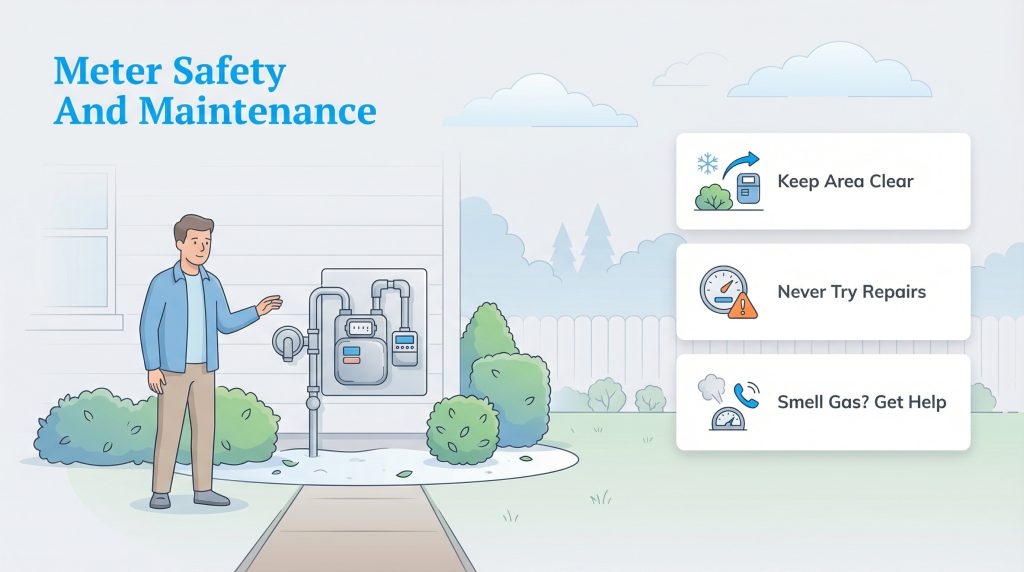
As a responsible homeowner, keeping your meter area safe is just as important as reading the numbers correctly. A well-maintained meter ensures accurate readings and allows utility workers quick access during emergencies.
- Keep it Clear: Ensure that shrubs, snow, or debris do not bury the meter. Utility workers need a clear path to read and service the equipment.
- Don’t DIY Repairs: Never attempt to fix a stuck dial or touch the regulator mechanisms. Tampering with a gas meter is illegal and extremely dangerous.
- Smell Gas? If you catch the scent of sulfur or rotten eggs while you are near the meter, stop what you are doing immediately. Leave the area, get to a safe location, and call your utility provider’s emergency line.
Why Reading Your Own Meter Matters
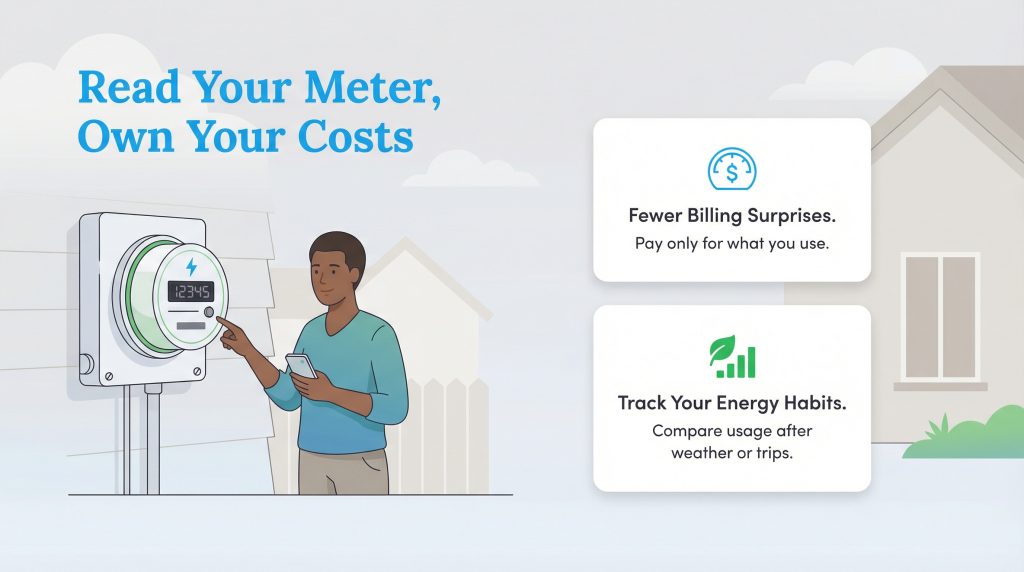
Taking a few minutes to read your meter each month gives you control over your household budget and prevents the shock of “catch-up” bills. When utility companies cannot access your meter, they estimate your usage based on historical averages, which can lead to significant overcharges or undercharges that must be reconciled later. By submitting your own accurate readings, you ensure you only pay for the energy you actually use, helping you budget better and maintain a more sustainable home. You can also compare your meter reading before and after a cold snap or a vacation to understand how your usage responds to weather and changes in your daily habits.
Turning Gas Meter Readings Into Smarter Energy Decisions
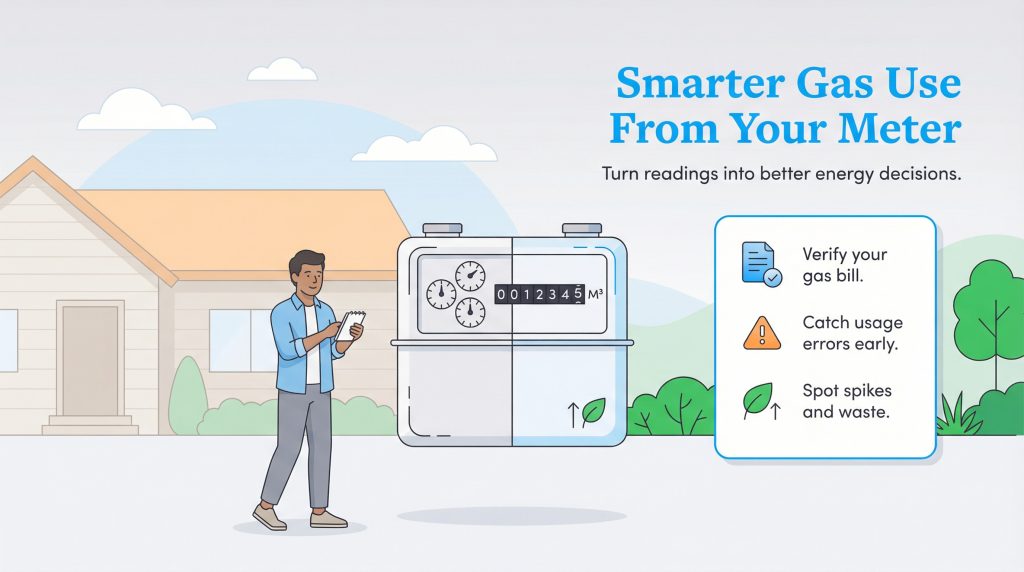
Now that you know how to decode both analog dials and digital displays, you can confidently track your household’s natural gas consumption. Checking your meter regularly empowers you to verify your bills, catch errors early, and see exactly when your energy usage spikes. By combining these reading skills with simple calculations, you turn a monthly chore into a powerful way to manage your budget and run a more efficient, eco-conscious home.
FAQs About Reading Gas Meters
How often should I read my gas meter?
What if my gas meter reading is lower than the previous month?
What is the difference between CCF and MCF?
Why does the gas company estimate my bill?
Can I submit my own gas meter reading?
About the Author

LaLeesha has a Masters degree in English and enjoys writing whenever she has the chance. She is passionate about gardening, reducing her carbon footprint, and protecting the environment.