
A side-by-side look at rates, fees, and customer service to help you pick the right gas provider for your Georgia home
Key Takeaways
- Georgia Natural Gas (GNG) often provides higher flexibility and premium perks like Delta SkyMiles, but usually comes with a slightly higher price per therm.
- Constellation generally offers competitive fixed-rate plans and renewable energy certificates, making it a strong contender for budget-conscious and eco-friendly renters.
- Cancellation fees vary significantly between the two, so matching your lease length to your contract term is the single best way to avoid surprise costs.
Moving into a new home in Georgia can feel overwhelming, especially when you realize you have to “shop” for natural gas the same way you shop for groceries. The state’s deregulated market gives you the power to choose, but it also creates confusion with dozens of rate plans and fine print to navigate. While both Constellation and Georgia Natural Gas are top-tier providers with strong reputations, the right choice for you ultimately depends on your priorities. In this Constellation vs. Georgia Natural Gas comparison, we break down exactly how they stack up. If you want the absolute lowest price per therm, Constellation is often the stronger bet, whereas Georgia Natural Gas is the go-to for established brand reliability and premium perks.

- $0.659 /THM
- $6.95-7.95
- 90 days
- 12-36 Months
- $0.399 /THM
- $0.00-9.99
- None
- 1-24 Months
*rates may vary by location and household usage
At a Glance: The Tale of the Tape
| Feature | Constellation | Georgia Natural Gas |
|---|---|---|
| Common Fixed-Term Options | Typically 12 and 24 months | Typically 6, 12, 18, and 24 months |
| Cancellation Fees | Often around $150 (Flat Fee) | Typically $50 – $150 (Sliding Scale) |
| Monthly Service Charge | Typically $5.95 – $9.95 | Typically $5.99 – $9.99 |
| Green Options | Yes (RECs available) | Yes (Greener Life program) |
| Best For | Budget-conscious renters | Homeowners wanting stability |
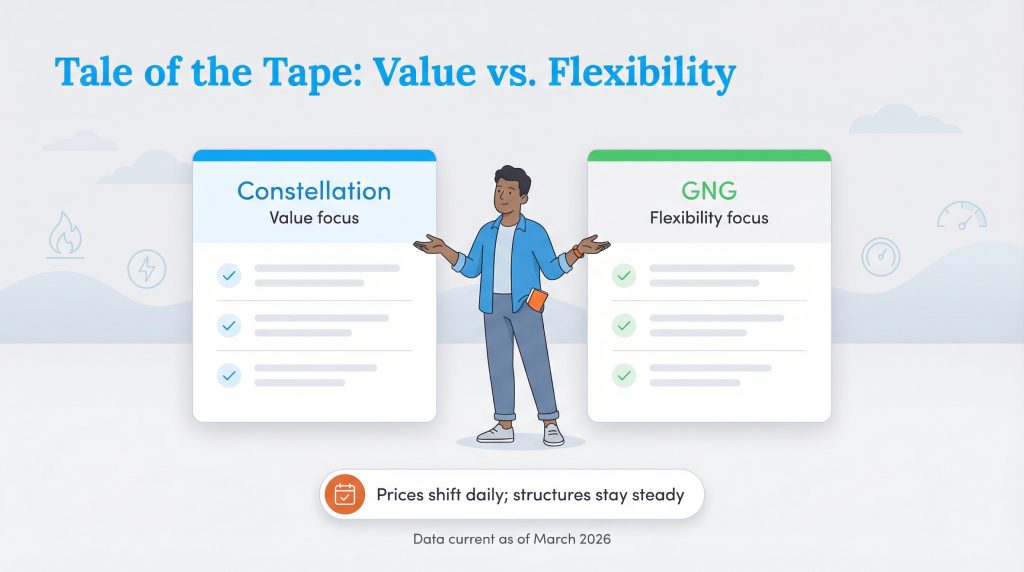
While the specific price per therm changes daily based on market conditions, the service structures listed above remain remarkably consistent. Both companies have carved out specific niches in the market, with Constellation focusing on value and GNG focusing on flexibility. Please note that the data in this table is current as of March 2026, though specific offers change frequently.
Rate Plans and Pricing Models
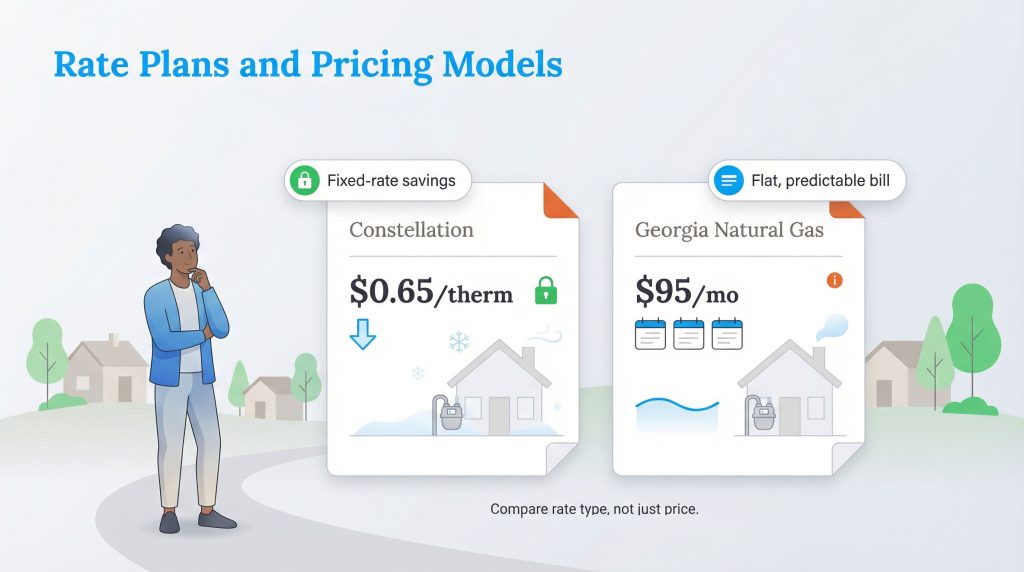
When you compare natural gas rates in Georgia, you will notice distinct differences in how these two giants approach pricing. Constellation has built a reputation for offering highly competitive fixed-rate plans. They frequently offer “teaser” rates or online-exclusive specials that undercut the competition. Their 12-month and 24-month fixed plans are particularly popular because they shield customers from price spikes for a long duration. For example, if a plan is $0.10 cheaper per therm and the average Georgia home uses about 700–750 therms a year, that’s roughly $70–$75 in annual savings. If you are looking for a simple, lock-it-and-leave-it rate that protects your wallet during a freezing January, Constellation is a solid choice.
| Plan Name | Rate | Plan Type | Base Charge | Cancellation Fee |
|---|
Georgia Natural Gas, on the other hand, operates as one of the largest marketers in the state with deep ties to Southern Company Gas. While they are rarely the cheapest option on a strictly per-therm basis, they offer unique pricing models that appeal to budgeters who hate volatility. Their “Guaranteed Bill” or “Flat Bill” plans allow you to pay the exact same amount every month for a year, regardless of how much gas you use or how cold it gets outside. This predictability is worth the premium for many families. Before signing any contract, it is vital that you understand the difference between fixed and variable rates to ensure you aren’t signing up for a plan that fluctuates when you least expect it.
| Plan Name | Rate | Plan Type | Base Charge | Cancellation Fee | |
|---|---|---|---|---|---|
| Market Intro | $0.399 /THM | 2 Months Fixed Rate | $0 | None | Check Availability |
| 6-Month Fixed | $0.649 /THM | 6 Months Fixed Rate | $6.99-7.99 | $50 | Check Availability |
| 12-Month Fixed | $0.749 /THM | 12 Months Fixed Rate | $7.99-8.99 | $100 | Check Availability |
| 24-Month Fixed | $0.749 /THM | 24 Months Fixed Rate | $8.99-9.99 | $200 | Check Availability |
| 18-Month Fixed | $0.749 /THM | 18 Months Fixed Rate | $8.99-9.99 | $150 | Check Availability |
| Variable Select | $2.009 /THM | 1 Months Variable Rate | $3.99-6.99 | None | Check Availability |
| Pre-Pay | $2.109 /THM | 1 Months Variable Rate | $8.99 | None | Check Availability |
Fees, Contracts, and Fine Print
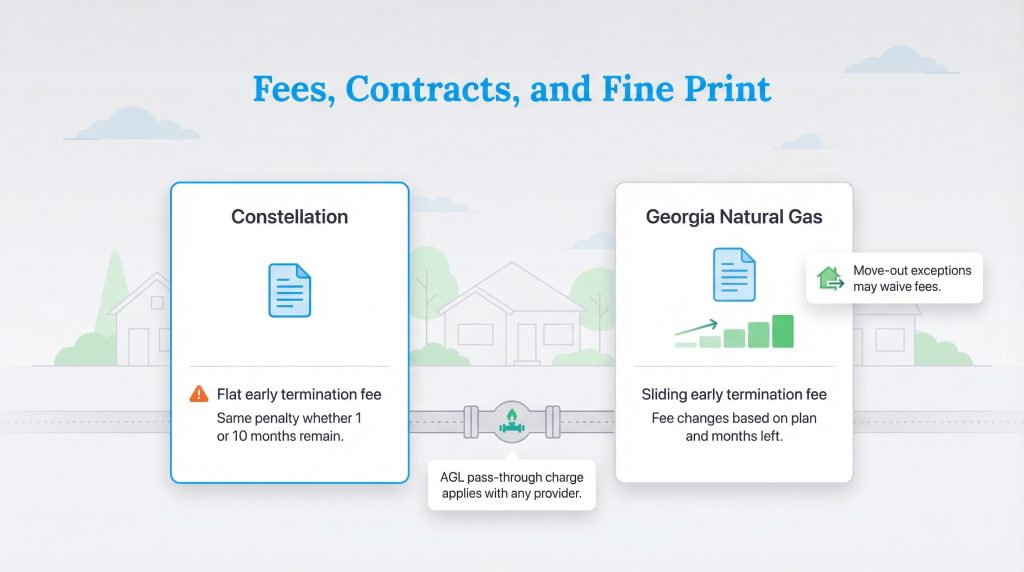
One of the biggest complaints consumers have regarding utility companies involves the “hidden” costs of ending a contract early. Both providers charge Early Termination Fees (ETFs), but they handle them differently. Constellation often charges a flat cancellation fee on fixed-term plans; many recent offers list fees in the $150 range, but you should always check the exact amount in your contract. This means if you cancel with one month left, you pay the same penalty as if you canceled with ten months left.
Georgia Natural Gas commonly uses a sliding scale for their cancellation fees. The fee might range from $50 to $150 depending on the specific plan and how much time remains on your agreement. A crucial differentiator here is the “Move-Out” policy. If you are a renter, this is the most important section for you. Georgia Natural Gas often waives termination fees when you move and provide proof of relocation, depending on your plan’s terms. Constellation may also waive early termination fees in certain move scenarios; you’ll need to provide documentation and confirm details with their customer support.
Finally, remember that you will see an AGL Pass-Through Charge on your bill regardless of which provider you choose. This fee goes directly to Atlanta Gas Light for maintaining the pipelines and infrastructure, not to the marketer you are buying gas from. No provider can waive or discount this fee. We suggest checking your current AGL pass-through charges so you’re not surprised when you switch providers.
Customer Service and Digital Experience

If you look up reviews for Constellation Energy in Georgia, you will see a mix of feedback typical for a massive national corporation. Because Constellation serves customers across the United States, their support infrastructure is robust, but some reviews suggest it can sometimes feel impersonal. Their digital app is functional and allows for easy bill payment and usage tracking, which is great for tech-savvy users who prefer not to call a support line.
Georgia Natural Gas positions itself as the “local” choice. Because they are the largest marketer in the state, they are often viewed as the standard for service. Many customers report that GNG provides a more localized support experience. They have invested heavily in their online account management tools, making it simple to monitor your “Greener Life” status or check your loyalty rewards. If you value feeling like a priority customer rather than just an account number, GNG often has the edge here.
Incentives and Rewards Programs
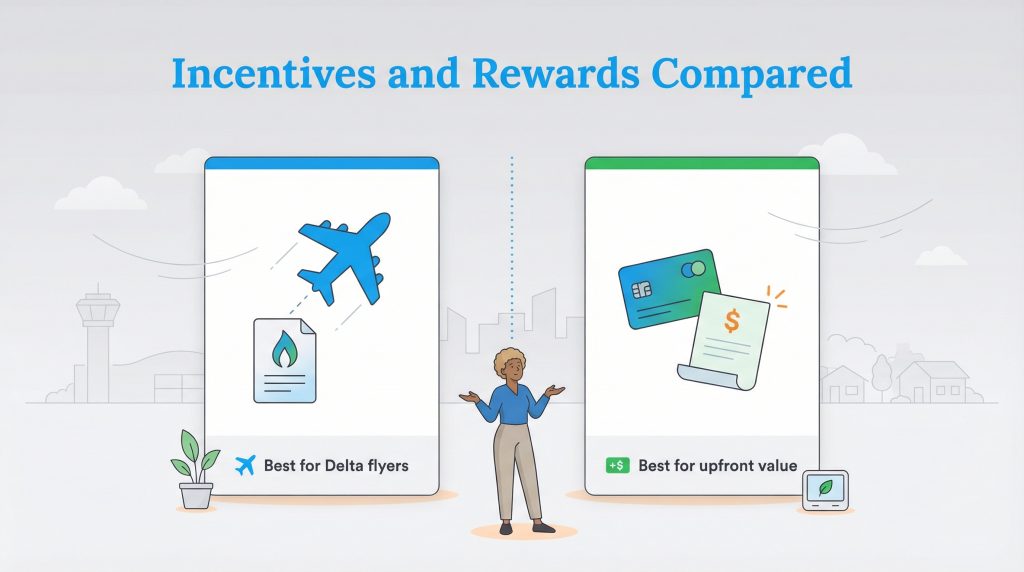
Incentives and rewards are one of the biggest areas where the two providers diverge. Georgia Natural Gas has a massive selling point for travelers: the Delta SkyMiles partnership. For residents in Atlanta, home of the world’s busiest airport, this is a significant perk. You can earn miles just for paying your gas bill, and they often offer sign-up promotions that award Delta SkyMiles. Exact bonus amounts vary by offer, so check the current promotion details. Over time, paying your heating bill can actually help fund your next vacation.
Constellation takes a different approach to rewards. Instead of travel perks, they focus on upfront value. Constellation has historically offered incentives like Visa gift cards, bill credits, or smart-home bundles on certain plans. If you don’t fly Delta or prefer cash-equivalent rewards that you can use immediately, Constellation’s incentives are likely more appealing to you. Ultimately, if you are a loyal Delta flyer, GNG wins; if you want immediate financial bonuses, Constellation takes the prize.
Sustainability and Green Energy Options
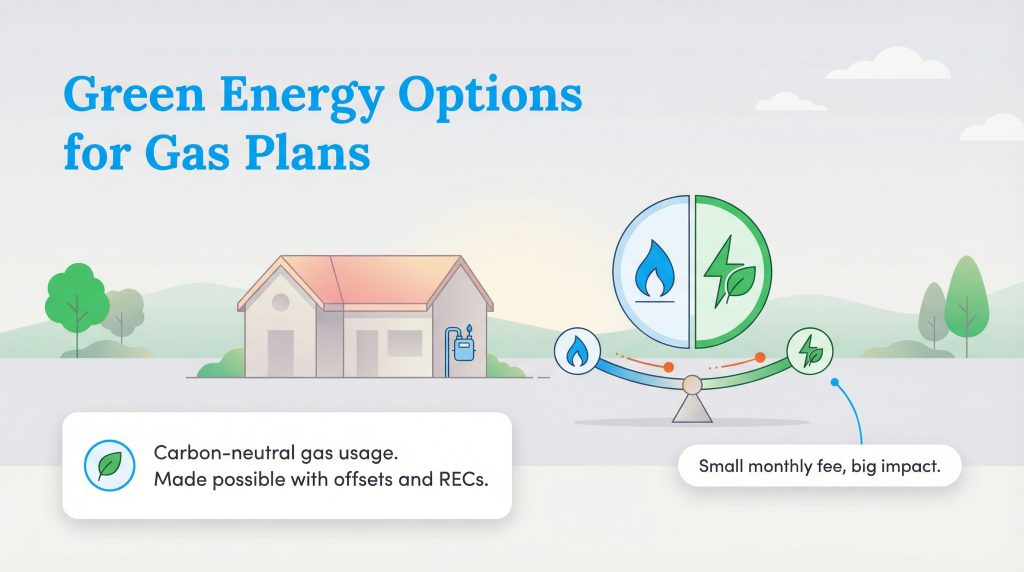
Both providers have recognized that modern consumers care about their environmental impact. Georgia Natural Gas offers a program called “Greener Life,” which claims to make your natural gas usage carbon-neutral. They achieve this by purchasing carbon offsets to balance out the greenhouse gases associated with your home’s consumption. It is a seamless way to make an eco-conscious alternative choice without changing your lifestyle.
Constellation is also a strong player in sustainability. As a major national energy producer, they offer plans backed by Renewable Energy Certificates (RECs) and carbon-offset gas. These plans ensure that for every therm of gas you use, an equivalent amount of renewable energy is generated or carbon is captured elsewhere. While natural gas is a fossil fuel, these programs help neutralize your personal carbon footprint for a small monthly fee. To understand exactly what you are buying, you can read more about how carbon offsets work from the EPA.
Making the Best Choice Between Constellation and Georgia Natural Gas
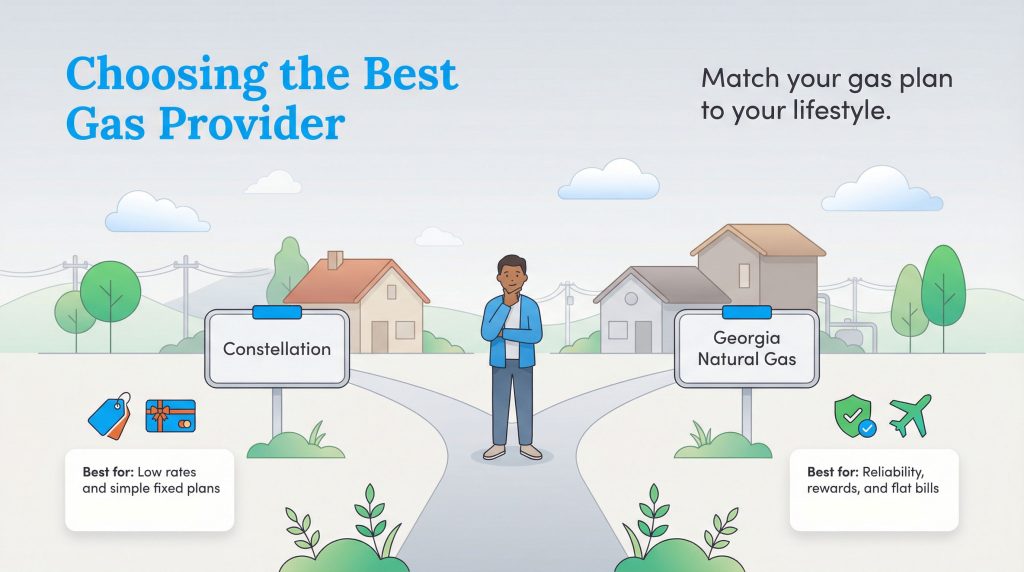
Choosing between these two heavyweights comes down to your specific lifestyle needs. There is no single “best” provider, but there is certainly a best provider for you.
Choose Constellation if: You are price-sensitive and want the lowest possible rate per therm. It is also the better choice if you prefer a simple fixed-rate plan with no frills, or if you are looking for a shorter commitment that comes with a gift card bonus to help with costs when moving to a new home.
Choose Georgia Natural Gas if: You want the reliability of the state’s largest provider and peace of mind. It is the clear winner if you collect Delta SkyMiles or if you require a “Flat Bill” plan to smooth out your winter spending spikes so you never have to worry about a high January bill again.
If you are still weighing your options, you can check out more reviews and comparisons on our main natural gas hub.
FAQs About Constellation and Georgia Natural Gas
Is Constellation the same as Georgia Natural Gas?
Who has the cheaper natural gas rates in Georgia?
Does Georgia Natural Gas charge a cancellation fee?
Can I switch from Constellation to GNG before my contract ends?
Will my gas service be interrupted when I switch providers?
Why is my bill so high in the winter?
About the Author

David has been an integral part of some of the biggest utility sites on the internet, including InMyArea.com, HighSpeedInternet.com, BroadbandNow.com, and U.S. News. He brings over 15 years of experience writing about, compiling and analyzing utility data.