

Before you move to South Dakota, compare housing costs, confirm utilities, and plan for winter heating.
Key Takeaways
- No state individual income tax keeps more money in your pocket, though you’ll still need to budget for local sales and property taxes, plus winter heating spikes.
- Your exact address determines utility availability, meaning the Missouri River divide dictates whether you connect to a municipality, a rural cooperative, or an investor-owned utility.
- Confirm your heating system and winter energy needs before choosing a home, as rural properties may require bulk propane deliveries or high-efficiency heat pumps.
Wide-open skies, no state individual income tax, and friendly neighborhoods where you can find room to breathe are drawing thousands of newcomers to the Mount Rushmore State every year. Still, moving to South Dakota comes with a few practical questions, especially if you’ve never stared down a January blizzard on the northern plains or navigated rural service territories. Whether you’re relocating to South Dakota for a healthcare career in Sioux Falls, remote work near the Black Hills, or a quiet retirement, we’re here to help you look past the tourist brochures. We’ll walk you through how to compare the state’s distinct regions, plan a household budget for real-world living and winter heating costs, and get your home utilities running smoothly before the moving truck pulls into your driveway.
Pros and Cons of Living in South Dakota
Every state comes with trade-offs, and weighing the pros and cons of living in South Dakota early on will save you from costly surprises after closing on a home. While your household budget might stretch further here thanks to the friendly tax structure, the local geography and four-season weather demand a bit of grit and preparation.
| Pros of Living in South Dakota | Cons of Living in South Dakota |
|---|---|
| No individual state income tax | Brutal winter blizzards with temperatures dropping well below freezing |
| Low unemployment rate (around 2.0% as of late 2026) | High summer humidity in the eastern half of the state |
| Over 80% of in-state electricity generation comes from renewables | Limited public transit outside of basic city bus routes |
| Short daily commutes averaging just over 17 minutes | Vast driving distances to major medical or retail hubs in rural areas |
| World-class outdoor recreation in the Black Hills and Glacial Lakes | Fewer big-city nightlife, dining, and pro sports amenities |
To truly understand daily life here, you first need to learn the state’s defining geographical divide: “East River” versus “West River.” Bisected right down the middle by the Missouri River, these two halves feel like entirely different states. East River features rolling prairies, rich farmland, higher rainfall, and a classic Midwestern sensibility anchored by growing cities like Sioux Falls and Brookings. Cross the bridges into West River, and the landscape shifts into rugged cattle ranches, arid badlands, Old West tourism, and the pine-covered mountains of the Black Hills.
Quick Fact
South Dakota is home to over 920,000 residents who enjoy no state individual income tax and a 4.2% state sales tax, though you should remember that local municipalities often add their own sales taxes.
Cost of Living in South Dakota and Home Energy Budgets
When you look at the overall cost of living in South Dakota, housing and taxes give you serious breathing room compared to the national average. However, what most relocation guides leave out is how dramatically the northern plains climate impacts your monthly household cash flow. While summer and spring utility bills are easy on the wallet, South Dakota winter heating costs can catch out-of-state movers off guard when Arctic cold fronts sweep across the prairie. To build a realistic utility budget, request a year of past utility bills from the home’s seller or landlord so you can see exact seasonal peaks.
| Service | What You Should Confirm | Potential Moving-Day Problem |
|---|---|---|
| Electricity and natural gas | Address-specific provider, start date, deposit, and access requirements | Service isn’t active when you arrive |
| Propane | Tank ownership or lease, supplier restrictions, fuel level, and delivery terms | An unexpected refill or contract expense |
| Water and sewer | Municipal service, rural water membership, or private systems | An overlooked transfer requirement |
| Internet | Exact-address availability, installation date, equipment, and plan terms | Remote work starts before service does |
| Trash and recycling | Licensed hauler, pickup schedule, accepted materials, and fees | No collection arranged after unpacking |
Breaking Down the Average Utility Budget
Your utility budget depends heavily on whether you settle inside city limits or out on a rural acreage. According to the U.S. Energy Information Administration (EIA), South Dakota generates over 80% of its in-state electricity from renewable wind and hydroelectric power. However, this impressive statewide generation mix doesn’t mean your specific home will run on cheap, 100% clean energy, as retail rates depend on your local provider’s infrastructure and tariffs.
Heating fuel also plays a massive role in your winter budget. The EIA notes that almost half of South Dakota households use natural gas as their primary heating fuel. Natural gas keeps winter heating bills relatively predictable in cities like Sioux Falls or Rapid City. If you buy a home outside municipal gas lines, you’ll likely heat with delivered propane or electric heat. Rural homeowners using propane must budget for bulk tank refills, which can introduce unexpected mid-winter expenses if you haven’t planned ahead. While some local farm co-ops offer summer pre-buy contracts to lock in lower per-gallon rates, these arrangements can come with minimum purchases or fees, so it pays to read the fine print.
Smart Ways to Cut Winter Heating Costs
Conquering sub-zero weather without burning through your savings comes down to tightening your home’s thermal envelope before Thanksgiving arrives. Start by installing a compatible smart thermostat, ensuring it works with your specific heat pump or auxiliary heat, to automatically dial back the furnace while you’re asleep or away. You should also inspect weatherstripping around exterior doors, seal drafty window frames with clear caulk or shrink-film kits, and check that your attic insulation meets recommended levels for your specific northern climate zone and existing assembly.
If you’re upgrading an aging HVAC system, look into a cold-climate air-source heat pump paired with a high-efficiency gas furnace (often called a dual-fuel system). This setup acts as a practical energy-saving option by running on clean electricity during mild autumn and spring days before switching to gas when temperatures plunge. You can explore more ways to winterize your furnace in our natural gas resources, or browse our sustainable living articles for whole-home efficiency upgrades.
Money-Saver
Ask your electric and natural gas providers about enrolling in budget billing (sometimes called levelized billing) as soon as you set up your account. These programs average your estimated annual energy usage into 12 predictable monthly payments, smoothing out your payments to protect your bank account from sticker shock during January cold snaps, though balances may be reconciled at the end of the year.
Best Places to Live in South Dakota by Region
Figuring out the best places to live in South Dakota means matching your career goals and lifestyle preferences with the right regional infrastructure. Because population density drops off quickly outside the main interstate corridors, each corner of the state offers a distinct mix of job markets, weather patterns, and local utility setups.
Sioux Falls and Southeastern South Dakota
If you want lively restaurants, booming job growth, and big-city conveniences, moving to Sioux Falls is an excellent choice. Home to over 200,000 residents in the city proper, Sioux Falls anchors the state’s economy with massive healthcare networks like Sanford Health and Avera Health alongside a thriving banking sector. Residents here generally enjoy reliable municipal water and access to natural gas heating. Nearby southeastern communities like Yankton and Vermillion (home to the University of South Dakota) offer a slower riverfront pace within an easy drive of the metro.
Rapid City and the Black Hills (West River)
On the western side of the state, Rapid City serves as the commercial hub for over 74,000 residents and the gateway to the Black Hills. Thanks to warm downslope winds off the mountains, Rapid City sits in a localized microclimate that can bring milder winter days than the eastern plains, though severe snow and cold are still common. Major employers include Ellsworth Air Force Base, Monument Health, and year-round national park tourism. Just up the canyon roads, smaller towns like Spearfish, Sturgis, and historic Deadwood attract outdoor enthusiasts who want hiking and mountain biking right outside their back doors.
Brookings, Aberdeen, and the Glacial Lakes Region
Stretching across the northeast corner of East River, the Glacial Lakes and Prairies region blends higher education, advanced manufacturing, and serene lakeside living. Brookings is a standout choice here — as the home of South Dakota State University, it pairs energetic college-town culture with low-cost municipal utilities. Further north, Watertown and Aberdeen offer family-friendly neighborhoods, rich pheasant hunting and walleye fishing, and stable employment in agriculture and regional healthcare.
Pierre and the Missouri River Corridor
Right in the geographic center of the state sits the capital city of Pierre (pronounced “Peer”) and scenic river towns like Chamberlain. Though Pierre has a modest population of around 14,000, it punches above its weight in quality of life for state government workers, anglers, and families seeking tight-knit neighborhoods. Because the city sits just below the massive Oahe Dam, residents benefit from municipal power backed heavily by Missouri River hydroelectricity.
Setting Up Utilities in South Dakota
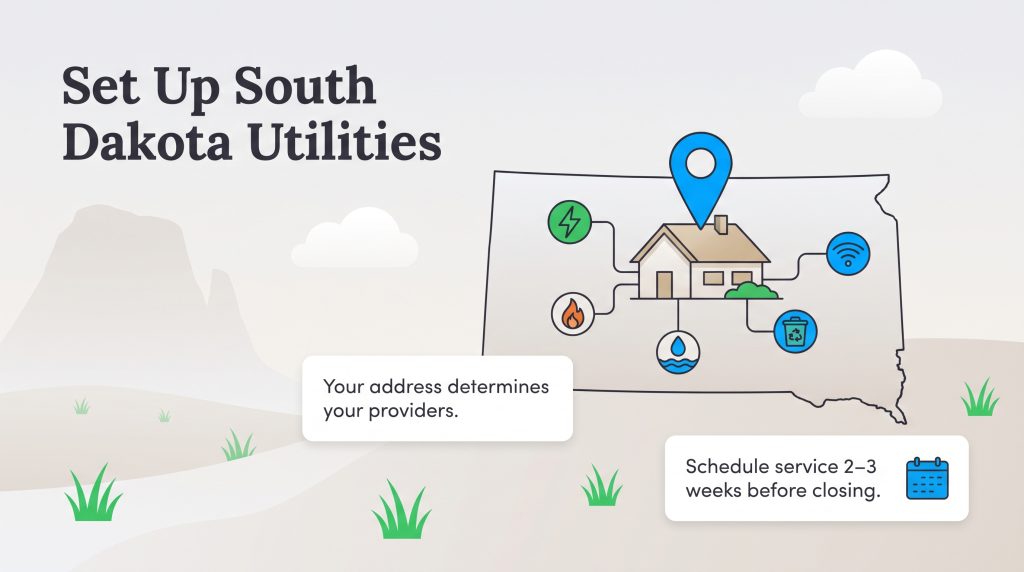
When it comes to setting up utilities in South Dakota, the process is refreshingly straightforward once you know who serves your exact address. Unlike states with deregulated energy markets where you have to comparison-shop dozens of private power marketers, South Dakota operates on a regulated utility model where your electric and gas providers are assigned by your location. To keep your relocation on track, check out our moving utilities hub and start scheduling your service transfers two to three weeks before closing day.
South Dakota Electric and Gas Companies by Region
Because utility territories shift dramatically between cities and rural areas, your provider depends on exactly which county or neighborhood you call home. You can verify service territory maps and review your consumer protections directly through the South Dakota Public Utilities Commission (PUC). Here are the primary electric and gas companies you might work with:
- Xcel Energy: Serves as a primary electric utility for Sioux Falls and surrounding southeastern communities.
- MidAmerican Energy: Supplies natural gas to homes across parts of Sioux Falls, Yankton, Vermillion, and the southeastern corridor.
- Black Hills Energy: Generates and delivers electricity or natural gas to Rapid City, Spearfish, Deadwood, and communities throughout the Black Hills.
- NorthWestern Energy: Provides electricity and natural gas to several central and eastern hubs, which can include Mitchell, Huron, Aberdeen, and Yankton.
- Montana-Dakota Utilities (MDU): Delivers natural gas to Rapid City and the Black Hills, as well as electric and gas service to northern border towns like Mobridge.
- Municipal Utilities and Rural Electric Cooperatives: Cities like Pierre, Watertown, Vermillion, and Brookings operate their own municipal electric systems, while rural properties and outer suburbs often connect through member-owned co-ops such as Sioux Valley Energy or West River Electric Association.
Eco Edge
Even though you can’t switch your neighborhood utility company, making an environmentally mindful choice with your power bill is often still possible. Many major providers and rural cooperatives offer voluntary green energy programs, allowing you to purchase blocks of certified renewable power for a small premium on your monthly bill.
Water, Sewer, and Private Trash Collection Realities
Setting up your water and sewer service usually requires a quick call or online application with your local city hall or finance office about two weeks before move-in day. If you’re buying a rural property outside city limits, ask the seller whether the home connects to a regional rural water system or relies on a private well and septic system. You can brush up on testing well water and transferring municipal accounts in our water resources.
One quirk that surprises many newcomers is how garbage pickup works here. In several South Dakota cities — most notably Sioux Falls — the city government does not collect residential trash. Instead, you have to research and hire your own licensed private hauler. Because haulers compete for your business, it pays to call two or three companies to compare monthly bin rates and accepted recycling materials.
Navigating Urban Fiber vs. Rural Internet Options
If you work from home, you’ll be relieved to learn that many of South Dakota’s urban centers and small farming towns enjoy strong fiber internet infrastructure thanks to regional telecom providers and cooperatives. However, if you’re shopping for remote ranchland in West River or a cabin tucked deep in the Black Hills canyons, always verify wired broadband availability at the exact parcel before making an offer. Some off-grid pockets require fixed wireless or satellite services, which can affect your remote-work capabilities. Learn how to compare speeds and installation timelines in our home internet setup category.
How to Establish Residency After Moving Day
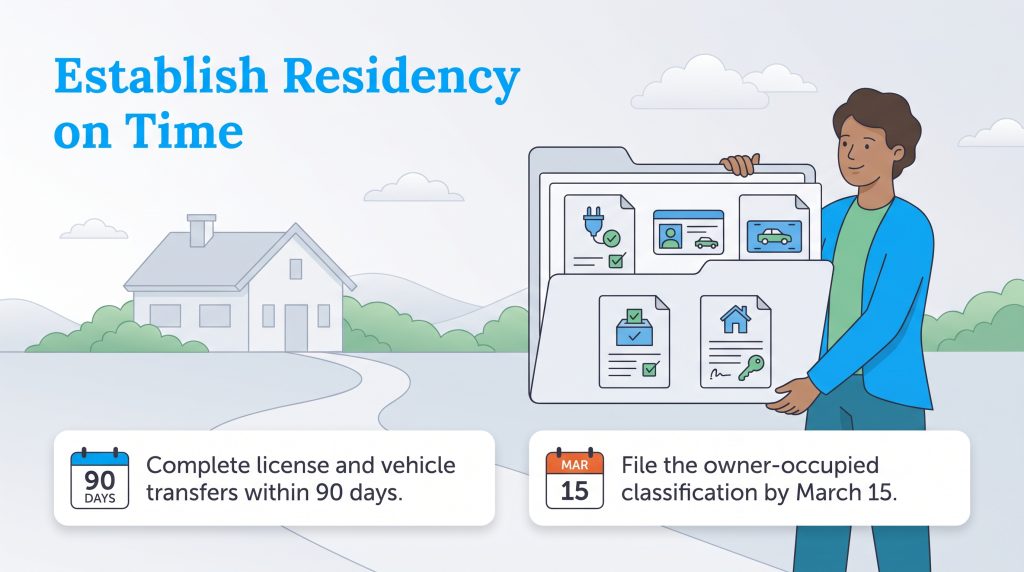
Handling your administrative errands requires gathering the right documentation and observing state deadlines. Whether you are transferring your driver’s license or registering a vehicle, the process is manageable if you plan ahead.
- Set up utilities early: Save your first utility bill or service connection confirmation document right away, because many state and local offices accept it as proof of your physical South Dakota address.
- Transfer your driver’s license within 90 days: Book an appointment at a local exam station and review the South Dakota Department of Public Safety’s required documents so you remember to bring a valid ID, proof of Social Security, and two official documents showing your new local address.
- Register your vehicle within 90 days: Visit your county treasurer’s office within 90 days of arriving to get your new license plates and pay any applicable motor vehicle excise taxes.
- Register to vote and file for property tax classifications: You can register to vote at your county auditor’s office or while getting your driver’s license. If you bought a home, file your owner-occupied classification form with your county director of equalization to ensure you are taxed at the appropriate residential rate.
Heads Up
If you buy a house in South Dakota, confirm your eligibility and submit your certificate of owner-occupied classification to your county director of equalization by the March 15 deadline. Missing this date means your property won’t qualify for the reduced owner-occupied tax levy for the applicable tax year.
Prepare for Your South Dakota Relocation
Moving to South Dakota rewards you with a rare combination of lower daily taxes, wide-open natural beauty, and communities where neighbors still wave from their front porches. While the winter wind across the plains demands respect and a well-insulated home, taking the time to weatherize early and understand your utility budget will keep your household comfortable through every season.
Once your electric, heating, water, and trash accounts are scheduled, you can put down the packing tape and start exploring everything from Falls Park to the Needles Highway. Welcome to the Mount Rushmore State — we hope you love calling it home.
Frequently Asked Questions About Moving to South Dakota
What Is the Best Time of Year to Move to South Dakota?
How Much Do Utilities Cost per Month in South Dakota?
Can I Choose My Own Electricity or Natural Gas Provider in South Dakota?
Is It Better to Live in East River or West River South Dakota?
Are Solar Panels Worth It for Homeowners in South Dakota?
How Long Does It Take to Establish Legal Residency in South Dakota?
About the Author

LaLeesha has a Masters degree in English and enjoys writing whenever she has the chance. She is passionate about gardening, reducing her carbon footprint, and protecting the environment. She also recently served as President of the Board for City Sprouts (a community garden).

Claudio is a sustainability-focused writer with a background in Anthropology and Psychology from NC State University. He has spent over 15 years working in writing, interpretation, and translation, driven by a deep interest in how human culture shapes the environment. Today, he shares his curiosity with readers by writing about sustainable living solutions and the connection between everyday choices and environmental impact.