

Plan Your Budget, Understand Your Options, and Establish Your Essential Home Services Before You Relocate to the Old Line State
Key Takeaways
- Depending on your territory and current utility rules, Maryland offers an optional energy choice program that lets you compare plans and renewable options from competitive suppliers.
- The cost of living and housing varies widely, but budgeting for an average electric bill of roughly $168 per month is a helpful starting point.
- Following a chronological utility setup timeline ensures you coordinate electricity, water, trash, and internet safely before move-in day.
Moving to Maryland means planning for more than housing and commute times. We will help you identify your utility providers, budget for home services, and organize your move so you know what to arrange before you arrive. By getting a head start on your residential to-do list, you can ensure your lights are on, your budget is set, and your new house feels like home from day one.
What to Budget Before Moving to Maryland
Start with a realistic monthly budget. The cost of living in Maryland leans higher than the national average, though your exact budget will depend heavily on your zip code. If you are eyeing the bustling DC Metro areas like Bethesda, Chevy Chase, or Silver Spring, expect to pay a premium for housing, dining, and daily conveniences. Conversely, settling in Western Maryland or finding a quiet spot on the Eastern Shore offers a more affordable lifestyle, though some waterfront communities remain highly priced.
Quick Fact
Maryland property taxes are assessed at both the state and local levels, so your exact rate will vary by county, and local assessments will heavily dictate your annual property tax bill.
Beyond your monthly rent or mortgage payment, Maryland property taxes will be a significant factor in your budget if you plan to buy a home. County rates fluctuate, and you will need to research the specific jurisdictional rates, assessments, and applicable credits for your new home. When estimating utility costs, data from the U.S. Energy Information Administration (EIA) indicates that the average residential electric bill in Maryland hovered around $168 per month in 2024. Remember that this figure is only for electricity; you still need to factor in natural gas, water, sewer, and internet costs based on your specific household usage and lease agreements.
Find the Utility Providers for Your Address
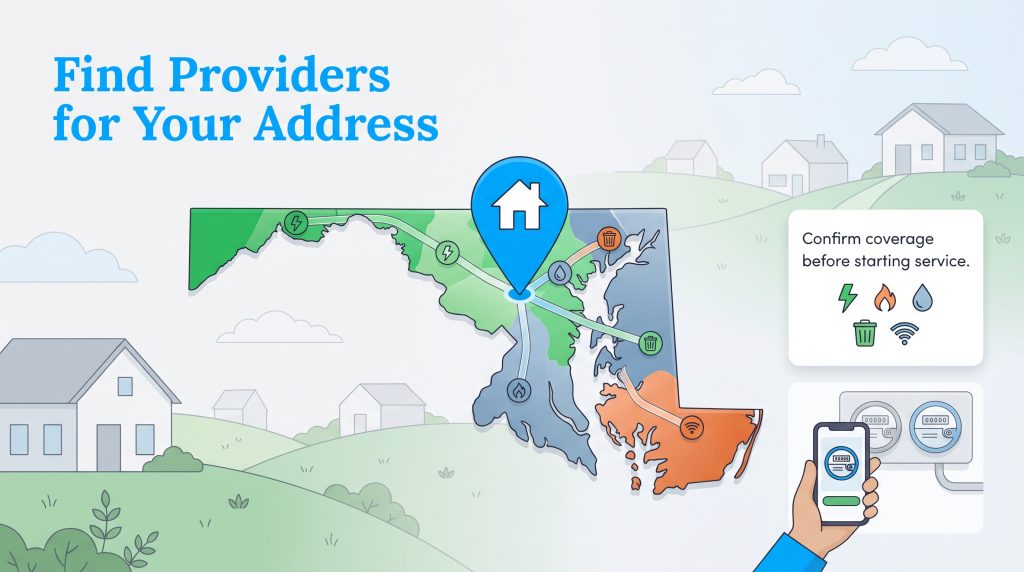
Your provider depends on your address. While some states have a single utility monopoly, Maryland is divided into several major service territories. To start your services, confirm which utilities cover your new address and request service through their official websites.
| Utility Provider | General Service Area |
|---|---|
| Baltimore Gas and Electric (BGE) | Central Maryland, including Baltimore and surrounding counties |
| Pepco | Washington, D.C. border suburbs, including Montgomery and Prince George’s counties |
| Potomac Edison | Western Maryland and parts of the Piedmont region |
| Delmarva Power | The Eastern Shore |
| SMECO | Southern Maryland |
| Choptank Electric Cooperative | Parts of the Eastern Shore |
You also need to arrange your other essential services. If you have natural gas, check if your electric utility also supplies your gas (like BGE) or if you need a separate provider. For water and sewer, confirm whether the owner, tenant, municipality, or regional authority handles the account. Trash and recycling are managed locally; determine if you need a private hauler, if your HOA covers it, or if you will use municipal collection. Finally, check address-level availability for internet service so you can schedule installation timing and equipment delivery.
Pro Tip
As soon as you step into your new home, snap a clear photo of your safely readable electric and water meters to create a visual record that can help document your account start readings.
Understand Maryland Energy Choice Before You Shop
If you are arriving from a state where a single monopoly handles everything, Maryland’s energy market might seem complex. Depending on your utility territory and current Maryland Public Service Commission (PSC) rules, eligible customers may choose a competitive supplier for their electricity and natural gas supply.
In this system, your local distribution utility still owns the poles, wires, and pipelines. They deliver the energy to your home and respond to regional outages. However, the actual energy you consume can be sold or arranged by a supplier of your choice. Shopping for a supplier is entirely optional. If you decide not to shop, your local utility will automatically provide a default Standard Offer Service rate, which can change on scheduled dates throughout the year. Comparing competitive suppliers gives you options, but savings are never guaranteed, and it is crucial to compare total costs, contract expiration terms, and current market rules before signing an agreement.
Eco Edge
The Maryland energy choice program often allows you to select plans that support renewable energy. Be sure to review how these suppliers purchase Renewable Energy Certificates (RECs) so you understand exactly how your choice supports wind and solar generation.
Follow Your Maryland Moving Timeline
Coordinating a relocation requires sharp organization. Managing the logistics in chronological order keeps you from feeling overwhelmed. Follow this actionable moving timeline to keep your transition smoothly on track.
- Four Weeks Out: Begin by securing your moving company or truck rental. Notify your current utility providers of your upcoming disconnect dates. Check address-level internet availability and schedule your installation, as technicians often book up weeks in advance.
- Two Weeks Out: Confirm your start dates with your new local Maryland utility. Determine if any deposits or appointments are required for electricity and natural gas. Submit a change-of-address form with the USPS, and update your billing address with your bank. If you plan to shop for an optional competitive energy supplier, do so after confirming your initial service start date.
- Moving Day: Do a final sweep of your old home. When you arrive at your new Maryland residence, test the lights, water pressure, and HVAC system immediately. Ask your landlord or real estate agent about any well and septic inspection responsibilities if your home is off the municipal grid.
- Within 60 Days Post-Move: Visit the Maryland Motor Vehicle Administration (MVA) to update your driver’s license and register your vehicles. You must have valid Maryland auto insurance to register a vehicle, and you may need to complete separate safety inspections and emissions tests. Ensure you bring all required documentation, including proper proof of residency.
Compare Maryland Regions With Your Commute in Mind
Every state has its unique quirks, and understanding the practical lifestyle realities helps set the right expectations. Maryland offers a fantastic blend of historical richness and breathtaking geography. You can spend your weekends hiking the Appalachian Mountains, boating on the Chesapeake Bay, or visiting the free museums in Washington, D.C. The state also features major employment centers and renowned healthcare institutions like Johns Hopkins.
However, you will also face a few localized hurdles. Traffic congestion is a common commuting challenge, particularly for drivers navigating the heavily traveled I-495 Capital Beltway and I-270 corridors. Additionally, the humid mid-Atlantic summers mean more air-conditioning use, which will impact your energy bills. Evaluating these practical tradeoffs will help you determine the best neighborhood for your daily commute and long-term budget.
| Pros of Living in Maryland | Cons of Living in Maryland |
|---|---|
| Access to diverse geography, from mountains to beaches | Frequent heavy traffic congestion around the DC Metro area |
| Proximity to Washington, D.C. and major employment centers | Higher housing costs and varying jurisdictional property taxes |
| Renowned healthcare facilities and educational institutions | Humid summer weather patterns that increase cooling costs |
| Incredible local seafood, particularly Chesapeake blue crabs | Required safety inspections and emissions testing for many vehicles |
Make Your Maryland Move Easier to Manage
Relocating across state lines is always a massive undertaking, but the effort pays off the moment you finally unpack that last box. By actively managing your utility setup and understanding your energy choices, you avoid preventable costs and protect your monthly budget. Ensure you confirm your essential service dates, keep your account confirmations accessible during the move, and tackle your mandatory MVA tasks as soon as you get settled. Taking control of these fundamental logistics early on frees up your mental energy to focus on exploring your new community.
Frequently Asked Questions About Moving to Maryland
Before you pack your boxes, review these common questions to help you understand the core logistics, utility costs, and legal requirements of moving to the Old Line State.
How much do electricity utilities typically cost in Maryland?
Do I have to choose an energy supplier in Maryland?
How long do I have to update my driver’s license after moving to Maryland?
What is the most expensive part of living in Maryland?
How do I set up water and trash service in my new home?
About the Author

LaLeesha has a Masters degree in English and enjoys writing whenever she has the chance. She is passionate about gardening, reducing her carbon footprint, and protecting the environment. She also recently served as President of the Board for City Sprouts (a community garden).

David has been an integral part of some of the biggest utility sites on the internet, including InMyArea.com, HighSpeedInternet.com, BroadbandNow.com, and U.S. News. He brings over 15 years of experience writing about, compiling and analyzing utility data.