
While both providers offer premium service and similar perks, your usage habits will determine which energy giant is actually worth the extra cost.
Key Takeaways
- Both TXU and Reliant are “premium” brands that charge higher rates in exchange for superior customer service and stability.
- Reliant often wins on plan simplicity for average homeowners, while TXU’s “Free Nights” plans can benefit specific high-usage households.
- Reading the Electricity Facts Label (EFL) is critical, as both companies use usage credits that can spike your bill if you don’t use enough power.
Choosing between TXU Energy and Reliant Energy is the Texas equivalent of choosing between Coke and Pepsi. Most of us know these two names better than any others on the market because they have been the dominant players since deregulation began. If you are looking for the absolute cheapest rate per kilowatt-hour, neither of these companies is likely your best bet. However, if you are a risk-averse customer who values 24/7 support, stable billing, and mobile apps that actually work, these are the safest options available. We are going to take a brutally honest look at the “gotchas” in their contracts that the slick television ads won’t show you so you can decide which premium provider actually deserves your money.

- 13.5¢ /kWh
- 3-100%
- 60 days
- 1-36 Months
- Best for Plan Variety & Reliability

- 11.9¢ /kWh
- 24%
- 90 days
- 0-36 Months
- Best for Smart Home Tools & App
*rates may vary by location and household usage
The Short Verdict: TXU vs. Reliant at a Glance
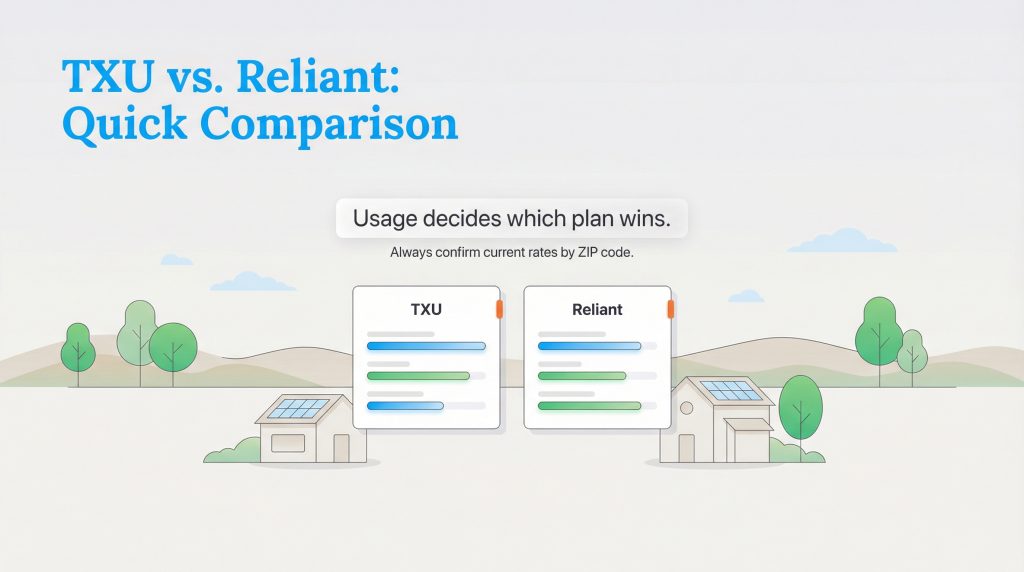
When you strip away the marketing fluff, the differences between these two providers often come down to how much energy you use. This table breaks down the core differences to help you spot the winner for your specific situation.
| Feature | TXU Energy | Reliant Energy | Winner |
|---|---|---|---|
| Typical 12-Month Rate Range (Around 1000 kWh) | Mid-teens to high-teens ¢/kWh* | Mid-teens to high-teens ¢/kWh* | Reliant (Slight Edge On Many Recent Offers) |
| Best For | High-usage families & EV owners | Average homeowners & renters | Dependent on usage |
| Contract Flexibility | High flat cancellation fees | Moderate fees (flat or monthly) | Reliant |
| Customer Support | 24/7 Phone & Chat | 24/7 Phone & Chat | Tie |
| Green Energy Options | Solar Buyback & Wind Plans | Solar Plans & Offsets | Tie |
*Examples only. Actual rates change frequently and vary by ZIP code, contract length, and market conditions. Always check current offers on official comparison tool.
TXU Energy Plans & Pricing
| Plan Name | Rate | Plan Type | Cancellation Fee | |
|---|---|---|---|---|
| Value Edge 12 | $0.135 /kWh | 12 Months Fixed Rate | $150.00 | Check Availability |
| Clear Deal 12 | $0.139 /kWh | 12 Months Rate | $150 | Check Availability |
| Smart Edge 12 | $0.139 /kWh | 12 Months Fixed Rate | $150.00 | Check Availability |
| Smart Edge 24 | $0.145 /kWh | 24 Months Fixed Rate | $295.00 | Check Availability |
| Clear Deal 24 | $0.155 /kWh | 24 Months Rate | $295 | Check Availability |
| Solar Value 12 | $0.156 /kWh | 12 Months Rate | $150 | Check Availability |
| Simple Value 12 | $0.157 /kWh | 12 Months Fixed Rate | $150.00 | Check Availability |
| Simple Rate 12 | $0.173 /kWh | 12 Months Rate | $150 | Check Availability |
| On Your Terms | $0.175 /kWh | 1 Month Months Rate | $ | Check Availability |
| Free Nights & Solar Days 12 (8 pm) | $0.189 /kWh | 12 Months Rate | $150 | Check Availability |
| Solar Club 12 | $0.191 /kWh | 12 Months Fixed Rate | $150.00 | Check Availability |
| Ultimate Season Pass 12 | $0.192 /kWh | 12 Months Rate | $150 | Check Availability |
| Texas Choice 12 | $0.192 /kWh | 12 Months Fixed Rate | $150.00 | Check Availability |
| Texas Choice 24 | $0.192 /kWh | 24 Months Fixed Rate | $295.00 | Check Availability |
| Flex Forward | $0.193 /kWh | 1 Month Months Rate | $ | Check Availability |
| Flex Rewards | $0.193 /kWh | Variable Rate | $0.00 | Check Availability |
| Smart Deal 12 | $0.196 /kWh | 12 Months Fixed Rate | $150.00 | Check Availability |
| Smart Deal 24 | $0.204 /kWh | 24 Months Fixed Rate | $295.00 | Check Availability |
| Smart Deal 36 | $0.204 /kWh | 36 Months Fixed Rate | $395.00 | Check Availability |
| Solar Saver 12 | $0.205 /kWh | 12 Months Rate | $150 | Check Availability |
| Saver's Discount 12 | $0.217 /kWh | 12 Months Rate | $150 | Check Availability |
| Saver's Discount 24 | $0.228 /kWh | 24 Months Rate | $295 | Check Availability |
Reliant Plans & Pricing
| Plan Name | Rate | Plan Type | Cancellation Fee | |
|---|---|---|---|---|
| Reliant Power Savings 24 plan | $0.129 /kWh | 24 Months Rate | $295 | Check Availability |
| Reliant Power On 15 | $0.139 /kWh | 15 Months Fixed Rate | $150.00 | Check Availability |
| Reliant Power Savings 12 plan | $0.145 /kWh | 12 Months Rate | $150 | Check Availability |
| Reliant Power On 24 Plan | $0.148 /kWh | 24 Months Fixed Rate | $295.00 | Check Availability |
| Reliant Power on 36 Plan | $0.149 /kWh | 36 Months Fixed Rate | $395.00 | Check Availability |
| Reliant Power On 12 Plan | $0.150 /kWh | 12 Months Fixed Rate | $150.00 | Check Availability |
| Reliant Basic Power 24 plan | $0.158 /kWh | 24 Months Rate | $295 | Check Availability |
| Reliant Basic Power 12 plan | $0.162 /kWh | 12 Months Rate | $150 | Check Availability |
| Reliant Conservation 12 plan | $0.165 /kWh | 12 Months Rate | $150 | Check Availability |
| Reliant Conservation 24 plan | $0.165 /kWh | 24 Months Rate | $295 | Check Availability |
| Reliant Power On Flex plan | $0.179 /kWh | Variable Rate | $0.00 | Check Availability |
| Reliant Power Savings 2,000 kWh 12 plan | $0.206 /kWh | 12 Months Rate | $150 | Check Availability |
| Reliant Power Savings 2,000 kWh 24 plan | $0.213 /kWh | 24 Months Rate | $295 | Check Availability |
Price and Plans: Who Offers Better Rates?

If you have spent any time browsing PowerToChoose.org or other rate comparison sites, you have probably noticed that TXU and Reliant are rarely the cheapest options. They position themselves as premium brands, much like buying insurance from a major national carrier versus a budget online startup. You are paying a premium for reliability and brand trust. However, when comparing TXU vs Reliant Energy rates, the structure of the plan matters far more than the advertised “average price” you see in big bold letters.
Both companies generally price their plans 2–4 cents higher per kWh than budget competitors. In 2026, we are seeing rates for both hover in the mid-to-high teens for 12-month contracts in recent years. While that might sting compared to a budget plan in the low teens, you are less likely to deal with surprise billing errors or customer service departments that are closed on weekends.
Fixed-Rate Plans Compared
For the vast majority of homeowners in cities like Houston or Dallas, a standard fixed-rate plan is the safest financial bet. Reliant’s flagship plans, often labeled under “Basic Power” or “Conservation,” tend to offer flatter rate structures. This means the price you pay per kilowatt-hour doesn’t change drastically whether you use 800 kWh or 1,500 kWh.
TXU often leans heavily on bill credit structures in their standard plans, such as the “Smart Deal” or “Saver” series. These plans can look attractive if you hit the specific usage target, usually 1,000 to 2,000 kWh, but the rate per kWh can jump significantly if you fall short of that usage. If you want a predictable bill that doesn’t require you to constantly monitor your meter, Reliant’s standard fixed plans are often slightly more user-friendly. Finding the right plan structure is a key step in learning how to save on your electric bill.
“Free” Plans: Free Nights vs. Free Weekends
This is the most common battleground: TXU Free Nights vs Reliant Free Weekends. These time-of-use plans sound fantastic on paper. Who doesn’t want free electricity? But you have to change your lifestyle to make them work, or you will end up paying much more than a standard plan.
TXU Free Nights is generally best for people who are out of the house all day or own an electric vehicle (EV). The free period usually kicks in around 8:00 p.m. or 9:00 p.m. If you can delay running your dishwasher, laundry, and pool pump until then—and you charge your EV overnight—you may lower your average rate significantly. However, the daytime rate on these plans is often punishingly high to compensate.
Reliant Free Weekends appeals to people who travel for work Monday through Friday. The concept is simple: from Friday evening to Sunday night, your energy usage is free (excluding delivery charges in some cases). The problem for most families is that “weekend laundry” isn’t enough to offset the higher rate you pay five days a week. Unless your home is empty during the workweek, the math rarely works out in your favor compared to a low fixed-rate plan.
The Fine Print: Usage Credits and Minimums
Both companies utilize “bill credits” to make their rates look competitive on comparison websites. This is why learning how to read an Electricity Facts Label is mandatory before signing up.
For example, a plan might offer a $30 credit if you use more than 1,000 kWh in a billing cycle. If you use 1,001 kWh, your bill is reasonable. If you use 999 kWh, you lose that $30 credit, and your effective rate skyrockets. TXU is notorious for these “target usage” credits, which are great for large homes that always use a lot of power but risky for efficient homes or apartments. Reliant uses them too, but they generally offer more plans without these strict thresholds.
Fees and Contracts: What It Costs to Leave
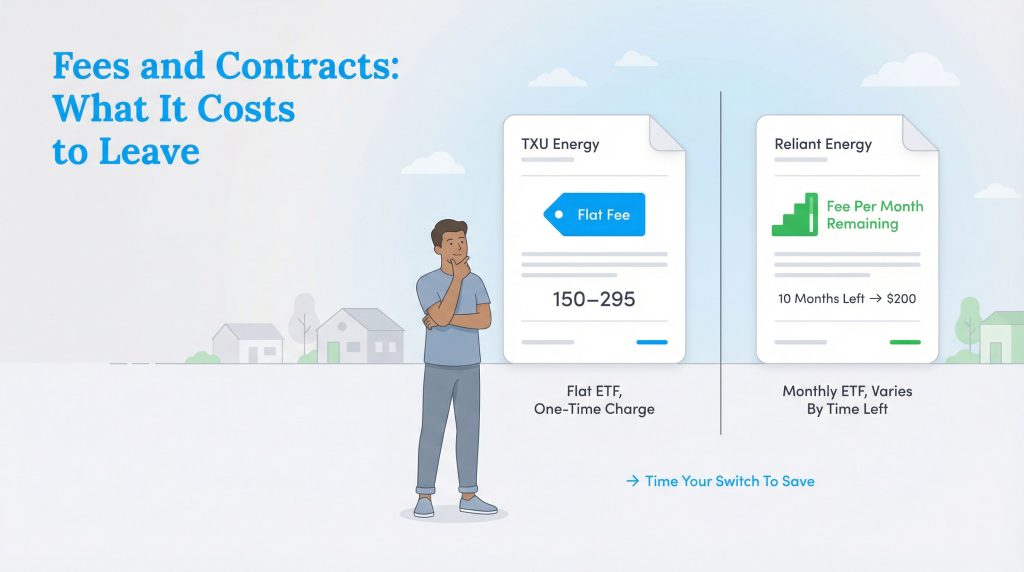
Life happens. You might move, or you might find a much better deal six months into your contract. When we look at Reliant vs TXU cancellation fees, there are distinct differences in how they penalize you for leaving early.
TXU Energy typically charges a flat Early Termination Fee (ETF) on many of their popular fixed-rate plans. Depending on the plan length, this is often $150 or $295. It is a clean break; you pay the fee, and you are done.
Reliant Energy uses a mix of flat fees and “fee per month remaining” structures. For example, some Reliant contracts charge $20 for every month left on your contract. If you leave 10 months early, that is a $200 fee. If you leave with only one month to go, it’s just $20. This can be advantageous if you are near the end of your term.
Switching between them is technically frictionless. You don’t need new equipment, and your lights won’t flicker. The switch is handled electronically, usually within 3 to 7 days. However, timing that switch to avoid the ETF is vital for your wallet.
Comparison Scenarios: Which Provider Fits You?
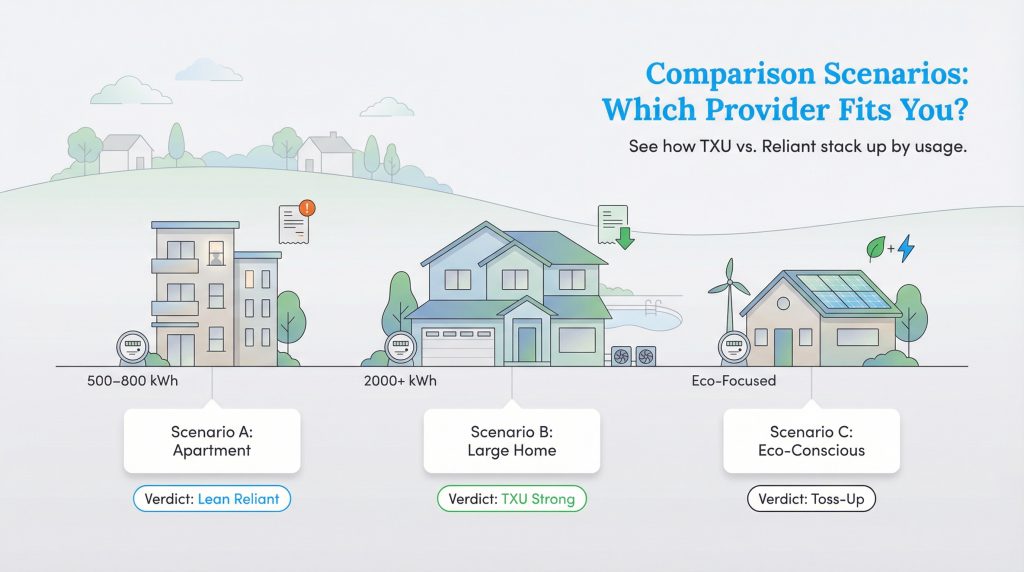
Rates and fees are abstract until you apply them to real life. Here is how these two stack up for different types of residents.
Scenario A: Apartment Renter (500–800 kWh)
Verdict: Proceed with caution on both, but lean toward Reliant. Many TXU plans are optimized for usage over 1,000 kWh, meaning you might miss out on bill credits and pay a much higher rate. Reliant often has “Conservation” plans with simpler structures that don’t penalize lower usage as severely.
Scenario B: Large Family Home (2000+ kWh)
Verdict: TXU Energy is a strong contender here. Their pricing structure often rewards high consumption. When you consistently hit those 2,000 kWh usage tiers, the bill credits kick in, driving your average price per kWh down. If you have a pool, two AC units, and kids leaving lights on, TXU’s bill-credit structure can reduce your effective rate when you hit those targets.
Scenario C: The Eco-Conscious Customer
Verdict: It’s a toss-up. Both companies offer renewable add-ons, but you should compare them against dedicated green providers. If you want an eco-conscious alternative without switching to a niche provider, both TXU and Reliant have 100% renewable plans available, though usually at a higher price point than their standard offerings.
Customer Experience: Reviews and Support

If you search for TXU Energy vs Reliant Energy reviews, you will find thousands of 5-star ratings mixed with angry complaints. That is the nature of the utility business. However, recent J.D. Power studies often place both companies near the top of the pack for customer satisfaction in Texas. They consistently score better than the budget providers.
Both providers offer excellent mobile apps that allow you to track your usage by the hour, pay bills, and report outages. This is a major differentiator from smaller companies that might only have a basic web portal. If you like seeing exactly how much electricity you used yesterday so you can adjust your thermostat today, both TXU and Reliant deliver a high-quality digital experience.
Renewable Options: Who is Greener?
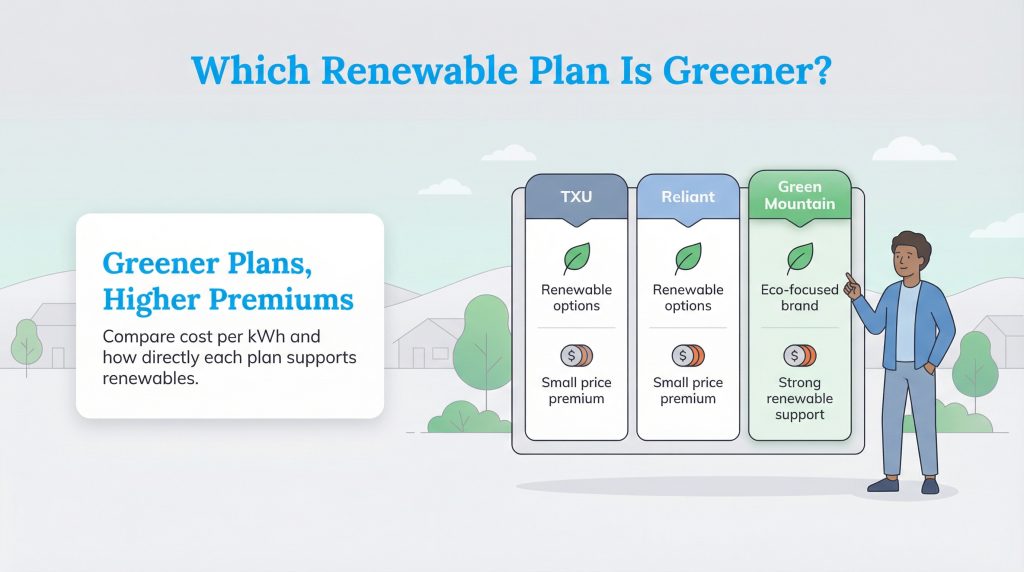
Sustainability is a growing priority for many Texans. Both companies offer renewable energy buyback plans for solar owners and 100% wind or solar plans for renters. However, you should know that you are usually paying a premium for these “green” upgrades compared to their standard brown power plans. These plans are an environmentally mindful choice, but they often cost more per kWh.
Eco Edge: If you’re on a budget but still want an environmentally mindful choice, look for fixed-rate plans with at least a partial renewable energy content. You’ll support cleaner power without jumping to the priciest 100% green options.When comparing TXU vs Reliant vs Green Mountain Energy, it is worth noting that Green Mountain Energy is actually owned by NRG Energy, the same parent company that owns Reliant. Green Mountain is the dedicated “eco-brand” in that portfolio. If your primary goal is supporting renewable energy, Green Mountain is often the more direct choice, though TXU and Reliant both have solid options if you want to stay with a major conventional brand while still offsetting your carbon footprint.
How To Choose Between TXU And Reliant For Your Home
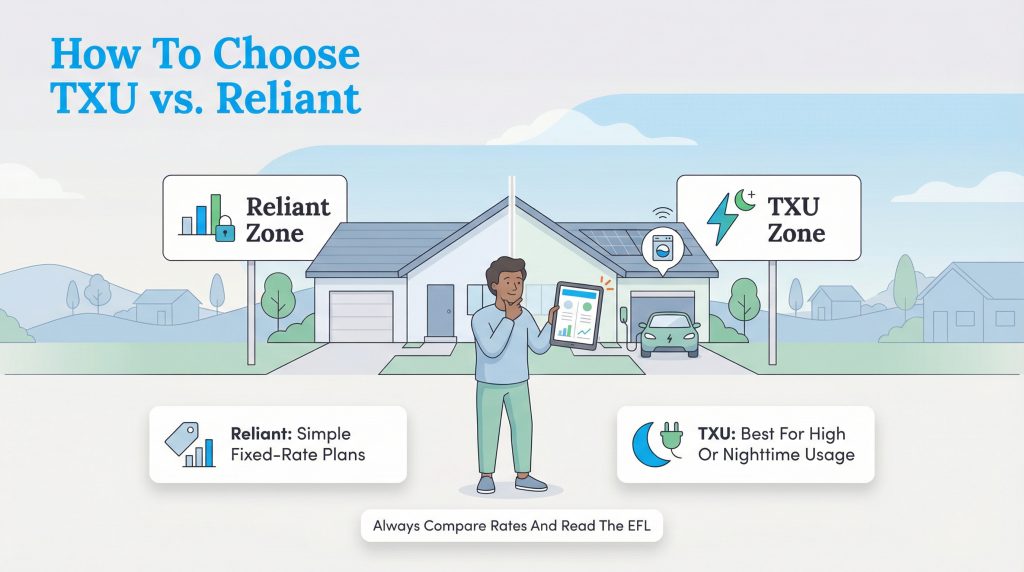
If you value simple pricing and want a plan you can mostly ignore once it’s set up, Reliant often has the edge with straightforward fixed-rate options that work well for average homeowners and renters. If you live in a large home, consistently use 2,000 kWh or more, or can shift a lot of usage to nights with an EV or smart appliances, TXU’s bill credits and Free Nights plans can sometimes bring your effective rate down.
Neither company is usually the rock-bottom price leader, but both are reliable, recognizable names with strong customer support and polished apps. If every dollar matters, it’s worth comparing them against smaller competitors on a site like PowerToChoose.org. If you’re willing to pay a bit more for stability, brand recognition, and support, choose the provider whose plan structure best matches how and when your household actually uses electricity — and always read the Electricity Facts Label before you sign.
FAQs About TXU vs. Reliant
Is TXU cheaper than Reliant?
Who has better customer service, TXU or Reliant?
Is it hard to switch from TXU to Reliant?
Do TXU and Reliant require a deposit?
Are TXU and Reliant the same company?
Are the “Free Nights” plans really free?
About the Author

LaLeesha has a Masters degree in English and enjoys writing whenever she has the chance. She is passionate about gardening, reducing her carbon footprint, and protecting the environment.