
Residential Default Supply Rates Jump Roughly 10% to 11% This Winter Across Southeastern Pennsylvania
Key Takeaways
- PECO’s default electricity supply rate jumps from 11.759¢ to a pending 12.944¢ per kWh on Dec. 1, 2026, marking an increase of roughly 10% to 11%.
- Monthly household bills will climb anywhere from $8.29 to more than $20 depending on your home’s total electricity consumption and heating setup.
- Pennsylvania’s deregulated energy market allows roughly 1.6 million residential customers to bypass this rate increase by selecting an alternative retail electric supplier.
Southeastern Pennsylvania residents are facing higher electricity bills just as cold weather settles into the region. On Dec. 1, 2026, PECO will update its residential default supply rate — known as the Price to Compare (PTC) — from 11.759¢ per kilowatt-hour (kWh) to a pending 12.944¢ per kWh, subject to final adjustments by the Pennsylvania Public Utility Commission. That 1.185¢ per kWh shift represents a jump of roughly 10% to 11% on the generation and transmission portion of your bill. Because Pennsylvania operates a deregulated energy market, you do not have to absorb this increase passively. By understanding how the Price to Compare works and shopping through licensed alternative retail electricity suppliers, you can take control of your winter energy expenses.
Understanding the PECO Rate Increase
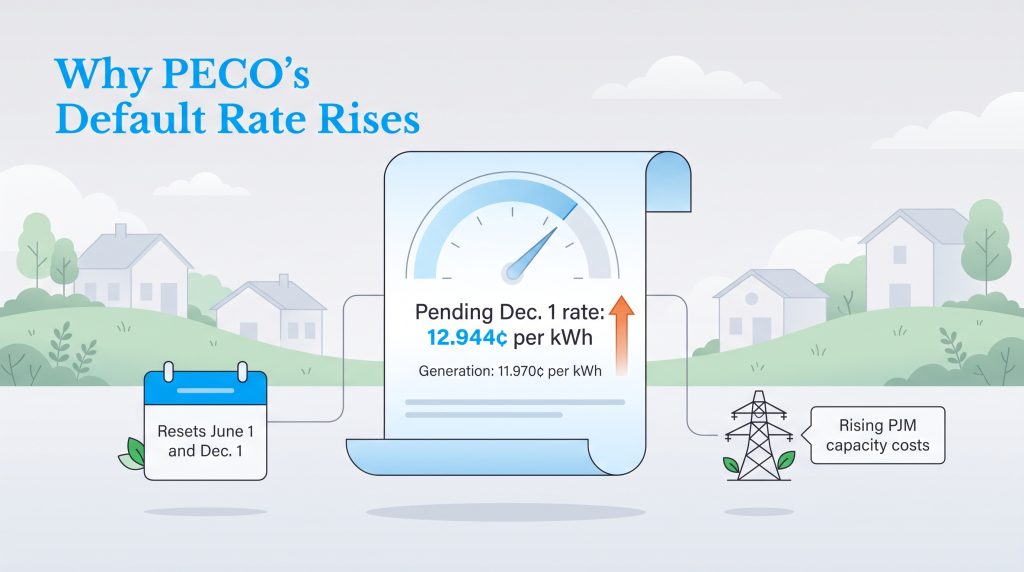
PECO resets its default Price to Compare twice each year, on June 1 and Dec. 1, to reflect prevailing market rates for wholesale generation and transmission capacity. When you do not select an independent retail electricity supplier, PECO purchases electricity on your behalf and passes along the procurement costs dollar-for-dollar without a profit markup.
In October 2026, PECO submitted its semi-annual tariff update to the Pennsylvania Public Utility Commission (PA PUC). The pending 12.944¢ per kWh rate covers generation charges (set at 11.970¢ per kWh) alongside transmission and ancillary compliance expenses. The transmission component will receive final certification in mid-November, meaning the exact figure may shift slightly before the Dec. 1 rollout.
The primary catalyst behind recent default service hikes across the mid-Atlantic grid is rising capacity prices within the regional transmission organization, PJM Interconnection. As regional power demand increases and generation reserve margins tighten, wholesale power procurement costs have expanded steadily over the past two years.
Monthly Bill Impacts for Households
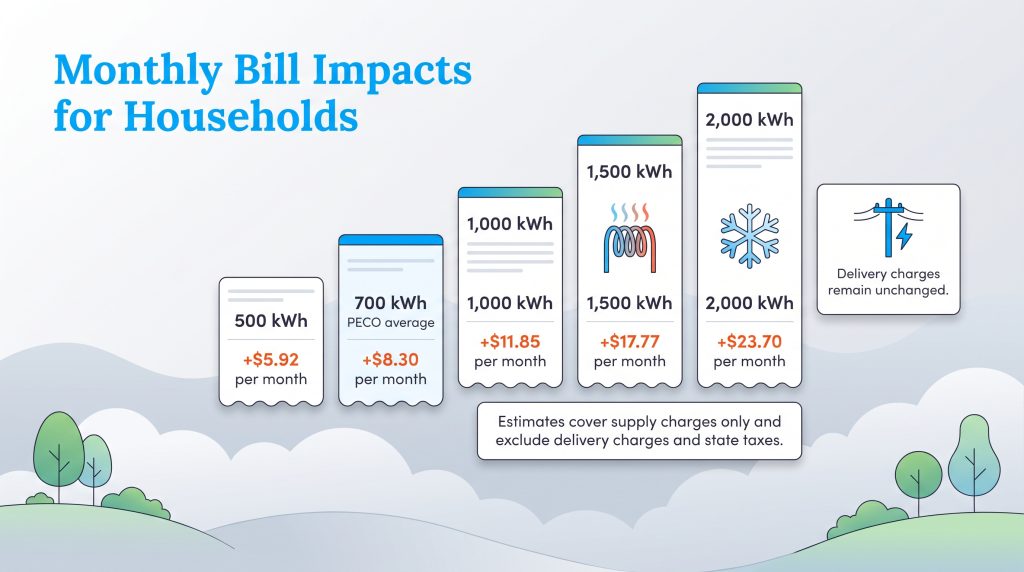
The financial effect of this rate increase will vary widely across households based on home size, appliance efficiency, and heating equipment. Because electricity delivery charges remain unchanged, the price increase applies strictly to the generation and transmission segment of your monthly statement.
For a baseline residential home consuming 700 kWh per month, PECO estimates the default supply cost will rise by $8.29 each month. Larger households and those using 1,000 kWh per month will see an added expense of approximately $12.00 monthly ($144 annually). During frigid winter months, households that heat with electric baseboards or heat pumps regularly exceed 1,500 kWh to 2,000 kWh, pushing monthly bill spikes above $18.00 to $24.00+.
| Monthly Household Usage | Current Monthly Supply Cost (11.759¢/kWh) | New Monthly Supply Cost (12.944¢/kWh) | Estimated Monthly Increase |
| 500 kWh | $58.80 | $64.72 | +$5.92 |
| 700 kWh (PECO Average) | $82.31 | $90.61 | +$8.30 |
| 1,000 kWh | $117.59 | $129.44 | +$11.85 |
| 1,500 kWh (Electric Heat) | $176.39 | $194.16 | +$17.77 |
| 2,000 kWh (High Winter Peak) | $235.18 | $258.88 | +$23.70 |
Note: Table estimates reflect electricity supply charges only and exclude local delivery charges and state taxes.
Electricity vs. Natural Gas Charges on Your Bill
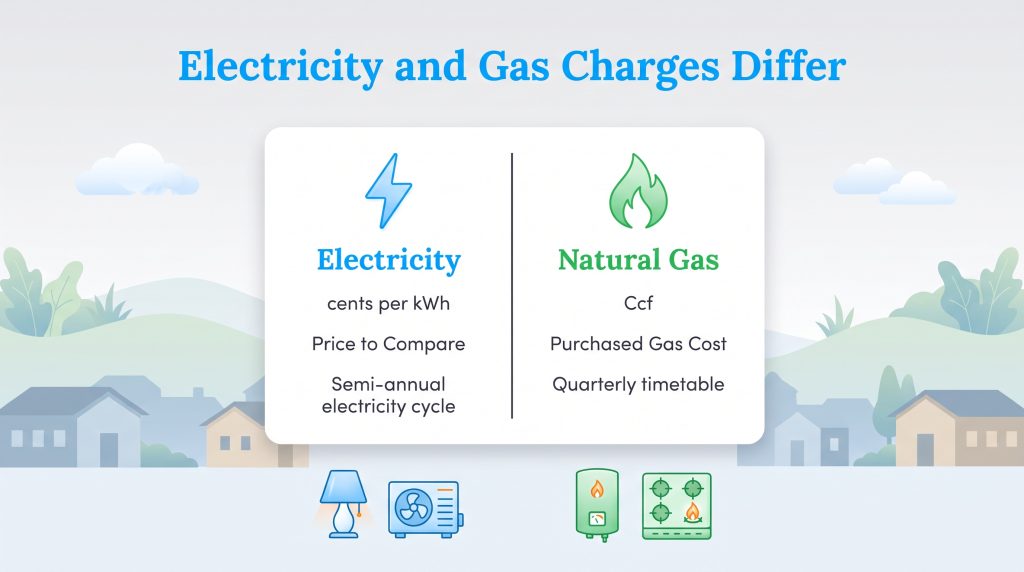
Electricity supply rates are billed in cents per kilowatt-hour and reflect the electrical energy needed to power your home lighting, appliances, electronics, and air conditioning or heat pumps. When you compare retail electric suppliers, you evaluate plans solely against PECO’s electricity Price to Compare to determine whether an alternative provider delivers savings on power generation.
Natural gas charges appear as an entirely distinct utility service on your PECO statement, measured in hundred cubic feet (Ccf) for home heating, hot water, and cooking. Natural gas commodity rates adjust under a separate regulatory mechanism — the Purchased Gas Cost (PGC) framework — and are evaluated on a quarterly timetable rather than the semi-annual electricity cycle.
Service Territory and Regional Impact Breakdown
PECO is Pennsylvania’s largest electric distribution utility, providing electric delivery across approximately 2,100 square miles in southeastern Pennsylvania. The upcoming default rate change affects roughly 1.6 to 1.7 million residential households that do not currently have a contract with an independent retail supplier.
The rate adjustment applies directly across five primary counties, along with portions of a sixth:
- Philadelphia County: The entire city and county of Philadelphia, encompassing major residential neighborhoods from Center City and South Philadelphia to West Philadelphia and the Northeast.
- Montgomery County: Communities throughout suburban Philadelphia, including Norristown and King of Prussia.
- Bucks County: Municipalities including Levittown and Doylestown.
- Delaware County: Urban and suburban centers such as Chester and Upper Darby.
- Chester County: Substantial portions of the county, including West Chester.
- York County: Southeastern border sections and rural townships served by PECO distribution lines.
How to Protect Your Budget Through Energy Choice
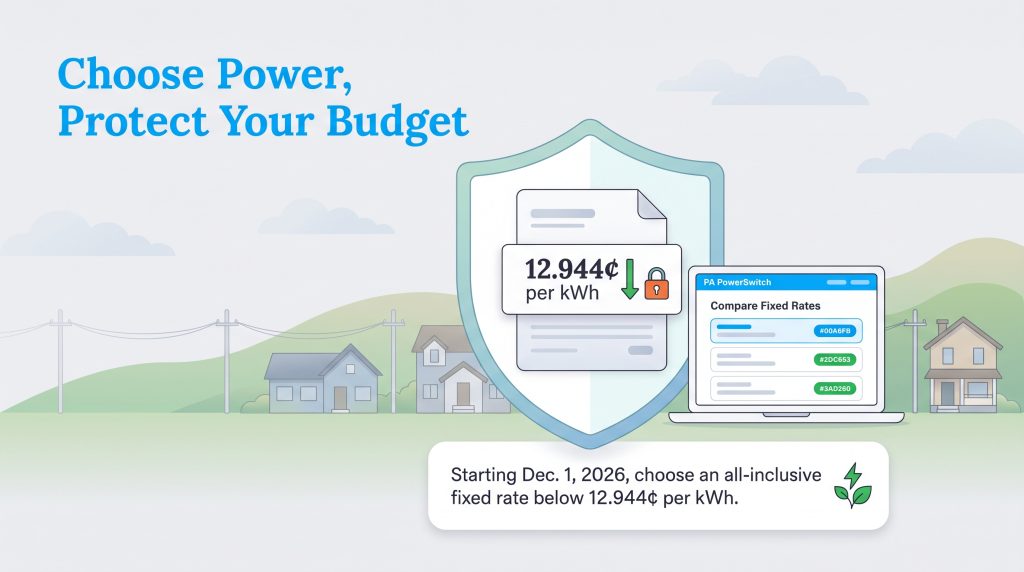
Because Pennsylvania features a deregulated retail electricity market, you have the legal right to choose your electric generation supplier rather than buying standard power from PECO. PECO will continue to deliver your power safely through its wires, maintain poles and substations, and respond to weather outages regardless of which retail company provides your energy.
The baseline number to remember is 12.944¢ per kWh. Any licensed supplier offering an all-inclusive fixed rate below that benchmark will reduce the supply portion of your energy bill starting Dec. 1, 2026.
Steps to Compare and Switch Electric Suppliers
- Locate your PECO account number: Check the top of your recent electric statement to find your 10-digit account number.
- Visit the official shopping portal: Head directly to PA PowerSwitch, the official, independent comparison website operated by the Pennsylvania Public Utility Commission.
- Filter for fixed-rate contracts: Select plans offering fixed rates for 12 months or longer to lock in stability through the winter heating season and summer cooling peaks. Avoid variable-rate plans that fluctuate unpredictably from month to month.
- Examine fine print and contract terms: Ensure the supplier has zero monthly enrollment or customer fees, and check whether an early termination fee applies if you decide to switch before the contract period concludes.
- Explore eco-conscious alternatives: Many independent retail suppliers offer 100% renewable energy plans backed by regional wind and solar generation at rates competitive with default utility power. Choosing an environmentally mindful option enables you to lower your household’s carbon footprint while locking in rate certainty.
Once you submit your enrollment, your chosen supplier coordinates directly with PECO. The change takes effect on your meter within one to two billing cycles with zero physical disruption to your home’s power supply.
Assistance Programs for Income-Eligible Households
If higher electricity charges strain your monthly budget, several state and utility support initiatives provide immediate relief:
- Low-Income Home Energy Assistance Program (LIHEAP): A federally funded program administered by the Pennsylvania Department of Human Services providing cash grants paid directly to your utility company to help pay heating bills.
- PECO Customer Assistance Program (CAP): Offers qualified residential customers a monthly discounted rate on their electric usage to make energy costs manageable.
- Low-Income Usage Reduction Program (LIURP): Provides free in-home energy assessments and weatherization assistance — such as insulation and air sealing — to help lower baseline consumption.
- Budget Billing: Available to all residential customers regardless of income, Budget Billing balances seasonal peaks by spreading your estimated annual utility costs across 12 equal monthly installments.
Taking Practical Steps Before Winter Arrives
Taking proactive steps ahead of the Dec. 1 rate adjustment gives you a distinct advantage as temperatures drop. Reviewing your current electric statement, exploring competitive fixed offers on PA PowerSwitch, and implementing simple weatherization measures will keep your living space comfortable without driving up monthly overhead. We encourage you to check your PECO bill today, calculate your typical winter kilowatt-hour consumption, and lock in an energy plan that aligns with your household budget.
Frequently Asked Questions About the PECO Rate Increase
Will my electricity service be interrupted if I switch to an alternative supplier?
Does the Dec. 1 rate increase affect both supply and delivery charges?
How can I verify that an alternative energy supplier is legitimate?
When will PECO adjust its residential electricity supply rates again?
About the Author

Claudio is a sustainability-focused writer with a background in Anthropology and Psychology from NC State University. He has spent over 15 years working in writing, interpretation, and translation, driven by a deep interest in how human culture shapes the environment. Today, he shares his curiosity with readers by writing about sustainable living solutions and the connection between everyday choices and environmental impact.