
Surging Wholesale Power Costs and Billing Anomalies Hit NYSEG Ratepayers Across 44 Counties as Heating Season Begins
Key Takeaways
- NYSEG residential customers across 44 New York counties face a roughly 40% jump in on-peak and off-peak electric supply charges heading into the winter heating season.
- Wholesale market volatility, natural gas pipeline constraints, and smart meter true-ups are compounding to push localized household bills from roughly $119.56 up to $595.09.
- New York’s deregulated retail energy market allows you to audit your meter reads and lock in a vetted, fixed-rate supplier through the state’s official comparison portal to avoid variable rate shocks.
If you recently opened your New York State Electric and Gas (NYSEG) statement and felt your jaw drop, you are far from alone. While mid-November media reports highlighted sudden 40% spikes in on-peak and off-peak electric supply charges among Sullivan County households, NYSEG’s market-based supply tariffs affect residential customers across 44 counties, 160 cities and villages, and 406 towns throughout upstate New York. These steep increases represent an immediate financial shock for fixed-income seniors, lower-income tenants, and families who rely on electric resistance heat or heat pumps during early cold snaps. We know how stressful unpredictable utility bills can be, so our team dug into NYSEG tariff filings, federal rate benchmarks, and state regulatory tools to explain what is driving these surges and how you can protect your household budget.
Regions and Counties Impacted Across NYSEG’s Service Territory
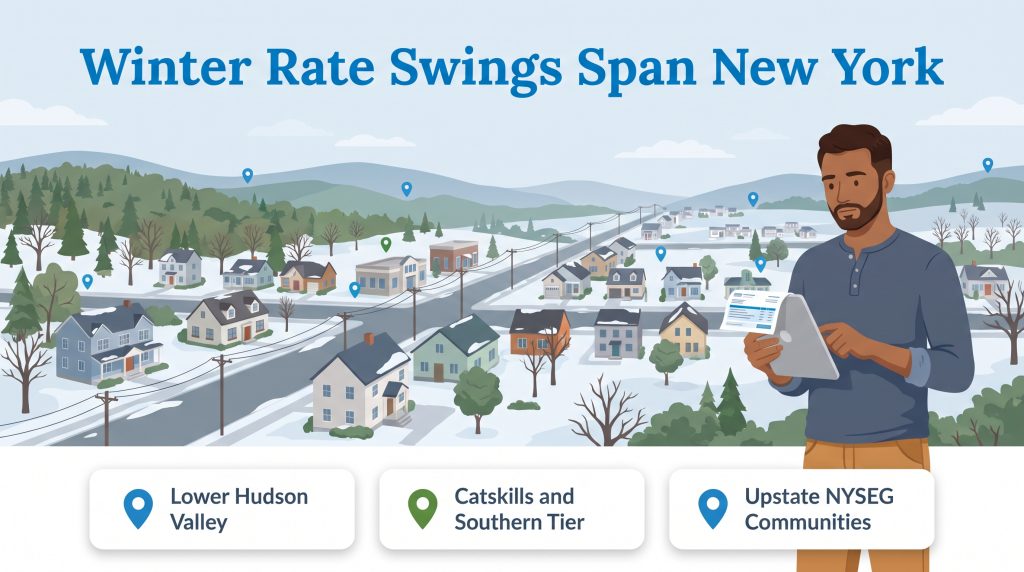
Although News 12 coverage on Nov. 13, 2026, focused heavily on consumer complaints pouring out of Sullivan County communities like Monticello and Rock Hill, this billing trend is not isolated to a single county. NYSEG delivers electricity to roughly 921,400 customers across 18,400 square miles of New York State. Because NYSEG’s default supply charges pass through regional wholesale power costs across multiple New York Independent System Operator (NYISO) load zones, ratepayers across the Lower Hudson Valley, Catskills, Southern Tier, Finger Lakes, Western New York, Capital Region, and North Country are exposed to winter supply swings.
In Sullivan County, documented residential bills jumped from $119.56 for 682 kWh of usage in November to $417.64 for 2,376 kWh in December and $595.09 for 2,785 kWh in January as both on-peak and off-peak supply rates climbed roughly 40%. Similar winter supply volatility has surfaced in neighboring Lower Hudson Valley divisions and upstate hubs whenever cold weather tightens regional power generation. The table below outlines the primary NYSEG operating divisions, impacted counties, and major municipalities affected across the state.
| NYSEG Operating Division | Key Impacted Counties | Major Municipalities Affected | Primary Regional Risk Factors |
| Liberty Division (Catskills) | Sullivan, Ulster, Delaware | Monticello, Rock Hill, Liberty, Woodridge | High concentration of electric resistance heating and acute 40% supply tariff complaints |
| Brewster Division (Lower Hudson Valley) | Putnam, Dutchess, Westchester | Brewster, Carmel, Beekman, Yorktown | NYISO Hudson Valley wholesale congestion and active smart meter deployment |
| Binghamton & Oneonta Divisions | Broome, Tioga, Chenango, Otsego | Binghamton, Johnson City, Endicott, Oneonta | Heavy winter heating loads and high proportion of fixed-income residential households |
| Elmira & Hornell Divisions | Chemung, Steuben, Schuyler, Allegany | Elmira, Corning, Hornell, Bath | Cold-weather volumetric spikes combined with aging housing stock |
| Ithaca, Auburn & Geneva Divisions | Tompkins, Cayuga, Ontario, Seneca, Yates | Ithaca, Auburn, Geneva, Penn Yan | High adoption of electric heat pumps and Time-of-Use rate sensitivity |
| Lancaster & Lockport Divisions | Erie, Niagara, Cattaraugus, Wyoming | Lancaster, Cheektowaga, Lockport, Depew | Lake-effect winter storms driving sudden peak wholesale demand |
| Mechanicville & Plattsburgh Divisions | Saratoga, Rensselaer, Washington, Clinton, Essex | Mechanicville, Plattsburgh, Granville | Extreme northern winter temperatures and extended heating cycles |
Three Core Drivers Behind the 40% Winter Supply Rate Surge
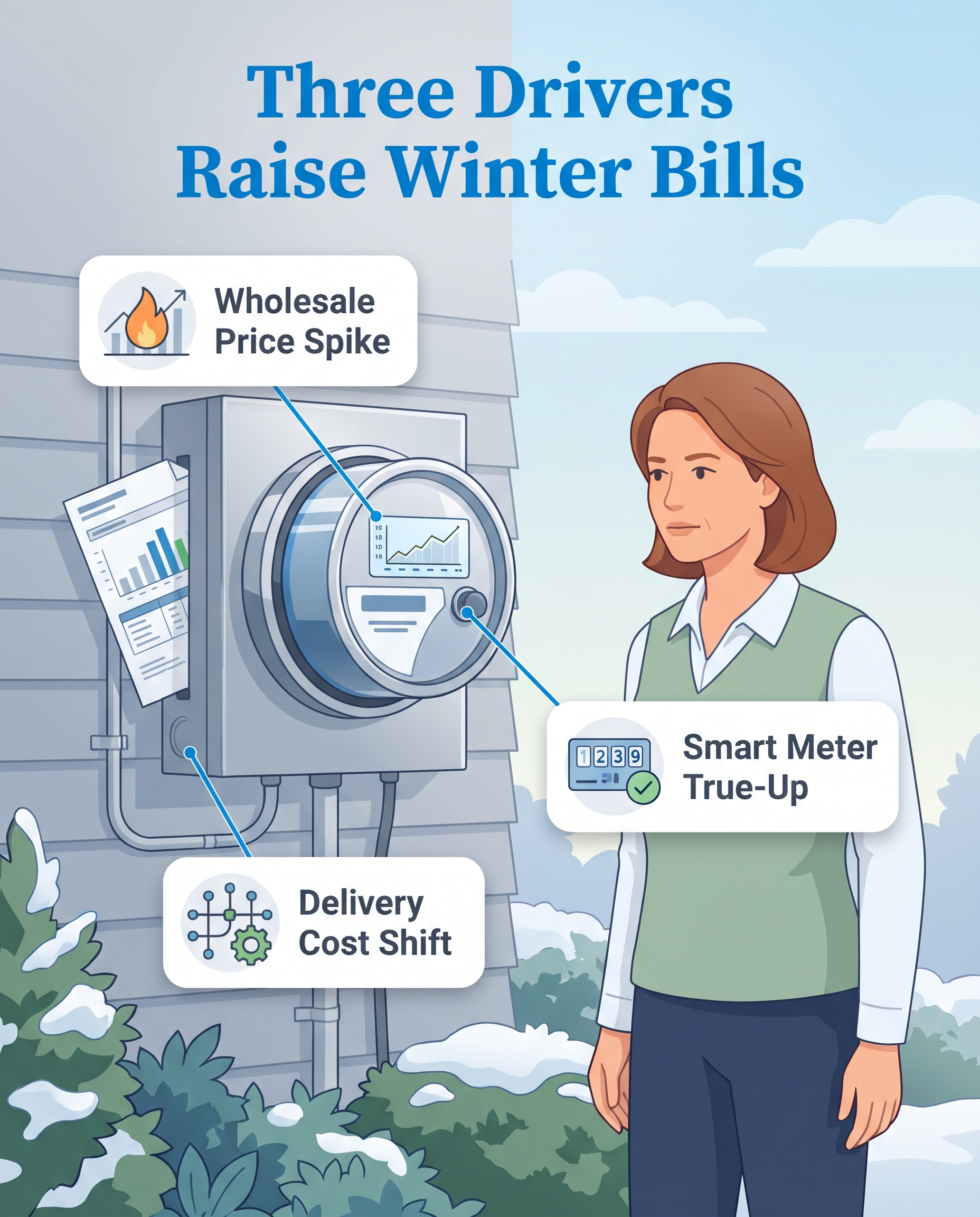
To understand why your bill can jump so dramatically even before peak January temperatures arrive, you have to separate your statement into its two primary halves: delivery charges and supply charges. According to data from the U.S. Energy Information Administration (EIA), New York’s statewide average residential electricity price reached 28.60 cents per kWh over the 12-month period ending in August 2026 — roughly 59% higher than the national residential average of 18.04 cents per kWh. While NYSEG’s bundled residential average typically hovers near 22.59 cents per kWh (or roughly $168.05 per month for 744 kWh), three converging factors can push winter bills sharply higher.
Wholesale NYISO Volatility and Natural Gas Generation Exposure
Nearly 50% of New York’s electricity is generated by natural gas-fired power plants. When early cold snaps hit the Northeast, natural gas pipelines prioritize home heating, causing wholesale spot gas prices and NYISO electricity clearing prices to spike. Under default NYSEG Supply Service (NSS), the utility buys electricity on the open market and passes that exact cost through to you without a markup. Customers enrolled in variable market-indexed tariffs — particularly residential Service Classification No. 8 (Day-Night) and Service Classification No. 12 (Time-of-Use) — experience immediate on-peak and off-peak rate jumps whenever wholesale prices surge.
Pending Delivery Rate Increases and Monthly Tariff Adjustments
Supply volatility is hitting ratepayers at the exact same time delivery costs are trending upward across New York. NYSEG filed a major rate request with the New York State Public Service Commission (PSC) seeking $464.4 million in additional revenue, which equates to a proposed 23.6% total residential bill increase — or roughly $33.12 more per month — to fund major storm allowances, grid infrastructure upgrades, and vegetation management. While the PSC approved a smaller 0.2% temporary bill adjustment while reviewing the full multi-year rate case, monthly updates to NYSEG’s Merchant Function Charge (MFC) and Rate Adjustment Mechanism (RAM) still cause baseline delivery and administrative fees to fluctuate on Nov. 1 and throughout the winter.
Smart Meter Rollouts and Estimated Billing True-Ups
Structural billing anomalies can also make a rate hike appear even worse on paper. NYSEG has been actively installing automated smart electric and gas meters across thousands of homes in its Brewster, Liberty, Binghamton, Ithaca, and Lancaster divisions. If your previous monthly bills relied on estimated meter readings because a technician could not access your property, the first actual reading from a new smart meter triggers an automatic “true-up”. That reconciliation dumps weeks of previously unbilled kilowatt-hours onto a single statement right as winter supply rates peak, creating massive bill shock.
How New York Energy Deregulation Affects Electricity and Natural Gas Bills
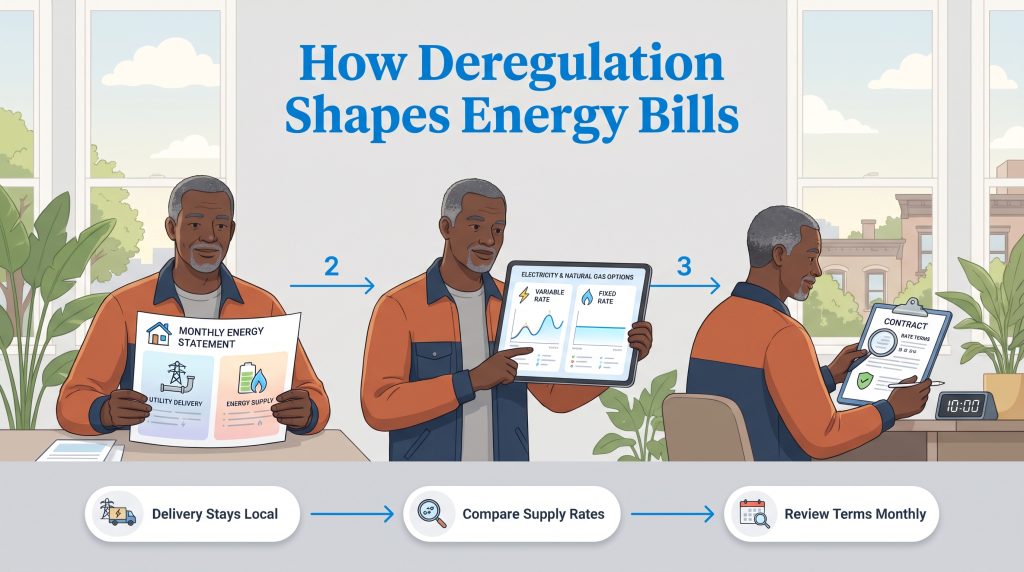
New York operates a deregulated retail energy market, which means you have the legal right to separate your utility delivery service from your energy supply. For electricity ratepayers, NYSEG always maintains the power lines, restores outages, and sends your monthly statement, but you can choose to buy your actual kilowatt-hours from either NYSEG’s default variable supply pool or an independent Energy Services Company (ESCO). Because default NYSEG supply rates fluctuate every month with wholesale market conditions, switching to a reputable, fixed-rate ESCO contract can shield your household from sudden 40% winter electricity spikes. However, consumer advocates warn against predatory ESCOs that use aggressive door-to-door or phone tactics during billing panics to lock homeowners into variable-rate contracts that charge teaser rates for one month before skyrocketing.
Natural gas utility customers operate under the same deregulated retail framework, though natural gas pricing follows a distinct seasonal curve. Currently, the acute 40% billing anomaly reported in mid-November is concentrated in NYSEG’s electric supply tariffs rather than its natural gas division. Even so, NYSEG’s roughly 266,000 natural gas customers remain exposed to winter Gas Supply Charge (GSC) adjustments, interstate pipeline capacity fees, and weather normalization adjustments as regional heating demand climbs between November and March. If you heat your home with natural gas, we recommend reviewing your therm supply rate each month and comparing fixed-rate gas supplier offers before severe mid-winter freezes arrive.
Four Steps to Audit Your NYSEG Bill and Lower Winter Energy Costs
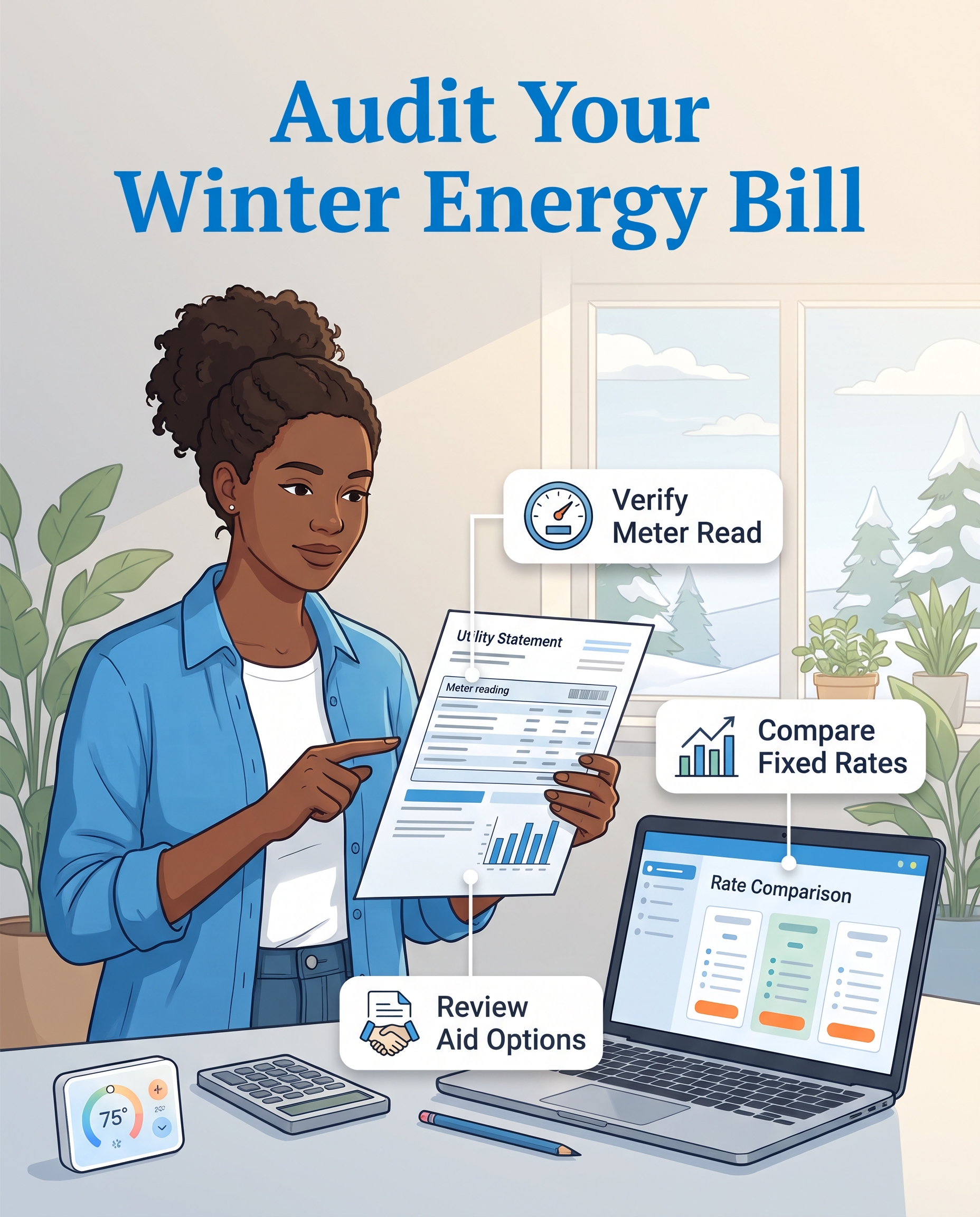
Panicking and signing the first energy contract that lands in your mailbox can end up costing you hundreds of extra dollars over the winter. Instead, follow these four steps in order to verify your charges and secure a predictable rate.
Step One: Audit Your Statement for Meter Read Accuracy
Before you change suppliers or alter your rate plan, inspect page three of your NYSEG bill to verify whether your usage was based on an “Actual” or “Estimated” meter reading. Compare your current kilowatt-hour usage against the same billing period from last year, and check the number of days in your billing cycle. If you see an unexplained usage jump or suspect an automated smart meter error, call NYSEG customer service at 800-572-1111 to request a meter read verification or open a formal billing review. If the utility fails to resolve a documented billing error, you can file a formal dispute with the New York State Department of Public Service.
Step Two: Compare Fixed-Rate Suppliers on NYS Power to Choose
If your meter read is accurate and you want protection against NYSEG’s variable supply rates, visit the official New York State Department of Public Service Power to Choose portal. Enter your five-digit ZIP code to filter exclusively for fixed-rate electricity offers with zero early termination fees. Use the site’s built-in historical pricing tool to see how each ESCO’s past rates compared against NYSEG’s default supply cost over previous quarters. For an environmentally mindful choice, you can also filter for renewable energy plans backed by New York wind or hydropower.
| Supply Plan Option | Rate Structure | Price Predictability | Best For | Key Watchouts |
| NYSEG Default Supply (SC1) | Monthly variable market mix | Low (fluctuates monthly) | Low-usage households under 1,000 kWh/month | Full exposure to winter wholesale price spikes |
| Fixed-Rate ESCO Plan | Locked cents/kWh for 6 to 24 months | High (rate stays flat) | Electric-heat homes seeking winter budget stability | Check for early termination fees and auto-renewal terms |
| Variable-Rate ESCO Plan | Intro rate followed by monthly changes | Very Low | Not recommended for most residential customers | High risk of steep rate hikes after month one |
| NYSEG Time-of-Use (SC8 / SC12) | On-peak, mid-peak, and off-peak pricing | Low to Moderate | High-usage homes shifting load to overnight hours | On-peak winter rates can spike sharply during cold snaps |
Step Three: Optimize Your Rate Classification and Home Efficiency
Check whether you are enrolled in NYSEG’s standard residential rate (SC1) or a Time-of-Use plan (SC8 or SC12). Time-of-Use plans only save money if you use at least 1,000 kWh per month and can consistently shift electric vehicle charging, laundry, and dishwashing to overnight off-peak hours. You can also enroll in NYSEG Budget Billing to average your annual energy costs into predictable monthly installments. To cut overall consumption, adopt energy-saving options such as lowering your thermostat to 68 degrees during the day, sealing window drafts, and upgrading aging electric water heaters or appliances to ENERGY STAR certified models.
Step Four: Apply for HEAP and Utility Affordability Assistance
If a 40% supply spike puts your household at risk of falling behind on payments, apply immediately for the New York State Home Energy Assistance Program (HEAP), which administers federal LIHEAP utility grants across New York. Eligible households that pay directly for electric or natural gas heat can receive a Regular HEAP benefit starting at $400 plus add-ons for vulnerable household members, as well as Emergency HEAP grants if you face an active shutoff notice. Qualifying for HEAP also automatically enrolls you in NYSEG’s Energy Affordability Program (EAP) for ongoing monthly bill discounts.
Protecting Your Household Budget From Winter Utility Volatility
Facing an unexpected 40% surge in your winter electric supply rate is frustrating, especially when heating costs already strain household budgets across upstate New York. By understanding that NYSEG’s variable supply charges impact ratepayers across all 44 counties in its service territory — not just Sullivan County — you can take proactive steps before mid-winter temperatures peak. Start by verifying your meter read accuracy, compare vetted fixed-rate suppliers through official state channels, and tap into energy-saving upgrades or HEAP assistance if you need support. Taking control of your supply rate today ensures you stay warm all winter without dreading the arrival of your next utility bill.
About the Author

Claudio is a sustainability-focused writer with a background in Anthropology and Psychology from NC State University. He has spent over 15 years working in writing, interpretation, and translation, driven by a deep interest in how human culture shapes the environment. Today, he shares his curiosity with readers by writing about sustainable living solutions and the connection between everyday choices and environmental impact.