
Starting Aug. 1, Major Utility Companies Across the State Are Raising Default Basic Service Rates, but You Have Several Options to Protect Your Budget
Key Takeaways
- Utility companies like Eversource, National Grid, and Unitil are increasing default supply rates on Aug. 1, 2026, which will affect default service customer bills through Jan. 31, 2027.
- You can switch to a competitive energy supplier or join a municipal aggregation program to lock in a lower fixed rate and protect your budget from seasonal price spikes.
- Investing in energy-saving options like Mass Save upgrades or certified heat pumps can shield your home from future grid price hikes while earning you valuable incentives.
If you have been keeping an eye on your household budget lately, we have some news that might make you want to take a closer look at your monthly power bill. Starting Aug. 1, 2026, default electricity supply rates for Massachusetts’ three largest investor-owned utilities — Eversource, National Grid, and Unitil — are going up. This means if you rely on your utility company’s default basic service, your monthly costs are about to increase just as the late summer heat peaks and we head into the colder winter months. In this guide, we will break down exactly how much your bill might change, why these rates are climbing, and, most importantly, the practical steps you can take to keep your hard-earned money in your wallet.
The New Rates: How Much More Will You Pay?
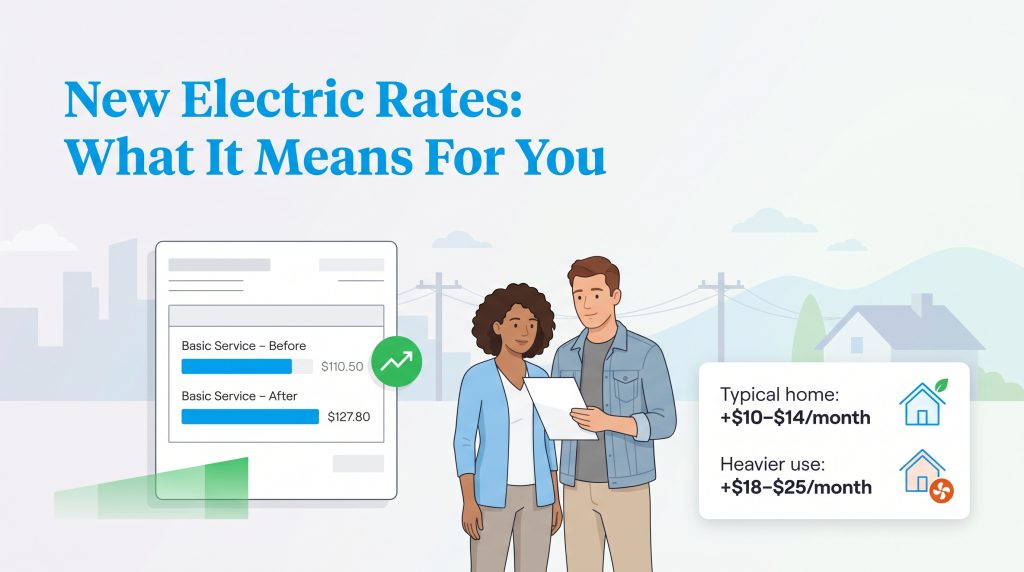
The upcoming rate hikes will affect the default Basic Service supply charge on your electric bill. This is the portion of the bill that covers the actual electricity you consume, rather than the cost of delivering it to your home. The price hikes represent a significant percentage increase across all three major utility companies, ranging from roughly 11% to over 16%.
| Utility | Old Supply Rate | New Supply Rate |
| Eversource (NStar East) | $0.15629 | $0.17323 |
| Eversource (Western MA) | $0.13683 | $0.15934 |
| National Grid | $0.15372 | $0.17185 |
| Unitil | $0.16470 | $0.18921 |
For a typical household using 570 kWh per month, this means monthly supply charges will go up by about $10 to $14. If you have a larger home or run your air conditioning heavily, your monthly bill could easily jump by $18 to $25.
Major Cities and Areas Affected by the Rate Hikes
These changes will hit major urban centers and suburbs alike. Eversource covers about 1.5 million customers in cities like Boston, Cambridge, Newton, and Springfield. National Grid serves another 1.3 million customers in Worcester, Lowell, and Brockton. Meanwhile, Unitil serves approximately 28,000 customers in the north-central Fitchburg area, including Ashby, Lunenburg, and Townsend.
Why Are Massachusetts Electric Rates Changing?
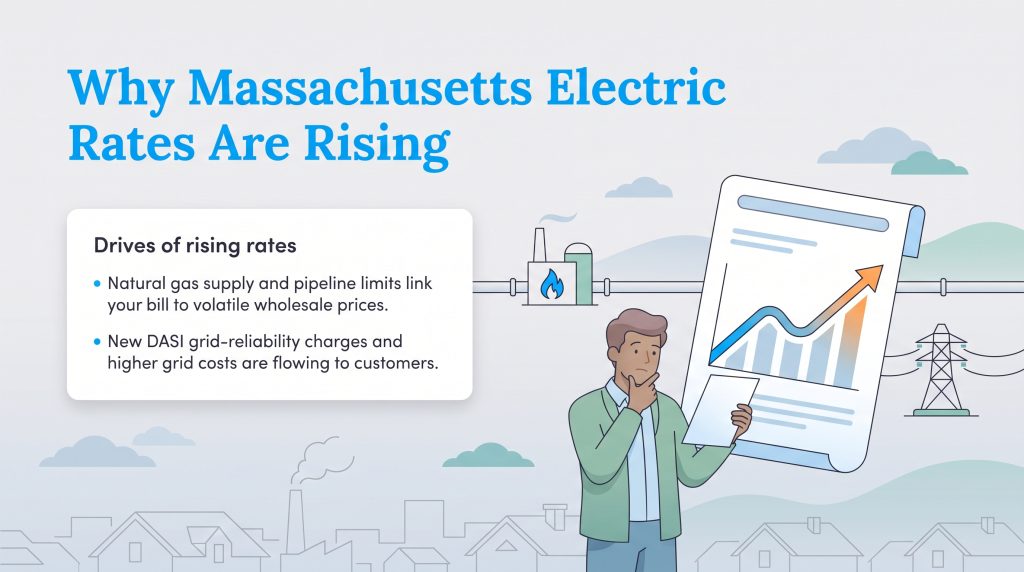
There are several factors driving these price hikes. New England relies heavily on natural gas, which fuels about 57% of our regional electricity generation. Because natural gas is often the marginal resource that sets wholesale electricity prices, our retail bills are closely tied to the volatile cost of gas. When pipeline capacity gets constrained during peak demand, wholesale prices climb. Because our local utility companies do not make a profit on default basic service — they simply pass the wholesale cost of energy directly to you — these external market pressures translate directly into retail rate hikes.
The DASI Reliability Initiative and Grid Costs
Another major catalyst behind the Aug. 1, 2026, increases is a new regional reliability program. ISO-New England recently implemented the Day-Ahead Ancillary Services Initiative (DASI) to compensate flexible generators that help keep the grid stable. While the initial cost of this program was projected to be around $120 million to $150 million annually, actual costs skyrocketed to $1.2 billion in its first year. These unhedged wholesale market liabilities are now flowing down to default service retail customers.
Smart Strategies to Lower Your Electricity Bill
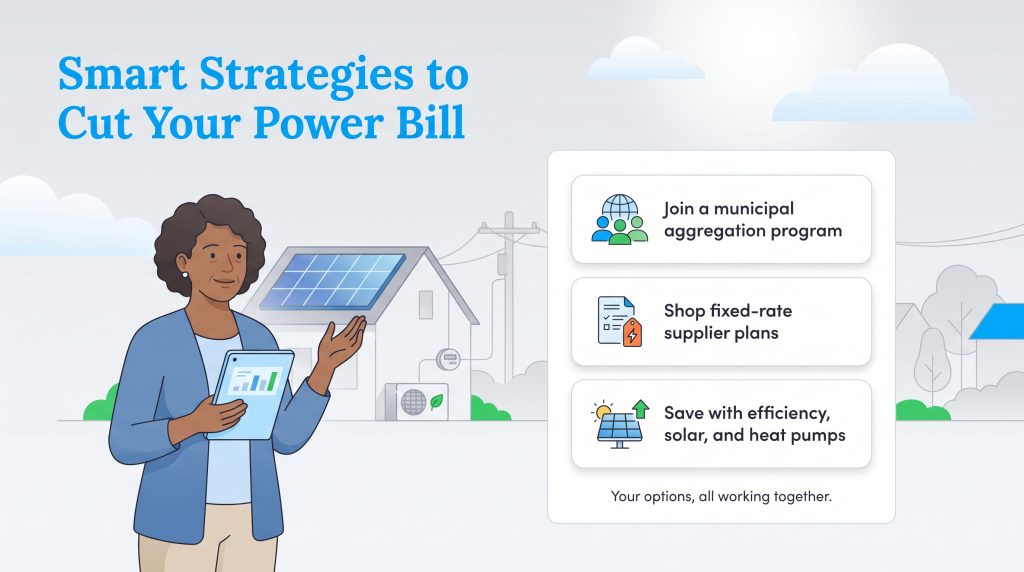
While you can’t control wholesale energy markets or regional grid policies, you have plenty of options when it comes to your own energy bill. Massachusetts is a deregulated energy market, meaning you have the freedom to choose who supplies your electricity. Here are some of the most effective ways to lower your monthly costs.
Join a Municipal Aggregation Program
More than 170 communities in Massachusetts have established municipal aggregation programs, also known as Community Choice Aggregation. In these programs, local governments leverage bulk buying power to secure fixed-price electricity contracts for residents and businesses. These rates are often locked in for several years, shielding you from seasonal utility price hikes. If your city or town has an active program, you are usually enrolled automatically but can opt out at any time without a fee.
Shop Around on the State Switch Portal
If your community doesn’t have an active municipal aggregation program, you can choose a competitive third-party supplier. You can compare licensed electricity plans in your area by using the official Energy Switch Massachusetts portal. When shopping, look for fixed-rate contracts to keep your price stable. Be sure to check the Electricity Facts Label to review contract length, percentage of clean energy, and potential early termination fees. Keep in mind that when you switch suppliers, your utility still delivers the power and handles any storm outages.
Explore Energy-Saving Options and Solar Incentives
The most sustainable way to lower your energy costs is to reduce your home’s consumption. We highly encourage booking a home energy assessment through Mass Save, a statewide program that offers massive incentives for insulation, weatherization, and heating upgrades. Mass Save can cover up to 100% of the cost of weatherizing your home, making it a highly effective energy-saving option.
You can also consider an environmentally mindful choice like installing a solar energy system. Generating your own power lets you bypass the utility’s high bundled retail rates. Plus, programs like the Solar Massachusetts Renewable Target (SMART) offer fixed compensation rates for the clean energy your panels produce, helping you offset the upfront costs over time.
Finally, if you have adopted a clean heating system, you can benefit from targeted seasonal relief. The Massachusetts Department of Public Utilities has approved seasonal heat pump rates for eligible households. Starting Nov. 1, 2025, households heating with certified heat pumps can receive an environmentally mindful delivery rate discount of more than 60% through April 30.
Take Charge of Your Monthly Power Costs
While news of a utility rate hike is never ideal, it’s a perfect reminder of how much control you actually have over your energy bills. By exploring alternative suppliers, checking into your town’s aggregation options, or taking advantage of state energy-efficiency programs, you can keep your home comfortable while keeping your costs down. Making a few smart, eco-conscious adjustments today will not only protect your budget for the upcoming winter but will also help support a cleaner, more resilient local power grid.
About the Author

Claudio is a sustainability-focused writer with a background in Anthropology and Psychology from NC State University. He has spent over 15 years working in writing, interpretation, and translation, driven by a deep interest in how human culture shapes the environment. Today, he shares his curiosity with readers by writing about sustainable living solutions and the connection between everyday choices and environmental impact.