
Track your consumption to identify energy hogs and lower your monthly utility bills
Key Takeaways
- You can calculate appliance energy cost manually using a simple formula based on the wattage listed on the device’s label.
- An electricity usage monitor is the most accurate tool for finding phantom loads and measuring variable-power devices like refrigerators.
- Whole-house monitoring systems connect to your breaker panel or utility meter to provide real-time data on your home’s total energy footprint.
Understanding exactly where your power goes is the first step toward lowering your monthly bills and reducing your carbon footprint. Whether you are dealing with a surprisingly high statement or simply want to live more sustainably, measuring electric usage removes the guesswork from your budget. By identifying which appliances are energy hogs and which are efficient, you can make smarter decisions about when to run your dishwasher, whether to replace that old refrigerator, or how to eliminate wasteful standby power. In this guide, we show you how to measure electricity usage at home using three practical methods: manual calculation formulas, plug-in monitoring tools, and whole-home digital tracking.
What is a Kilowatthour (kWh)?
Electricity usage is measured in Watts, a unit of power named after James Watts. A single watt is a very small amount of power and some devices use thousands of watts, kilowatts, to operate.
A Watthour (Wh) is the energy of one Watt used steadily from an electrical circuit for one hour. Utility providers generally use killwatthours (kWh) to measure the amount of energy a customer uses over a given amount of time. One kWh is equal to 1000 watts consumed for one hour. If, for example, you use a 60W light bulb for five hours, you would have used 300W or .3 kWh of energy.
The Manual Method: How to Calculate Appliance Energy Cost
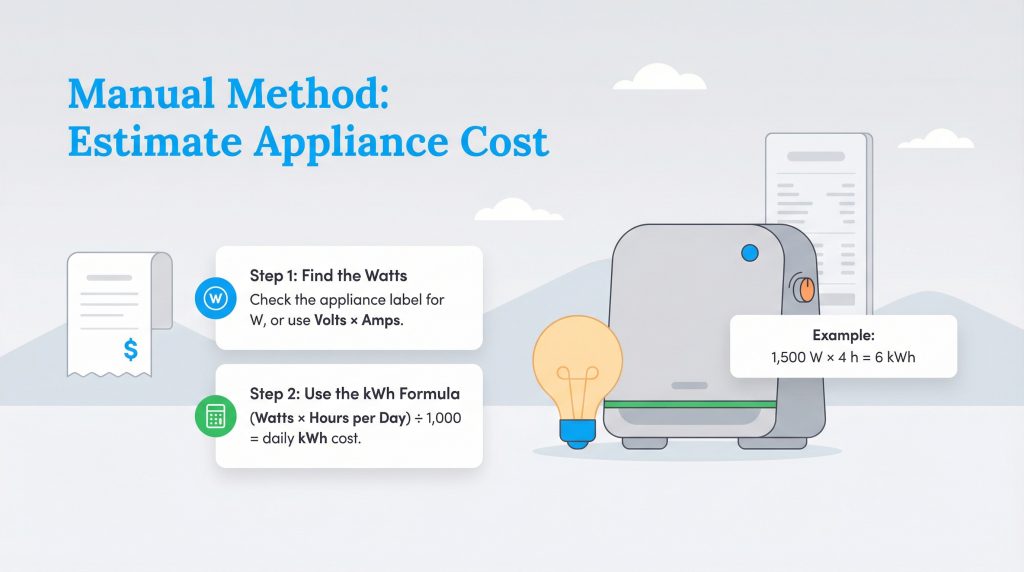
If you want a quick estimate without buying extra equipment, you can measure electric usage using a simple math formula. This method is ideal for devices with a constant energy draw, such as lightbulbs or space heaters, but requires you to locate the technical specifications of your appliance first.
Step 1: Find the Wattage Label
Every electrical device is required to have a label or nameplate that lists its power requirements. You can usually find this sticker on the back or bottom of the appliance, or molded directly onto the plug itself. Look for a number followed by a “W” (Watts). If the label only lists Volts (V) and Amps (A), you can find the watts by multiplying them together (Volts × Amps = Watts). If you can’t find any label, you can often look up the model number online to get approximate wattage.
Step 2: Use the kWh Calculator Formula
Once you have the wattage, you need to convert it into kilowatt-hours (kWh), which is how your utility company bills you. Use the following formula to determine how much energy a device uses over time:
(Watts × Hours Used Per Day) ÷ 1,000 = Daily kWh
For example, if you run a 1,500-watt space heater for 4 hours a day, the calculation is (1,500 × 4) ÷ 1,000, which equals 6 kWh per day. To find the cost, multiply that daily kWh usage by your electricity rate (found on your utility bill and explained in our electricity guides). If you pay 15 cents per kWh, running that heater costs you $0.90 a day.
The Precision Method: Using an Electricity Usage Monitor
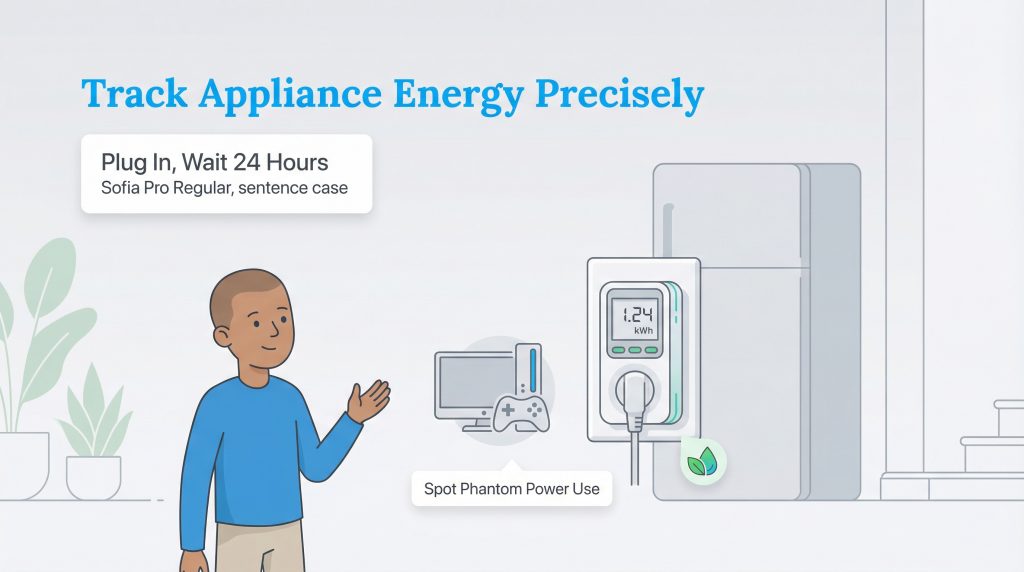
For appliances that cycle on and off, like refrigerators, air conditioners, or washing machines, manual math is often inaccurate because these devices don’t run at full power 100% of the time. An electricity usage monitor (often referred to generically as a kill a watt meter) serves as a middleman between your wall outlet and the appliance plug to record exactly how much power your appliance is using.
How to Use a Plug-In Monitor
To use these devices, you simply plug the monitor into the wall, then plug your appliance into the monitor. Leave it running for a full 24 hours to get an accurate average of the device’s cycle. The display will show you exactly how many kWh were consumed during that period, allowing you to project the monthly cost with high precision.
Detecting Phantom Loads
One of the best uses for a monitor is acting as a phantom load calculator. Many electronics, such as gaming consoles, TVs, and coffee makers, draw power even when they are turned “off.” By plugging these devices into a monitor while they are in standby mode, you can see if they are vampire power sources that are inflating your bill unnecessarily.
The Big Picture: Monitor Whole House Electricity Usage
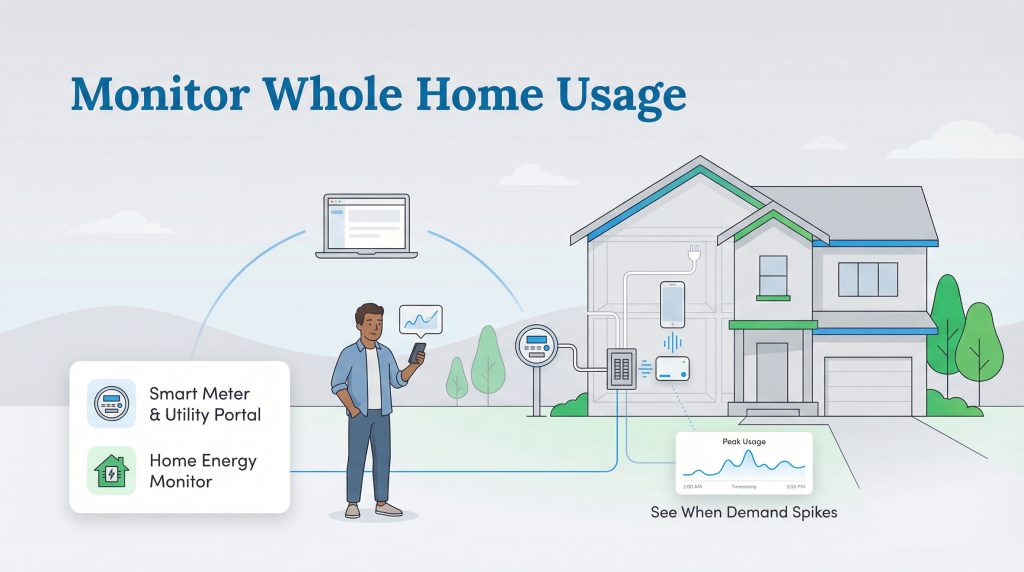
If you want to understand your home’s total energy footprint rather than just a single outlet, you need to look at the bigger picture. Monitoring whole house electricity usage allows you to see when your demand peaks, such as when the HVAC system kicks on or when the electric vehicle is charging.
Smart Meters and Utility Dashboards
Most modern homes are equipped with a digital smart meter installed by the utility company. Unlike old analog dials, these meters send data directly to your provider in short intervals. You can often log in to your utility provider’s web portal to view your “smart meter reading explained” in colorful graphs that show your hourly or daily usage trends without needing to install any extra hardware. For more information on how these systems communicate, you can review resources on smart grid technology at Energy.gov.
Home Energy Monitors
For even more granular data, you can install a home energy monitor directly into your electrical panel. These smart devices use current transformer (CT) clamps to measure the flow of electricity through your circuit breakers. You’ll see which activities in your daily routine drive the biggest spikes, so you can decide where to cut back first. They connect to a smartphone app, giving you real-time data on exactly how much power your entire home is using at any given second, helping you spot inefficiencies instantly.
Cheat Sheet: Common Appliance Energy Consumption
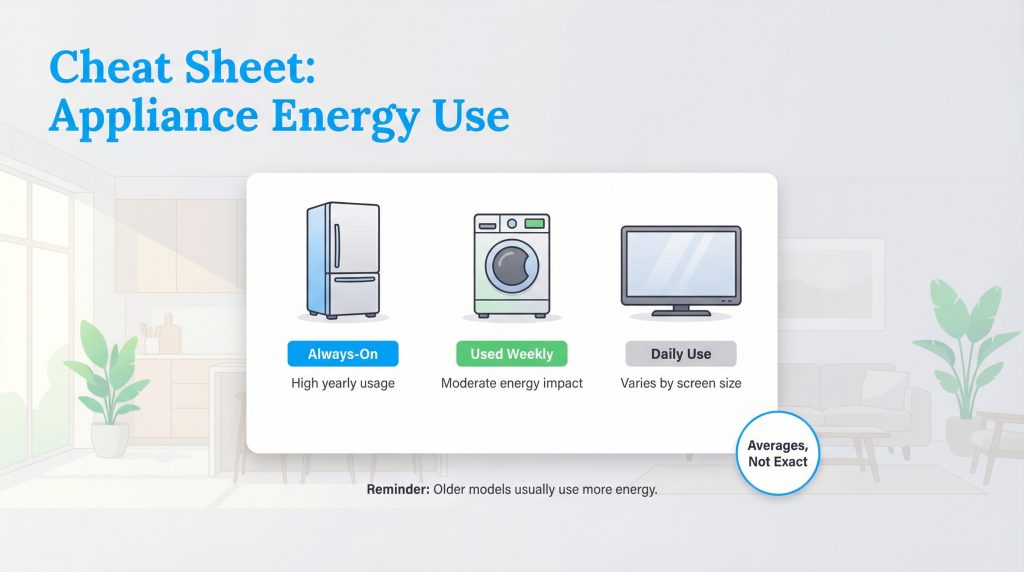
If you aren’t ready to do the math or buy a monitor, this reference chart provides average usage estimates for common household devices. Keep in mind that older appliances will generally use more power than newer models.
| Appliance | Average Wattage | Estimated Cost per Hour(at $0.15/kWh) |
|---|---|---|
| Central AC | 3,500W | $0.53 |
| Water Heater | 4,500W | $0.68 |
| Refrigerator | 150W – 400W | $0.02 – $0.06 |
| Gaming Console | 100W – 200W | $0.02 – $0.03 |
| LED Lightbulb | 10W | < $0.01 |
Take Action on Your Data to Save Money
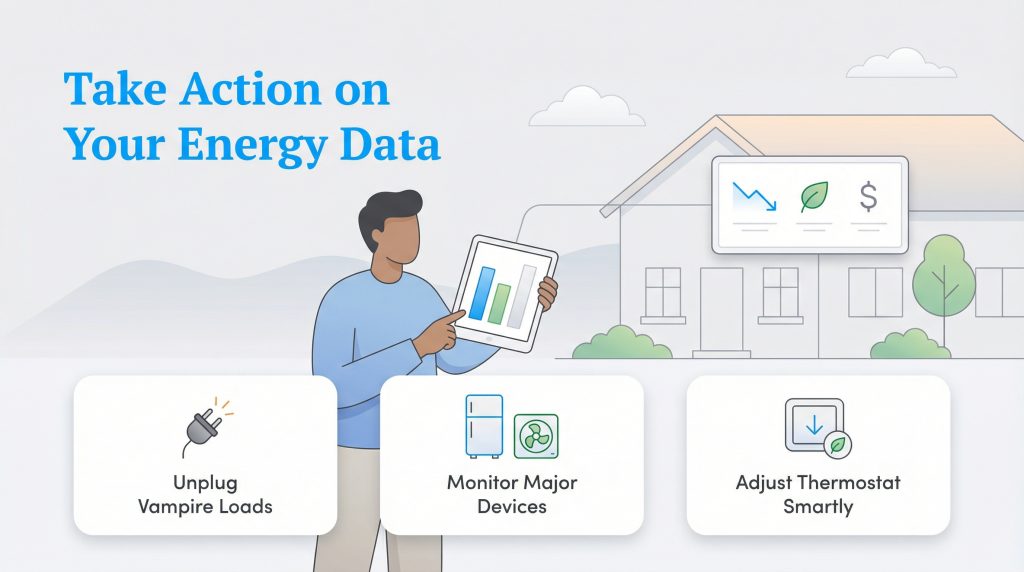
Measuring electric usage is only useful if you use the data to make changes in your daily habits or home setup. Once you know which devices are costing you the most, you can decide to unplug vampire electronics, upgrade old appliances, or adjust your thermostat settings. A hybrid approach works best in most homes: use simple formulas for fixed, low-power items like lights, and plug-in monitors or whole-home tools for larger, cycling appliances like HVAC systems and refrigerators. By combining manual checks for simple devices and monitoring tools for complex ones, you can take full control of your energy bill, cut unnecessary waste, and build a more sustainable home. If you need more strategies for reducing costs, check out our guide on how to save on your electric bill.
FAQs About Measuring Electric Usage
What is the most accurate way to measure electricity usage?
How do I calculate the cost of an appliance per month?
Can I measure electricity usage without a tool?
What is a phantom load?
How do I read my electric meter?
Learn more about How To Read an Electricity Meter
How can measuring my electricity usage help the environment?
About the Author

David has been an integral part of some of the biggest utility sites on the internet, including InMyArea.com, HighSpeedInternet.com, BroadbandNow.com, and U.S. News. He brings over 15 years of experience writing about, compiling and analyzing utility data.