
Choosing between Gexa’s usage-based discounts and TriEagle’s straightforward pricing depends entirely on your home’s energy consumption habits.
Key Takeaways
- Gexa Energy offers lower rates for high usage, but their plans often rely on bill credits that require you to hit specific kilowatt-hour targets every month.
- TriEagle Energy focuses on “no gimmick” plans, offering consistent fixed rates that remain stable regardless of whether you live in a small apartment or a large house.
- Cancellation fees vary significantly, with TriEagle typically charging a lower penalty for early termination compared to Gexa’s higher flat-rate fees.
Choosing an electricity provider in Texas often feels like navigating a maze of numbers, but the choice between Gexa Energy and TriEagle actually comes down to a simple question of lifestyle. If you have a large home and consistently use a lot of power, Gexa’s bill credit plans can offer incredible savings that are hard to beat. However, if you want to avoid the stress of monitoring your meter or if your usage fluctuates wildly between seasons, TriEagle’s straightforward pricing model provides the stability and peace of mind you might prefer. We analyzed the plan structures, fee policies, and customer reviews for both companies to help you decide which provider deserves your business.

- 7.5¢ /kWh
- 100%
- 60 days
- 4-36 Months
- Committed to Renewable Energy

- 12.9¢ /kWh
- 3-100%
- 60 days
- 12-36 Months
- Best for Straightforward Contracts
*rates may vary by location and household usage
The Core Difference: Bill Credits vs. Straightforward Pricing
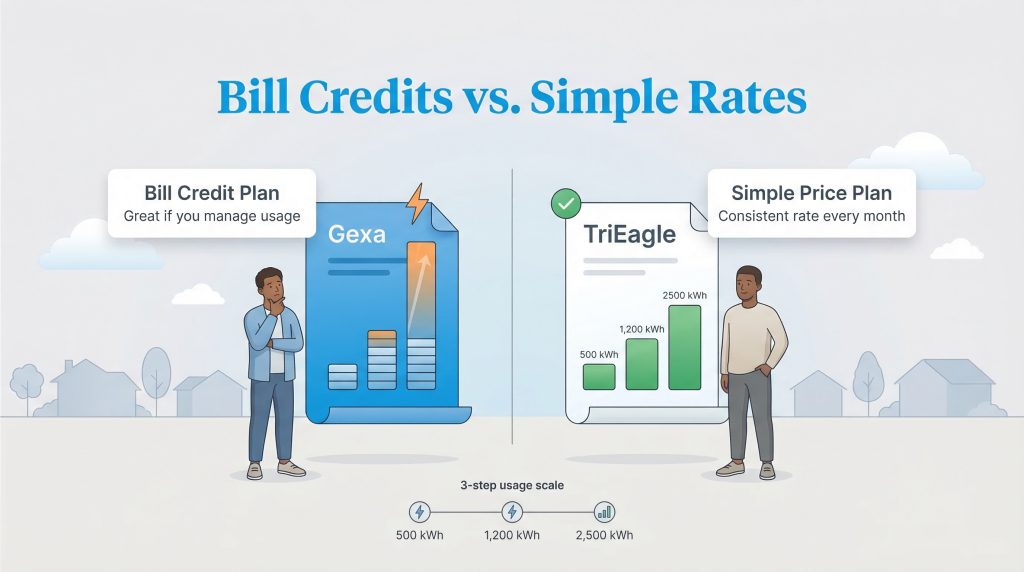
The fundamental difference between these two providers lies in their business models. Gexa Energy is well-known for its bill credit plans. These plans are designed to look incredibly cheap on electricity search engines because they factor in a large credit (often ranging from $50 to over $100) that you only receive if you use a certain amount of electricity, typically between 1,000 and 2,000 kilowatt-hours (kWh) per month. If you hit that target, your effective rate is very low. If you miss it, your rate can skyrocket.
Gexa Energy Plans and Pricing
| Plan Name | Rate /kWH | Plan Term | Cancellation Fee | |
|---|---|---|---|---|
| Gexa Eco Saver Plus 14 | 7.5¢ | 14 Months | $150 | Check Availability |
| Gexa Eco Saver Plus 12 | 7.5¢ | 12 Months | $150 | Check Availability |
| Gexa Eco Saver Plus 24 | 8¢ | 24 Months | $295 | Check Availability |
| Gexa Eco Choice 3 | 11.5¢ | 3 Months | $150.00 | Check Availability |
| Gexa Eco Choice 12 | 13.9¢ | 12 Months | $150.00 | Check Availability |
| Gexa Prime Preferred 24 Plan | 13.9¢ | 24 Months | $295.00 | Check Availability |
| Gexa Saver Edge 12 | 14.2¢ | 12 Months | $150 | Check Availability |
| Gexa Prime Preferred 12 Plan | 14.4¢ | 12 Months | $150.00 | Check Availability |
| Gexa Light Saver 12 | 15.2¢ | 12 Months | $150 | Check Availability |
| Gexa Eco Saver Value 12 | 15.9¢ | 12 Months | $150 | Check Availability |
| Gexa Solar Export Saver 12 | 16.9¢ | 12 Months | $150 | Check Availability |
| Gexa Straight Saver 24 | 18¢ | 24 Months | $295.00 | Check Availability |
| Gexa Freedom 12 | 18.4¢ | 12 Months | $150.00 | Check Availability |
| Gexa Saver Freedom 36 | 18.4¢ | 36 Months | $295 | Check Availability |
| Gexa Saver Freedom 24 | 19.1¢ | 24 Months | $295.00 | Check Availability |
| Gexa Straight Saver 12 | 19.5¢ | 12 Months | $150.00 | Check Availability |
| Gexa Eco Saver Premier 24 | 19.8¢ | 24 Months | $295 | Check Availability |
| Gexa Eco Saver Premier 12 | 20.4¢ | 12 Months | $150 | Check Availability |
| Free 3 Day Weekends Preferred 12 | 20.6¢ | 12 Months | $150 | Check Availability |
| Gexa Eco Saver Lite 12 | 21.3¢ | 12 Months | $150 | Check Availability |
| Gexa Prime Preferred Plus 24 | 21.4¢ | 24 Months | $295.00 | Check Availability |
| Gexa Prime Preferred Plus 12 | 21.7¢ | 12 Months | $150.00 | Check Availability |
| Gexa Eco Saver Advantage 12 | 22.5¢ | 12 Months | $150 | Check Availability |
In contrast, TriEagle Energy focuses on straightforward pricing. While they do offer some plans with credits, their core philosophy revolves around “no gimmick” rates. This means the price you pay per kWh remains relatively consistent whether you use 500, 1,200, or 2,500 kWh. You don’t have to constantly check your thermostat to ensure you “earn” your discount. Gexa isn’t a “bad” choice, in fact, it can be the cheapest option on the market for the right home, but it requires active management. TriEagle pays off in consistency, making it ideal for those who prefer a “set it and forget it” utility experience.
TriEagle Energy Plans and Pricing
| Plan Name | Rate /kWH | Plan Term | Cancellation Fee | |
|---|---|---|---|---|
| Sure Value 12 | 12.9¢ | 12 Months | $20 | Check Availability |
| Simple Savings 28 | 13.8¢ | 28 Months | $20.00 per month left in term | Check Availability |
| Sure Value 36 | 13.9¢ | 36 Months | $20.00 per month left in term | Check Availability |
| Savvy Value 12 | 14.7¢ | 12 Months | $20 | Check Availability |
| Real Deal 12 | 14.9¢ | 12 Months | $20.00 | Check Availability |
| Real Deal 36 | 14.9¢ | 36 Months | $20.00 | Check Availability |
| Real Deal 24 | 14.9¢ | 24 Months | $20.00 | Check Availability |
| Savvy Value 24 | 15.3¢ | 24 Months | $20 | Check Availability |
| Savvy Value 36 | 15.3¢ | 36 Months | $20 | Check Availability |
| Simple Savings 24 | 15.3¢ | 24 Months | $20 | Check Availability |
| Simple Savings 12 | 15.7¢ | 12 Months | $20.00 per month left in term | Check Availability |
| Silver Eagle 12 | 15.9¢ | 12 Months | $20.00 | Check Availability |
| Sure Value 24 | 16¢ | 24 Months | $20 | Check Availability |
| Simple Green 24 | 16.2¢ | 24 Months | $20 | Check Availability |
| Simple Green 36 | 16.3¢ | 36 Months | $20 | Check Availability |
| Bronze Eagle 24 | 16.5¢ | 24 Months | $20.00 | Check Availability |
| Golden Eagle 36 | 16.5¢ | 36 Months | $20.00 | Check Availability |
| Real Saver 12 | 16.7¢ | 12 Months | $20.00 | Check Availability |
| Green Eagle 12 | 16.9¢ | 12 Months | $20.00 | Check Availability |
| Simple Savings 36 | 17.3¢ | 36 Months | $20.00 per month left in term | Check Availability |
| Real Saver 36 | 17.3¢ | 36 Months | $20.00 | Check Availability |
| Real Saver 24 | 17.3¢ | 24 Months | $20.00 | Check Availability |
| Green Eagle 36 | 17.5¢ | 36 Months | $20.00 | Check Availability |
| Green Eagle 24 | 17.5¢ | 24 Months | $20.00 | Check Availability |
| Simple Green 12 | 17.7¢ | 12 Months | $20.00 per month left in term | Check Availability |
How to Read the Electricity Facts Label (EFL) for These Plans
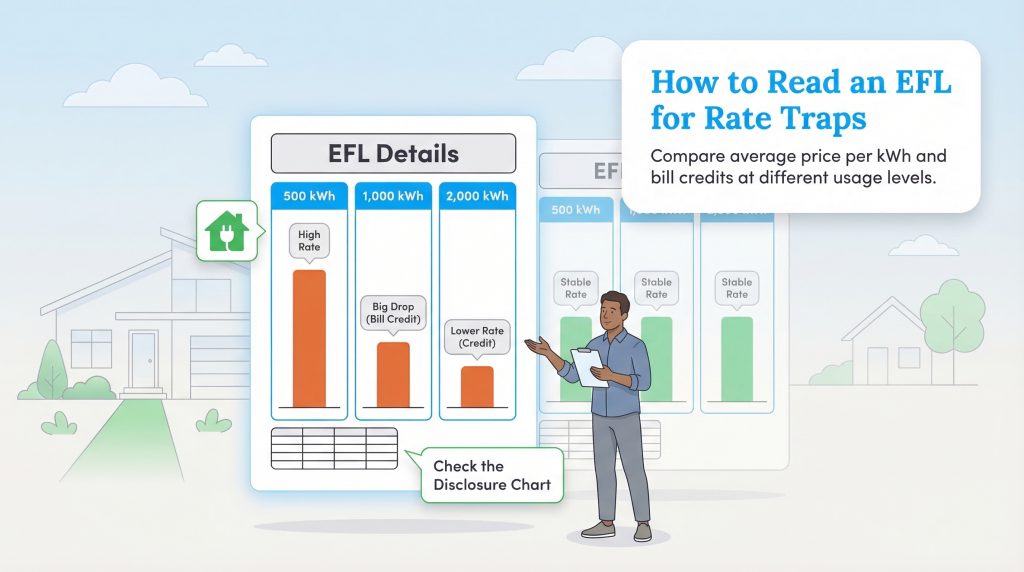
Before signing up, you must check the Electricity Facts Label (EFL). This document is the “nutrition label” for your electricity plan. When comparing Gexa and TriEagle, look specifically at the “Average Price per kWh” section.
For Gexa plans, you will likely see a significant price drop at the 1,000 kWh or 2,000 kWh usage levels, indicating a bill credit is involved. For TriEagle plans, the price per kWh will usually be similar across 500, 1,000, and 2,000 kWh columns, indicating a flatter, more predictable rate structure. Always verify the “Disclosure Chart” at the bottom of the EFL to see the exact dollar amount of any credits and the usage range required to get them.
Gexa Energy vs. TriEagle: Rates by Usage
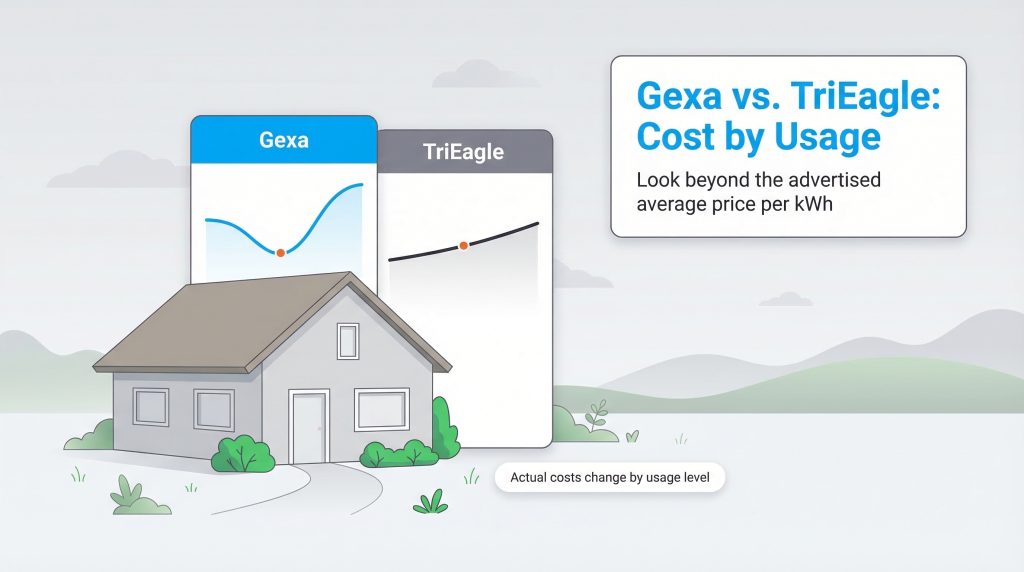
To understand the real cost difference, you have to look beyond the advertised “average price per kWh.” Advertised rates often assume you use exactly 1,000 or 2,000 kWh. Below is a comparison of how a typical Gexa bill credit plan compares to a standard TriEagle fixed-rate plan across different usage levels.
| Monthly Usage | Gexa Energy (Bill Credit Structure)* | TriEagle Energy (No Gimmick Structure)* | Likely Winner |
|---|---|---|---|
| 500 kWh (Apartment) | High effective rate(Credit threshold usually missed) | Standard fixed rate(Consistent pricing) | TriEagle |
| 1000 kWh (Small Home) | Low effective rate(Credit usually applied) | Standard fixed rate(Consistent pricing) | Gexa |
| 2000 kWh (Large Home) | Low effective rate(Credit usually applied) | Standard fixed rate(Consistent pricing) | Gexa |
*Note: This table represents typical plan structures. Actual rates vary by TDU region and current market conditions.Always check the current Electricity Facts Label (EFL)for live pricing.
Plan Showdown: Eco Saver vs. Simple Savings
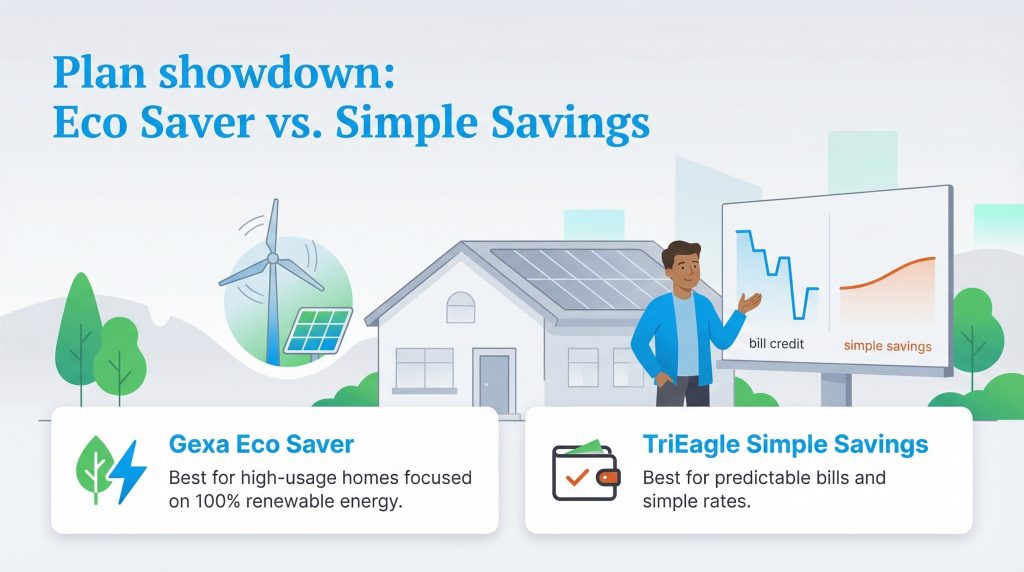
When shopping, you will likely encounter two flagship products: the Gexa Eco Saver series and the TriEagle Simple Savings series. These plans perfectly represent the differing philosophies of the two companies.
Gexa Eco Saver
The Gexa Eco Saver is a heavy hitter for sustainability and high-usage homes. Its primary selling point is that it is backed by 100% renewable energy certificates (RECs), making it an excellent choice for eco-conscious homeowners who can’t install solar panels. However, the pricing structure is strictly usage-based. You typically receive a significant bill credit (e.g., $75 to $100) once your usage surpasses 1,000 kWh. This makes it one of the most competitive renewable energy plans for medium-to-large families. The downside? If you go on vacation and your usage drops, you lose the credit, and your bill might be higher than expected.
TriEagle Simple Savings
As the name suggests, TriEagle Simple Savings is designed to eliminate confusion. While the rate per kWh might be slightly higher than Gexa’s “best case” scenario, it lacks the volatility. There are generally no hidden cliffs where the price doubles. The EFL for a Simple Savings plan is usually a flat line or a gentle curve, rather than the rollercoaster shape seen in bill credit plans. This plan is ideal for customers who prioritize budget certainty over chasing the absolute lowest possible advertised number.
Hidden Costs and Cancellation Fees
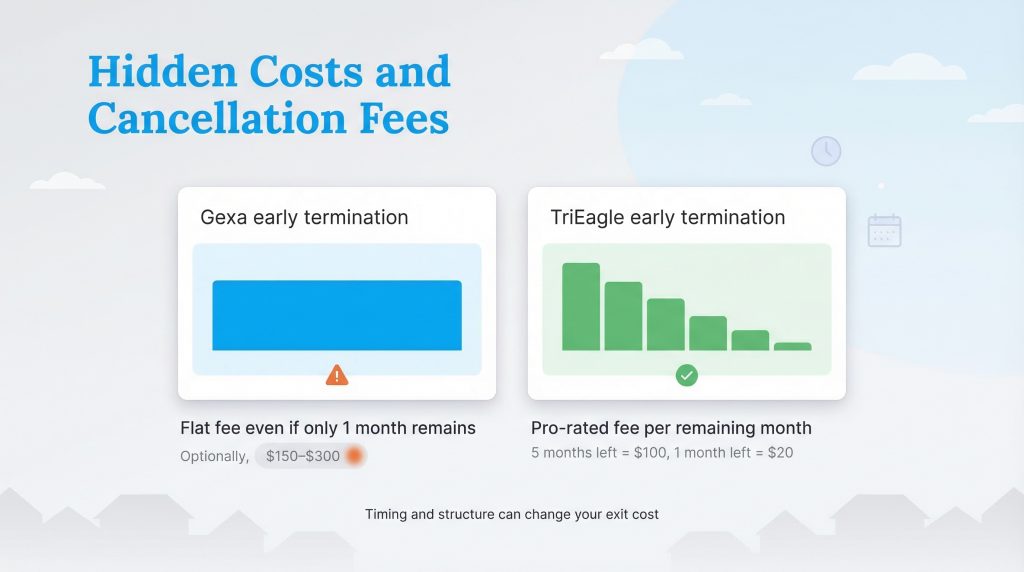
Every contract eventually ends, but what if you need to leave early? This is where the Gexa vs TriEagle cancellation fees differ dramatically. An early termination fee (ETF) is charged if you switch providers before your contract expires (though this fee is usually waived if you move to a new address and provide proof).
Gexa Energy typically utilizes a flat-fee structure. Depending on the plan, you might owe a flat fee ranging from $150 to nearly $300 regardless of whether you have one month or 20 months left on the term. This makes switching away from Gexa expensive unless you time it perfectly.
TriEagle Energy uses a pro-rated structure that is generally more consumer-friendly. They typically charge a specific amount, such as $20, for every month remaining on your contract. If you have five months left, you pay $100. If you only have one month left, you only pay $20. This structure offers a much safer “exit strategy” for customers who might need flexibility.
Customer Service and Reputation
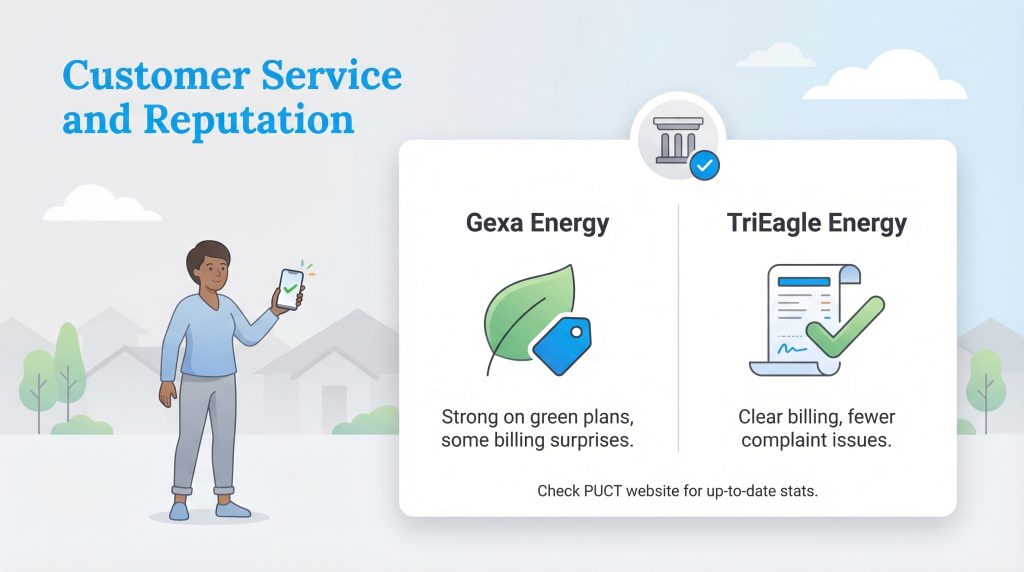
Both providers are established players in the Texas market with generally positive reputations compared to fly-by-night operators. When comparing Gexa Energy reviews vs TriEagle Energy, distinct trends emerge.
TriEagle Energy often ranks highly for billing transparency. Customers appreciate that their bills match their expectations, leading to fewer complaints filed with the Public Utility Commission of Texas (PUCT). Gexa Energy also scores well, particularly for its commitment to green energy and competitive pricing. However, Gexa tends to see more friction regarding billing surprises, usually from customers who didn’t fully understand the bill credit requirements before signing up. For the most current complaint statistics, you can always check the Public Utility Commission of Texas (PUCT) website.
The Verdict: Which Provider Fits Your Home?
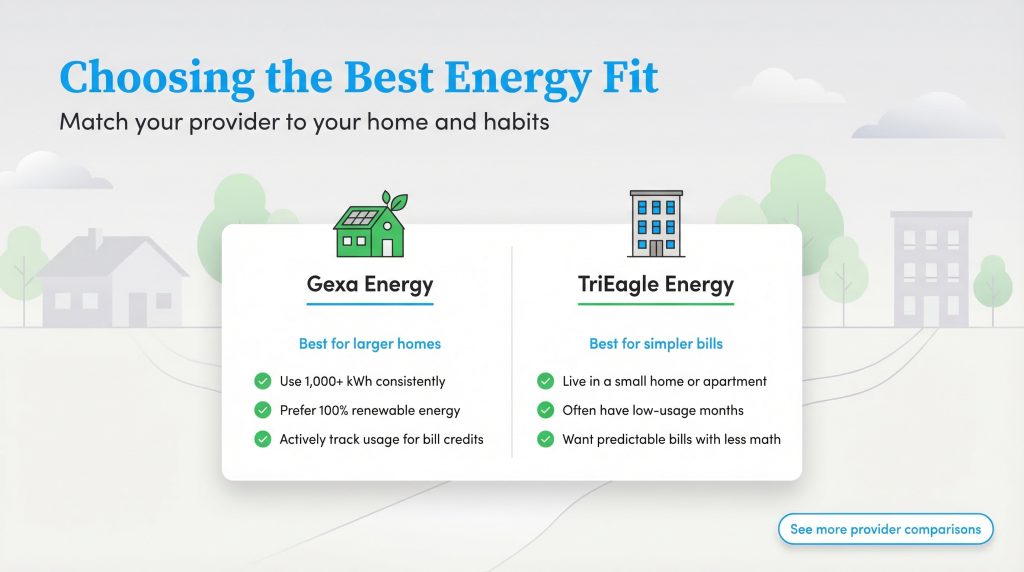
There is no single “best” provider, but there is certainly a best provider for you based on your specific needs.
- Choose Gexa Energy if: You have a large home (consistently using 1000+ kWh), you want 100% renewable energy included at no extra cost, and you are diligent about tracking your monthly usage to maximize bill credits.
- Choose TriEagle Energy if: You live in an apartment, travel frequently (resulting in low usage months), or simply want a predictable bill without having to do math equations every time you look at your electricity plan.
For more comparisons on providers and tips for lowering your rate, visit our main electricity hub.
Making Your Final Decision
Selecting the right electricity provider is about matching the plan structure to your lifestyle rather than just chasing the lowest advertised number. By understanding your average monthly usage and your tolerance for price fluctuations, you can choose between Gexa’s high-reward bill credit plans and TriEagle’s reliable, straightforward rates with confidence.
Frequently Asked Questions About Gexa Energy vs. TriEagle
Which company has better reviews, Gexa or TriEagle?
Does Gexa or TriEagle have cheaper cancellation fees?
Are Gexa Energy plans really 100% renewable?
Is TriEagle Energy good for apartments?
How do I switch from Gexa to TriEagle?
About the Author

David has been an integral part of some of the biggest utility sites on the internet, including InMyArea.com, HighSpeedInternet.com, BroadbandNow.com, and U.S. News. He brings over 15 years of experience writing about, compiling and analyzing utility data.