
Choosing the right provider comes down to understanding your specific monthly usage and tolerance for bill credits.
Key Takeaways
- Gexa Energy generally offers lower headline rates for specific usage tiers (usually 1,000 to 2,000 kWh) but relies heavily on bill credits that disappear if you miss the usage window.
- Just Energy tends to offer more stable, predictable pricing structures and longer contract terms, making them a safer choice for consumers who want to “set it and forget it.”
- Cancellation fees vary significantly between the two, with Just Energy often charging a flat fee per remaining month and Gexa typically charging a fixed lump sum Early Termination Fee.
Choosing between Gexa Energy and Just Energy can feel like splitting hairs, but the difference in your monthly bill often hides in the fine print of their “Electricity Facts Labels.” Both are massive players in the Texas deregulated market, yet they appeal to two very different types of customers. One rewards the vigilant user who hits specific usage targets every month, while the other caters to the homeowner seeking stability and long-term predictability. We analyzed the rates, reviews, and contract terms to help you decide which provider deserves your business.

- 7.7¢ /kWh
- 100%
- 60 days
- 4-36 Months
- Committed to Renewable Energy

- 7.7¢ /kWh
- 31%
- 60 days
- 11-60 Months
- Popular Bill Credit Plans
*rates may vary by location and household usage
Note: Rates and plan details change frequently. We reviewed plan structures and Electricity Facts Labels (EFLs) available in the Texas market to provide this comparison.
At a Glance: Gexa Energy vs. Just Energy
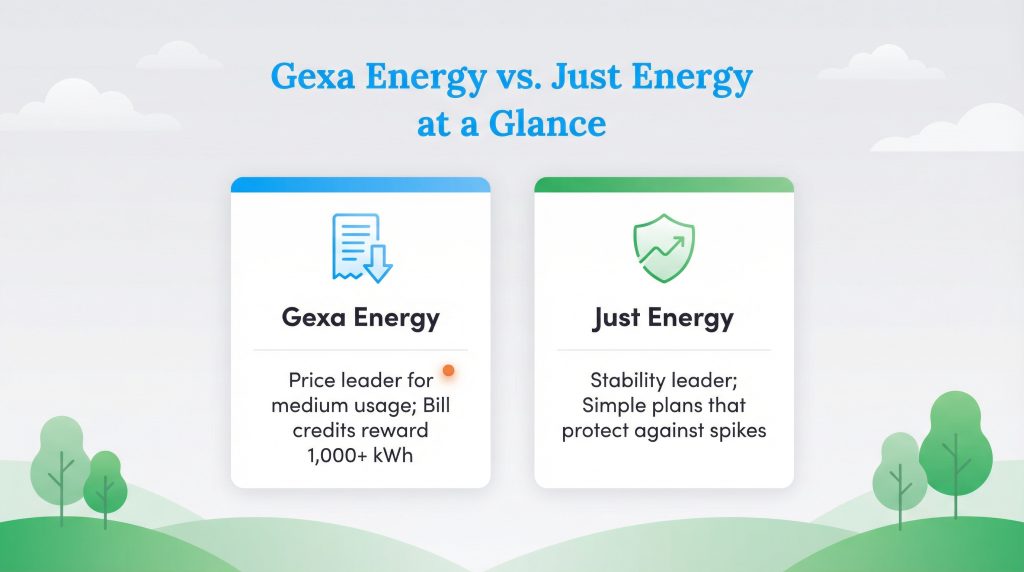
If you need a quick answer, this scorecard breaks down the primary differences between these two major providers.
| Feature | Gexa Energy | Just Energy |
|---|---|---|
| Price Stability | Variable (Bill Credit Dependent) | High (Fixed Rate Focus) |
| Green Energy | Standard on many plans | Available as an add-on |
| Contract Length | Usually 12–24 months | Up to 36–60 months |
| Ideal Customer | Active Usage Manager | “Set It and Forget It” Homeowner |
The Verdict: Gexa Energy is often the “Price Leader for Medium Usage” because their bill credits can drive your effective rate down significantly if you consistently use over 1,000 kWh. Just Energy is typically the “Stability Leader,” offering plans that are less confusing and less likely to spike if your usage fluctuates.
Which Provider is Best for You?
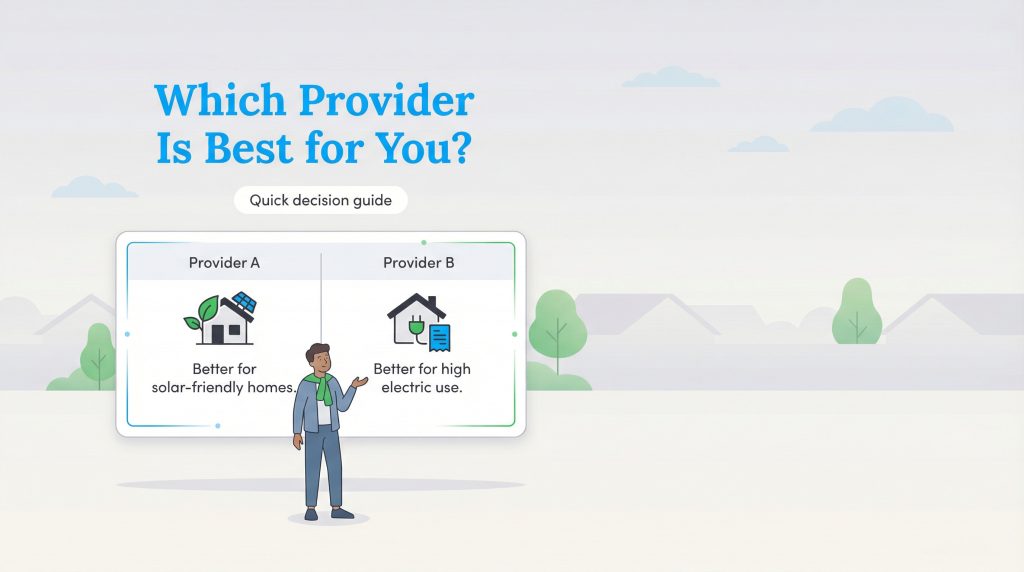
Before diving into the fine print, use this quick decision guide to see which provider aligns best with your home’s energy profile.
| Best For… | Gexa Energy | Just Energy |
|---|---|---|
| Usage 500–999 kWh (Apartments) | Rarely (Credits often don’t apply) | Better Pick (More stable rates) |
| Usage 1,000–2,000 kWh (Houses) | Better Pick (Maximize bill credits) | Good (But likely higher rate) |
| Green Energy Priority | Better Pick (Frequently included) | Available (Often extra cost) |
| Renters / Short Terms | Check ETF (Fixed fee can be high) | Better Pick (Fees often prorated) |
Analyzing the Rates: The “Bill Credit” Trap
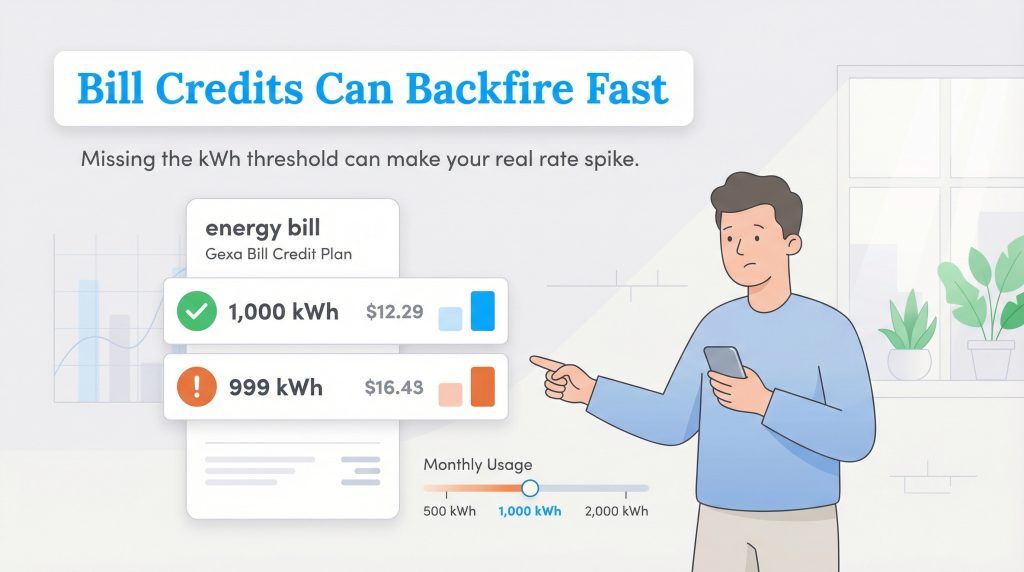
The most important distinction between these two providers is how they calculate your price per kilowatt-hour (kWh). Just Energy typically offers “bundled rates” or straightforward fixed pricing. This means your rate stays relatively consistent regardless of how much power you use. Gexa Energy, however, frequently uses a “bill credit” model. This is where you get a massive discount, often substantial amounts like $30 to $100, but only if your usage falls within a specific window, like 1,000 to 2,000 kWh.
It is crucial to understand the math here. For example, a plan might advertise an average rate of 12 cents per kWh based on 1,000 kWh usage. However, this rate often relies on a bill credit that only kicks in after you hit that 1,000 kWh mark. If you use 999 kWh, just one unit short of the threshold, you miss the credit entirely. Without that credit, your effective rate could jump significantly, potentially increasing your bill by a large margin for that month. You can learn more about managing these costs in our guide on how to save on your electric bill.
How to Read an Electricity Facts Label (EFL)
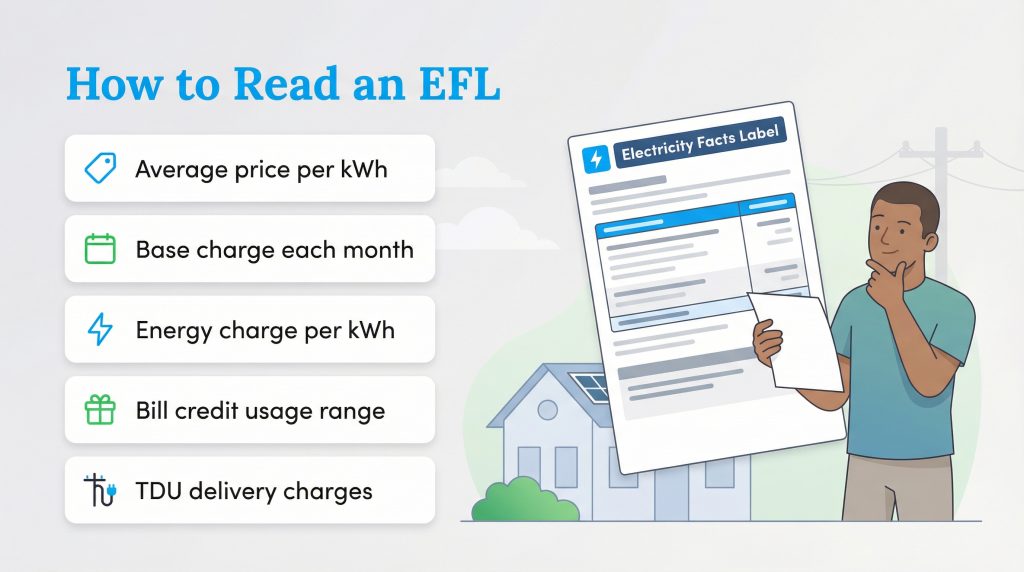
To truly compare these plans, you must look at the Electricity Facts Label (EFL). This document is required by Texas law and serves as the “nutrition label” for your electricity plan. Here is what to check before you sign:
- Average Price per kWh: Look at the price listed for your typical usage level (500, 1,000, or 2,000 kWh). Do not just look at the lowest number.
- Base Charge: A monthly fixed fee (e.g., $4.95 or $9.95) that you pay regardless of usage.
- Energy Charge: The cost per kWh for the electricity itself.
- Bill Credit Criteria: Look for the exact usage range required to get the credit (e.g., “Credit applies when usage is greater than 1000 kWh and less than 2000 kWh”).
- TDU Delivery Charges: These are fees from your local utility (like CenterPoint or Oncor) passed through to you. Ensure you know if they are included in the bundled rate or added separately.
Renewable Energy Plans and Sustainability
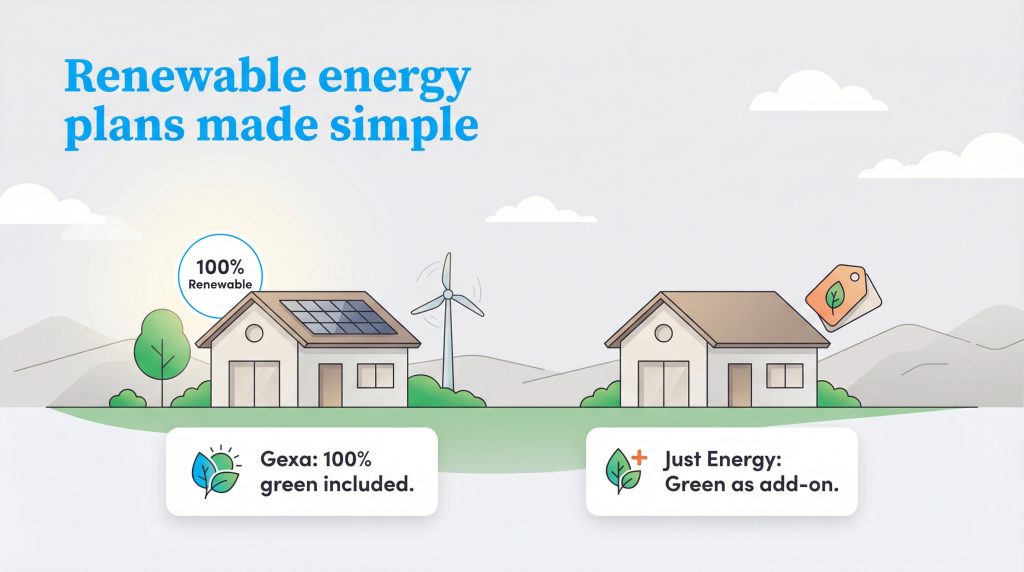
For those looking to make an environmentally mindful choice, Gexa Energy often has the edge. Gexa is a subsidiary of NextEra Energy, the world’s largest generator of renewable energy from the wind and sun. Because of this backing, Gexa frequently offers plans with 100% renewable energy included at no extra cost. This makes them a strong eco-conscious alternative for the average homeowner.
Gexa Energy Plans and Pricing
| Plan Name | Rate | Plan Type | Cancellation Fee | |
|---|---|---|---|---|
| Gexa Eco Saver Plus 14 | $0.077 /kWh | 14 Months Rate | $150 | Check Availability |
| Gexa Eco Saver Plus 24 | $0.085 /kWh | 24 Months Rate | $295 | Check Availability |
| Gexa Eco Saver Plus 12 | $0.112 /kWh | 12 Months Rate | $150 | Check Availability |
| Gexa Eco Choice 3 | $0.123 /kWh | 3 Months Fixed Rate | $150.00 | Check Availability |
| Gexa Prime Preferred 24 Plan | $0.139 /kWh | 24 Months Fixed Rate | $295.00 | Check Availability |
| Gexa Saver Edge 12 | $0.142 /kWh | 12 Months Rate | $150 | Check Availability |
| Gexa Prime Preferred 12 Plan | $0.144 /kWh | 12 Months Fixed Rate | $150.00 | Check Availability |
| Gexa Eco Choice 12 | $0.150 /kWh | 12 Months Fixed Rate | $150.00 | Check Availability |
| Gexa Eco Saver Value 12 | $0.159 /kWh | 12 Months Rate | $150 | Check Availability |
| Gexa Solar Export Saver 12 | $0.170 /kWh | 12 Months Rate | $150 | Check Availability |
| Gexa Straight Saver 24 | $0.180 /kWh | 24 Months Fixed Rate | $295.00 | Check Availability |
| Gexa Light Saver 12 | $0.180 /kWh | 12 Months Rate | $150 | Check Availability |
| Gexa Freedom 12 | $0.184 /kWh | 12 Months Fixed Rate | $150.00 | Check Availability |
| Gexa Saver Freedom 36 | $0.184 /kWh | 36 Months Rate | $295 | Check Availability |
| Gexa Saver Freedom 24 | $0.191 /kWh | 24 Months Fixed Rate | $295.00 | Check Availability |
| Gexa Straight Saver 12 | $0.195 /kWh | 12 Months Fixed Rate | $150.00 | Check Availability |
| Gexa Eco Saver Advantage 12 | $0.199 /kWh | 12 Months Rate | $150 | Check Availability |
| Gexa Eco Saver Premier 24 | $0.203 /kWh | 24 Months Rate | $295 | Check Availability |
| Gexa Eco Saver Premier 12 | $0.204 /kWh | 12 Months Rate | $150 | Check Availability |
| Free 3 Day Weekends Preferred 12 | $0.206 /kWh | 12 Months Rate | $150 | Check Availability |
| Gexa Eco Saver Lite 12 | $0.213 /kWh | 12 Months Rate | $150 | Check Availability |
| Gexa Prime Preferred Plus 24 | $0.214 /kWh | 24 Months Fixed Rate | $295.00 | Check Availability |
| Gexa Prime Preferred Plus 12 | $0.217 /kWh | 12 Months Fixed Rate | $150.00 | Check Availability |
Just Energy also offers green energy options, typically through their “JustGreen” program. However, this is often an add-on product that costs a few dollars extra per month or is attached to specific premium plans. If having a 100% green plan is a priority for you, Gexa simplifies the process by baking it into their base offers more frequently. You can learn more about how these credits work by researching Renewable Energy Certificates (RECs).
Just Energy Plans and Pricing
| Plan Name | Rate | Plan Type | Cancellation Fee | |
|---|---|---|---|---|
| Smart Choice - 6 | $0.065 /kWh | 6 Months Fixed Rate | $0.00 | Check Availability |
| Power Plus - 12 | $0.109 /kWh | 12 Months Fixed Rate | $0.00 | Check Availability |
| Smart Choice - 24 | $0.111 /kWh | 24 Months Fixed Rate | $0.00 | Check Availability |
| Sustainable Living Bundle - 3 | $0.115 /kWh | 3 Months Fixed Rate | $175.00 | Check Availability |
| Sustainable Days Bundle - 3 | $0.115 /kWh | 3 Months Fixed Rate | $175.00 | Check Availability |
| Power Plus - 24 | $0.125 /kWh | 24 Months Fixed Rate | $0.00 | Check Availability |
| Smart Choice - 12 | $0.127 /kWh | 12 Months Fixed Rate | $175.00 | Check Availability |
| Simple Choice- 12 | $0.154 /kWh | 12 Months Fixed Rate | $0.00 | Check Availability |
| Basics - 12 | $0.163 /kWh | 12 Months Fixed Rate | $0.00 | Check Availability |
| Simple Choice- 24 | $0.165 /kWh | 24 Months Fixed Rate | $0.00 | Check Availability |
| Basics - 24 | $0.167 /kWh | 24 Months Fixed Rate | $0.00 | Check Availability |
| Basics PTC - 60 | $0.175 /kWh | 60 Months Fixed Rate | $175.00 | Check Availability |
| Basics PTC - 24 | $0.175 /kWh | 24 Months Fixed Rate | $175.00 | Check Availability |
| Mega Saver - 24 | $0.202 /kWh | 24 Months Fixed Rate | $0.00 | Check Availability |
Contract Terms and Cancellation Fees
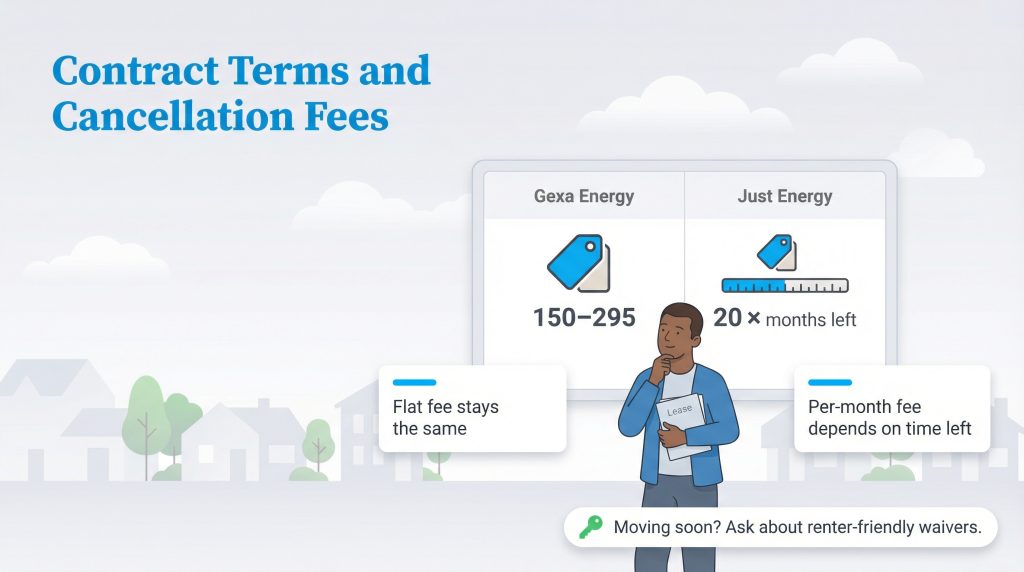
Life happens, and sometimes you need to break a contract. The cost of leaving early is a major differentiator between these two companies. Gexa Energy typically charges a fixed Early Termination Fee (ETF). This is usually a lump sum, such as $150 or $295, regardless of when you cancel. Whether you have one month left or 11 months left, the fee remains the same.
Just Energy often uses a different structure. Their cancellation fees are frequently calculated per month remaining on the contract. For example, if your fee is $20 per month remaining and you cancel with a year left on your contract, you would owe $240. However, if you cancel with only two months left, you would only owe $40. This structure can be beneficial if you are near the end of your term, but very costly if you cancel early in a long-term agreement.
| Fee Type | Gexa Energy | Just Energy |
|---|---|---|
| Structure | Flat Fee (Lump Sum) | Prorated ($ per month remaining) |
| Typical Cost | $150 – $295 | $20 per month remaining |
| Best For… | Staying the full term | Leaving near the end of term |
If you are renting, always check for “renter-friendly” clauses. Many providers will waive the cancellation fee if you provide proof that you are moving to a new address.
Customer Service and Public Reviews
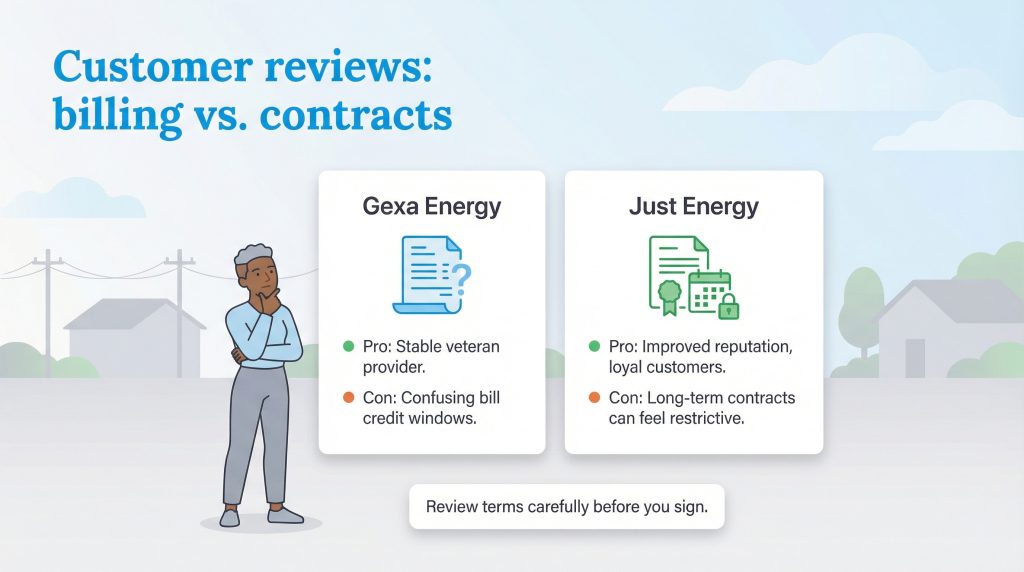
Both companies are established veterans in the Texas energy market, but they face different types of customer feedback. Reviews often highlight that Gexa Energy sometimes faces complaints regarding billing confusion. This is almost always tied to the bill credit usage windows mentioned earlier. Customers are often surprised when their bill spikes because they missed a usage threshold.
Just Energy has worked hard to improve its reputation over the years. Today, they are generally viewed as a stable provider with good retention, though some customers still find their long-term contracts restrictive. Some reviews mention aggressive marketing tactics, so always double-check the terms before you sign up. For more specific details on their plans, you can view our deep dive on Gexa Energy.
Making the Final Decision
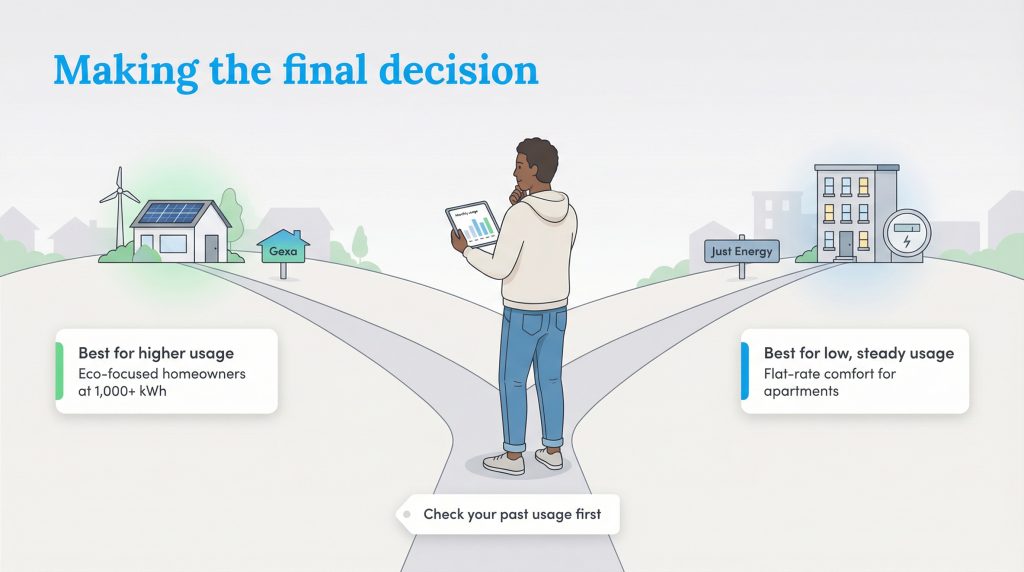
Ultimately, the choice between Gexa and Just Energy depends on your lifestyle and housing situation. If you are an eco-conscious homeowner who consistently uses over 1,000 kWh per month, Gexa Energy’s renewable plans and bill credits offer a path to significant savings. On the other hand, if you value predictability, live in an apartment with lower usage, or want a plan that you don’t have to monitor constantly, Just Energy’s flat-rate structures are likely the safer bet. Always check your past usage history before signing a contract to ensure you don’t get caught on the wrong side of a bill credit threshold.
Frequently Asked Questions About Gexa Energy and Just Energy
Which company has the cheaper electricity rates?
Does Gexa or Just Energy require a deposit?
Are Gexa and Just Energy the same company?
What are the “hidden fees” to watch out for?
Who has better reviews, Gexa or Just Energy?
Is a bill credit plan worth it for apartments?
About the Author

David has been an integral part of some of the biggest utility sites on the internet, including InMyArea.com, HighSpeedInternet.com, BroadbandNow.com, and U.S. News. He brings over 15 years of experience writing about, compiling and analyzing utility data.