
Choosing the right green energy provider in Texas comes down to how they source their power, plan structures, and your home’s average usage.
Key Takeaways
- Gexa Energy excels in straightforward plans that utilize Renewable Energy Certificates to guarantee your electricity usage is offset by green power.
- Chariot Energy focuses heavily on Texas-sourced solar messaging, making it an environmentally mindful choice for keeping your energy dollars local.
- Always check the Electricity Facts Label (EFL) to bypass marketing gimmicks and calculate your actual estimated bill based on your home size.
Setting up utilities in a deregulated Texas market can feel incredibly stressful, especially when trying to sift through confusing plan structures. We created this direct Gexa Energy vs. Chariot Energy comparison to cut through the noise. Whether you are buying a house or renting an apartment, our guide helps you confidently choose between two of the most commonly advertised renewable energy providers Texas has to offer without falling for marketing traps.

- 7.5¢ /kWh
- 100%
- 60 days
- 4-36 Months
- Committed to Renewable Energy

- 7.2¢ /kWh
- 100%
- None
- 3-36 Months
- 100% Solar-Powered Electricity
*rates may vary by location and household usage
Are Gexa and Chariot Available Where You Live?
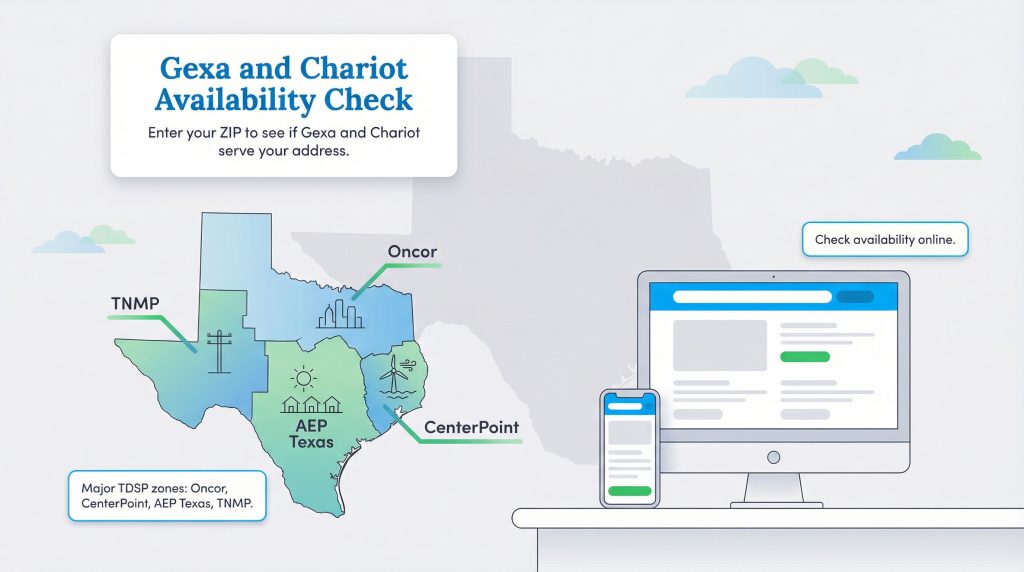
Before diving into plan details, you must confirm that these providers service your specific address. In Texas, retail electric providers operate within distinct Transmission and Distribution Service Provider (TDSP) territories. Both Gexa Energy and Chariot Energy offer plans across major deregulated utility zones, including Oncor (Dallas–Fort Worth), CenterPoint Energy (Houston), AEP Texas (Central and South Texas), and Texas-New Mexico Power (TNMP). You can easily verify availability in your exact zip code by visiting the official Power To Choose website.
At a Glance: Gexa vs Chariot Energy Features
Both companies offer eco-conscious alternatives to traditional fossil fuels, but they structure their plans and power generation quite differently. Review the breakdown below to see how Chariot Energy vs Gexa compare on plan offerings, best-fit scenarios, and renewable sourcing approaches.
| Feature | Gexa Energy | Chariot Energy |
|---|---|---|
| Best For | Longer-term fixed-rate options and simple plan designs | Solar-positioned plans and local energy messaging |
| Renewable Sourcing Method | National Renewable Energy Certificates (RECs) | Texas solar RECs or solar-backed sourcing |
| Common Plan Types | Fixed-rate, term lengths of 12 to 36 months | Fixed-rate, term lengths of 12 to 36 months |
| Base Charges | Varies by plan (Check EFL) | Varies by plan (Check EFL) |
Decoding the Electricity Facts Label (EFL)
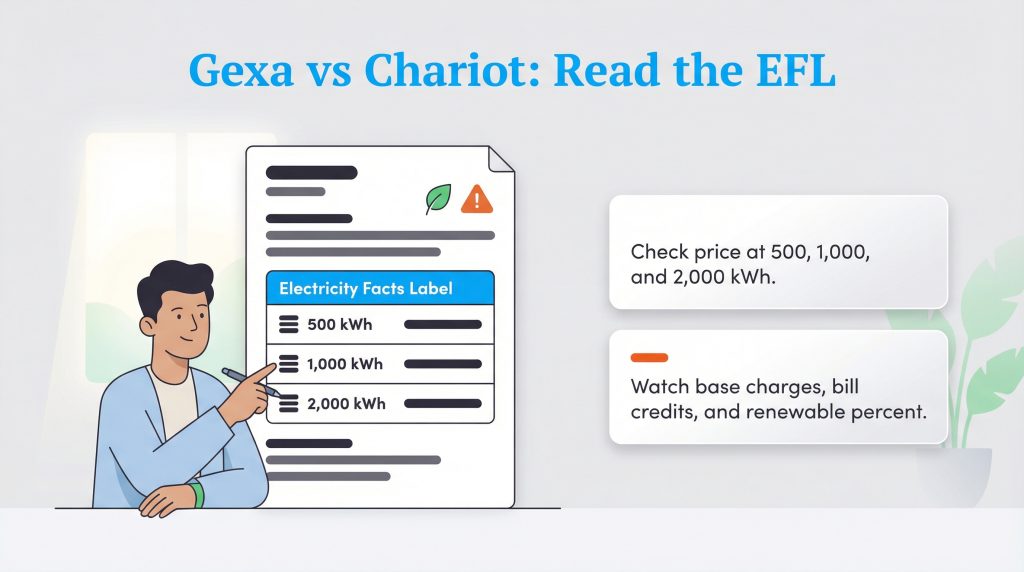
Before you commit to a contract, you need to understand the Electricity Facts Label, or EFL. This standardized document is your best defense against misleading pricing. It clearly outlines the “Base Charge”, a flat monthly fee just for being a customer, and details any “Bill Credits” you might receive. Some providers lure you in with a low advertised rate that relies on a bill credit gimmick, which only activates if you hit an exact usage tier like 1,000 kWh. If you use 999 kWh, your bill can jump significantly. We want to help you find straightforward plans with no hidden traps.
When scanning an EFL, always verify the average price at your expected usage levels (500, 1,000, or 2,000 kWh), any base charges, early termination fees, and the specific renewable content percentage for that exact plan.
Sourcing Green Power: RECs vs. Texas Solar
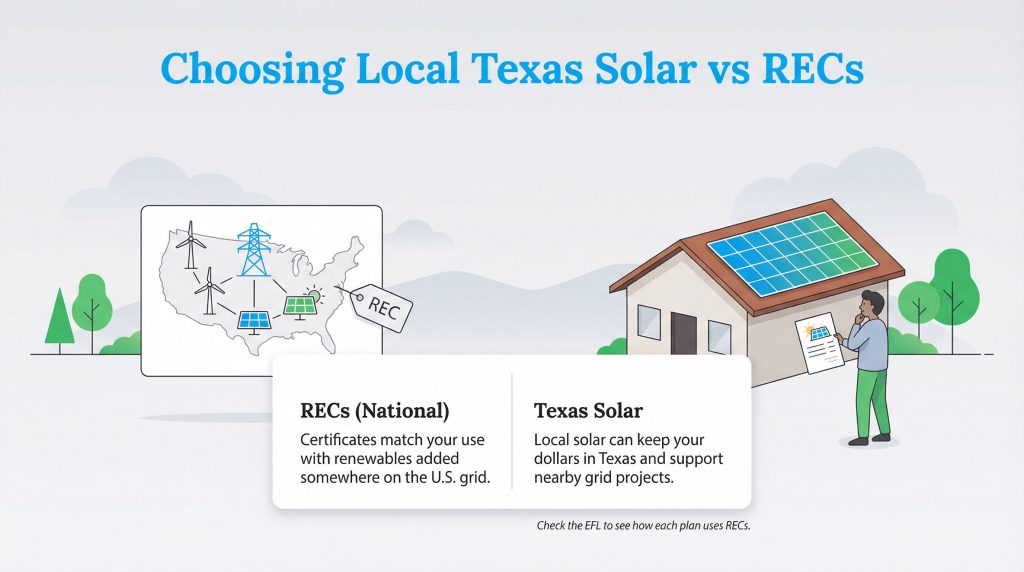
Navigating the renewable power market often brings up a sneaky issue known as “greenwashing,” where consumers don’t realize exactly how their energy is sourced. When searching for the best green energy plans Texas has available, you will likely encounter Gexa Energy. They primarily rely on Renewable Energy Certificates (RECs) purchased from national wind and solar generators. Essentially, for every kilowatt-hour you use, Gexa buys a certificate proving that an equivalent amount of renewable energy was added to the national grid somewhere in the country.
Gexa Energy Plans and Pricing
| Plan Name | Rate /kWH | Plan Term | Cancellation Fee | |
|---|---|---|---|---|
| Gexa Eco Saver Plus 14 | 7.5¢ | 14 Months | $150 | Check Availability |
| Gexa Eco Saver Plus 12 | 7.6¢ | 12 Months | $150 | Check Availability |
| Gexa Eco Saver Plus 24 | 8¢ | 24 Months | $295 | Check Availability |
| Gexa Eco Choice 3 | 12.3¢ | 3 Months | $150.00 | Check Availability |
| Gexa Prime Preferred 24 Plan | 13.9¢ | 24 Months | $295.00 | Check Availability |
| Gexa Prime Preferred 12 Plan | 14.4¢ | 12 Months | $150.00 | Check Availability |
| Gexa Eco Choice 12 | 14.7¢ | 12 Months | $150.00 | Check Availability |
| Gexa Light Saver 12 | 15.2¢ | 12 Months | $150 | Check Availability |
| Gexa Saver Edge 12 | 16.6¢ | 12 Months | $150 | Check Availability |
| Gexa Straight Saver 24 | 18¢ | 24 Months | $295.00 | Check Availability |
| Gexa Eco Saver Value 12 | 18.2¢ | 12 Months | $150 | Check Availability |
| Gexa Freedom 12 | 18.4¢ | 12 Months | $150.00 | Check Availability |
| Gexa Saver Freedom 36 | 18.4¢ | 36 Months | $295 | Check Availability |
| Gexa Saver Freedom 24 | 19.1¢ | 24 Months | $295.00 | Check Availability |
| Gexa Solar Export Saver 12 | 19.2¢ | 12 Months | $150 | Check Availability |
| Gexa Straight Saver 12 | 19.5¢ | 12 Months | $150.00 | Check Availability |
| Gexa Eco Saver Lite 12 | 19.8¢ | 12 Months | $150 | Check Availability |
| Gexa Eco Saver Premier 24 | 19.8¢ | 24 Months | $295 | Check Availability |
| Gexa Eco Saver Premier 12 | 20.4¢ | 12 Months | $150 | Check Availability |
| Free 3 Day Weekends Preferred 12 | 20.6¢ | 12 Months | $150 | Check Availability |
| Gexa Prime Preferred Plus 24 | 21.4¢ | 24 Months | $295.00 | Check Availability |
| Gexa Eco Saver Advantage 12 | 21.5¢ | 12 Months | $150 | Check Availability |
| Gexa Prime Preferred Plus 12 | 21.7¢ | 12 Months | $150.00 | Check Availability |
Conversely, Chariot Energy takes a more localized approach. Chariot markets several plans tied to Texas solar and may match your usage with solar RECs or direct solar-backed sourcing depending on the specific plan you choose. This means your energy dollars can stay local and help fund the expansion of Texas solar infrastructure. Both methods legitimately reduce your carbon footprint, but understanding the difference ensures your money aligns with your personal sustainability goals.
Chariot Energy Plans and Pricing
| Plan Name | Rate /kWH | Plan Term | Cancellation Fee | |
|---|---|---|---|---|
| GridPlus 15 | 7.2¢ | 15 Months | $15 x Month | Check Availability |
| GridPlus 24 | 7.6¢ | 24 Months | $15 x Month | Check Availability |
| GridPlus 18 | 8.3¢ | 18 Months | $15.00 | Check Availability |
| GridPlus 12 | 8.7¢ | 100 Months | $12 | Check Availability |
| GridPlus 36 | 11.4¢ | 36 Months | $15 x Month | Check Availability |
| Bright Nights 12 | 12.2¢ | 12 Months | $15 per remaining month | Check Availability |
| Bright Nights 15 | 12.4¢ | 15 Months | $15 per remaining month | Check Availability |
| Chariot Choice 24 | 12.5¢ | 24 Months | $150.00 | Check Availability |
| Chariot Choice 36 | 12.7¢ | 36 Months | $150.00 | Check Availability |
| GridEdge 36 | 12.9¢ | 36 Months | $15 x Month | Check Availability |
| Bright Nights 24 | 12.9¢ | 24 Months | $15 per remaining month | Check Availability |
| GridEdge 12 | 13.1¢ | 12 Months | $15 x Month | Check Availability |
| GridEdge 24 | 13.1¢ | 24 Months | $15 x Month | Check Availability |
| GridEdge 18 | 13.1¢ | 18 Months | $15 x Month | Check Availability |
| Solarize 24 | 13.9¢ | 24 Months | $15 x Month | Check Availability |
| Solarize 36 | 14.4¢ | 36 Months | $15 x Month | Check Availability |
| Solarize 15 | 14.5¢ | 15 Months | $15 x Month | Check Availability |
| Free Days 36 | 14.9¢ | 36 Months | $15 x Month | Check Availability |
| Free Nights 36 | 14.9¢ | 36 Months | $15 x Month | Check Availability |
| Free Days 18 | 15¢ | 18 Months | $15 x Month | Check Availability |
| Free Nights 15 | 15¢ | 15 Months | $15 x Month | Check Availability |
| Free Nights 12 | 15.1¢ | 12 Months | $15 x Month | Check Availability |
| Bright Nights 36 | 15.2¢ | 36 Months | $15 per remaining month | Check Availability |
| Free Days 12 | 15.3¢ | 12 Months | $15 x Month | Check Availability |
| Free Days 15 | 15.3¢ | 15 Months | $15 x Month | Check Availability |
| Free Nights 24 | 15.5¢ | 24 Months | $15 x Month | Check Availability |
| Free Nights 18 | 15.5¢ | 18 Months | $15 x Month | Check Availability |
| FreeDays 36 | 16.1¢ | 36 Months | $15.00 | Check Availability |
| Solarize 12 | 16.1¢ | 12 Months | $15 x Month | Check Availability |
| Solarize 18 | 16.5¢ | 18 Months | $15 x Month | Check Availability |
| PowerBank 24 | 17.2¢ | 24 Months | $15 x Month | Check Availability |
| Free Days 24 | 17.5¢ | 24 Months | $15 x Month | Check Availability |
| Chariot Freedom | 17.7¢ | Month to Month | $0.00 | Check Availability |
| GridMax 36 | 19.6¢ | 36 Months | $15 x Month | Check Availability |
| GridMax 18 | 20¢ | 18 Months | $15 x Month | Check Availability |
| GridMax 15 | 20¢ | 15 Months | $15 x Month | Check Availability |
| GridMax 24 | 20.3¢ | 24 Months | $15 x Month | Check Availability |
| GridMax 12 | 20.4¢ | 12 Months | $15 x Month | Check Availability |
Keep in mind that the exact renewable content and the use of RECs will be explicitly listed on each plan’s EFL. These details can differ drastically from one plan to another, even when you are shopping with the same provider.
Calculating Real-World Costs for a Typical Texas Home

Let’s step away from abstract rates per kWh and look at a concrete example. Imagine you are setting up utilities in Houston and moving into a mid-sized home. During a blistering Texas July, you might use exactly 2,000 kWh of electricity to keep the air conditioning running.
Instead of relying on estimated averages, you should calculate your exact anticipated costs using a straightforward formula: (Usage × Energy Charge) + Base Charge + TDSP Delivery Charges + Taxes and Fees. If you pull a sample EFL for a Gexa plan, you will find their specific energy charge and base fee. You can then compare that directly against the energy charge and base fee listed on a Chariot EFL. Plugging your 2,000 kWh into this formula allows you to see if paying a potential premium for Chariot’s locally positioned solar power is worth the extra few dollars compared to Gexa’s national REC offset strategy. Always pull the most current EFLs to run this math, as market rates change frequently.
Texas PUC Provider Ratings and Customer Experience
Even the most affordable electricity plan loses its appeal if you can’t get someone on the phone to fix a billing error. That makes customer service a crucial factor in your decision. We highly recommend reviewing official Public Utility Commission of Texas complaint scorecards to evaluate objective, third-party data on retail electric providers.
When analyzing the Texas PUC provider ratings, both companies generally maintain competitive standing, but their customer feedback highlights different strengths. Positive Gexa Energy reviews frequently mention their long-standing reliability and simple online account management. Meanwhile, recent Chariot Energy reviews often praise their transparent pricing structures and friendly, locally based support agents. Checking these official scorecards helps you set realistic expectations for your customer experience.
To interpret the complaint data effectively, look at the number of complaints per 1,000 customers rather than the total volume, as larger providers naturally receive more calls. Evaluate the provider’s trend over time and compare their performance strictly within your specific TDSP territory for the most accurate picture.
Setting Up Service: Tips for New Movers

Relocating involves a million moving parts, but comparing deregulated electric providers doesn’t have to be one of them. Setting up a brand-new service at a new address is slightly different from transferring an existing plan, as you start with a clean slate for historical usage. Both Gexa and Chariot typically allow you to schedule your new connection up to 60 days in advance, giving you plenty of time to lock in a favorable fixed-rate electricity plan before moving day.
Follow these three simple steps to secure your connection:
- Gather your property details: Make sure you have the exact service address and the targeted move-in date ready.
- Review the EFL carefully: Confirm the base fees, average rates, and cancellation policies fit your anticipated budget.
- Schedule your start date: Pick a connection date one day before your actual move-in to ensure the lights and air conditioning are on when you arrive.
Making Your Final Texas Electricity Choice
Choosing the winner in the Gexa vs Chariot Energy debate ultimately depends on your household priorities. Gexa stands out as an excellent choice if you have established historical usage data and want a straightforward, REC-backed guarantee to offset your footprint at a competitive price. Conversely, Chariot shines for local solar advocacy and highly transparent pricing tiers that bypass the usual industry gimmicks. Review your budget, check the latest EFLs, and you can confidently sign a contract knowing you made an energy-saving choice for your home.
Frequently Asked Questions About Gexa Energy vs. Chariot Energy
Does Chariot Energy require solar panels on my roof?
Are there cancellation fees with Gexa or Chariot?
Which company offers better plans for apartment renters?
How long does it take for electricity to turn on when moving?
Can I switch from Gexa to Chariot without losing power?
Who actually maintains the power lines if an outage occurs?
Will I need to pay a deposit to start my electricity service?
About the Author

David has been an integral part of some of the biggest utility sites on the internet, including InMyArea.com, HighSpeedInternet.com, BroadbandNow.com, and U.S. News. He brings over 15 years of experience writing about, compiling and analyzing utility data.