
Your complete guide to managing Texas Gas Service rates, setting up your account, and saving on energy costs
Key Takeaways
- Texas Gas Service is a regulated monopoly, meaning you cannot shop around for alternative natural gas providers in their specific service areas.
- Monitor your monthly usage with the mobile app and conveniently pay online via bank draft to avoid late fees and processing charges on your utility bill.
- Enroll in the Average Payment Plan (APP) to smooth out seasonal spikes and leverage state and federal assistance programs to lower your winter heating bills.
If you’re moving into a new home in Austin, El Paso, or the Rio Grande Valley, your natural gas connection will likely be supplied by Texas Gas Service. As a regulated division of ONE Gas, Inc., this utility provider manages the physical pipelines and meters that safely deliver fuel directly to your doorstep. Unlike the deregulated electricity market in Texas where you can freely choose your retail power provider, natural gas remains a regulated monopoly across the state. This guide will help you navigate your new utility account, understand recent rate changes and billing surcharges, track down the right Texas Gas Service customer service phone number, and find practical ways to lower your monthly gas bill without sacrificing comfort.
Understanding Texas Gas Service: A Regulated Provider
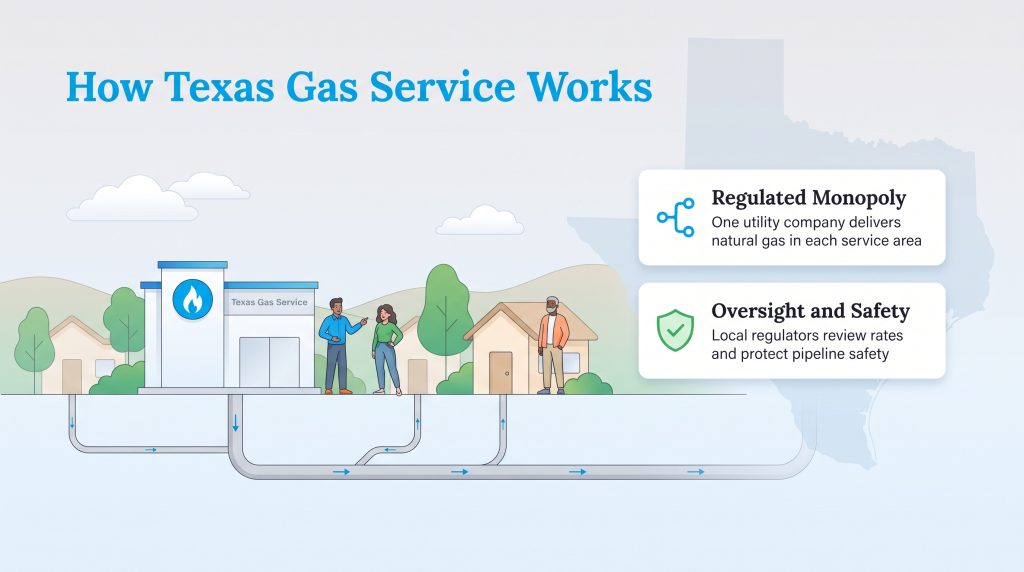
When setting up utilities in Texas, it’s easy to get confused by the different market rules. While the majority of the state enjoys a deregulated electricity market that allows you to compare plans and shop for power, natural gas operates under a completely different model. Because physical gas pipelines are expensive and complex to build, Texas Gas Service operates as a regulated monopoly in the specific regions they cover. You cannot shop around for alternative gas providers if you live within their designated operating territories.
To prevent unfair pricing, their rates and services are strictly overseen by local municipalities and the Railroad Commission of Texas. This state regulatory agency ensures fair pricing for consumers while enforcing strict safety standards for underground infrastructure. While the modern iteration of the company was formed in 2003, their roots run deep, dating back to 1929. Today, they serve over 706,000 customers across 100+ communities in Texas. As the third-largest natural gas distribution company in the state, they are a vital piece of the regional energy ecosystem, continuously investing in pipeline modernization and local community support.
Coverage Area and Major Cities Served
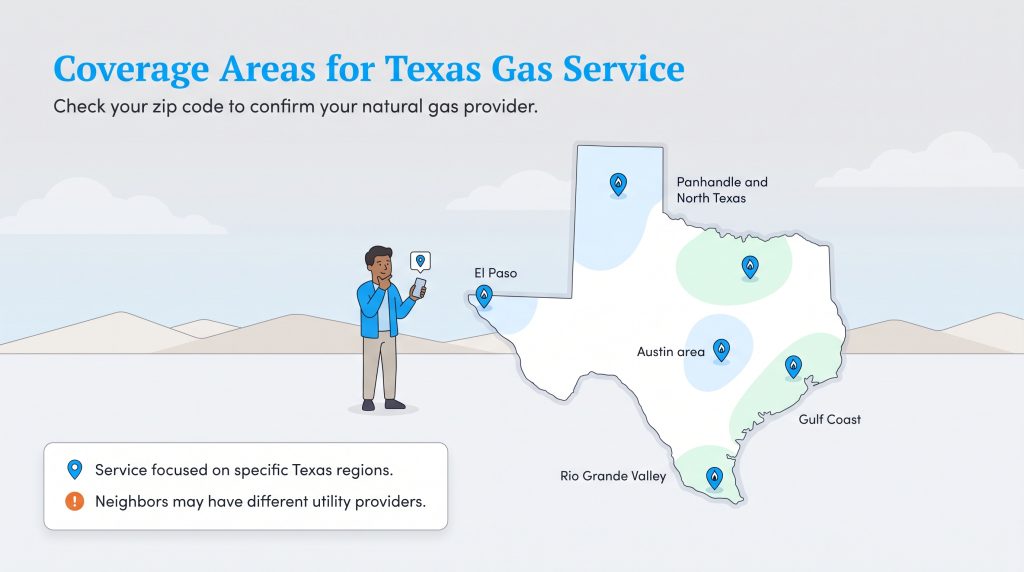
As the name implies, Texas Gas Service operates exclusively within the state. However, unlike some utility conglomerates that blanket the entire Texas Gas Service coverage map, they serve distinct, localized regions. If you’re relocating to El Paso, Austin, the Rio Grande Valley, or Pecos, they will likely be your dedicated natural gas provider.
Here is a breakdown of the major regions and cities they serve:
- Central Texas: This is one of their largest hubs, covering the greater Austin metropolitan area. Service extends across surrounding suburbs and neighboring communities, including Bee Cave, Lakeway, Sunset Valley, Kyle, Buda, Cedar Park, Dripping Springs, Lockhart, Luling, Rollingwood, and West Lake Hills.
- West Texas and the Permian Basin: They are the primary and dominant provider for El Paso, serving the vast majority of the city and neighboring border communities, alongside West Texas and Permian Basin towns like Pecos, Andrews, Monahans, Crane, and Dell City.
- Rio Grande Valley (RGV): They maintain a major footprint deep in South Texas, capturing high localized demand in cities like McAllen, Mission, Harlingen, Brownsville, and Pharr.
- North Texas and the Panhandle: They serve specific pockets of the Panhandle and North Texas, including Borger, Weatherford, and Aledo.
- Gulf Coast: Essential service extends down to the Galveston and Port Arthur areas.
📍 Location Check: Natural gas service areas can be incredibly fragmented. Even if you live in a general region they serve, it is always best to double-check your specific zip code on their website. Neighbors across the street from each other can sometimes fall under completely different municipal utility jurisdictions.
Texas Gas Service Plans, Pricing, and Rate Breakdown
When you look closely at your monthly statement, you’ll see that Texas Gas Service rates are split into two main categories: fixed infrastructure fees and volumetric fuel charges. Understanding how these line items work together explains why your bill never drops to $0 in the summer and why it climbs so quickly during a January cold snap.
Every residential statement is built around four primary billing components:
- Customer Charge: This is a fixed base monthly fee — often ranging from $20 to $45 or more depending on your specific municipal rate schedule — that covers meter reading, billing, and basic line maintenance. You pay this charge every month just to keep an active meter connected to your home, even if you use zero gas.
- Delivery Charge: Measured per hundred cubic feet (Ccf) or thousand cubic feet (Mcf), this volumetric infrastructure fee pays for the physical operation and upkeep of the distribution pipes moving gas through your neighborhood.
- Cost of Gas: This is a 100% pass-through commodity cost per Mcf with zero profit markup. You pay the exact wholesale market price that Texas Gas Service pays to acquire and transport raw natural gas for your region.
- Weather Normalization Adjustment (WNA): Applied during winter billing cycles, the WNA adjusts your delivery rate based on how much warmer or colder the month was compared to historical norms. It protects both the utility and consumers from extreme financial swings during unusually frigid or mild winters.
Beyond standard usage rates, your bill includes two notable regulatory surcharges approved by the Railroad Commission of Texas. First, the company utilizes annual Gas Reliability Infrastructure Program (GRIP) filings. These regulatory adjustments add roughly $3.58 per month to residential bills each year to reimburse the utility for prior-year pipeline modernization and safety upgrades. Second, customers pay a Winter Storm Uri Securitization Fee — a state-mandated volumetric charge of roughly $1.13 per Mcf (averaging about $3.96 per month for a typical household) designed to pay off the historic wholesale fuel price spikes incurred during the February 2021 freeze.
To give you a clear picture of how these charges impact your budget across the year, here is a realistic comparison of summer versus winter bills for a standard 1,800-square-foot Texas home:
| Billing Component | Typical Summer Bill (Low Usage: ~1.5 Mcf) | Typical Winter Bill (High Heating Usage: ~10 Mcf) |
|---|---|---|
| Fixed Customer & Base Delivery Charges | $28.00 – $42.00 | $28.00 – $42.00 |
| Volumetric Delivery & GRIP Adjustments | $3.50 – $5.00 | $25.00 – $45.00 |
| Pass-Through Cost of Gas | $6.00 – $9.00 | $55.00 – $115.00+ |
| Weather Normalization & Uri Securitization | $1.50 – $2.00 | $12.00 – $28.00 |
| Municipal Franchise Fees & Taxes | $2.00 – $4.00 | $10.00 – $20.00 |
| Estimated Monthly Total | $41.00 – $62.00 | $130.00 – $250.00+ |
Billing Options and Ways to Manage Seasonal Spikes
Because natural gas bills can easily triple between August and January, managing seasonal volatility is one of the smartest ways to protect your household budget. Rather than bracing for winter bill shock, you can use built-in account tools to smooth out your monthly expenses.
The most popular tool is the Texas Gas Service Average Payment Plan (APP) — also referred to historically on some regional statements as the Average Bill Calculation (ABC) Plan. Instead of billing you for your exact gas consumption each month, the APP calculates your monthly payment using a 12-month rolling average of your home’s historical usage. Because the average shifts gradually by only about 5% to 10% from month to month, you pay slightly more than your actual usage during the summer in exchange for dramatically lower, predictable bills during peak winter heating months.
🚩 Heads Up: To enroll in the Average Payment Plan, your account must have a zero past-due balance. Once enrolled, you must pay your full averaged amount on time every single month — missing a due date can result in immediate removal from the program, forcing any deferred winter balance to become due all at once.
To streamline your monthly routine even further, we recommend pairing the Average Payment Plan with two free digital billing features:
- Electronic Statements (Paperless Billing): Opting out of paper mail delivers an instant email notification the moment your monthly statement is generated, giving you plenty of time to review your usage before the due date.
- Automatic Bank Draft (ACH): Linking your checking or savings account for automatic monthly withdrawals guarantees you never miss a payment deadline or risk losing your APP eligibility, all while bypassing third-party card processing fees.
Fees, Deposits, and Home Protection Guarantees
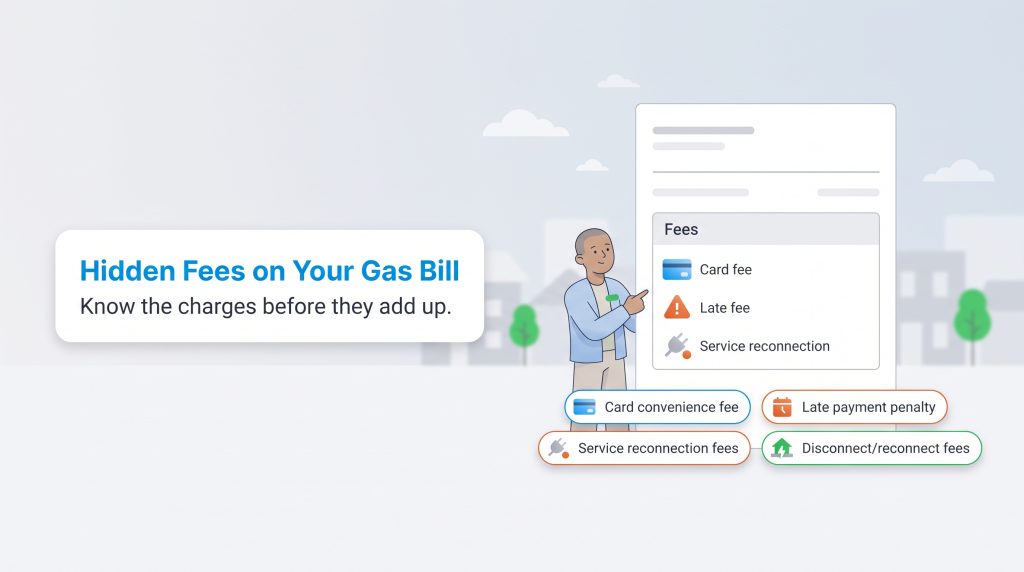
Navigating utility bills means keeping a close eye on administrative charges and deposit rules that can quietly inflate your move-in and monthly costs. Transparency is key to maintaining a household budget, so you should be aware of the standard fees associated with your natural gas account:
- Credit Card Convenience Fee: One-time phone and card payments are processed through Speedpay, a third-party payment vendor that charges a standard $1.49 convenience fee per transaction. To avoid this fee entirely, link your checking account directly for free ACH bank drafts through your online portal.
- Security Deposits: When you initiate service, Texas Gas Service runs a soft credit check or reviews your utility payment history to determine if a security deposit is required. If you are required to pay a deposit (or if you aren’t able to provide a Letter of Credit from a previous natural gas utility), rest assured that residential deposits earn interest and are automatically refunded as a bill credit after 12 consecutive months of on-time payments.
- Connection and Initiation Fees: Setting up service at a new address requires a one-time connection or activation fee, typically ranging between $30 and $65 depending on your city’s specific tariff schedule and whether a technician needs to physically install or unlock a meter.
- Late Payment Penalties: Missing your due date triggers a late penalty calculated as a regulated percentage of your overdue balance, which can add up quickly during peak winter heating months.
- Disconnection and Reconnection Fees: If your gas is shut off due to non-payment, you will be charged a disconnection fee. Restoring service triggers a subsequent reconnection fee, along with a requirement to pay the full past-due balance and potentially a new security deposit.
Oncourse Home Solutions Protection Plans
When setting up your account or browsing the official Texas Gas Service website, you will likely see prominent advertisements for the Customer Home Protection Program offered in partnership with Oncourse Home Solutions. While Texas Gas Service maintains the underground pipes up to your gas meter, you are legally and financially responsible for the customer-owned gas lines running from the meter into your house, as well as your interior appliances.
Oncourse Home Solutions offers optional warranty plans covering gas lines, water heaters, HVAC systems, and plumbing. Because Texas Gas Service allows Oncourse to place these monthly plan charges directly onto your regular gas utility bill for convenience, many new movers mistakenly believe they are mandatory utility fees. These third-party warranty plans are 100% optional, and you are under no obligation to enroll in them to receive standard natural gas service or emergency leak responses.
How to Start, Stop, or Transfer Your Gas Service
Because natural gas involves strict physical safety protocols, setting up or changing your connection requires a bit of advance planning. You cannot instantly flip it on or off from afar like a Wi-Fi router. Whether you need to submit a Texas Gas Service start service request, close your current account, or transfer service to a new house across town, follow these step-by-step instructions.
To Start New Service:
- Gather your documents: Have your lease agreement or closing documents, government-issued identification (such as a driver’s license and Social Security Number), and your exact move-in date ready.
- Submit the request: The fastest way to process a Texas Gas Service start service request is online through their web portal at least three to five business days before moving in. You can also call customer service directly.
- Schedule the safety check: A field technician will need to physically access your property to turn on the meter, check interior appliance connections, and perform a mandatory pressure test. Make sure your water and electricity are already turned on so the technician can properly test your water heater and furnace, and ensure an adult age 18 or older is present during the appointment window.
To Stop or Transfer Service:
- Log into your account: Navigate to the “Stop or Transfer Service” tab in your online dashboard.
- Provide a notice period: Give the utility at least three to five business days’ notice before your desired stop date to ensure you aren’t billed for days you no longer live in the home.
- Provide a forwarding address: Enter your new mailing address so your final prorated bill and any applicable security deposit refunds are sent to the right place.
Texas Gas Service Login and Bill Pay Options
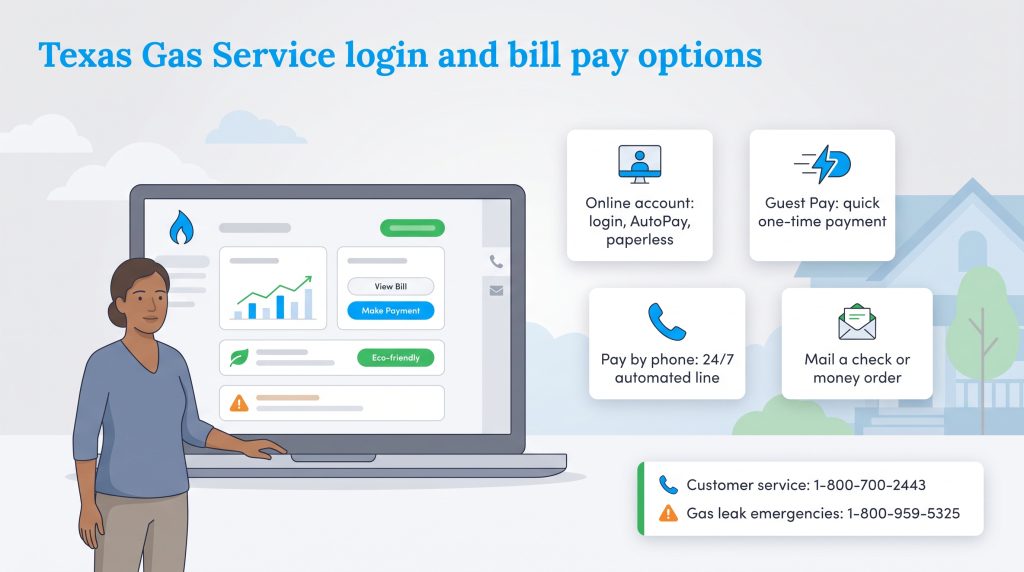
Managing utility bills shouldn’t feel like a chore, so having flexible ways to pay is essential. Texas Gas Service bill pay options include online portals, automated phone lines, and in-person retail kiosks to help you settle your monthly statement on your own schedule.
- Texas Gas Service Login: Create an online profile to view up to 24 months of billing history, enroll in automatic bank drafts (AutoPay), monitor usage trends, and manage your paperless billing preferences.
- Guest Pay: If you’re in a rush or helping out a family member, you can use the One-Time Guest Pay feature on their website with just the account number and service zip code.
- Pay by Phone: Call their dedicated 24/7 Speedpay automated phone payment lines at 1-877-782-4244 or 1-844-785-4943 to pay using a debit card, credit card, or electronic check.
- Authorized In-Person Payment Locations: If you prefer paying with cash in person, you can use authorized CheckFreePay and Speedpay retail locations across Texas, including Walmart, H-E-B, and Western Union service desks. Always verify that a store is an authorized agent on the utility’s website — avoid unauthorized third-party payment websites or storefronts that charge steep processing fees and delay payment posting by several days.
- Mail-In Options: If you prefer sending a physical check or money order, mail your payment stub directly to their lockbox address: Texas Gas Service, P.O. Box 219913, Kansas City, MO 64121-9913.
To make getting support even faster, we’ve compiled every important Texas Gas Service phone number and portal link into this quick-reference table:
| Contact Method | Details |
|---|---|
| Customer Service Phone Number | 1-800-700-2443 |
| Automated Bill Pay (Speedpay) | 1-877-782-4244 or 1-844-785-4943 |
| Emergency Leak Phone Number | 1-800-959-5325 (Available 24/7) |
| Customer Service Hours | Monday – Friday, 7:00 a.m. to 7:00 p.m. CT |
| Guest Pay & Account Login Portal | Available via Official Website |
Mobile App, Customer Reviews, and BBB Ratings
For on-the-go account access, parent company ONE Gas, Inc. offers the official Texas Gas Service app for iOS and Android devices. The mobile app allows you to pay your bill, view 24 months of usage and payment history, start, stop, or transfer service, and even complete a self-guided home energy audit to identify drafty areas in your house. However, the app’s digital stability leaves plenty of room for improvement, currently holding a 1.9-star rating on the Apple App Store due to recurring login loops and biometric FaceID glitches.
💡 Pro Tip: If you use a Samsung Galaxy or Android phone and your PDF billing statements fail to open inside the Texas Gas Service app, the pre-installed Hancom Office Editor app is likely blocking the file viewer. Either disable Hancom Office Editor in your phone’s app settings or install Google Sheets and Microsoft Excel to resolve the formatting conflict.
When looking at broader customer service credentials, Texas Gas Service holds an A+ rating with the Better Business Bureau (BBB), maintaining continuous accreditation since 1979 in Austin and 1985 in El Paso. Relative to serving over 706,000 accounts, their formal complaint volume with the BBB and the Railroad Commission of Texas is remarkably low, and the utility responds promptly to resolve billing disputes or meter estimation errors.
Still, day-to-day customer sentiment on local Reddit forums like r/Austin and r/ElPaso paints a more nuanced picture. While residents widely praise the physical reliability of the underground network and the professionalism of field technicians, homeowners frequently vent frustration over $40 to $50 base summer bills when almost zero gas is consumed. Because Texas regulators have allowed the company to shift more infrastructure recovery into fixed monthly charges, low-usage households often feel penalized during the warmer months.

- Calculate Your Moving Costs
- Compare Moving Companies
- Get Multiple Quotes
- Move with Confidence
Sustainability, Assistance Programs, and Ways to Save
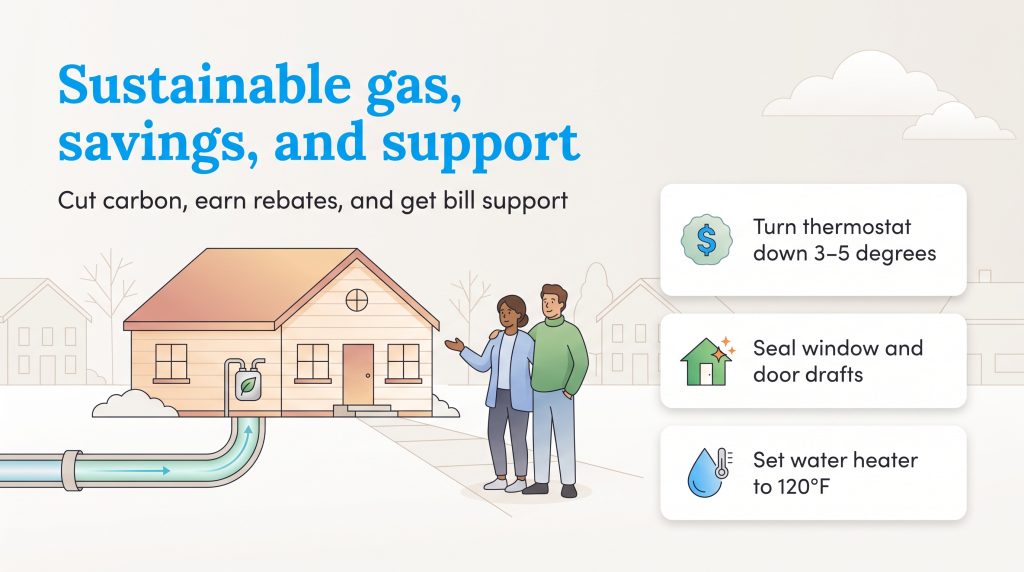
If you’re interested in eco-conscious living, you’ll appreciate how ONE Gas and Texas Gas Service are investing in renewable natural gas (RNG) and methane emission reductions. RNG is a lower-carbon fuel created by capturing organic waste from landfills, wastewater treatment plants, and agricultural farms. Instead of letting raw methane escape into the atmosphere, it is purified and injected directly into existing distribution pipelines — providing your home with reliable energy while reducing the overall carbon intensity of the grid.
If you are shopping for new appliances like tankless water heaters or smart thermostats, you should be aware of a major recent change to utility incentives. The general Texas Gas Service residential energy efficiency rebate program has expired because the Railroad Commission of Texas did not approve the company’s latest program renewal filing. While direct rebates from Texas Gas Service are no longer available in most areas, you can still tap into substantial savings through alternative local, state, and federal programs:
- State-Level Texas Home Energy Rebates: Keep an eye on the Home Efficiency Rebates (HOMES) and Home Electrification and Appliance Rebates (HEAR) programs managed by the Texas State Energy Conservation Office (SECO), which provide substantial point-of-sale discounts and weatherization grants for qualifying Texas households.
- Local Municipal Partner Rebates: Depending on where you live, your municipal electric or water utility (such as Austin Energy in Central Texas) may still offer localized rebates for attic insulation, duct sealing, and smart thermostats.
- Federal Energy Tax Credits: Homeowners upgrading to high-efficiency ENERGY STAR-certified heating equipment or adding home insulation can claim federal energy efficiency tax credits on their annual IRS filings.
If your household is struggling to keep up with winter heating bills, direct financial assistance is also available:
- Low Income Home Energy Assistance Program (LIHEAP): Administered across Texas as the Comprehensive Energy Assistance Program (CEAP), this federally funded initiative helps eligible low-income households pay their utility bills through local community action agencies.
- Share The Warmth: Funded by Texas Gas Service customers who voluntarily round up their monthly bills to the nearest dollar, 100% of these charitable proceeds go to local nonprofits to help low-income families, seniors, and disabled residents cover winter gas bills.
To immediately cut your natural gas consumption right now, try these three environmentally mindful choices around the house:
- Turn your thermostat down 3 to 5 degrees while sleeping or away from home.
- Seal drafts around windows and exterior doors with affordable weatherstripping.
- Lower the temperature setting on your water heater to 120 degrees Fahrenheit.
Reporting a Gas Leak or Natural Gas Emergency
Safety is paramount when dealing with combustible natural gas. Unlike electric utilities that publish live outage maps during storms, natural gas networks rarely experience widespread outages unless a physical line is severed. Instead, emergency tools focus on rapid leak detection. If you ever smell a distinct “rotten egg” sulfur odor, hear an unusual hissing or roaring sound near a pipeline or appliance, or notice unexplained dead vegetation in an otherwise green yard, you may be dealing with a dangerous gas leak.
Leave the premises immediately on foot. Do not flip light switches, unplug appliances, use a garage door opener, use your cell phone inside the house, or start a car nearby, as even a tiny static spark could ignite leaking gas. Once you are a safe distance away from the property, call the 24/7 Texas Gas Service emergency number at 1-800-959-5325 and dial 911. Never wait or assume someone else in your neighborhood has already reported the smell, and always call 811 at least two business days before digging in your yard to have underground gas lines marked for free.
Why Choose (or Skip) Texas Gas Service and Who It Is Best For
Because Texas Gas Service operates as a regulated utility monopoly, residents in Austin, El Paso, and the Rio Grande Valley cannot switch to a competing natural gas provider. However, homeowners still face a meaningful long-term energy choice: whether to maintain an active natural gas connection or transition to an all-electric home.
Keeping Texas Gas Service is best for:
- Households with multiple gas appliances: If your home relies on a natural gas furnace, gas water heater, gas clothes dryer, and gas cooktop, the high efficiency and rapid heating capability of natural gas easily justify the monthly base charge.
- Home cooks and cold-weather comfort seekers: Many homeowners prefer the instant flame control of a gas stove and the warm air output of a gas furnace during freezing West Texas or Panhandle nights.
- Budget-conscious families using the Average Payment Plan: Enrolling in the 12-month rolling average plan makes winter heating costs predictable and easy to manage.
Skipping Texas Gas Service (via full home electrification) may make sense for:
- Single-appliance gas users: If your home already uses an electric heat pump for heating and an electric water heater — leaving only a gas stove or fireplace connected to the meter — paying $25 to $45+ every month in fixed gas base delivery fees just to cook dinner is rarely cost-effective.
- Solar-powered homes: Homeowners with rooftop solar panels who swap their aging gas appliances for an induction range and a heat pump water heater can disconnect their gas meter entirely, eliminating the monthly Texas Gas Service customer charge for good.
Navigating Your Texas Gas Service Account
While you can’t shop around for a competing natural gas company in your neighborhood, keeping your Texas Gas Service bills in check doesn’t have to be a headache. By understanding how fixed delivery charges and seasonal adjustments work, you can plan ahead for winter heating spikes before they arrive. Once your service is active, take five minutes to enroll in Paperless Billing, set up free AutoPay via bank draft to skip card convenience fees, and activate the Average Payment Plan for year-round budget stability. Don’t forget to call 811 before starting any backyard landscaping projects so you can enjoy safe, reliable energy in your new Texas home.
Frequently Asked Questions About Texas Gas Service
How do I contact Texas Gas Service customer service?
You can reach their customer service team by calling 1-800-700-2443. Their standard operating hours are Monday through Friday, from 7:00 a.m. to 7:00 p.m. Central Time. You can also manage your account or submit service requests through your secure online account portal.
Does Texas Gas Service still offer energy efficiency appliance rebates?
No, the general Texas Gas Service Energy Efficiency Rebate Program has expired and is currently unavailable after the company’s latest program renewal proposal was not approved by the Railroad Commission of Texas. However, homeowners can still save on upgrades through the Texas Home Energy Rebates (HOMES and HEAR programs) managed by the State Energy Conservation Office (SECO), local municipal electric utility incentives, and federal energy tax credits.
How does the Texas Gas Service Average Payment Plan work?
The Average Payment Plan (APP) calculates your monthly bill using a 12-month rolling average of your natural gas usage rather than your exact monthly consumption. This smooths out expensive winter heating spikes into predictable payments year-round. To qualify, you must have a zero past-due balance upon enrollment and pay your bill on time every month to remain eligible.
Why is my Texas Gas Service bill $40 to $50 in the summer when I barely use any gas?
Even if your furnace is turned off all summer, Texas Gas Service bills include a mandatory fixed monthly Customer Charge (often $20 to $45+ depending on your city) plus regulated infrastructure surcharges like Gas Reliability Infrastructure Program (GRIP) filings. These fixed fees apply every month simply to maintain an active, safe meter connection at your home, regardless of how little fuel you consume.
What is the phone number to pay my Texas Gas Service bill over the phone?
You can pay your bill 24/7 over the phone via Speedpay by calling 1-877-782-4244 or 1-844-785-4943. Keep in mind that Speedpay charges a $1.49 convenience fee for credit and debit card payments, whereas setting up online ACH bank drafts through your Texas Gas Service login portal is completely free.
How do I stop or transfer my Texas Gas Service account?
To stop or transfer your service, log into your online account dashboard and navigate to the “Stop or Transfer Service” tab, or call customer service directly. You should provide a three-to-five business day notice before your requested move date to ensure accurate final billing.
How do I report a gas leak or emergency?
Evacuate the immediate area on foot without flipping switches or using electronics, then call their 24/7 emergency line at 1-800-959-5325 and dial 911. Never ignore the distinct rotten egg smell of a gas leak or try to locate the source of a hissing pipe yourself.
About the Author

David has been an integral part of some of the biggest utility sites on the internet, including InMyArea.com, HighSpeedInternet.com, BroadbandNow.com, and U.S. News. He brings over 15 years of experience writing about, compiling and analyzing utility data.