
While Chicago rates see a slight bump, suburban customers get a break, but infrastructure projects could change the game for everyone.
Key Takeaways
- Mixed bag for supply costs: Peoples Gas supply rates in Chicago rose to $0.4123 per therm this April, while Nicor Gas customers in the suburbs saw their rates drop to $0.46 per therm.
- Global factors at play: International instability, particularly the ongoing war in Iran, continues to cause “yo-yo” effects in wholesale gas prices, even as spring weather typically lowers demand.
- Infrastructure hikes loom: Both major utilities are currently petitioning the state for massive delivery rate increases to fund aging pipe replacements, which could add $10 or more to your monthly bill if approved.
- You have choices: If you live in Northern Illinois, you can use the Customer Select program to shop for alternative suppliers and potentially lock in a fixed rate to avoid market volatility.
At UtilitiesForMyHome.com, we know that moving into a new place is stressful enough without having to decipher a complicated energy bill. This April, if you are living in Chicago or the surrounding suburbs, you’ll notice some shifts in what you’re paying for natural gas. We’ve broken down the latest data from the Illinois Commerce Commission (ICC) and consumer watchdogs to help you stay ahead of the curve.
Why Are Your Rates Changing?
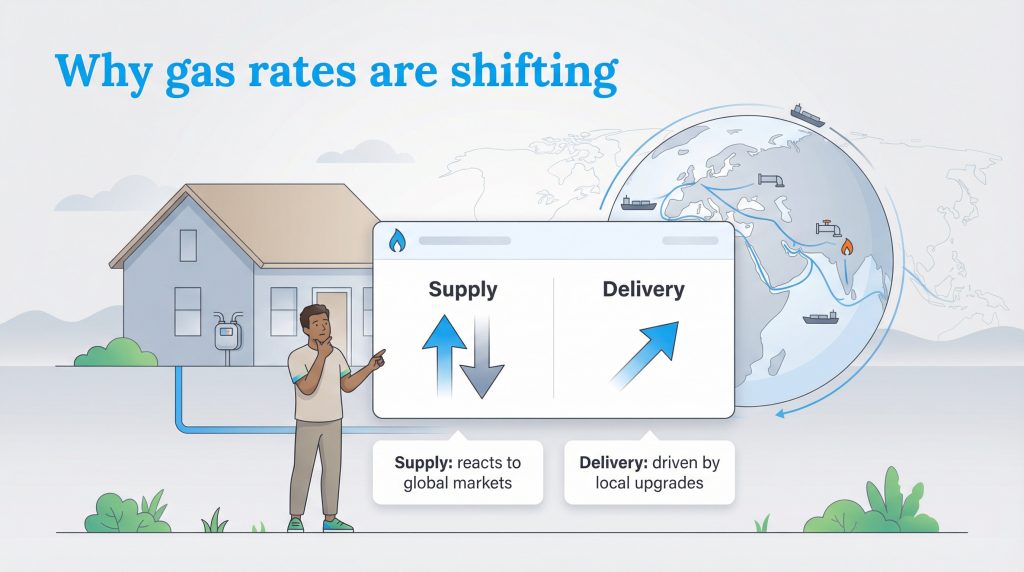
Your gas bill is actually split into two main parts: the supply charge (the cost of the gas itself) and the delivery charge (the cost to get it to your house).
The Supply “Yo-Yo”
For April 2026, the supply charges are moving in opposite directions. Peoples Gas increased its rate to $0.4123 per therm, up from $0.4067 in March. Meanwhile, Nicor Gas dropped its rate to $0.46 per therm from $0.49.
These fluctuations happen because utilities buy gas on the open market and pass that cost to you without making a profit. Right now, the market is jumpy. Global supply chains have been snarled by the conflict in Iran and the blockade of the Strait of Hormuz, a major gateway for the world’s energy. This instability, combined with increased U.S. exports of natural gas, means our local bills are now tied to global events more than ever before.
The Delivery Debate
While the supply cost goes up and down, both Peoples Gas and Nicor Gas are asking the ICC for permanent increases to their delivery rates. Peoples Gas is seeking a $202.3 million hike, citing the need to replace over 1,000 miles of old iron pipes in Chicago by 2035 for safety and reliability. Nicor has filed a similar $221 million request. While these wouldn’t hit your bill until late 2026 or 2027, they represent a growing trend of rising fixed costs for Illinois residents.
How This Impacts Your Typical Bill
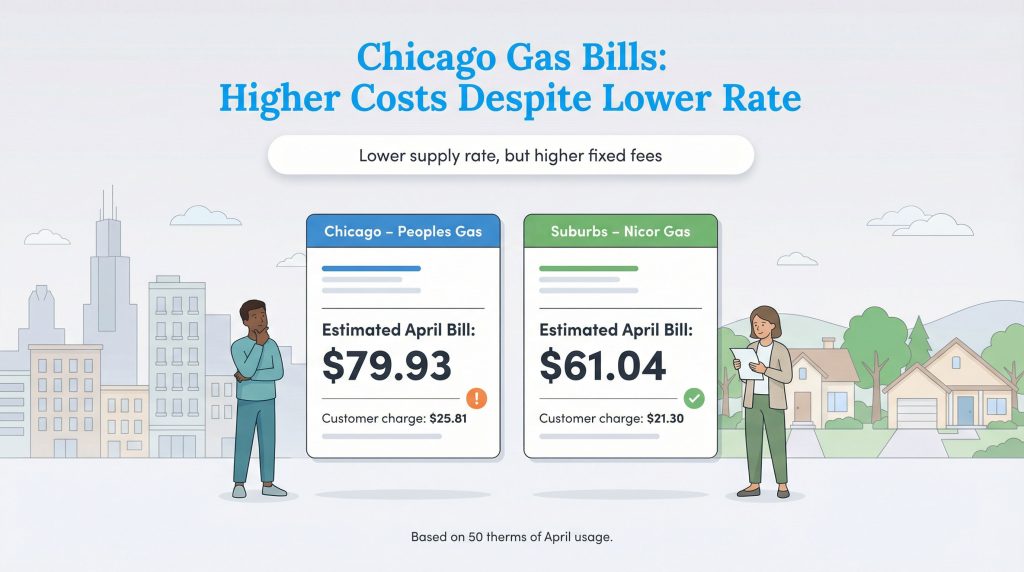
Even though Chicago residents (Peoples Gas) pay a lower supply rate per therm than suburban residents (Nicor), they often end up with higher total bills. Why? Because the fixed “customer charge” and delivery fees in the city are higher to support those massive infrastructure projects.
For a typical household using about 50 therms in April — a “shoulder” month where you aren’t blasting the heat as much — here is how the math shakes out:
- In Chicago (Peoples Gas): You can expect an estimated total bill of about $79.93. Your fixed customer charge for heating is currently $25.81 per month.
- In the Suburbs (Nicor Gas): A similar household might see an estimated bill of $61.04. Nicor’s fixed customer charge is currently $21.30 per month.
Major Cities and Areas Impacted
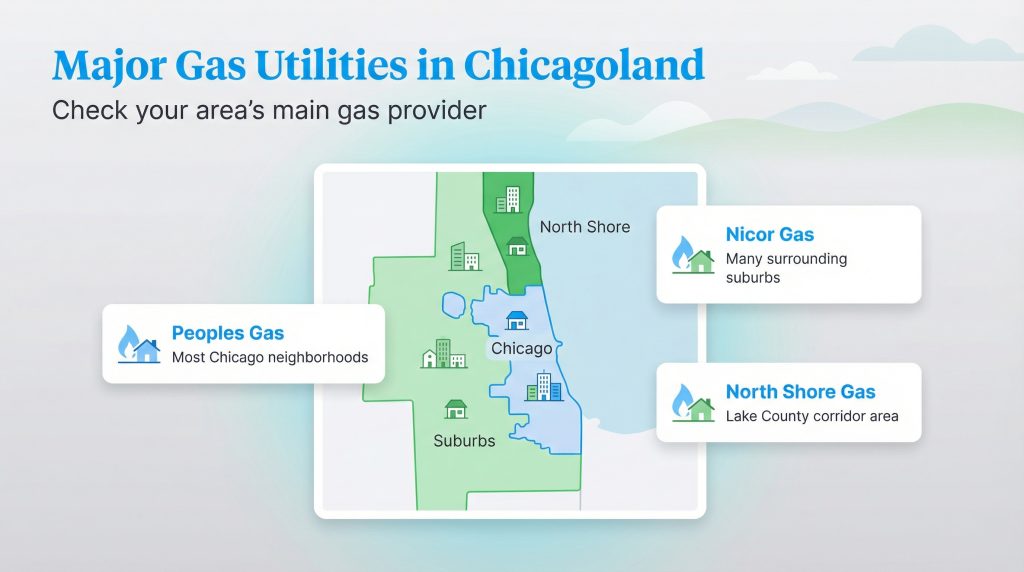
Depending on your zip code, you are likely served by one of these two giants:
- Peoples Gas: Services the entire city of Chicago, including neighborhoods like Rogers Park, Logan Square, West Town, and Hyde Park.
- Nicor Gas: Serves a massive 17,000 square mile territory including Arlington Heights, Aurora, Cicero, Elgin, Evanston, Joliet, Naperville, and Rockford.
- North Shore Gas: If you are in the Lake County corridor — think Waukegan, Highland Park, or Zion — you likely have North Shore Gas, which saw a sharper 12% supply rate increase to $0.4982 per therm this month.
What You Can Do About Changing Rates
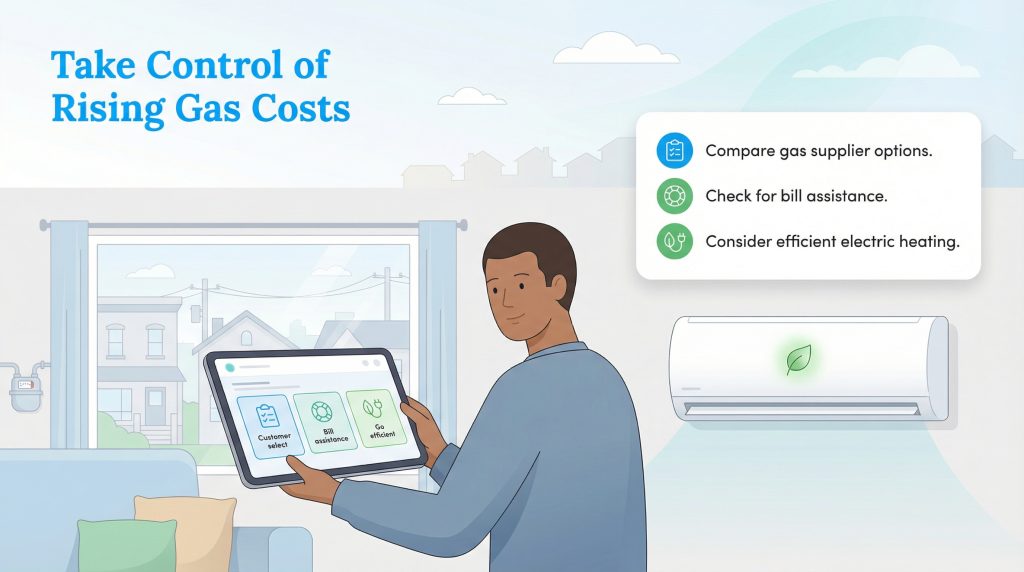
If you’re feeling the pinch, we have a few strategies to help you take control of your utility costs:
1. Explore “Customer Select”
If you live in Northern Illinois, you aren’t stuck with your utility’s supply rate. Through the Citizens Utility Board, you can choose an Alternative Retail Gas Supplier (ARGS).
- Pros: You can lock in a “Fixed-Rate Plan” for 12 or 24 months, which protects you from price spikes if global conflicts worsen.
- Cons: Watch out for hidden monthly fees or “introductory” rates that skyrocket after a few months. Always compare the offer to your utility’s “Price to Compare.”
2. Check for Assistance
If you’re struggling with arrears, you aren’t alone. Chicagoans currently owe nearly $90 million in unpaid gas bills, there is help available.
- LIHEAP: The Low-Income Home Energy Assistance Program provides one-time grants to eligible households.
- LIDR: The new Low-Income Discount Rate provides an automatic monthly discount on your bill if you meet certain income requirements.
3. Think Sustainable
At UtilitiesForMyHome.com, we’re big fans of long-term efficiency. As gas infrastructure costs rise, many of our neighbors are looking into electric heat pumps. Not only do these reduce your carbon footprint, but they can also lower your heating energy consumption by more than 60% compared to older gas furnaces.
Information for New Movers
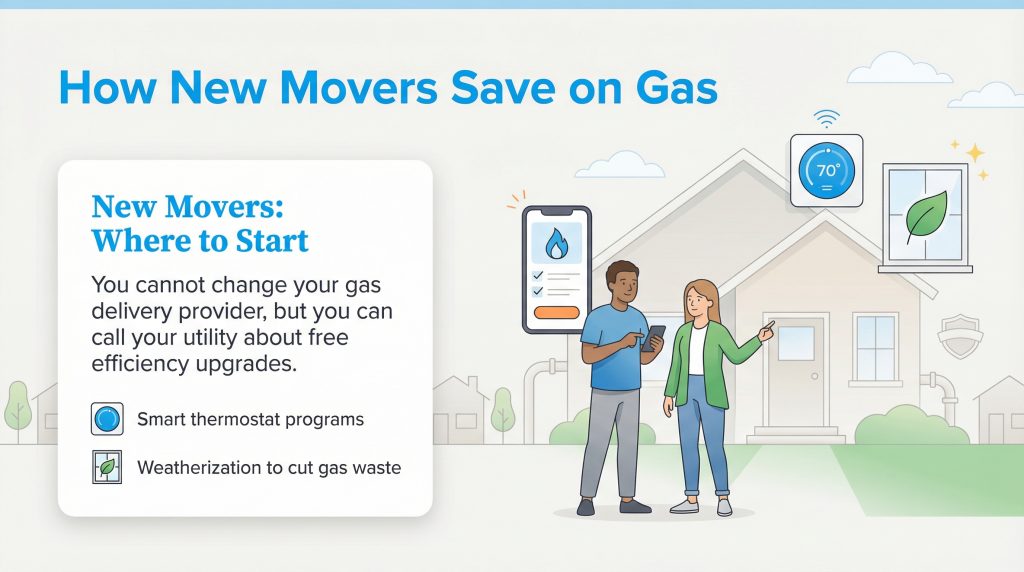
If you are just moving in, remember that you cannot switch your delivery provider, that is determined by your home’s location, but you can switch suppliers. You should always contact your utility to ask about energy efficiency rebates. Both Peoples Gas and Nicor offer free programs to help you get a smart thermostat or weatherize your home, which are the easiest ways to keep your therms (and your dollars) from escaping through the cracks.
About the Author

Claudio is a sustainability-focused writer with a background in Anthropology and Psychology from NC State University. He has spent over 15 years working in writing, interpretation, and translation, driven by a deep interest in how human culture shapes the environment. Today, he shares his curiosity with readers by writing about sustainable living solutions and the connection between everyday choices and environmental impact.