
We’re breaking down why rates are rising, which Texas cities are affected, and how you can lock in a better deal today.
Key Takeaways
- Variable delivery charges for TNMP customers rose by 12.48% on March 1, 2026, as part of a regulated semiannual update to fund grid modernization and storm recovery.
- A typical home using 1,000 kWh will see a monthly increase of approximately $7.70, while those using 2,000 kWh can expect to pay about $15.40 more per month.
- While you can’t choose a different utility provider, you can switch to a fixed-rate energy plan to lower the other 64% of your bill and offset these rising costs.
- Residents in cities like Lewisville, Galveston, and Texas City can access rebates between $125 and $175 for smart thermostats to help lower their overall energy consumption.
If you live in a community served by Texas New Mexico Power (TNMP), you may have noticed your recent electricity bill looks a bit higher. On March 1, 2026, the Public Utility Commission of Texas (PUCT) approved a 12.48% increase in TNMP’s variable delivery charges.
At UtilitiesForMyHome.com, we know that these “pass-through” charges can be confusing, especially when they change twice a year. We’re here to help you understand what’s happening, why it’s happening, and, most importantly, how you can protect your wallet.
Why are TNMP rates going up?
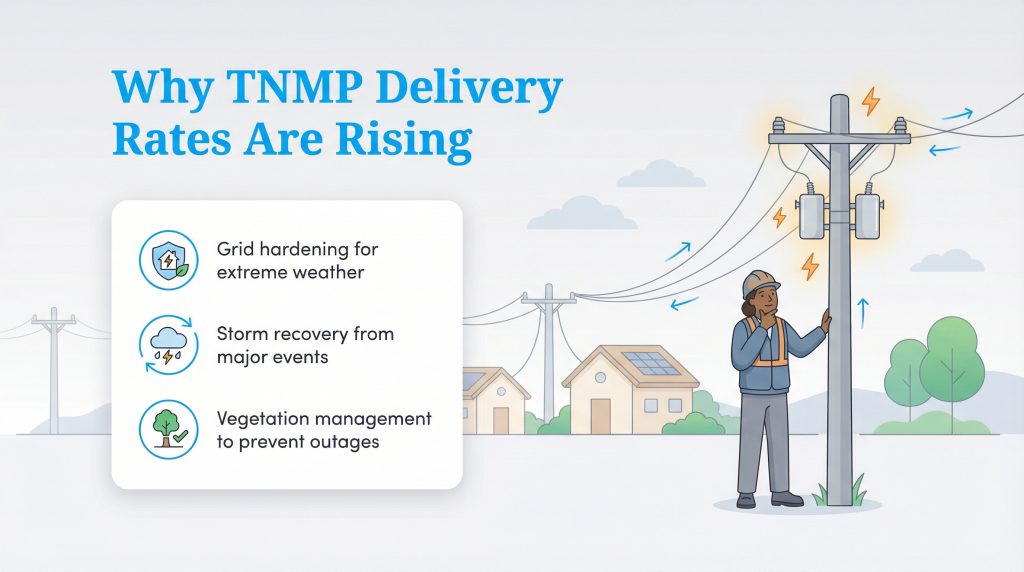
Think of your electric bill in two parts: the energy you use (set by your provider) and the cost to get that energy to your home (set by the utility). TNMP is your utility, they own the poles and wires.
Every March and September, utilities are allowed to adjust their rates to cover the costs of keeping the lights on. For 2026, TNMP is catching up on some big projects. The company has invested nearly $2.8 billion into the grid to handle a 44% surge in peak demand since 2018. These rate hikes also help fund:
- Grid Hardening: Upgrading infrastructure to withstand extreme weather.
- Storm Recovery: Recovering costs from major events like Hurricane Beryl.
- Vegetation Management: A $12 million program to trim trees and prevent outages.
How this impacts your monthly bill
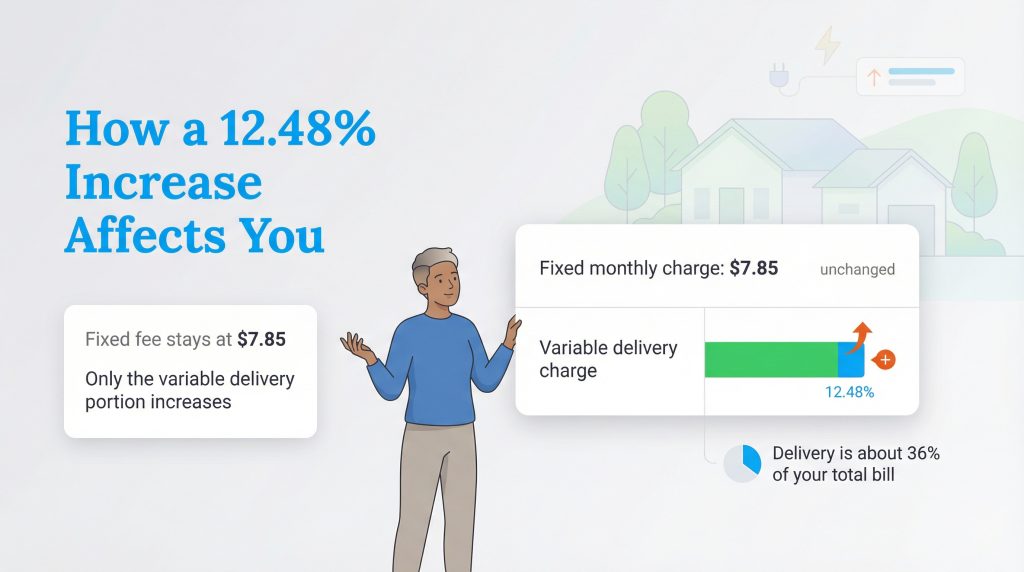
The 12.48% increase only applies to the “variable” portion of your delivery fee, the part based on how much electricity you use. Your fixed monthly charge remains steady at $7.85.
Here is how those numbers break down for a typical home:
| Monthly Usage | Old TDU Charge | New TDU Charge (March 2026) | Monthly Increase |
| 500 kWh | $40.19 | $44.22 | $4.03 |
| 1,000 kWh | $72.52 | $80.22 | $7.70 |
| 2,000 kWh | $137.19 | $152.59 | $15.40 |
Note: These figures represent only the delivery portion of your bill, which usually accounts for about 36% of your total “all-in” cost.
Major cities affected by the change
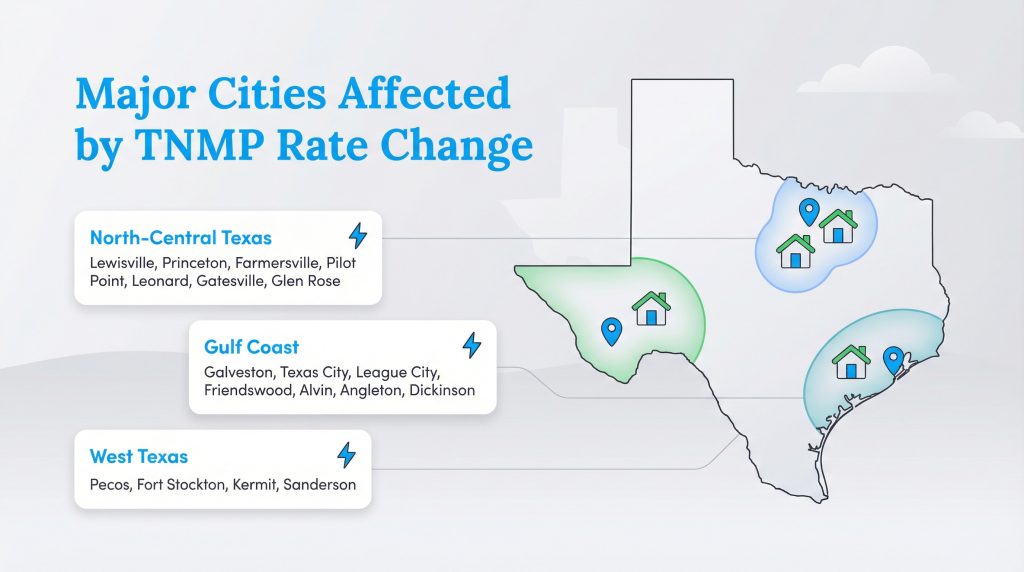
TNMP doesn’t serve one big block of Texas; instead, they cover a patchwork of about 20 communities across three main regions. If you live in one of these areas, these new rates apply to you:
- North-Central Texas: Lewisville, Princeton, Farmersville, Pilot Point, Leonard, Gatesville, and Glen Rose.
- Gulf Coast: Galveston, Texas City, League City, Friendswood, Alvin, Angleton, and Dickinson.
- West Texas: Pecos, Fort Stockton, Kermit, and Sanderson.
What you can do to lower your costs
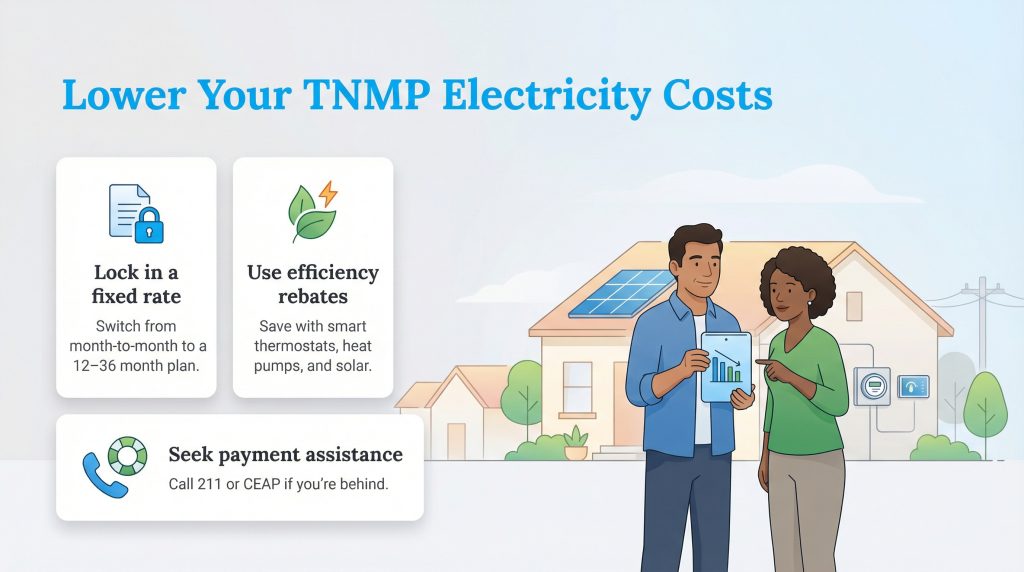
While you can’t switch away from TNMP as your delivery company, you have total control over your Retail Electric Provider (REP). Here are three smart moves we recommend to stay ahead of rising rates:
1. Lock in a lower fixed rate
If you are on a month-to-month plan, you are vulnerable to market spikes. By switching to a fixed-rate contract, you can lock in the “energy” portion of your bill for 12 to 36 months. As of April 2026, competitive plans in the TNMP area include:
- BKV Energy (Verbena 15 Months): Approx. 15.6¢ per kWh.
- APG&E (True Classic 36 Months): Approx. 15.7¢ per kWh.
- CleanSky Energy (Embrace Green 6): Approx. 16.2¢ per kWh for 100% green energy.
2. Grab efficiency rebates
TNMP offers incentives to help you reduce your usage, which is the best way to lower the variable part of your bill. For 2026, you can get:
- Smart Thermostats: Rebates of $125 (standard) or $175 (for low-income households).
- Heat Pump Water Heaters: Rebates between $400 and $500.
- Solar & Battery Storage: Incentives up to $4,250 for solar systems and $1,000 for paired battery storage.
3. Check for assistance programs
If you’re having trouble keeping up with payments, don’t wait. You can dial 211 or contact the Texas Department of Housing for help through the Comprehensive Energy Assistance Program (CEAP). TNMP also offers a program for households at or below 200% of the federal poverty level.
To track the latest filings or report an outage, you can visit the TNMP site or check the Texas PUC for updates.
About the Author

David has been an integral part of some of the biggest utility sites on the internet, including InMyArea.com, HighSpeedInternet.com, BroadbandNow.com, and U.S. News. He brings over 15 years of experience writing about, compiling and analyzing utility data.