Idaho Electricity Information
Idaho’s electricity generation is one of the cleanest in the country, thanks to its heavy reliance on hydropower. Rivers and dams provide the majority of the state’s electricity, with wind, solar, and geothermal energy also growing. Unlike many states, Idaho uses very little coal or natural gas for power, keeping its energy mix largely renewable.
Electricity prices in Idaho are among the lowest in the nation, thanks to abundant hydropower and low production costs. The state also has some of the lowest carbon emissions per capita, as most of its electricity comes from clean sources. With continued investments in renewables and grid modernization, Idaho is well-positioned for a sustainable energy future.
Find Electricity Providers In Idaho
Ranks 42nd Highest in the U.S.
Average Price: 13.01¢ /kWh
Ranks 5th Cheapest in the U.S.
Average Electric Bill: $146
Ranks 19th Cheapest in the U.S.
Electricity Production By Source
Emissions From Electricity Generation

Estimate Your Emissions From Your Electricity Usage
How much CO2, SO2, and NOx do you generate from the electricity that powers your home?
Renewable Electricity Generation
65.24% of Total Production
Energy Usage in Idaho
Idaho’s electricity consumption is relatively low compared to other states, thanks in part to its mild summers. Located in the Mountain West climate region, the state experiences cold winters and warm, dry summers, which influence energy use. Heating needs drive demand in the winter, while cooler evenings and lower humidity reduce the need for air conditioning in summer. Agriculture and industry also contribute to electricity consumption, but overall, Idaho’s reliance on clean, low-cost hydropower helps keep energy use efficient and affordable.
Municipal Utilities in Idaho
While most cities, towns, and villages throughout the state of Idaho offer municipal essential services like providing clean water, sewage treatment and dealing with waste and storm water, some also offer other services like electricity, natural gas, sanitation or recycling. In Idaho, 13 cities offer municipal electricity utility services to their residents.
Largest Electric Companies in Idaho
The rest of Idaho receives electric utility service from one of many primary providers. Here’s a list of some of the larger providers that might be available to your home:


Map of Electric Providers in Idaho
Setting up your electricity doesn't have to be a headache. We built this interactive map to help you quickly identify the electric provider that services your area. Whether you are moving across the country or just a few towns over, you can use the map below to find your local utility company, review their service areas, and take the next step in making your new house a home.
Idaho Natural Gas Information
Natural gas is a everyday staple in Idaho homes and on the grid. Just over half of households use it as their primary heating fuel, and the state’s mix of hot valley summers and long, cold mountain winters creates clear seasonal swings. Residential customers account for about 23% of in-state gas use, commercial users about 18%, and industry about 25%, while power plants pick up the rest during peak electricity demand. Despite that wide adoption, Idaho still ranks in the lower third for per-capita gas consumption thanks to efficient homes and a large share of clean hydropower on the electric side.
Most households are served by Intermountain Gas in southern Idaho and Avista in the north, and the market is regulated rather than a retail shop-around model. With no in-state production, supply comes via interstate pipelines, so reliability planning matters as much as price, especially when cold snaps hit the Rockies and High Plains. The varied climate across the panhandle, mountains, and Snake River Plain is exactly why gas remains a year-round workhorse for heat, hot water, and flexible support for the grid.
Largest Natural Gas Companies in Idaho
Many of the residents of Idaho receive their natural gas utility service from one of the larger companies that service the state.
Find Natural Gas Providers In Idaho
Idaho Internet Connectivity
Largest Internet Providers in Idaho
When it comes to high-speed internet, homes in Idaho have plenty of options to stay connected! From bustling cities to quiet rural areas, a variety of providers offer reliable service across the state. Here are some of the biggest names keeping Idaho homes online and in the loop:







Find Internet Providers In Idaho
Idaho's Dual Water Systems: Potable vs. Irrigation
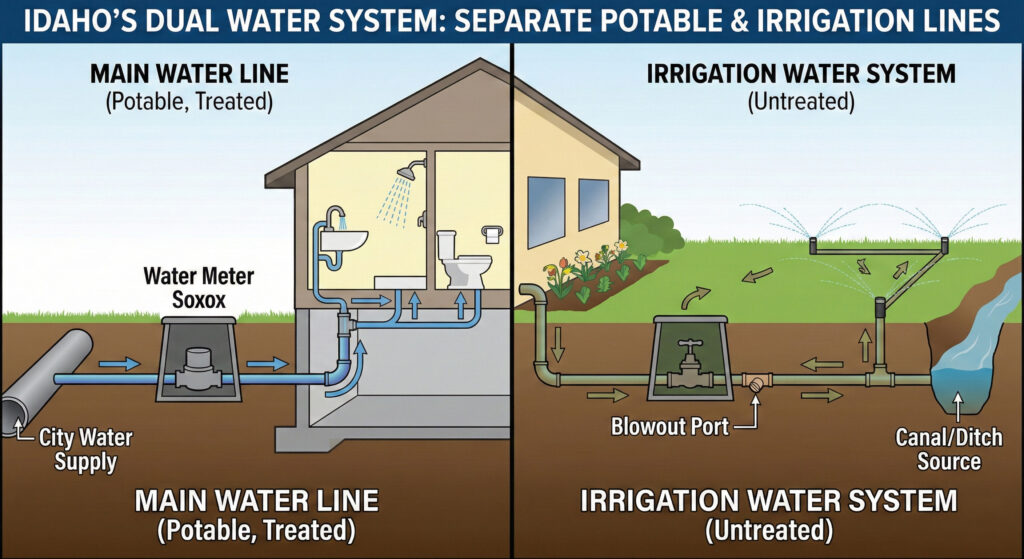
One of the most confusing aspects of homeownership in Idaho for newcomers is the "dual water" system. Many properties, especially in the Treasure Valley and agricultural areas, have two separate water sources.
- Potable Water: This is the treated water that comes out of your taps, showers, and hoses. You pay a higher rate for this, and it is metered.
- Irrigation (Canal) Water: This is untreated, unfiltered water often sourced from the Snake River or local canals. It is used only for watering lawns and gardens. It is usually paid for via a flat annual fee (often part of your property taxes or HOA dues) rather than by usage.
- The "Blowout" Ritual: Because irrigation lines are shallow, they must be cleared of water before the first freeze. Every October, you will see neighbors hiring landscaping companies to "blow out" their sprinklers with compressed air to prevent pipes from bursting.
- Cost Tip: If your home has access to irrigation water, ensure your sprinkler system is connected to it, not your expensive house water.
Solar in Idaho: Incentives & Net Billing
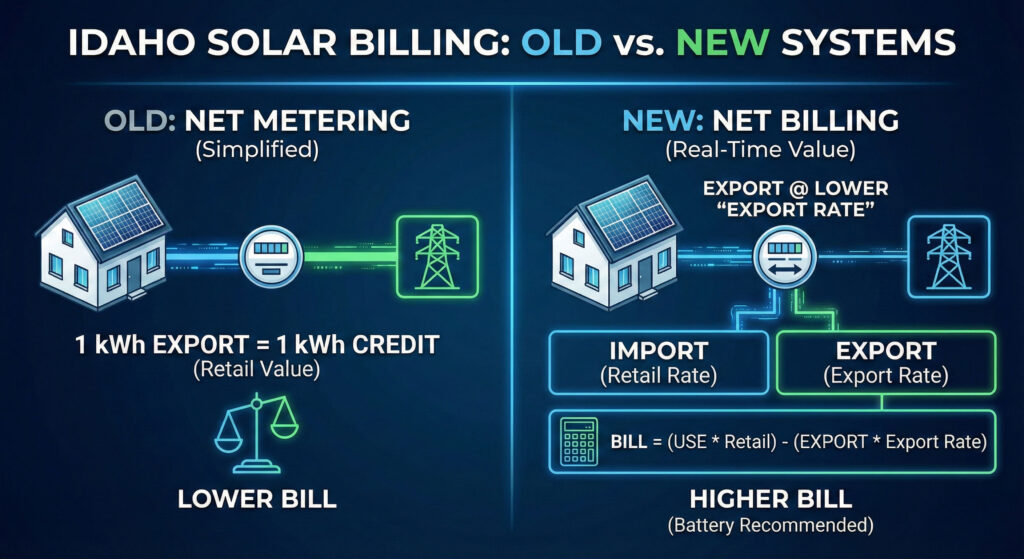
Idaho generally offers excellent solar potential, but financial rules have changed recently.
- State Tax Deduction: Idaho offers a state income tax deduction (not a credit) for residential solar. You can deduct 40% of the system cost in the year of installation and 20% per year for the next three years. The maximum deduction is $5,000 per year or $20,000 total.
- From Net Metering to Net Billing: For customers of major utilities like Idaho Power, the rules for selling power back to the grid have shifted.
- Old Way: You used to get a 1-to-1 credit (1 kWh sent to the grid = 1 kWh free later).
- New Way (Net Billing): You are now credited at a specific "Export Credit Rate" (ECR), which may be lower than the retail rate you pay for power. This makes installing a battery backup system more financially attractive, as it allows you to store your own power for use in the evening rather than selling it back at a discount.
Know Your Rights: The Idaho Public Utilities Commission (IPUC)
If you have a dispute with a regulated utility (like Idaho Power, Intermountain Gas, or Avista) that you cannot resolve directly with the company, the IPUC is your recourse.
- When to Contact:
- Unexplained billing spikes or incorrect rates.
- Refusal of a reasonable payment plan for past-due bills.
- Disputes over deposit requirements.
- How to File a Complaint:
- Phone: 1-800-432-0369
- Online: IPUC Consumer Assistance Form
- Note: The IPUC generally does not regulate city-run (municipal) utilities or member-owned co-ops. You must contact their city councils or boards directly.
Utility Costs in Idaho
The average monthly total utility bills in Idaho is $240, which is 8.76% lower than the national average.
Assistance for Paying Utility Bills in Idaho
If you are struggling to pay your utility bills in Idaho, several state, federal, and charitable programs are available to help. These programs can provide financial grants, prevent service disconnection during winter months, or help weatherize your home to reduce future costs.
General Assistance Programs
Low Income Home Energy Assistance Program (LIHEAP) LIHEAP is a federally funded program that helps low-income households pay for heating and cooling costs. It provides a one-time cash benefit paid directly to your utility company. Eligibility is based on your household income and size.
-
How to Apply: In Idaho, LIHEAP is administered by local Community Action Partnerships (CAP). You must apply through the agency that serves your county:
-
Southwestern Idaho (including Boise): El-Ada Community Action Partnership or WICAP
-
Eastern Idaho: Eastern Idaho Community Action Partnership (EICAP) or SEICAA
-
South Central Idaho: South Central Community Action Partnership (SCCAP)
-
Northern Idaho: Community Action Partnership (CAP)
-
Project Share Funded by donations from customers of Idaho Power, Intermountain Gas, and Avista, Project Share provides emergency funds to families who are facing disconnection and have exhausted other resources (like LIHEAP).
-
How to Apply: Contact the Salvation Army or your local Community Action Partnership listed above to apply for Project Share funds.
Idaho Care Line (2-1-1) For immediate help finding local resources, including food pantries, rental assistance, and utility help, you can dial 2-1-1 from any phone in Idaho or visit the 2-1-1 Idaho Care Line website.
Special Programs for Seniors (Age 62+)
Idaho has specific protections in place to ensure seniors are not left without heat during the coldest months.
-
Winter Protection Plan (Moratorium): Under Idaho Public Utilities Commission rules, regulated utilities (like Idaho Power, Intermountain Gas, and Avista) cannot disconnect service for non-payment during the winter months (typically December through February) if the household includes someone 62 years of age or older, children, or infirm individuals.
-
Action Required: You must contact your utility provider to declare that you are unable to pay and that a senior lives in the home to receive this protection. You will still owe the balance, but you will not be disconnected during this period.
-
-
Weatherization Assistance: Seniors are often prioritized for the Weatherization Assistance Program, which provides free home upgrades (like insulation and window repairs) to lower energy bills permanently. Apply through your local CAP agency.
Assistance for Veterans
Veterans in Idaho have access to standard energy assistance programs, but additional resources are specifically tailored to their needs.
-
Supportive Services for Veteran Families (SSVF): This program is designed to promote housing stability for low-income veteran families. It can assist with utility deposits and past-due utility bills if they threaten your ability to stay in your home.
-
Where to find help: In the Treasure Valley and surrounding areas, this is often administered by the El-Ada Community Action Partnership. You can also contact the Boise VA Medical Center homeless veteran coordinators for referrals.
-
-
Operation Homefront: This national non-profit sometimes offers critical financial assistance for overdue utility bills for military families and wounded warriors. Check eligibility at Operation Homefront.
Information for Students
While there is no specific “Student Utility Grant,” college students living off-campus may still qualify for general assistance depending on their income and dependency status.
-
Qualifying for LIHEAP: Students who are not claimed as dependents on their parents’ taxes and meet the income poverty guidelines may be eligible for LIHEAP grants.
-
Campus Resources: If you are a student at Boise State University, University of Idaho, or Idaho State University, check with your Dean of Students office or Financial Aid office. Many universities have “Student Emergency Funds” specifically designed to help students cover unexpected essential costs like utility shut-off notices.
Learn more in the Student Utility Setup Guide
Energy Efficiency Rebates
Before buying a new appliance or upgrading your home, check for “free money” in the form of rebates. These are often available even for DIY installations.
- Idaho Power Rebates:
- Smart Thermostats: Often up to $75 back.
- Evaporative Coolers: Rebates available for installing energy-efficient models.
- Heat Pumps: Significant incentives for upgrading from electric baseboard heat to a ductless heat pump.
- Intermountain Gas Rebates:
- Smart Thermostats: $100 rebate for Energy Star certified models.
- Furnaces: Up to $350 for high-efficiency (95% AFUE) natural gas furnaces.
- Water Heaters: Tankless units can qualify for $300-$325 rebates depending on efficiency.
- Action Step: Keep your receipts and apply within 90 days of installation. Visit your utility’s “Savings” or “Rebates” webpage for the specific forms.
Find Utility Providers In Idaho
Utility Providers by City in Idaho
| City Name | Population | Municipal Electricity |
|---|---|---|
| Aberdeen | 2,795 | No |
| American Falls | 4,531 | No |
| Ammon | 17,401 | No |
| Bellevue | 2,508 | No |
| Blackfoot | 12,106 | No |
| Boise | 422,665 | Yes |
| Bonners Ferry | 2,495 | Yes |
| Buhl | 4,532 | No |
| Burley | 11,274 | Yes |
| Caldwell | 58,872 | No |
| Chubbuck | 15,445 | No |
| Coeur d'Alene | 114,880 | No |
| Dalton Gardens | 2,492 | No |
| Driggs | 2,324 | No |
| Eagle | 29,665 | No |
| Emmett | 7,408 | No |
| Filer | 2,734 | No |
| Fort Hall | 2,499 | No |
| Fruitland | 5,903 | No |
| Garden City | 12,056 | No |
| Gooding | 3,625 | No |
| Grangeville | 3,296 | No |
| Hailey | 9,001 | No |
| Hayden | 15,316 | No |
| Heyburn | 3,592 | Yes |
| Hidden Springs | 3,382 | No |
| Homedale | 2,845 | No |
| Idaho Falls | 101,326 | Yes |
| Iona | 2,640 | No |
| Jerome | 12,182 | No |
| Kellogg | 2,255 | No |
| Ketchum | 3,448 | No |
| Kimberly | 4,508 | No |
| Kuna | 23,765 | No |
| Lewiston | 33,964 | No |
| Lincoln | 3,919 | No |
| Malad City | 2,112 | No |
| McCall | 3,568 | No |
| Meridian | 115,227 | No |
| Middleton | 9,091 | No |
| Montpelier | 2,610 | No |
| Moscow | 25,336 | No |
| Mountain Home | 15,863 | No |
| Mountain Home AFB | 2,863 | No |
| Nampa | 194,547 | No |
| Orofino | 3,216 | No |
| Payette | 7,999 | No |
| Pocatello | 74,359 | No |
| Post Falls | 38,162 | No |
| Preston | 5,545 | No |
| Priest River | 2,103 | No |
| Rathdrum | 9,099 | No |
| Rexburg | 33,684 | No |
| Rigby | 4,920 | No |
| Rupert | 5,994 | Yes |
| Salmon | 3,114 | No |
| Sandpoint | 8,448 | No |
| Shelley | 4,784 | No |
| Soda Springs | 3,084 | Yes |
| St. Anthony | 3,677 | No |
| St. Maries | 2,951 | No |
| Star | 10,929 | No |
| Sugar City | 2,300 | No |
| Twin Falls | 51,223 | No |
| Victor | 3,315 | No |
| Weiser | 5,578 | Yes |
| Wendell | 2,859 | No |