
Sustainable waste management starts in your own backyard or kitchen
Key Takeaways
- Composting reduces household waste significantly while creating nutrient-rich soil for your plants and garden.
- Balancing green and brown materials is the secret ingredient to a healthy, odorless compost pile.
- You can compost anywhere, whether you have a sprawling backyard or a small city apartment.
If the idea of keeping a pile of food scraps in your yard or kitchen brings to mind bad smells and swarming flies, you aren’t alone. We know the concept can seem intimidating, but mastering how to compost at home is actually a simple, natural process that mimics what happens on the forest floor every single day. By utilizing a few actionable composting tips, you will drastically reduce food waste, shrink your carbon footprint, and save money on expensive store-bought fertilizers. In this comprehensive guide on composting for beginners, we break down the science into easy steps, helping you set up a customized system that is clean, highly efficient, and perfectly matched to your specific living situation.
Why Start Composting?
Before diving into the exact logistics, it helps to understand why transforming your food scraps is an essential household habit. Setting up a dedicated system at home actively prevents organic materials from ending up in local landfills, where they would otherwise decompose anaerobically and release methane — a highly potent greenhouse gas. By choosing an environmentally mindful choice like composting, you take direct control over a significant portion of your daily household waste.
Beyond the impressive environmental benefits, this practice produces a free, premium soil amendment that avid gardeners refer to as “black gold.” Instead of purchasing chemical-heavy fertilizers, you can rely entirely on this nutrient-dense organic matter to fortify your lawn, house plants, and vegetable garden. Quality compost drastically improves soil structure, increases natural water retention, and introduces beneficial microorganisms that help your plants thrive year after year.
Choosing Your Setup: Indoor Composting vs. Backyard Compost Pile
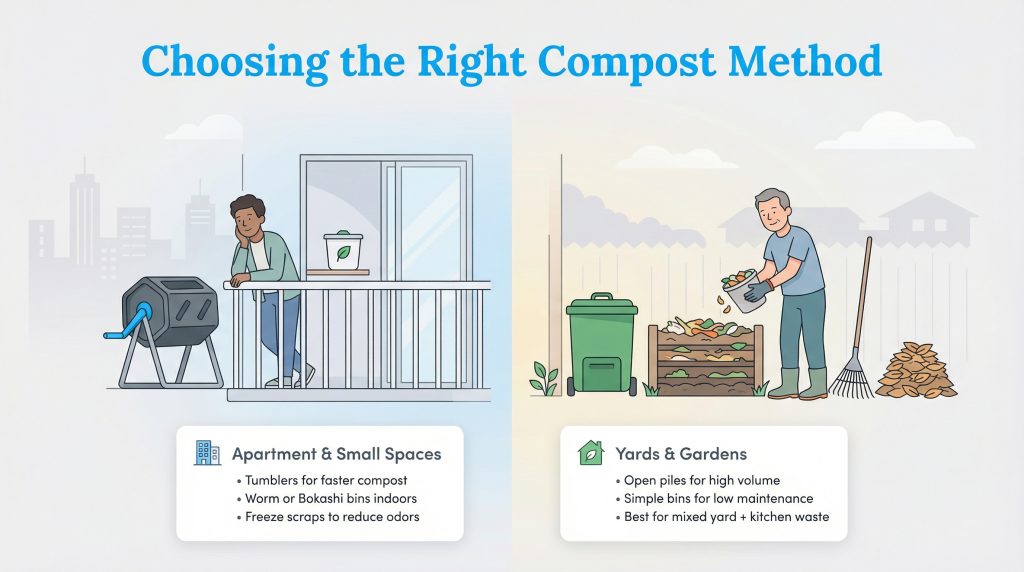
Before you confidently save your first apple core, you need to decide exactly where it will go. Many people incorrectly assume they need acres of land to start, but modern tools have made composting accessible to everyone. The debate between different methods usually comes down to your available square footage and how much organic waste your family generates. As you are setting up your new home, we encourage you to treat this process as one more utility-like habit. Planning your waste stream right now saves plenty of headaches later.
To help you decide the best route, here is a quick breakdown of the most common setups for both outdoor and indoor composting:
- Backyard compost pile: For the avid gardener with plenty of yard space, an open pile is a free and traditional method. It handles a massive volume of yard trimmings and kitchen scraps, though it breaks down slower than enclosed methods and requires some manual turning.
- Compost bins: A standard stationary bin is ideal for suburban backyards. It keeps your yard tidy and protects your degrading materials from curious pests while sitting directly on the soil to attract beneficial worms and microbes.
- Compost tumblers: If you only have a small patio or a compact yard, a sealed tumbler is an excellent, pest-proof choice. These elevated containers rotate with a simple handle, allowing you to aerate the mix effortlessly and cook the material much faster.
- Indoor composting options: Urban dwellers can easily process their organic waste indoors using a specialized worm bin (vermicomposting) or an airtight Bokashi bucket. Alternatively, you can collect daily scraps in a sleek countertop caddy and simply drop them off at a municipal collection site or community garden.
The Golden Rule: The Greens and Browns Ratio

The most important part of successful composting is understanding the underlying biological recipe. A healthy, active compost pile relies entirely on balancing two main types of ingredients: “Greens” and “Browns.” Greens are your wet, nitrogen-rich materials that provide essential moisture and nutrients for microorganisms. Browns are your dry, carbon-rich materials that provide the necessary energy, structural bulk, and airflow.
To keep your pile breaking down efficiently without generating nasty odors, you must maintain a proper greens and browns ratio. You should aim for a golden rule of roughly 2 to 3 parts brown to 1 part green. Think of it exactly like baking a cake. If you add too much liquid (Greens), you end up with a sludgy, foul-smelling mess. If you use too much flour (Browns), the mixture remains bone-dry and refuses to react. Balancing these elements guarantees your compost stays damp and highly active.
Keep in mind that appearances can sometimes be deceiving. For example, coffee grounds are entirely brown in color but act as a potent nitrogen source, meaning they actually count as a green material in your recipe.
What to Compost (And What to Avoid)

Knowing what to put into your bin is crucial, but knowing what not to compost is arguably even more critical for a beginner. The fear of attracting rodents, raccoons, or neighborhood strays is completely valid, but you can easily sidestep these issues by adhering to a strict exclusion list. Keeping the wrong items out ensures your pile remains hygienic and mostly odorless.
Use the following breakdown as a quick reference guide when sorting your daily kitchen scraps and yard waste:
| Safe to Compost | Do Not Compost |
|---|---|
| Fruit and vegetable peels (Greens) | Meat, poultry, or fish bones |
| Coffee grounds and tea bags (Greens) | Dairy products (cheese, butter, milk) |
| Fresh grass clippings (Greens) | Fats, grease, and cooking oils |
| Dried leaves and twigs (Browns) | Glossy cardboard or coated magazines |
| Non-glossy paper and egg cartons (Browns) | Dog or cat pet waste |
You can readily add crushed eggshells to your pile as well. While grouped with food scraps, they act primarily as a beneficial calcium source rather than a nitrogen source. Conversely, you must be exceptionally careful with pet waste. While manure from herbivores like cows makes fantastic fertilizer, waste from carnivorous pets contains dangerous pathogens. According to the US EPA, dog and cat waste should remain strictly out of piles intended for vegetable gardens to ensure food safety.
Step-by-Step: Building Your Compost
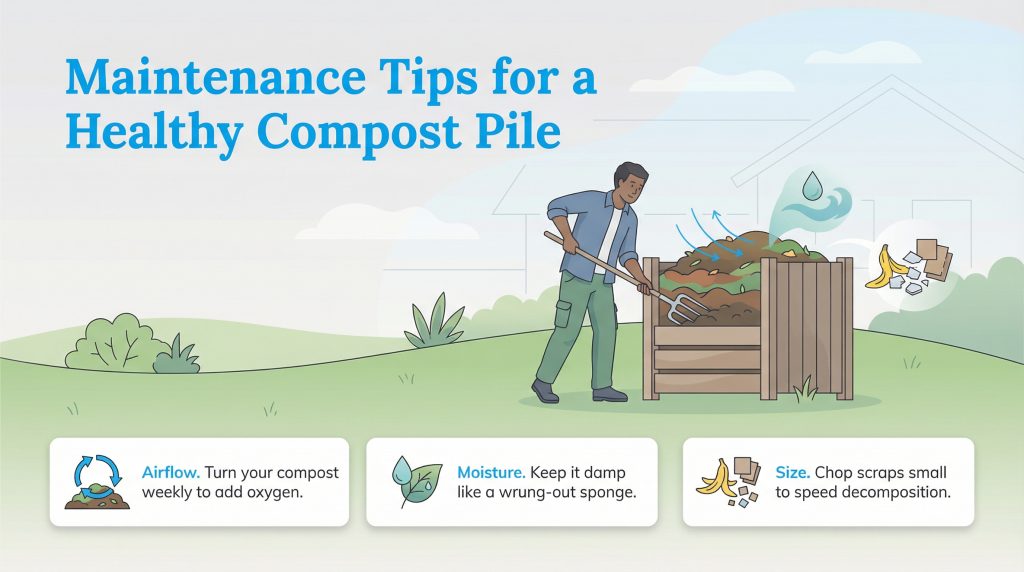
Once you understand your materials, assembling and maintaining your setup requires just a little routine effort. Following these specific steps will help you speed up the overall decomposition process and yield rich soil much faster.
- Start with a coarse base layer: Place a few inches of twigs or coarse wood chips at the very bottom of your bin. This foundational layer creates essential drainage and lets air flow naturally upward through the center of the heap.
- Chop your waste: Microbes break down small particles much faster than massive chunks. Take a few extra seconds to chop up large melon rinds, dice old vegetables, and tear apart cardboard boxes before tossing them in.
- Layer your greens and browns: Alternate adding your fresh kitchen scraps with thick layers of dry materials. Always finish with a top layer of browns to suppress odors and aggressively deter fruit flies.
- Monitor your moisture: Your compost should feel exactly like a wrung-out sponge — damp to the touch but never dripping wet. If you live in an arid climate or are managing water usage carefully during a dry summer, you may need to lightly sprinkle the pile with a hose occasionally.
- Prioritize compost aeration: Composting is an aerobic process, meaning the hardworking microbes demand plenty of oxygen to thrive. Make it a habit to turn the compost every three to four weeks using a pitchfork. If you own a tumbler, simply give it a hearty spin. This regular aeration entirely prevents the rotten egg smell associated with anaerobic decay.
Troubleshooting Common Problems
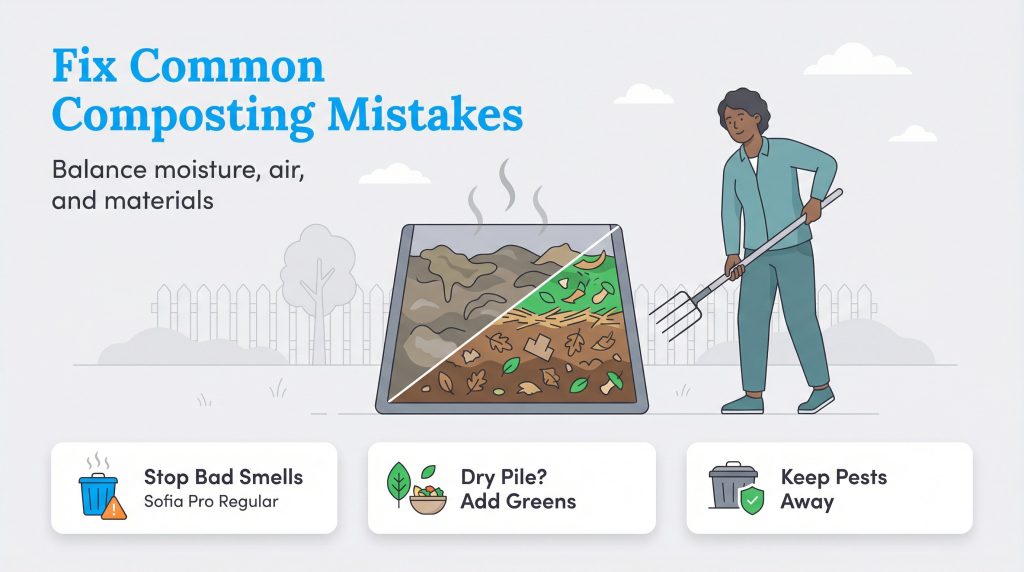
Even the most seasoned gardeners run into occasional hiccups. If you encounter issues with your pile, do not panic; most common composting mistakes are easily reversible with a few quick adjustments.
Problem: The compost smells terrible.
Solution: A foul, rotting garbage smell typically means your pile is far too wet and lacks vital oxygen. Conversely, a sharp ammonia scent points to a massive overload of nitrogen. To fix unpleasant odors, simply add a generous layer of dry browns — like dried leaves or shredded newspaper — and turn the pile thoroughly to dry it out and reintroduce air.
Problem: Decomposition is incredibly slow.
Solution: If your materials look exactly the same as they did a month ago, the pile is likely too dry or entirely suffocating. You need to instantly increase compost aeration by turning the heap more frequently. Furthermore, double-check your moisture levels; you should always target a 40% to 60% moisture content. Give the pile a good watering and mix in a fresh batch of nitrogen-rich greens to kickstart the microbial engine.
Problem: The bin is attracting pests.
Solution: First, ensure you are not accidentally adding prohibited items like leftover meat or cooking oils. If your bin is open, switch to a secure, locking lid. The NC State Extension advises burying fresh food scraps deep in the dead center of the pile and covering them with a thick insulating layer of browns to completely mask the scent from curious animals.
Preparing Your Garden for Black Gold
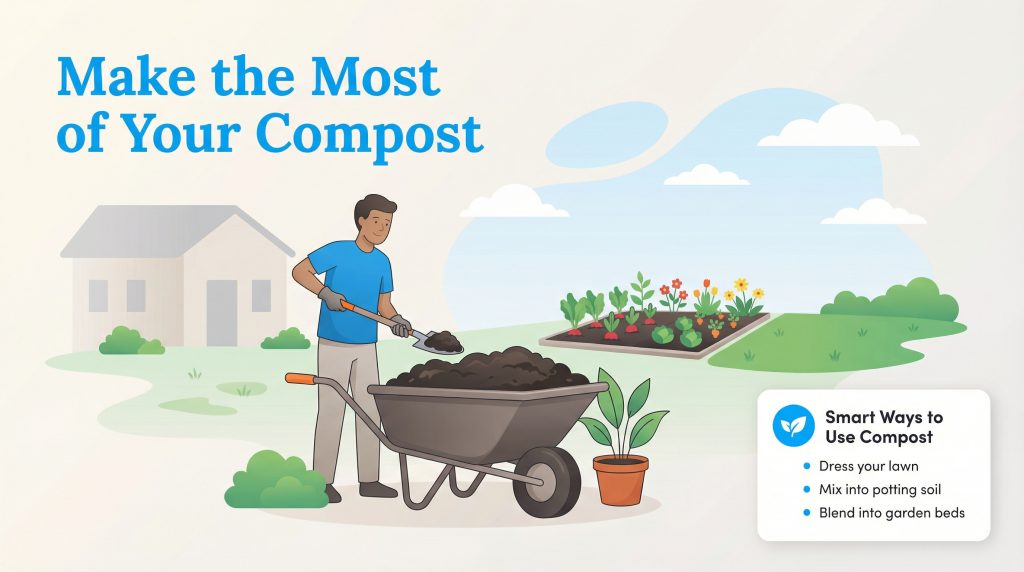
Composting is a highly rewarding journey that pays off in noticeably healthier soil and a lighter household trash can. You will know your organic matter is finally ready to harvest when it appears dark, incredibly crumbly, and smells exactly like fresh forest earth. You can leverage this “black gold” to top-dress your lawn, mix it into standard potting soil for your indoor house plants, or blend it directly into your raised vegetable beds to improve water drainage and natural nutrient content.
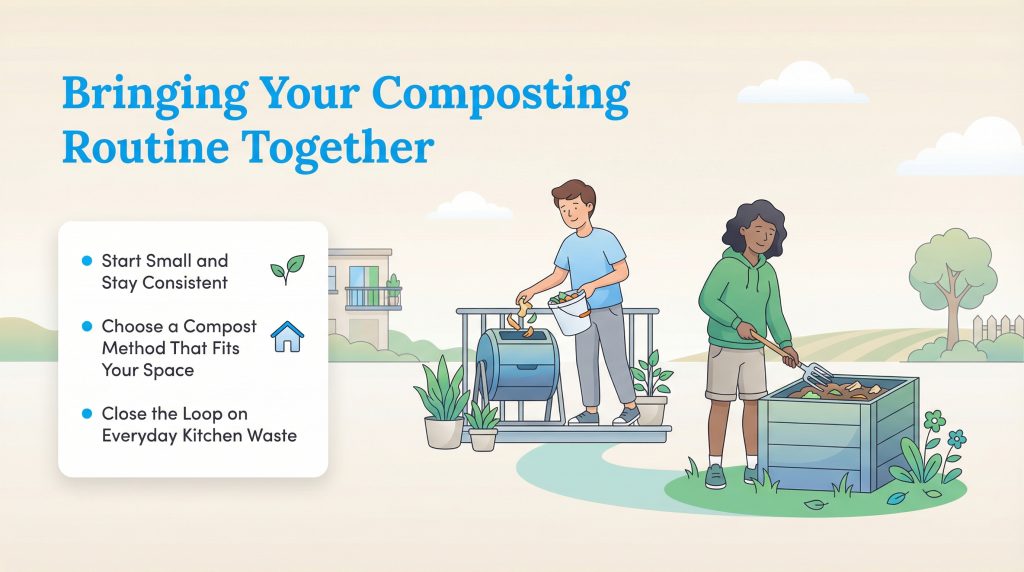
Sustainable waste management is a lifelong habit that yields incredible returns. By confidently following these step-by-step instructions, you are doing far more than just casual gardening; you are actively participating in a global effort to curb household emissions. Whether you manage acres of sprawling land or a tiny city balcony, there is a perfect setup that effortlessly fits your lifestyle. Start small, remain patient with the natural decomposition process, and enjoy the profound eco-conscious benefits of closing the loop on your home’s valuable resources.
Frequently Asked Questions About Composting
How long does it take for compost to be ready?
Do compost bins attract rodents or pests?
Can I compost if I live in an apartment without a yard?
What is the fastest way to make compost?
Can I compost citrus peels and onions?
Do I need a special bin to compost?
Can you compost in the winter?
Is newspaper safe to compost?
What are the environmental benefits of composting?
About the Author

LaLeesha has a Masters degree in English and enjoys writing whenever she has the chance. She is passionate about gardening, reducing her carbon footprint, and protecting the environment.