
A detailed breakdown of pricing, plan terms, and customer experiences to help you confidently select your next natural gas provider in Georgia
Key Takeaways
- Atlanta Gas Light (AGL) always handles your home’s gas delivery and emergency service, meaning your gas delivery and emergency response come from AGL either way.
- Walton Gas is known for its community-centered customer service and straightforward pricing, appealing to homeowners who prefer a local, cooperative feel.
- Constellation brings the financial stability of a national corporation, frequently offering robust fixed-rate plans and digital account management features.
Are you moving into a new Georgia home or finally fed up with unexpectedly high winter utility bills? We know comparing natural gas providers often feels like a frustrating guessing game full of hidden fees and dense industry jargon. That’s exactly why we put together this guide to pit Constellation vs. Walton Gas head-to-head. By cutting through the confusing marketing speak and focusing on the actual costs, plan types, and customer service records, you’ll quickly find a budget-friendly marketer that fits your household’s specific needs without the headache.

- $0.659 /THM
- $6.95-7.95
- 90 days
- 12-36 Months

- $0.719 /THM
- $5.95
- None
- 1-24 Months
*rates may vary by location and household usage
Understanding the Atlanta Gas Light Factor Before You Switch
Before diving into specific company rates, you need a quick primer on how the deregulated natural gas market actually operates in Georgia. Unlike traditional utility setups where one company manages everything, Georgia splits the responsibilities. Atlanta Gas Light (AGL) owns and maintains all the physical infrastructure, the underground pipes, the meters on the side of your house, and the emergency response teams. When you choose between Georgia certified natural gas marketers, you are strictly selecting the company that purchases the gas on your behalf and handles your monthly billing.
This setup means your physical gas delivery remains incredibly reliable regardless of who you sign up with today. Choosing a provider simply comes down to finding the best supply rate, identifying favorable contract terms, and picking a company that provides the level of customer service you expect. Shopping for deregulated natural gas gives you the power to compare options, ensuring you never pay more than necessary for the exact same physical product.
Walton Gas Overview: The Local Cooperative Experience
Established in 2002, Walton Gas emerged as a subsidiary of Walton EMC, bringing a distinctly cooperative and community-focused mindset to the competitive Georgia natural gas market. Homeowners drawn to smaller, locally operated utilities frequently gravitate toward this provider because of their straightforward approach to business. Instead of dazzling customers with overly complex promotional gimmicks, they focus on transparency, easy-to-understand billing, and keeping their operations close to home.
If you start reading Walton Gas reviews online, you’ll quickly notice a recurring theme regarding their customer support. People appreciate calling a service line and speaking to a representative based right here in Georgia. When weighing Walton Gas vs Constellation, this localized touch often acts as the deciding factor for consumers who want to avoid massive automated call centers. They consistently deliver competitive rates alongside a genuine commitment to the communities they serve, making them a comfortable, familiar choice for many families.
Constellation Overview: National Reach and Energy Options
On the opposite end of the spectrum sits Constellation, a large national energy provider with significant financial backing and an expansive footprint across the United States. This level of corporate stability translates into several tangible benefits for the average homeowner. Because they purchase energy on such a large scale, Constellation often offers fixed-rate terms; the best value depends on the customer service charge and per-therm rate you qualify for today. They also offer a convenient digital experience, providing robust online account management tools that make tracking your usage and paying your bill incredibly simple.
Constellation Plans and Pricing
| Plan Name | Rate | Plan Type | Base Charge | Cancellation Fee | |
|---|---|---|---|---|---|
| 24 Month + Water Heater Protection | $0.659 /THM | 24 Months Fixed Rate | $7.95 | $150 | Check Availability |
| 24 Month Home Natural Gas Plan | $0.659 /THM | 24 Months Fixed Rate | $7.95 | $150 | Check Availability |
| 12 Month Home Natural Gas Plan | $0.669 /THM | 12 Months Fixed Rate | $6.95 | $150 | Check Availability |
| 12 Month + Water Heater Protection | $0.669 /THM | 12 Months Fixed Rate | $6.95 | $150 | Check Availability |
| 36 Month Home Natural Gas Plan | $0.759 /THM | 36 Months Fixed Rate | $7.95 | $150 | Check Availability |
Beyond convenience, their size allows them to invest heavily in modern energy solutions. If you want to understand the basics of household consumption, the U.S. Energy Information Administration offers excellent resources on how natural gas energy works. For eco-conscious consumers who still rely on natural gas for heating and cooking, some marketers also provide offset programs as an easy way to balance environmental goals with everyday household realities.
Walton Gas vs. Constellation: Which Is Better for Your Home?
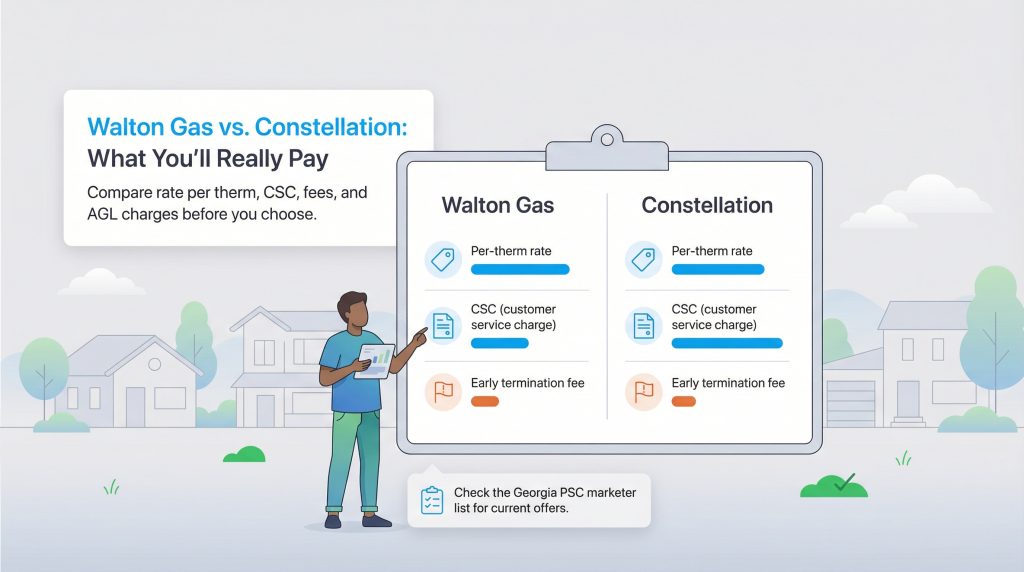
When you start to compare Georgia natural gas rates, the true difference between these providers lies in the contract specifics. Both companies offer fixed-rate plans, which we strongly recommend, and variable-rate plans, which fluctuate based on monthly market conditions. However, finding the cheapest gas company in Georgia requires you to look beyond the advertised per-therm rate. You must factor in the monthly customer service charge (CSC) and the potential penalty for breaking your contract early.
Instead of relying on outdated estimates, reviewing these extra costs before you sign a contract prevents frustrating billing surprises down the road. Whether you live in the suburbs or are checking natural gas rates in Atlanta, keep an eye out for these essential contract features.
| Feature | What to Check | Why It Matters |
|---|---|---|
| Contract Term Options | Look for standard fixed-term lengths, often ranging from six to 36 months depending on the marketer’s current availability. | Longer terms offer more price protection but less flexibility if you plan to move soon. |
| Monthly Customer Service Charge (CSC) | Review the marketer’s official offer document to find the exact CSC, as this administrative fee varies by company and plan. | Even if a per-therm rate is low, a high base charge can drive up your total monthly bill. |
| Early Termination Fees (ETF) | Check the plan’s terms and conditions to see if the ETF is a flat rate or if it scales based on how many months remain in the contract. | You will be charged this fee if you switch providers or break your contract before the term expires. |
Comparing natural gas marketers requires you to look closely at how specific charges impact your unique usage. To understand what you will actually pay, it helps to walk through an illustrative estimate. For example, if you use 60 therms in a winter month on a fixed-rate plan, your bill calculation involves multiplying your per-therm supply rate by 60, then adding the marketer’s fixed monthly CSC, and finally including the AGL pass-through charges. A provider with a slightly higher per-therm rate but a lower CSC might actually be cheaper for a household with low usage.
To ensure you secure the best deal, always verify current marketer offers on the official Georgia PSC marketer list. Before finalizing your switch, save or screenshot the plan’s terms, paying special attention to the rate per therm, the CSC, the early termination fee structure, and the renewal language.
Evaluating the Customer Service and Billing Experience
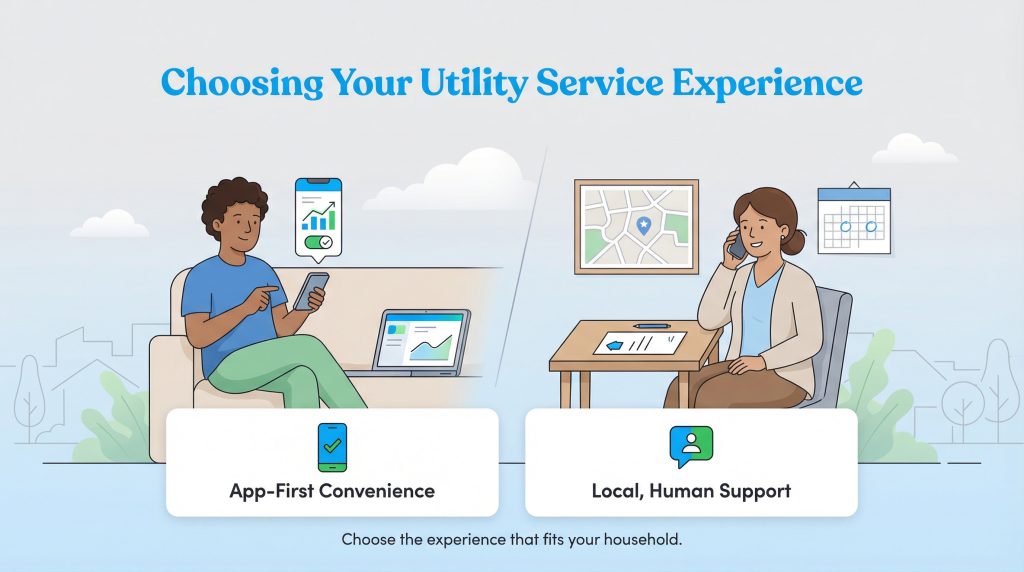
Even with the best rate in the state, a clunky website or an unresponsive support team can turn your monthly utility routine into a headache. Constellation shines when it comes to digital self-service. Their mobile app and desktop portal make setting up auto-pay, analyzing usage graphs, and renewing contracts a breeze. Walton Gas takes a different approach, focusing heavily on human interaction. While their online portal handles all the essential billing functions efficiently, their true strength lies in a localized support team that quickly answers the phone when a billing issue arises.
To determine which experience suits your household better, ask yourself these essential questions:
- Do you prefer managing your utility accounts through a highly functional mobile app without ever speaking to a representative?
- Is it important to you to have localized, community-based customer support when you have a specific billing question?
- Are you comfortable navigating an automated phone tree with a larger corporation if it means securing a slightly longer-term fixed rate?
Our Take: Pick the Plan That Fits Your Timeline
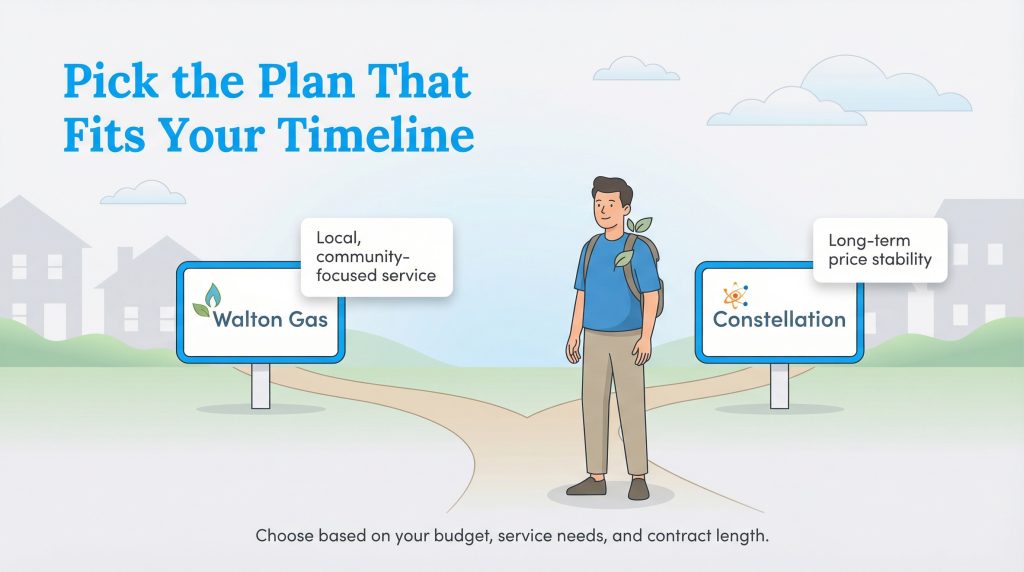
Selecting the right natural gas provider ultimately depends on how you balance your budget, your desire for convenience, and your customer service preferences. Walton Gas stands out as a strong option if you value community-focused operations, easy-to-read contracts, and local representatives who treat you like a neighbor. On the flip side, Constellation remains a reliable choice if you want the long-term price security of a fixed contract and excellent digital account management tools. By assessing your household’s specific priorities and verifying current market rates, you can confidently lock in a provider that keeps your home warm and your finances intact.
Frequently Asked Questions About Constellation and Walton Gas
Which provider is the cheapest gas company in Georgia?
Do I need to contact Atlanta Gas Light if I switch from Walton Gas to Constellation?
What are the early termination fees for Constellation and Walton Gas?
Can I get green or renewable natural gas plans in Georgia?
How long does it take to switch natural gas providers?
Will my natural gas service be interrupted during the switch?
About the Author

David has been an integral part of some of the biggest utility sites on the internet, including InMyArea.com, HighSpeedInternet.com, BroadbandNow.com, and U.S. News. He brings over 15 years of experience writing about, compiling and analyzing utility data.